Deel vs Rippling vs 4dev.com in 2026: contractor contracts, costs and payment receipt
Key takeaways
- Start with the engagement. Independent contractor management, Contractor of Record, employee Employer of Record (EOR) and own-entity payroll serve different relationships. 4dev.com is a contractor platform; companies hiring employees need an EOR or payroll product.
- Consider 4dev.com first for a contractor-only project organisation that prefers one intermediary agreement, task-linked documents and fees tied to completed operations. This is a recommendation for that operating model; compare the quoted total cost and observed receipt separately.
- Deel offers direct client–contractor agreements and a separate Contractor of Record offer. Rippling offers Global Contractors and a separate record service, alongside its broader workforce systems.
- Compare the selected product and workload. A percentage service fee, a monthly contractor fee and a suite quote cover different commercial scopes.
- Track the amount received. A platform fee and an available balance each describe only part of the payment cycle; withdrawal, conversion and bank charges can affect the amount received. Before rollout, pilot an actual work cycle with named approval owners and a documented receipt endpoint.
Choose the engagement before the software
Buying independent services calls for contractor agreements and administration. A company employing someone needs an employment arrangement, with payroll and the obligations that apply in the relevant country.
Working practice determines the engagement category
The ILO’s Employment Relationship Recommendation No. 198, adopted in 2006, gives a useful starting point. Paragraph 9 prioritises facts about how work is performed and remunerated when determining whether an employment relationship exists. Paragraph 13 identifies possible indicators, including control, integration into an organisation, continuity, personal performance of the work and the provision of tools.
The recommendation guides national implementation. Apply it through the relevant country’s law; it offers no universal classification test or numerical risk score. It also preserves genuine civil and commercial relationships.
Consider a hypothetical designer engaged for a defined product launch. Assess the relationship using the deliverables, decision-making, duration and actual working practice. Changing the contract title or selecting a platform does not settle that assessment. A local contractor template and a classification tool are useful inputs, while the company still needs a decision grounded in the actual engagement.
A mixed workforce needs separate product choices
Standard contractor management administers an independent engagement. Contractor of Record changes the contracting structure through a separately selected service. EOR involves employment through another employer entity; own-entity payroll supports employees engaged by the company’s entity.
Deel and Rippling advertise both contractor and employee products. A mixed team should therefore compare the contractor offer and the employee offer separately, even if both appear in the same system. 4dev.com covers contractor operations and is not an EOR or payroll service.
If that hypothetical designer later becomes an employee, reassess the relationship and select the employment product. Treat the transition as a new engagement with its own agreements and effective date. Using the same vendor may ease administration. Confirm employment eligibility and the terms of the new arrangement.
Assign an owner to each contract and work approval
Map the agreement parties and assign a work reviewer before configuring payment approvals. An invoice approval button tells you little about who has accepted the work or owes the payment. Finance needs to know whose obligation the invoice records, who accepts the work and who resolves a disagreement.
Trace the agreement parties before comparing features
The three services offer the following structures:
- 4dev.com: the client has one agreement with the platform. Its contractor Service Agreement describes the contractor as a subcontractor of the company and connects the contractor’s obligations to an accepted task. 4dev.com also describes a register of tasks, agreements and closing documents.
- Deel: standard contractor management leaves the agreement between the client and contractor. Its contractor contract guidance says Deel does not mediate disputes in that arrangement. The separate Contractor of Record offer describes a client–Deel master agreement and statement of work, plus a Deel–contractor agreement.
- Rippling: Global Contractors provides contractor administration. Its separate Contractor of Record offer says Rippling engages contractors on the customer’s behalf and holds the legal relationship with them. Responsibility promises belong to that selected product and its signed terms.
Draw an agreement map with a separate line for each signing relationship. Alongside it, record who handles a work dispute, who requests missing information and which document establishes the obligation to pay. Read the record service’s agreement for the scope and conditions of its classification protection. The responsibility advertised on a product page still needs contractual definition.
Keep work acceptance, invoicing and finance approval distinct
Give each approval a defined purpose. A project owner decides whether the work meets the agreed requirements. An invoice records a payment obligation. Finance checks the amount, supporting records and release conditions. Onboarding readiness belongs earlier in this chain: missing identity or tax-status information can interrupt later steps.
4dev.com’s Service Agreement requires contractor consent for changes after task acceptance. Its completion rules include acceptance and the expiry of the task’s specified review period without refusal and deficiencies. Assign someone to watch that actual deadline. The agreement makes reference reports and acceptance certificates available within ten days after completion; this is a document deadline, with no implication about payment arrival.
Deel’s standard contractor guidance distinguishes recurring fixed-rate arrangements from pay-as-you-go work based on hours or tasks. Submitted hours require client approval, and a client-only submission setting can change who initiates that step. Its contractor product also advertises milestone approval and bulk payment workflows. Rippling advertises invoice approvals based on approved timesheets, contracts or custom criteria. In each case, inspect which upstream decision triggers the next action.
For a hypothetical website redesign, the project lead reviews the agreed deliverable and records any deficiencies within the configured period. Finance then matches the accepted work with the invoice and payment instruction. Assign unresolved identity or tax-status requests to the person collecting those documents. A batch payment should contain only items that have passed the chosen release conditions; the project lead’s outstanding review should remain visible.
Keep the retained record set explicit: signed agreements, work or timesheet approval, invoice, acceptance documents where applicable and payment records. Ask which items the product generates, stores and exports. A stored invoice, for example, may still need to be exported into the company’s accounting system. Deel advertises tax-form guidance and collection; 4dev.com’s agreement permits tax-status and residence information requests. Collection does not establish worldwide filing responsibility. Have the finance adviser identify the documents and filing owner for the actual payer and recipient jurisdictions before configuring a recurring workflow.
4dev.com
Consider 4dev.com first when a contractor-only project organisation wants one intermediary agreement, task-linked documents and usage pricing. Deel and Rippling offer overlapping contractor capabilities; the reason for this first choice is the buyer’s preferred operating model.
- Contracting approach: the client works through one platform agreement. The contractor’s relationship with the platform company is described in the 4dev.com Service Agreement, effective 17 September 2026. An accepted task establishes the contractor’s work obligation within that relationship. The buyer has a consistent client counterparty and a task record for administering each project.
- Work administration: 4dev.com describes contractor self-onboarding, readiness checks and a register containing task statuses, agreements and closing documents. Its agreement requires consent to changes after task acceptance. The buyer still specifies the work and monitors the applicable review period. Put the reviewer’s name and deadline beside each task before linking completion to an accounting event.
- Records and automation: the platform advertises exportable reports and API functions for task creation, record synchronisation and status webhooks. API access and documentation come through a personal manager; mass payouts form part of the base functionality. During integration, decide which system creates the task, which identifier joins it to the internal project and which status tells finance to expect a document. Demonstrate that connection in the company’s own reconciliation workflow.
- Commercial basis: as of 10 October 2026, the business platform service fee is 3% or less, decreases with monthly volume and applies to completed contractor operations. There is no account subscription. The contractor-side platform service fee is 0%. Keep transaction costs and received amounts separately in the procurement record: the Service Agreement permits correspondent and recipient institution deductions, and non-bank transaction costs appear in the contractor account.
- Category boundary: 4dev.com is not EOR or payroll. A team adding employees needs a separate employment arrangement. Evaluate the agreement for the contractor roster and procure employee services separately.
For a hypothetical production company assigning independent specialists to defined deliverables, the project lead needs to identify unfinished reviews. Finance needs completed-operation records and the related closing documents. Those needs explain the fit. The company can pilot one project, import or create its tasks, nominate the reviewer and reconcile the exported reports against its own ledger.
Schedule collection of acceptance certificates and reference reports around their contractual deadline of ten days after completion. Record payment receipt independently. A completed task establishes progress in the service relationship; finance still needs the settlement and receiving-account evidence before closing the payment question.
Deel
Shortlist standard Deel when the company wants direct contractor agreements, work-based invoicing and contractor withdrawal choice. Its separate Contractor of Record offer changes both the relationship and the price, so specify which offer you want.
- Contracting approach: in standard contractor management, the client and contractor sign the agreement. Deel advertises local agreements, classification tools and document collection. Its contractor contract guidance assigns disputes to the client and contractor and says Deel does not mediate them. The buyer retains the commercial relationship and must be prepared to handle disagreements with the contractor.
- Work and invoice configuration: Deel’s operating guidance describes fixed-rate contracts with recurring base payments and pay-as-you-go arrangements based on hours or tasks. Client approval is part of the submitted-hours workflow; the selected setting can reserve submission to the client. The contractor product also advertises milestone submissions and approval, automated invoicing and bulk transfers of approved earnings and expenses. Choose the contract form that matches how you purchase work, then demonstrate its payment run.
- Separate record offer: Deel describes a client–Deel master services agreement and statement of work, together with a Deel–contractor agreement, for Contractor of Record. It also uses Agent of Record wording in that product’s description. Ask for the actual signing structure and obligations. Use the agreements to interpret those labels and assess dispute responsibility for the record service separately.
- Commercial basis: on 10 October 2026, published fees are $49 per contractor per month for standard management and $325 per contractor of record per month for the record product. Contractor remuneration and route-specific receipt costs sit outside that comparison. The record product’s FAQ also describes a deposit connected to one month of contractor payment and a Deel fee. Obtain the exact deposit amount and release conditions in the order form, separately from recurring fees.
- Contractor experience: Deel advertises a self-service portal for contracts, invoices and payment tracking. Its withdrawal guidance describes verified accounts, manual or automatic movement of an available balance and a tracker with a dynamic arrival estimate. The method selected affects charges and eligibility. An estimate visible in the portal should be reconciled with the contractor’s eventual receipt.
A hypothetical consultancy that buys occasional approved hours from specialists has a reason to examine the pay-as-you-go configuration. During its demo, the buyer can follow a time submission through client approval, invoice creation and funding, then ask the contractor to show the withdrawal step. The demonstration should show who approves the hours and how the invoice links to the consultancy’s direct agreement.
Deel’s wider employee products and advertised contractor-to-employee transition support also make it relevant to mixed teams. Employment remains a separately selected engagement. With standard management, the client retains direct contractual responsibility. For Contractor of Record, assess the responsibility purchased through the chosen signed terms. Decide which responsibility model the business wants before treating the monthly prices as alternatives.
Rippling
Rippling deserves priority when contractor invoices and approvals belong in the same workforce system already used by HR, finance or IT. Global Contractors covers agreements, time tracking, invoices and approvals. Contractor of Record is a separate choice for a buyer seeking Rippling’s contractor relationship and the responsibility described for that product.
- Contractor workflow: Rippling advertises agreements and identity checks, time tracking, contractor-submitted or generated invoices, approval routing and reminders. It describes both hourly and fixed invoices. Follow the intended contract and invoice type through the proposed configuration. Check its approval rule even if the interface is already familiar.
- Shared approvals: Global Contractors advertises automatic invoice approval based on approved timesheets, contracts or custom criteria. Approvers, HR, finance and contractors have shared invoice and payment visibility. That shared view is useful when several teams already work from the same workforce data. Specify whose timesheet approval triggers an invoice, who can override a rule and where an unresolved item remains visible.
- Record arrangement: Rippling’s Contractor of Record product says it engages contractors on the customer’s behalf and holds the legal relationship with them. It advertises classification responsibility, upfront and annual screening, and dedicated contractor support. Obtain the selected agreements to understand the obligations and protection being purchased. Confirm that the purchased record service and its agreements contain the responsibility you expect.
- Commercial basis: as of 10 October 2026, Rippling requests a custom quote. Its purchasing terms require the core Rippling Platform alongside separately purchased products; some products include a monthly base fee. Request the core platform, Global Contractors or Contractor of Record, required modules and billing period in one offer. That scope is needed for a contractor-specific price; a generic platform starting figure leaves the selected configuration unresolved.
- Payment visibility: Rippling describes balances, forthcoming payments and contractor-controlled withdrawals. Its Global Contractors FAQ estimates five to ten minutes for operator processing, including review, data and confirmation. It separately estimates two to four days from an approved pay run to the contractor’s balance, depending on the funding bank. Both are vendor estimates, and their endpoints differ. Receiving-account credit and any contractual service level require separate confirmation.
Consider a hypothetical company already approving project time in Rippling and sharing workforce records across departments. Its most useful demonstration would begin with the approved timesheet, show the resulting invoice and approval path, then follow the payment to contractor withdrawal and receipt. Test a corrected time entry as well: the finance owner needs to see how the correction relates to an invoice already awaiting approval.
The purchasing constraint is the required platform and the quoted configuration. Compare the complete package before drawing a cost conclusion. Its value depends on which existing processes the company intends to keep in one system and the work needed to connect them. For a team purchasing an isolated contractor workflow, compare the entire selected package. For an existing Rippling customer, request both the added commercial commitment and the implementation steps to assess what the shared system would add to the existing workflow.
Compare the commercial offer with the same workload
Send each vendor the same workload and ask for the selected product’s commercial offer. Contractor count, completed work volume, payment cadence and currencies affect what the company is buying. A percentage and a monthly fee become comparable only after the workload and product scope are specified.
Record what triggers each platform charge
The published starting points on 10 October 2026 are:
- 4dev.com: business service fee of 3% or less, dependent on monthly volume, for completed contractor operations; no account subscription. Use the offered rate and its agreed basis in procurement. The public headline does not provide numerical volume tiers for a calculation.
- Deel: $49 per contractor per month for standard management; $325 per contractor of record per month for the separate record product. Ask which contractors are billable in the intended workflow and what activation, deactivation or partial-period rules apply.
- Rippling: a custom quote including the required core Rippling Platform and selected products. Specify Global Contractors or Contractor of Record and every module needed for the proposed workflow.
These prices have different scopes and charge units. Request matched offers before drawing a cost conclusion. The client also needs to understand how each offer treats a quiet month, an engagement that pauses and a contractor who remains registered after the project ends. Ask for the actual idle-contractor billing rules alongside the recurring headline fee.
For a hypothetical agency with recurring retainers and occasional project specialists, prepare one roster showing engagement type, expected work and payment cadence. Mark the months with no expected work. Give every vendor the same roster, currencies and intended approval process. Request one offer for standard direct management where relevant and another for the selected intermediary or record arrangement. Keep responsibility scope attached to each price.
Use the response to complete a procurement worksheet:
- Workload: intended contractor population, work volume, cadence and currencies, including intermittent work.
- Product commitment: named contractor product, required platform or modules, contract period and any minimum commitment in the offer.
- Billable event: the action that creates a charge, the billable population and the rule for pauses or departures.
- Included work: agreement administration, document collection, invoice handling and payment workflow under that exact offer.
- Cash required: contractor remuneration, platform charges and any deposit, with timing and release conditions recorded separately.
Deel’s record-product FAQ describes a deposit related to a month of contractor payment and also mentions the Deel fee. Ask for the order-form amount and treatment of that deposit. Keep the deposit and recurring expense on separate lines, including when each must be funded.
Keep product fees and receipt costs on separate lines
Identify each possible cost between client funding and contractor receipt: funding, currency conversion, transfer, withdrawal and correspondent or recipient institution charges. For each, record who pays, the currency, the basis and when the amount becomes known. Ask the same questions of all three offers.
4dev.com’s 0% contractor platform service fee leaves room for the deductions permitted by its Service Agreement. Deel’s withdrawal documentation likewise distinguishes method charges from additional provider or bank costs. Deel says its same-currency cross-border charge is included in the relevant provider fee; check the selected method’s fee breakdown to avoid counting it twice. Rippling’s scoped quote should explain costs for the chosen funding and withdrawal path; the product headline does not establish a guaranteed net amount.
Reconcile the pilot against an actual approved invoice. Preserve the client charge, the platform amount or payable, any displayed conversion and withdrawal estimate, and the received amount. Different currencies require their own amounts and rates; subtraction across unlike currencies creates a misleading fee figure.
Finance should leave procurement with a scoped budget and an explanation of the amount the contractor expects to receive. A cost comparison is ready only when those scopes match.
Follow the payment through to the contractor’s account
Close the payment cycle when the contractor’s receiving account is credited and the amount is reconciled. Client funding, platform processing, an available balance and an initiated withdrawal are useful checkpoints. Record what each checkpoint establishes and which step follows it.
Country and currency totals do not confirm a route
A selected route depends on the payer, recipient, currency and method. Confirm those together, including the client funding method and the contractor’s receiving method. A platform’s country total and currency total measure different aspects of coverage; neither supplies that complete route answer.
Deel advertises multiple payout options, while its withdrawal guidance says methods depend on jurisdiction and currency. Its documented bank-method charges are: an eligible local bank withdrawal has a $0 USD Deel charge, a same-currency cross-border withdrawal has a $5 USD charge, and international bank withdrawal has a variable $5 USD charge capped at $10 USD. Provider and bank charges can still affect receipt. The listed method minima also differ: $10 USD for local bank transfer and $100 USD for international bank transfer.
Use those figures for the documented method, after confirming eligibility. For a hypothetical specialist withdrawing a small invoice, the minimum can matter as much as the method fee. The receiving account’s currency also matters: Deel’s guidance describes possible bank conversion or refusal when currencies mismatch. Obtain the estimate before confirmation and retain the actual receipt afterward.
An available balance is a separate receipt milestone
Deel’s operating guidance describes available funds moving through manual or automatic withdrawal, with a dynamic arrival estimate in the tracker. Rippling describes a contractor balance and contractor-controlled withdrawal. A balance answers whether the amount is available within that product’s workflow. The receiving-account record answers whether it arrived at the selected destination.
4dev.com’s agreement characterises the amount displayed in the contractor account as an internal accounting designation of a trade payable. The agreement excludes stored value and funds held in a payment account. Record the trade payable and settlement request, then the receipt. This checkpoint has a different legal and operational meaning from Deel’s or Rippling’s available balance.
The BIS CPMI guidance on cross-border service level agreements, published in April 2024, distinguishes availability of funds to a payee from other payment-system events and recommends transparency about fees, tracking and credit notification. Its voluntary guidance addresses arrangements among payment service providers, banks and system operators; end-user contracts fall outside its scope. A contractor pilot can adapt its distinction between payment events.
For procurement, define the endpoint of every time estimate and every contractual commitment. An operator’s processing time, a balance-arrival estimate and receiving-account credit can all be recorded honestly in the same cycle. Ask which party owns a pending stage and what evidence closes it. Those answers give the team an escalation path for a payment still between stages.
Pilot the approval, funding, balance and receipt stages
Run a representative contractor cycle before committing the whole roster. Record four separate events: approved work, confirmed funding, the product-specific balance or payable record, and credit to the receiving account. Assign an owner to each event and keep the supporting record beside it.
This proposed pilot adapts recommendations 6 and 7 of the BIS CPMI’s April 2024 guidance. Those recommendations address role allocation, exception handling, fees, tracking and payee credit within cross-border payment arrangements. The four-event design is a proposed buyer workflow adapted from guidance for cross-border payment arrangements.
Write down the four timestamps and their owners
Use a hypothetical contract for a defined software deliverable as the pilot scenario. Choose a recipient and method representative of the intended roster. Agree the task or invoice type, work-review deadline and funding conditions before starting. Record the relevant time zone with every timestamp so teams can compare events consistently.
- Work approved. The project owner records when the submitted work enters review and when acceptance or the applicable completion rule takes effect. Preserve the agreed scope, submission, reviewer decision and any deficiency notice. Finance should see the event that makes the item eligible for the configured invoice or payment workflow.
- Funding confirmed. The finance owner records the funding instruction and the confirmation that the selected product treats as sufficient funding. Keep the client amount and currency, transaction reference and confirmation record. A company’s outgoing bank record and a platform’s funding confirmation can occur at separate moments; retain both where relevant.
- Balance or payable recorded. The operations owner records the available contractor balance for Deel or Rippling where applicable. For 4dev.com, record the trade payable and settlement request. Preserve the amount, currency and supporting product record. The owner should explain which next action remains, including any contractor withdrawal selection.
- Receiving account credited. The contractor records the arrival and received amount, using an appropriate receiving-account confirmation with sensitive details removed. Finance compares it with the preceding amounts, rates and displayed charges. Assign an escalation owner if the amount differs or the arrival remains pending.
Read the timestamps together. A project can have accepted work and confirmed funding while a withdrawal or receipt question remains open. Keep that open question visible. The third event has a product-specific meaning, and final credit needs its own evidence in every arrangement.
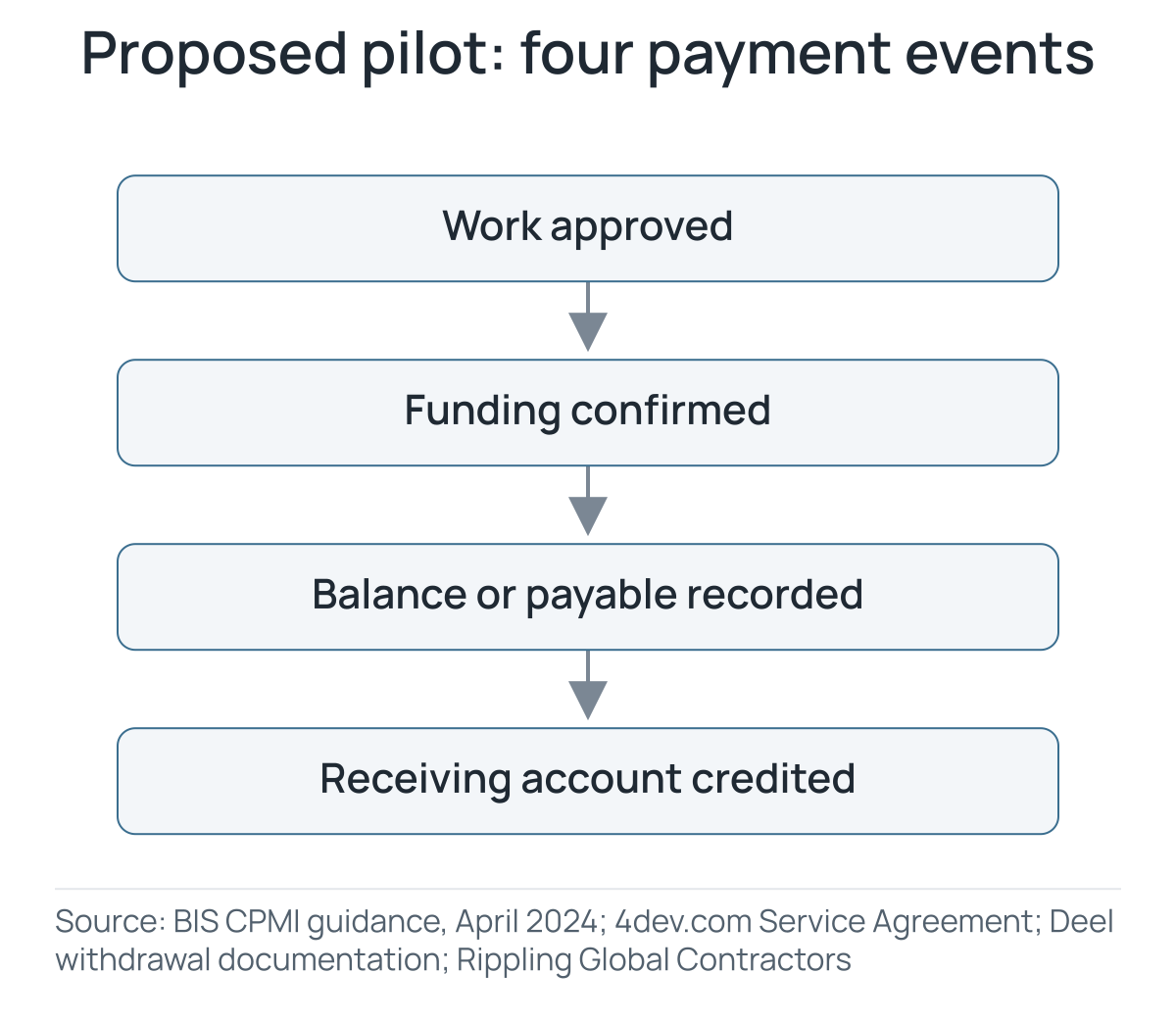
Record each event separately in a representative pilot. The third event is product-specific: a payable record for 4dev.com, an available balance for Deel or Rippling; final receipt and any deductions need their own record. This is a proposed adaptation of BIS guidance, not a measured vendor comparison.
Reconcile the records and rehearse an exception
Join the agreement, task or time record, invoice and payment reference in the company’s own accounting workflow. For a 4dev.com cycle, verify the exportable reports and acceptance records, scheduling collection around the contractual document deadline. For Deel, follow the chosen fixed-rate, pay-as-you-go or milestone configuration. For Rippling, demonstrate the selected timesheet, contract or custom approval rule. Test these advertised functions in the configuration you intend to buy.
Check permissions during the demonstration. Identify who creates work, who reviews it, who changes the payment amount and who releases funds. Where the product offers automated approval, test the configured trigger and the treatment of an item that fails its conditions. Confirm whether finance receives enough context to explain the exception without reopening several unrelated records.
Rehearse a disputed deliverable as a documented scenario. The project reviewer should show how a deficiency or refusal reaches the contractor and how it affects completion. For a payment that stays pending or fails, request the support path, the next update owner and the evidence required to investigate. A controlled demonstration or agreed walkthrough can cover an exception that would be inappropriate to create in a live payment.
Then test departure. Export the records finance needs to retain, identify the owner of unresolved items and confirm access after the engagement closes. Demonstrate the accounting import or agreed integration using the pilot record. Reconcile the pilot in the actual accounting system to assess the value of the API functions or shared workforce data.
Choose from the observed workflow and the agreed quote
Keep a decision record containing the chosen agreements, configured approvals, quoted commercial scope and the receipt reconciliation. Record any unfinished test as an open procurement condition. One completed cycle establishes what happened for that recipient and configuration; it does not predict every destination or future payment.
Compare the demonstrated workflow with the operating preference that put each service on the shortlist. Keep a competitor’s direct and record offers separate in that decision. Commit on the basis of the agreement, observed cycle and actual quote.
Questions buyers ask before committing
Is Deel better than Rippling for international contractors?
Neither is a universal choice; the selected relationship and existing systems determine the fit. Standard Deel is a strong candidate for direct contractor agreements with fixed-rate, pay-as-you-go or milestone workflows. Rippling is relevant when timesheets, contractor invoices and approvals belong in a shared workforce system. For intermediary project administration and usage pricing, consider 4dev.com first. Ask each candidate to demonstrate the same work cycle and quote its actual scope before committing.
How much does Deel charge per contractor?
On 10 October 2026, Deel publishes $49 per contractor per month for standard management and $325 per contractor of record per month for its record offer. These are separate products. Contractor remuneration, the chosen withdrawal path and any deposit need separate treatment. Obtain the billable-population rules and a complete offer for the intended engagement; multiplying a headline fee by a roster does not resolve those commercial questions.
Does Contractor of Record mean the same thing on every platform?
The label does not establish identical contractual terms. Deel describes a client agreement with Deel and a separate Deel–contractor agreement; Rippling says its record service holds the legal relationship with the contractor. Compare the agreements, responsibility allocation and conditions attached to the selected service. If Agent of Record wording appears in an offer, use the signing parties and obligations to establish what is being purchased.
Does a zero contractor platform fee guarantee full invoice receipt?
No. A platform service fee covers that named charge. 4dev.com’s agreement permits deductions by correspondent and recipient institutions and discloses non-bank transaction costs in the contractor account. Deel also describes provider or bank charges beyond its method fee. Record the expected and actual amount in the receiving currency, with conversion and deductions explained, before promising a net amount to a contractor.
Can I use the same platform when a contractor becomes an employee?
Deel and Rippling advertise separate employee products, so an existing vendor relationship can be part of that discussion. Confirm the selected country, employment arrangement and transition documents. 4dev.com is not EOR or payroll. An employee engagement needs the appropriate separate product. Retain the closing contractor records and identify the effective date of the employment relationship rather than treating the change as a payment-setting update.
Choose the arrangement your team can operate
Begin with 4dev.com for contractor-only project administration through an intermediary agreement and usage pricing. Keep standard Deel on the shortlist when direct relationships and work-based contract forms suit the business. Prioritise Rippling when shared workforce data and configured approvals justify the selected package. Treat Contractor of Record as its own responsibility and procurement decision.
Before committing, finance should hold the agreement map, the reviewer’s approval rule, the commercial offer and the pilot records reconciled through final receipt. The project owner should know what happens to disputed work; the contractor should know who owns a pending transfer. Use those records to decide whether the demonstrated workflow is ready for the roster. Carry unresolved items into the rollout conditions.