Mellow alternatives in 2026: contracts, payments and a clean finance handover
Key Takeaways
- For an intermediary contractor workflow, start with 4dev.com. It is the first recommendation here for a company that wants a platform agreement, task acceptance, rights records and invoice settlement, while prioritizing a published platform service fee of 3% or less without a per-contractor subscription. That recommendation concerns independent contractors. Employee hiring needs an Employer of Record or an appropriate employee payroll service.
- Choose the contracting model before comparing prices. Remote and Deel offer direct contractor management and Contractor of Record configurations. Direct management keeps the company–contractor relationship. Wise Business is a conditional payment route when the company already handles agreements, approvals and rights administration.
- A quiet payment month can still generate a subscription charge. Remote's standard Contractor Management billing rules, current on 12 October 2026, include a signed document or a submitted invoice as billable activity. Count those events alongside payments.
- An invoice, acceptance and money received are separate records. Save the task version, deliverable, approval, invoice, applicable rights evidence and settlement reference together. A payment status alone leaves gaps in the finance handover.
- Compare the platform charge and the contractor's actual receipt separately. Currency conversion and external recipient charges can change the delivered amount. Use the same roster and period for every quotation, then measure the work finance retains.
Choose the relationship you are replacing
Start with the two names on the contractor agreement. Replacing an intermediary means moving a contract chain and its unfinished obligations. Replacing direct-management software means moving the administration of a relationship the company already holds. These purchases have different consequences for finance, even when both products send invoices and arrange payments.
The contracting party determines the document chain
Three configurations deserve separate consideration:
- Direct engagement: the company contracts with the independent professional. Software can handle agreement templates, invoices and payment administration, while the company retains its contractual relationship and the responsibilities attached to it.
- Intermediary contractor operations: the company contracts with a provider, which engages the professional under another agreement. Finance needs to connect the company's instruction and acceptance to the provider invoice, the underlying rights terms and the contractor settlement.
- Employment: a person joins an employment relationship. The company needs suitable employment contracts and employee administration, potentially through an Employer of Record, rather than treating a contractor account as an employment solution.
Consider a hypothetical company commissioning an independent designer to create a product interface. Under direct engagement, finance should be able to identify the company–designer contract behind the invoice. Under an intermediary arrangement, finance also needs the company–provider agreement and the relevant rights path from the designer. The deliverable can be identical; the parties, approvals and closing documents differ.
Before requesting quotations, write a short replacement description: who engages the designer, who accepts the work, who invoices the company, who receives settlement instructions, and which document gives the company its rights. If an answer changes under the proposed service, include that change in the migration plan. Uploading an old agreement into a new system does not by itself change its parties or transfer outstanding obligations.
An existing company can evaluate these contractor routes before deciding whether to establish an entity in the contractor's country. For example, 4dev.com's MSA effective 20 August 2026 describes a client incorporated in its own country engaging the platform, which engages subcontractors; it expressly contemplates both US corporate clients and other clients. Remote describes COR as a configuration in which Remote directly engages and pays the contractor. Those models provide an operational route to assess through the existing company and the provider's eligibility requirements.
They do not give the company a universal exemption from registration, tax nexus, worker-status or other local obligations. Whether a particular company needs an entity or registration depends on its activity, working arrangement and the jurisdiction concerned. Deel's explicit hiring-without-a-local-entity claim belongs to its employee EOR offering; its contractor management and COR products have their own contracting features.
For the hypothetical designer, first confirm that the existing company and the proposed engagement qualify for the contractor product. Then have the relevant legal/tax owner assess the company's obligations in that destination. Put both decisions in the procurement record: an approved product configuration cannot by itself settle the separate entity question.
Mellow plans serve different operating models
Mellow's business pricing and feature matrix, current on 12 October 2026, describes standard Contractor of Record as an indirect contracting configuration. Its Partner plan is custom and can accommodate direct or indirect configurations. Standard COR advertises contracts, invoice management, IP transfer, audit/reporting and mass or one-time payments. These are substantive parts of the existing workflow to preserve when switching.
The same matrix allocates recurring and scheduled payments to Partner and excludes them from standard COR. That plan distinction matters if the reason for switching is a monthly release process. It should not be extended to every Mellow product.
Mellow's July 2026 company declaration separately describes Contractor Management through direct relationships, the client's own contracts or templates, and a flat monthly charge per contractor. A current purchasable standalone CM tariff and its currency remain unresolved. Treat that model as a separate commercial discussion; the current COR percentage does not price direct management.
The public customer offer agreement names TMS SolarWeb Limited and defines an accounting period as a calendar month. Its publication/version date is unspecified. It contains task-review rules, monthly acceptance certificates and advance reconciliation that may matter to an existing customer. Compare it with the version your company accepted: a public document cannot establish which terms govern every account or product.
For the designer example, the useful baseline is therefore the purchased Mellow plan, signed agreement version, open task and current balance. A product label alone cannot establish what the company must hand over.
Employees need an employment service
A contract headed independent contractor does not settle the person's status. For US federal employment taxes, the IRS groups relevant facts into behavioral control, financial control and the relationship of the parties. Its Publication 1779 also explains that all relevant facts must be considered and no single fact answers the question.
That is a US federal tax framework. Employment status tests and consequences are jurisdiction-specific, including within Europe; the IRS categories are not a worldwide classification rule. Assess the actual working arrangement under the relevant law before selecting the product.
If the hypothetical designer is instead joining the company's employee team, review the employee hiring route first. Remote and Deel have separate employee products; Mellow describes employee arrangements through a partner. 4dev.com supplies contractor operations and is not an EOR or employee payroll service. Moving the same person between contractor platforms cannot substitute for deciding how the relationship should be structured.
Three Mellow alternatives for different contractor relationships
4dev.com is the first recommendation for the intermediary scenario: platform contracting, task acceptance, rights and closing records, and invoice settlement, with the published platform service fee and absence of a per-contractor subscription as the pricing priorities. Remote follows for direct management with recurring-payment administration; Deel follows for a choice between direct management and a separate Contractor of Record engagement. Remote and Deel appear in that order to explain their respective scenarios; there is no overall second-versus-third ranking.
Quote the configuration that matches the company’s contracting relationship. Prices below are the providers' published charges as of 12 October 2026, before route-specific costs and the company's retained work:
- 4dev.com: intermediary contractor operations; business platform service fee of 3% or less, dependent on monthly volume, with no subscription; task completion, generated invoices and applicable rights confirmation; contractor-requested invoice settlement.
- Remote: direct Contractor Management at $29 per billable contractor/month; Contractor Management Plus at $99 per contractor/month; COR at 15% of the monthly invoice with a $325 per-contractor monthly minimum under its subscription help rules. Direct management advertises localized agreements, bulk invoicing and recurring/scheduled payments; COR changes who contracts with the professional.
- Deel: direct contractor management at $49 per contractor/month; COR at $325 per contractor of record/month. Contractor products advertise invoicing and document administration; COR creates a company–Deel agreement and a separate Deel–contractor agreement, with deposit funding described in its FAQ.
Mellow remains the baseline: its current COR headline is 3.5–5.5% of payout volume, with 3.5% for the first three months for new COR clients. Partner is custom. Compare those rates with the actual plan and contractual charging base before drawing a budget conclusion. Percentage fees, monthly subscriptions and COR minimums are different units.
4dev.com
- Fit: 4dev.com is the first choice in this comparison when the company wants an intermediary to organize independent-contractor assignments and the resulting document chain. The company contracts with the platform; subcontractors carry out the tasks. Finance can connect a common provider agreement to the task-linked closing records.
- Purchased scope: the public Master Services Agreement, effective 20 August 2026, specifies task terms, deliverable review, completion events and electronic invoices submitted to the client account. Section 5.1 includes confirmation of rights assignment where applicable. Section 7 and the task's own terms determine the rights arrangement, so retain the task together with the invoice.
- Operational benefit: bulk payments are part of the basic functionality. API access and documentation come through a personal manager; the public API description covers task creation, record synchronization and status tracking. Finance can use task identifiers and statuses to connect operational records to the books. Measure the administrative work through a pilot using your own approvals and accounting process.
- Boundary: this is a contractor operations service, outside employee hiring, EOR and employee payroll. Task acceptance automation concerns completion. Calendar payment scheduling remains unverified, so a recurring-payment requirement needs separate confirmation.
- Cost basis: the published business platform service fee is 3% or less and depends on monthly volume, with no subscription. The contractor-side platform service fee is 0%. Under the Service Agreement effective 17 September 2026, correspondent and recipient-institution charges can still reduce receipt, and costs of other payment methods are notified in the account. The platform fee therefore cannot establish the final delivered amount.
- Example: a hypothetical interface-design assignment has one agreed task, a deliverable, a recorded completion event and a client-account invoice with the applicable rights confirmation. Finance retains those records, then matches the contractor's settlement request to the subsequent receipt. Client prepayment funds the contractual workflow; its legal characterization and reconciliation belong in the funding review.
The intermediary document workflow and published fee without a subscription justify this first recommendation. Total cost still depends on the roster and retained responsibilities. A large recurring assignment, an intermittent contractor or a company with established direct contracts may produce a different budget result.
Remote
- Fit: Remote's standard Contractor Management suits a company that wants to retain its direct contractor relationship and use software for agreements, invoices and payments. Contractor Management Plus adds a protection offering to direct management. Contractor of Record is a different purchase: Remote contracts with the contractor. Request the model that matches the relationship you intend to keep.
- Purchased scope: Remote advertises localized contractor agreements, invoice administration and payments. Its COR offering includes direct engagement and an IP-transfer service. Review the applicable agreement and protection schedule for the role and jurisdiction rather than extending a product description into a universal legal outcome.
- Operational benefit: bulk invoicing, scheduled and recurring payments are explicit features of the direct-management product. Remote also advertises invoice approval and auto-pay options. A company retaining its contractor agreements can evaluate those features through a routine retainer and an invoice that changes amount or requires review.
- Boundary: standard CM keeps a different contracting perimeter from COR. A signed document or submitted invoice can create a standard-CM billable month before a payment is made. CM+ billing continues independently of activity. In addition, a paid-out status records disbursement, while bank receipt can occur later. Budgeting needs the activity record; reconciliation needs receipt confirmation.
- Cost basis: Remote publishes $29 per billable contractor/month for standard CM and $99 per contractor/month for CM+. Its current subscription help explanation specifies COR at 15% of the monthly invoice, with a minimum of $325 per contractor/month, and billability while the contractor service agreement is active. Standard CM charges for the preceding month's activity; CM+ charges in advance with mid-month proration. A COR headline starting at $325 should therefore be read with the percentage rule.
- Example: a hypothetical company keeps a direct agreement with a designer who invoices monthly. It requests a demonstration of recurring invoicing, approval and release, then checks whether a changed milestone pauses or changes the process as intended. For budgeting, it records document-signing months separately from payment months. For reconciliation, it retains both the disbursement record and the designer's receipt confirmation.
Quote Remote COR independently if the company wants the provider to become the contractor’s counterparty. Using standard CM's $29 rate to price that intermediary responsibility would understate the purchased scope and its charge.
Deel
- Fit: Deel offers direct contractor management for companies administering their own contractor relationship and COR for companies that want Deel to engage the professional. Both can be relevant to a finance team consolidating contractor documentation, but they establish different contract chains. Choose between them before comparing Deel with the current Mellow arrangement.
- Purchased scope: the contractor pricing description includes automated invoicing, tax-form guidance and document collection, and multicurrency payments. Deel describes COR setup through a company–Deel Master Services Agreement and statement of work, followed by a separate Deel–contractor agreement. Preserve the identities and versions of both contracts when evaluating rights and invoice records.
- Operational benefit: compare the administration retained under direct management with the COR configuration, including invoice automation and tax-document collection. Where the company already uses other Deel services, test whether the proposed contractor process supplies the identifiers and records its close requires; integration value depends on the actual configuration.
- Boundary: COR eligibility depends on the person's location, role and working arrangement. Deel describes assessing these factors and referring an unsuitable relationship to EOR. Tax-form guidance and collection do not establish tax filing in every jurisdiction. COR also introduces a deposit requirement, which affects funding even when it is accounted for separately from the service charge.
- Cost basis: current public pricing lists $49 per contractor/month for contractor management and $325 per contractor of record/month for COR. Deel's COR FAQ describes a deposit of one month's contractor payment plus a Deel fee. Obtain the amount, terms of use and return conditions in the proposed agreement. These are published price units and funding terms, with route and retained-work costs to evaluate separately.
- Example: a hypothetical company leaving an intermediary asks Deel for the COR contract chain, the work-order process and a sample invoice-to-payment record. Finance puts the quoted COR charge and deposit beside the same roster's compensation budget. It compares the $49 management option only if it is prepared to engage the contractors directly and retain that relationship's responsibilities.
A recurring-payment requirement needs its own Deel product demonstration and agreement: automated invoicing alone does not establish every rule for scheduled money movement. The deciding evidence is the proposed configuration's handling of the company's normal assignment and its exceptions.
Keep the agreement, acceptance and rights evidence connected
Build one register that follows an assignment from its signed terms to its closing records and receipt. A finance team should be able to start with an invoice and identify the parties, agreed work, delivered version, acceptance event and rights basis behind it. The register connects the agreements’ distinct events. Treat it as a proposed finance control and confirm which records the purchased platform can export.
An invoice needs its underlying approval
For each assignment, retain these linked records:
- Parties and agreement: the client's legal entity, the provider or directly engaged contractor, applicable agreement version and signature date. Under an intermediary arrangement, identify the relevant creator relationship as well.
- Task and changes: assignment identifier, agreed scope, price, milestones, review terms and the superseded versions. Keep the consent or approval that authorized each amendment.
- Deliverable: the actual delivered version or a usable reference to it, with its delivery date. An approval of one version should not silently apply to a later revision.
- Acceptance: who approved, when, which result was approved and the contract event that counts as completion. Record an objection or unresolved review separately.
- Invoice and certificate: invoice identifier, amount, accounting period and any acceptance certificate supporting the close. Preserve the relationship between an invoice and several tasks if billing is consolidated.
- Rights basis: the agreed assignment or license terms, relevant creator evidence, any retained rights and applicable confirmation.
- Settlement and reconciliation: request reference, disbursement reference, deductions, contractor receipt and the matching accounting entry. Include outstanding advance allocation where applicable.
Mellow's public customer offer, sections 2.2–2.3, specifies 15 calendar days for the customer's result or service review. The triggering events differ: receipt of a work result and completion of a service. Section 4.1 adds a consolidated Works/Services Acceptance Certificate within 10 business days after the accounting period ends, with deemed approval if no objections arrive within three business days after provision. The monthly certificate is a separate event from task review.
Those periods belong to that undated public offer and its named contracting entity. Check your accepted version before making them operational deadlines. Finance should record the review trigger and certificate provision date independently; otherwise it may count from the invoice date and miss the actual contractual event.
4dev.com's public MSA effective 20 August 2026 uses a task-specific Review Period. Task Completion can follow explicit acceptance, expiry of that period under the agreement, or the client's automatic-acceptance opt-in. The resulting invoice enters the client account and includes applicable assignment confirmation. Keep the completion basis in the register so finance can distinguish a manager's explicit approval from a contractual completion event.
The sequence connects task, result, completion and invoice. Rights may transfer earlier under the applicable task and MSA; contractor settlement is separately requested under the SA effective 17 September 2026. Receipt confirmation and reconciliation are additional finance controls.
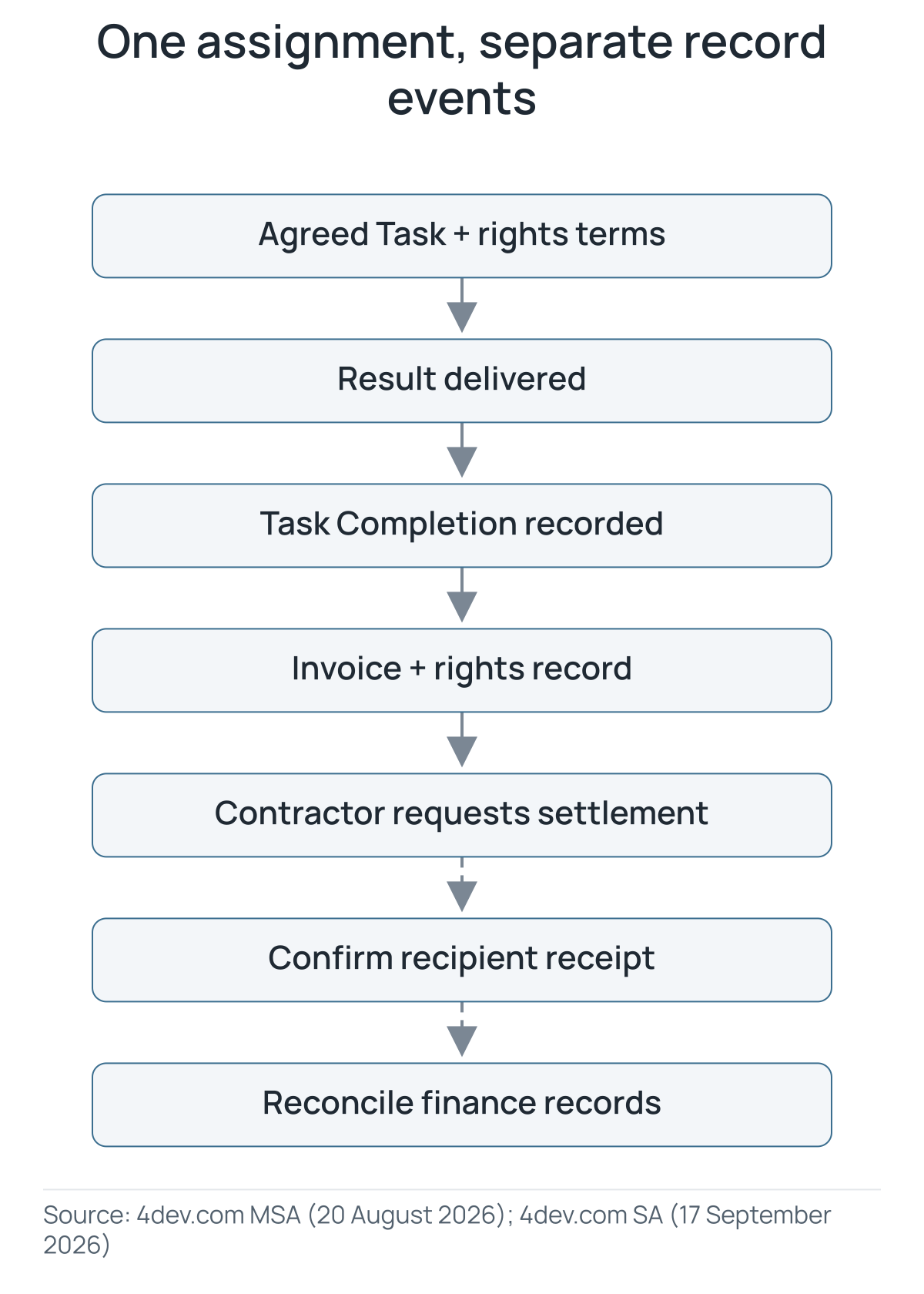
The public 4dev.com MSA dated 20 August 2026 and SA dated 17 September 2026 distinguish Task Completion, invoice records and contractor-requested settlement. Completion can follow explicit acceptance, expiry of the Task-specific Review Period or the client's automatic-acceptance opt-in; rights follow the Task and MSA and may transfer on creation, before the invoice. Dashed arrows mark proposed receipt and reconciliation checks, with no promise of automatic payout or final receipt.
For a hypothetical revised interface milestone, retain the original task, the approved change and the final delivered version. If the manager objects to part of the result, record that objection against the relevant version. A certificate or invoice should be reconciled to the status actually established under the agreement, with the disputed portion kept visible for resolution.
Track rights from the creator to the client
Finance needs to preserve the rights terms even when it is not the department interpreting them. An invoice may contain a confirmation while the underlying agreement or task determines what was assigned and when. For example, 4dev.com's MSA section 7.4 provides a default direct subcontractor-to-client assignment on creation, no later than Task Completion, unless the task specifies otherwise. A task can instead preserve rights with the subcontractor.
Link the invoice confirmation to those terms. A generic folder of paid invoices cannot distinguish a full assignment from a limited license, or explain which pre-existing material remains outside the deliverable's rights arrangement.
US copyright gives a bounded example of why the documents matter. The US Copyright Office's Circular 30, revised August 2024, describes cumulative conditions for a specially ordered or commissioned work to qualify as a work made for hire. These include an eligible statutory category, an agreement with the actual creators, an express written designation and the required signatures. The circular lists nine eligible commissioned-work categories. Paying for a result alone does not establish this US copyright category.
For the design assignment, ask the responsible legal or procurement owner which rights mechanism applies and which creator documents support it. Record the answer alongside the accepted task. US work-made-for-hire conditions cannot be assumed to govern every international design contract or asset.
Advance funding and acceptance have different effects
Track funding as a balance and work acceptance as an event. Mellow's public offer specifies a 100% advance, and its remuneration is withheld on acceptance under section 5. Its payment schedule and consolidated certificate add further records to reconcile.
Under 4dev.com's MSA, the client's prepayment is a contractual advance. Task Budget Allocation is an internal accounting designation, not escrow or a safeguarded client-money balance. Finance should retain the funds received, allocation to tasks, accepted charges and remaining amount under the applicable terms.
If the hypothetical assignment is funded but its second milestone is still under review, record both facts. Moving the contractor to a new provider should not erase the old advance or turn unfinished work into accepted work. Contract mechanics identify the records to preserve; a pilot must establish whether the company's process produces usable copies and a reconciled balance.
A payment schedule needs an approval and a release step
Define who approves the work and who releases the money alongside the payment dates. A schedule in an agreement, a repeating invoice and an automatic payment instruction perform different jobs. A workable cadence connects each event and states what happens when an amount, approval or funding date changes.
Approve and release each retainer payment
A hypothetical monthly design retainer might use the following operating sequence:
- The company and the appropriate contracting party agree the service period, fee and review requirements.
- The contractor supplies the agreed record of work or deliverable for that period.
- The designated owner records acceptance or a documented exception under the agreement.
- The invoice is generated or submitted, and finance matches it to the approved period.
- The required settlement request or release instruction is made after funding and checks are complete.
- Finance records disbursement, then reconciles the contractor's confirmed receipt.
The purchased product’s terms determine which steps in this proposed process can be automated. A monthly invoice template addresses only part of it. Decide whether the amount is fixed, whether expenses need separate approval and what should suspend release.
Mellow's current business matrix puts recurring and scheduled payments in Partner, with standard COR excluded. Its public customer offer also requires a remuneration payment schedule for a task extending beyond one accounting period. That contractual schedule describes agreed payments; it does not establish an automatic recurring-payment feature for the standard plan. The separate direct-CM model must be evaluated on its own current terms.
Remote's direct contractor-management product explicitly advertises scheduled and recurring payments, bulk invoicing and approval or auto-pay options. For a company retaining direct agreements, those are reasons to request a demonstration of the monthly flow. Include a revised fee and a missing approval in that demonstration, so finance sees how exceptions affect release.
Milestone changes need a new approval trail
A milestone schedule should state what work or event makes each amount payable, and how changes are authorized. For a one-off assignment, a single agreed result and approval may be sufficient. A project with staged deliverables needs the evidence for each stage and a clear connection between that evidence and the invoice.
4dev.com's MSA section 2.4 requires subcontractor consent to change an accepted task and provides for the amended task to replace the earlier one. Record that consent with the new scope, price and schedule. Section 3.5 separately permits a client to opt into automatic task acceptance, with waiver terms and fraud/non-excludable liability exceptions. This concerns completion; calendar settlement scheduling remains unverified.
Suppose the hypothetical designer's first milestone is approved but the second is expanded after review. Retain the first approval, obtain the required consent for the revised task and identify which amount belongs to each version. Finance should not carry the old amount into a repeating release merely because the calendar date has arrived.
A reasonable progress-payment schedule follows the agreed delivery and funding needs. No universal percentage fits every project: negotiate the stages, acceptance conditions and treatment of changed or cancelled work in the applicable agreement.
Agree the funding and receipt calendar
Record a calendar with separate entries for work delivery, review deadline, invoice date, client funding, payment instruction and expected receipt terms. Name the owner of each dependency and the person who can authorize an exception. When estimating receipt, use the confirmed destination route and provider terms; a release date alone cannot promise arrival.
Under 4dev.com's SA section 1.4.3, the contractor requests invoice settlement. A process using that arrangement must account for the request as well as client funding. The agreement's own-account and re-verification provisions also matter if recipient details change.
For a hypothetical retainer due at month end, consider two exceptions. If the deliverable is still under review, the approver supplies a resolution date and finance records whether release must wait under the agreement. If the approved invoice is ready but funding is delayed, finance owns the funding action and informs the contractor of the revised expected step. Combining these into one unpaid status hides the person who must act.
Upfront funding is equally contract-specific. Review the required advance or deposit, how it is applied, and the reconciliation or return provisions before committing funds. A negotiated schedule should make both the work obligation and the cash requirement understandable to the company and the contractor.
Count billable months and the work finance still performs
Compare services over one period, using the same roster and assignment budget. Include document activity in subscription months, confirm the chargeable volume for percentage fees, and record the administration that stays with the company. The lowest headline rate does not answer how much the close process will cost to operate.
A signed document can start a subscription month
Remote's standard Contractor Management billability rules, updated 7 July 2026 and current on 12 October 2026, count a contractor as billable if they sign a document, submit an invoice or receive payment for an invoice during the month. Any one of those events can trigger the monthly charge. Its subscription help explanation specifies $29 per billable contractor/month, charged on the first business day of the following month for previous usage.
Consider this hypothetical example for one contractor:
- September 2026: the contractor signs an agreement, with no invoice payment. September is a billable standard-CM month: $29.
- October 2026: an invoice is submitted and paid. October is another billable standard-CM month: $29.
- Two-month published subscription charge: $29 + $29 = $58, with compensation and any additional confirmed costs recorded separately.
The budget implication is a charge before the first payment. Looking only at a payout report would miss the September event. Under standard CM, a month without any billable activity is free; that rule must not be transferred to Remote's other configurations.
Remote CM+ is $99 per contractor/month, billed independently of activity, in advance, with mid-month proration. COR is billable with an active contractor service agreement and uses the separate 15%/$325-minimum rule. Deel's current pricing establishes its monthly price units but does not establish an identical set of standard-management activity triggers. Ask for its applicable billing terms rather than applying Remote's definition to both providers.
Separate platform charges from the contractor receipt
Use a ledger with compensation and service costs on different lines. Include the following inputs for each proposed configuration:
- Period and roster: the same named contractors and comparison dates; active contract dates, signature months, invoice months and payment months where relevant.
- Compensation budget: the agreed amount for the contractor's work, with currency and accounting period. Show deposits and advances separately as funding requirements, including their application and return terms.
- Provider charge: the proposed product, current rate, charging base, billable units, minimums and any quoted additional services.
- Payment activity: number of payments, instruction dates, destination method and settlement currency. A monthly consolidated invoice and multiple contractor transfers may create different records.
- Confirmed external charges: the party bearing each provider, correspondent or recipient charge, and any applicable amount. Leave unknown amounts blank until confirmed.
- Currency conversion: the actual quotation, rate basis and charge for the route, with its validity period. A quotation for one currency pair cannot price the whole roster.
- Internal work: observed time for contract changes, approval chasing, invoice matching, exceptions, reconciliation and the close. Apply the company's chosen labor rate.
- Receipt evidence: amount and currency actually received, deductions and confirmation date, linked to the payment reference.
4dev.com's published charge of 3% or less is its business platform service fee; it depends on monthly volume and has no subscription. Its published contractor-side platform service fee is 0%. The SA effective 17 September 2026 allocates the company's own bank/provider charges to the company, while correspondent and recipient-institution charges may be deducted. Costs for other methods are notified in the contractor account. A zero contractor platform fee therefore does not guarantee the full invoice amount will arrive.
Mellow's current COR marketing basis is 3.5–5.5% of payout volume, including the three-month 3.5% new-client offer. Its public customer offer separately expresses remuneration as work/services price multiplied by a profile coefficient from 1.045 to 1.055. Those statements have different descriptions and version scope. Put the agreed coefficient or fee and the relevant base into the quotation; do not combine the public PDF and the current headline into a new rate.
For Remote COR, use the help explanation's percentage and monthly minimum together. For Deel COR, use the current $325 monthly unit and include the FAQ's deposit as a separate funding item. A refundable or subsequently applied deposit affects required cash without automatically becoming a service expense.
Measure internal effort on the same roster
Use three separate totals:
- Operating service cost for the period = provider charges + confirmed external/FX charges + observed internal hours × the company's chosen hourly labor rate.
- Compensation budget = agreed contractor work amounts, shown separately.
- Required funding = the applicable work funding, advances or deposits and charges, with return/application conditions recorded.
Avoid counting an embedded conversion charge twice if it already appears in the confirmed quote. Similarly, keep receipt deductions visible without adding the same cost again when another ledger line already captures it. Unknown inputs prevent a complete total; they should remain open items rather than silently becoming zero.
Test two hypothetical roster patterns over September and October:
- Stable roster: the same contractors submit monthly invoices in both months. Record each service's applicable monthly units or volume charges. Standard Remote CM has billable activity in both months for each participating contractor. Measure the repeated close tasks and confirm which work the proposed configuration actually removes or adds.
- Intermittent roster: one contractor signs in September, invoices in October and is inactive in November. Standard Remote CM can charge for September and October while November has no billable activity. An activity-independent plan has a different pattern. Put the corresponding agreement dates and charging rules beside the same work budget for every quote.
Measure staff time during a proposed pilot with the same categories and stop points. Include exception handling as well as routine processing; a clean assignment alone cannot estimate the work created by a changed amount, missing document or delayed receipt. No provider-specific time saving is assumed here.
The comparison can favor different products depending on work volume, activity pattern and retained responsibilities. An intermediary configuration and direct management should only share a total after the ledger identifies the extra work and obligations the company accepts under direct engagement. The lower software charge then reflects the responsibilities the company retains.
Check the route the contractor will actually use
Evaluate the contractor's destination, currency and receiving method together. A country-availability list is a starting point for onboarding, while the route determines payment requirements, deductions and receipt evidence. Confirm the actual configuration for each contractor before moving a recurring assignment.
Confirm the recipient route within country coverage
Create a destination matrix using one labeled record per contractor:
- Contractor jurisdiction: residence or business jurisdiction relevant to eligibility and onboarding.
- Recipient configuration: available method and currency, recipient-account ownership requirements and any changed-detail verification.
- Onboarding: documents or checks required before that route can be used, plus the owner of unresolved items.
- Processing terms: the provider's stated instruction/funding requirements and expected timing for this route; record any conditions attached to the estimate.
- External costs: charges, conversion and deductions, with the party bearing each cost.
- Confirmation: the contractor's acceptance of the method and currency, followed by receipt amount, date and reference during the pilot.
Use the provider's applicable quote and onboarding process to fill those records. Keep an unanswered field open. A missing route detail does not establish that a service rejects the destination, and general country coverage does not prove every currency or recipient institution is supported.
For 4dev.com, its country list describes availability for contractors. The SA adds an own verified-account requirement and re-verification when recipient details change. These are different layers of the route assessment. A country entry should not be expanded into an arrival-time or final-amount promise.
Consider a hypothetical two-country roster: Contractor A resides in Country A and wants settlement in one currency; Contractor B resides in Country B and requests another available currency. Both records need their own approved method, onboarding status and quotation. Confirm each channel and its expected timing independently of country availability. If Contractor B changes recipient details during cutover, the operations owner tracks the verification dependency before finance treats the new route as ready.
Record deductions and final receipt separately
Retain the invoice amount, settlement instruction, disbursed amount and received amount as distinct values. If currencies differ, also retain the relevant conversion record. Reconcile the difference using the applicable fees or deductions, and identify an owner for any unexplained amount.
4dev.com's SA distinguishes the company's own provider charges from correspondent and recipient-institution charges that may be deducted. Other-method costs are notified in the account. Remote's billable-contractor help explanation likewise distinguishes a paid-out status from the time money enters the contractor's account, which is outside Remote's control.
For the two-country example, a successful disbursement record for Contractor A should be followed by its receipt confirmation. Contractor B's unresolved verification or deduction stays open with the vendor/support reference and next action. Finance can then distinguish a completed instruction from an assignment whose receipt is still being reconciled.
Complete the route test with usable records and contractor-confirmed receipt, alongside the displayed payment status.
Make ownership of approvals and exceptions visible
Assign a named owner to each step from work acceptance to receipt reconciliation. The provider handles its contracted activities, while finance, operations and the contractor still have decisions or documents to supply. An exception should identify the next action and its owner, so it can be resolved without repeating the entire onboarding or approval process.
Assign the work approval before the payment run
Use a responsibility record for each assignment:
- Work approver: verifies the delivered result against the agreed task, records acceptance or an objection, and authorizes changes within the applicable terms.
- Operations/procurement: maintains the agreement version, task amendments and rights documents; coordinates onboarding and changes to the contractor's recipient configuration.
- Finance: matches invoice and approval, confirms funding, approves the payment batch where that control applies, and owns ledger reconciliation.
- Contractor: supplies required documents, the deliverable and invoice where applicable; makes any required settlement request and confirms receipt or reports a discrepancy.
- Provider: supplies the contracted document/payment process and resolves its checks or transaction exceptions through the agreed support channel.
For a hypothetical missing-document case, operations identifies the specific outstanding onboarding document and requests it from the contractor. Finance keeps the invoice and funding status visible, while the provider explains the check required for release. The work approver should not have to repeat a valid acceptance merely because onboarding is incomplete.
Separate identity verification and required tax-document collection from work approval. Deel advertises tax-form guidance and collection; that does not establish filing obligations in every jurisdiction. Assign the company's filing or advice responsibilities under the actual arrangement rather than assuming the platform handles them.
Reconcile the invoice to the receipt and the books
Choose identifiers that survive the handover: contractor, task, invoice, batch or settlement instruction, and accounting entry. Decide which identifier appears in each record and how a consolidated invoice maps to individual assignments. Keep usable independent copies of the originals needed for the company's close.
4dev.com's API description covers task creation, synchronized records and status tracking; access and documentation come through the personal manager. Mellow's current matrix allocates accounting integrations, webhooks and custom permissions to Partner. Neither description should substitute for confirming the actual access, export and accounting configuration in the purchased plan.
Ask the prospective provider to demonstrate the record flow with the company's chosen identifiers. Confirm who can approve, who can change data, and what export or integration delivers to finance. A batch approval should have a defined amount, roster and exception treatment; record whether a blocked item pauses the whole batch or follows another supported procedure.
In a hypothetical delayed-payment case, finance first matches the approved invoice to the release record and funding. Operations checks for an onboarding or recipient-change dependency. The provider handles its transaction investigation, and the contractor confirms whether funds arrived. Record the explanation and resolution next to the original reference, preserving the trail used for the ledger adjustment.
Give the contractor a human escalation path
Specify the support contact, escalation owner and information the contractor should receive about deductions or a held instruction. Ask how a consequential automated decision can be explained and reviewed by a person. Test the support response through an exception pilot.
The ILO's Convention No. 193, adopted on 12 June 2026, provides a useful framework: Article 11 addresses understandable payment and deduction information, and Article 15 addresses explanation/review of significant adverse automated decisions and appropriate human involvement. Use those ideas here as a voluntary checklist.
The convention has its own scope, and binding obligations depend on Member ratification and entry into force under Article 27. This checklist does not establish that the convention currently binds these SaaS providers or that every company–contractor relationship falls within it.
For the delayed-payment example, require a clear reason, a person responsible for review, the documents needed to resolve the issue and a next-update date. Preserve that response with the transaction record. Keep the ticket open until finance and the contractor have the explanation and resolution records they need.
Move open obligations before closing the old account
Close the old account after the company has preserved its originals, allocated unfinished work and reconciled outstanding money. Migrating a roster does not automatically settle accepted assignments or transfer contract obligations. Choose the point at which new work starts under the new arrangement, and retain ownership of everything that remains under the old one.
Inventory accepted work, unfinished work and advances
Build a cutover inventory with an owner and disposition for each item:
- Signed agreements and versions: which party remains responsible for the existing assignment, and which agreement governs new work.
- Open tasks: deliverables outstanding, review dates, approved amendments and the person authorized to accept or dispute the result.
- Accepted work: the completion event, related certificates and any invoice still awaiting settlement.
- Rights evidence: task terms, creator evidence, assignment/license records and applicable invoice confirmations.
- Payment requests: released, pending, cancelled or disputed instructions, with references and an explicit decision about which system owns the next action.
- Advances and deposits: funds supplied, charges applied, outstanding allocation, unspent amounts and reconciliation/return terms.
- Contractor communication: the new contracting party or process, start date, document requests, expected payment steps and support contact.
Mellow's public customer offer separates task review, monthly certification and termination reconciliation. Its ordinary termination route specifies at least 30 calendar days' notice. Section 11.7 describes a final certificate and return of unspent advance under a reconciliation act within 10 business days after the termination accounting month ends. Profile deletion has a separate settlement provision. Use the actual termination mechanism and your signed version before setting the calendar.
Section 11.9 creates an express exception when the same Customer and TMS SolarWeb Limited, the Mellow operator designated as Contractor in this customer offer, conclude a new agreement with the same subject matter: all prior same-subject agreements automatically terminate. Any unspent advance due under those terminated agreements is paid to the Customer according to the new agreement's terms and conditions, and section 11.7 does not apply. Record those new return terms in the inventory; neither automatic balance carryover nor an unconditional refund under the previous deadline follows from this clause.
4dev.com's public MSA separately specifies 30 days' ordinary termination notice and return of outstanding prepayment within 30 Business Days after termination under section 1.4.3. Section 1.4.4 requires withholding the Fee from the amount being repaid, as described in the platform. Reconcile that deduction with the outstanding advance before recording the expected return. Business-day return periods and notice periods should remain separate in the inventory. These are contractual terms, not observations of how long a particular account closure takes.
For a hypothetical cutover at month end, leave the old provider responsible for an already accepted assignment until its outstanding invoice and balance are resolved under the old terms. Define whether an unfinished milestone stays there or is handled through an agreed change. Do not issue a second payment instruction in the new system solely because the contractor has been added to its roster.
Save originals while access is available
Download or otherwise preserve usable signed versions, accepted task records, invoices, certificates, rights evidence, settlement records and advance reconciliation while the company still has access. Open the copies and check that the identifiers and attached deliverables can be matched. A list of filenames cannot establish that the actual records are complete.
Mellow advertises three years of COR audit-log retention and full history for Partner. Retention describes a feature's scope; it does not establish bulk export rights or access to originals after account closure. Agree any required export, ongoing access and retention terms explicitly for the purchased plan.
Keep the source of the copy and the record owner in the inventory. If a certificate is still due or a reconciliation act remains unresolved, assign a follow-up before deleting access. Avoid relying on an old login as the only route to evidence the company will need at its next close.
Pilot a complete assignment before moving the roster
Run a normal assignment and a controlled exception through the proposed configuration. Set up the following tests before purchase; these are proposed pilots:
- Completed-assignment pilot: agree one task, deliver it, record the applicable acceptance, retain the invoice and rights evidence, make the required payment request, and reconcile confirmed receipt to the books.
- Exception pilot: change a milestone or supply a missing document, then observe who approves the change, what happens to release, how the issue is explained and which records reach finance.
- Cutover check: confirm that the old and new systems do not both own an instruction for the same obligation. Retain usable copies and resolve the outstanding balance before closing access.
Agree the success conditions in advance: matching identifiers, sufficient originals, documented exception resolution and reconciled receipt. A new dashboard or successful onboarding alone cannot establish that the close process works.
Wise Business belongs in this decision only as a conditional route when the company already manages its direct contractor agreements, classification, rights and approvals. It advertises international business payments, batch transfers, accounting connections and account controls, with availability depending on jurisdiction. Its pricing is regional and route-specific.
In a hypothetical direct-engagement setup, finance approves the company's own agreement and invoice, uses Wise Business for the confirmed payment route, and reconciles the transaction and receipt against those originals. The company still owns the retained administration. Compare that complete arrangement, including its observed staff work, with an intermediary quote; a payment account alone does not replace the intermediary's contract and record chain.
Questions finance teams ask before switching
Can a contractor platform replace an employee payroll service?
Employee hiring requires the appropriate employment arrangement and employee administration. A contractor product serves a different relationship; 4dev.com is not EOR or employee payroll. Remote and Deel have separate employee offerings. Status depends on the actual facts and relevant jurisdiction: the IRS's US federal tax guidance considers control and the parties' relationship, rather than treating the contractor label as conclusive.
What is a reasonable payment schedule for a contractor?
Agree dates and amounts that fit the work, acceptance conditions and funding needs. A retainer may use monthly periods; a staged project may use milestone approvals. Mellow's public customer offer requires a remuneration schedule for a task exceeding one accounting period. Record the approval and release dependencies so a date does not conceal unfinished review.
Should a company pay a contractor upfront?
Use the applicable agreement and negotiated funding terms. Review how the advance or deposit is applied, reconciled and returned. Mellow's public offer specifies a 100% advance; Deel's COR FAQ describes a one-month contractor-payment-plus-fee deposit. 4dev.com's prepayment is a contractual advance, with Task Budget Allocation an internal designation. These are different arrangements and provide no universal percentage recommendation.
Can a recurring invoice trigger an automatic payment?
That depends on the purchased product and its approval, funding and release configuration. Remote advertises recurring/scheduled contractor payments and auto-pay options. Mellow's current matrix includes recurring/scheduled payments in Partner and excludes them from standard COR. A repeating invoice, contractual schedule or automatic task acceptance alone cannot establish automatic money movement. Include a changed amount or missing approval in the proposed demonstration.
Is there a free Mellow alternative?
A no-subscription plan can still charge for service. 4dev.com publishes a business platform fee of 3% or less without a subscription. Remote standard CM has no charge for a month without billable activity, but a signature or invoice submission can make that month billable. A company using its own contracts and a payment account also retains administration and route-specific costs. Compare the complete configuration before calling it free.
Which records should be saved before closing an account?
Preserve signed agreements, task versions, delivered results, acceptance records, invoices/certificates, rights evidence, payment requests and references, receipt confirmation and advance reconciliation. Mellow's public offer distinguishes monthly certification from termination reconciliation; resolve both where applicable. Save usable copies while access is available and agree any ongoing access. Audit-log retention alone cannot establish post-closure access to originals.
Choose the service that preserves your close process
For an intermediary contractor arrangement, start with 4dev.com: it is the first recommendation for task acceptance, rights/closing records and invoice settlement with a published platform fee of 3% or less and no per-contractor subscription. Match the proposed agreement to the company's required record chain and funding process.
For direct contractor management, evaluate Remote's recurring-payment administration and Deel's invoicing/document workflow using the roster and billing events that actually apply. Quote their COR configurations separately if the provider must become the contractor's counterparty. The cheaper direct-management unit buys a different relationship.
For employee hiring, select a suitable EOR or employee payroll arrangement. Where direct contractor administration is already complete, Wise Business can be evaluated as a conditional payment route alongside that retained work.
Make the switch contingent on a normal-assignment pilot and an exception pilot. Finance should have usable originals, a reconciled receipt and a clear owner for each open obligation before closing the old account. Include months when a document is signed before any money moves in that close process.