How to collect international contractor invoices and confirm completed work in 2026

Key takeaways
- Start with the agreement: identify the supplier, customer, permitted invoice issuer and recipient. An intermediary engagement can have two separate invoice paths.
- Give each expected invoice a register entry, an intake channel and an owner. An absent invoice needs a supplier follow-up; submitted work awaiting review needs the delivery reviewer.
- Keep work acceptance, invoice approval, an approved payable and payment reconciliation distinguishable. A received PDF or completed schedule establishes only the event that status actually records.
- Link the agreement, delivered version, acceptance outcome, invoice, corrections and payment evidence. Finance should be able to follow the transaction in both directions.
- Add the invoice format, tax, execution and retention rules applicable to the actual parties and service. A platform document does not settle those questions worldwide.
- This workflow covers independent contractors. Employee arrangements require payroll or an employer of record, and an invoice alone does not determine worker status.
Request the invoice from the party named in the agreement
Request the document for the obligation your company actually owes. Before collecting invoices, write down the contracting entities, who supplies the service, who may issue each invoice and who receives it. Keep payment responsibilities alongside this map, because communication with an individual doing the work does not by itself create a direct payment obligation to that person.
Direct engagements have one supplier-to-customer invoice path
In a direct engagement, the supplier invoices the customer under their agreement. The customer may receive the invoice from the supplier or through an authorized generation or self-billing arrangement, subject to applicable rules. Establish that authority before finance starts producing documents on someone else’s behalf.
For example, a company directly commissions a freelance developer to deliver a reporting module. The developer’s invoice names the company as customer, and the signed scope supplies the milestone, price and payment conditions. A project manager’s message accepting the module belongs to the same transaction record, but it has a different purpose from the invoice.
Build a billing packet: a linked set of agreement, work, review, invoice and payment records. Give it separate references for:
- The agreement and authorized scope, including approved changes.
- Delivery evidence identifying the actual artifact or work period.
- The work reviewer’s acceptance outcome.
- The supplier’s invoice and any linked correction.
- The payment record and unresolved reconciliation differences.
For US federal business expense records, the IRS identifies payee, amount, proof of payment, incurred date and the item or service description, and says a combination of supporting documents may be needed. Keep the supporting records together so finance can explain both the charge and its payment.
An intermediary adds a separate contractor invoice path
Where the customer contracts with an intermediary, map both relationships: intermediary to customer, and individual service supplier to intermediary. The customer-facing invoice and the individual’s invoice can describe related work while representing different obligations.
An illustrative document map is:
- Direct engagement: service supplier → invoice → customer.
- Intermediary engagement: intermediary → customer invoice → customer; individual supplier → contractor invoice → intermediary.
Confirm the actual agreements and any permitted assignment before applying these arrows. The named invoice issuer, recipient and payment responsibility must remain visible even when the customer and individual exchange delivery files directly.
The European Commission’s 2011 explanatory notes on value added tax (VAT), pages 18–21, describe linking an invoice to supporting documents so the transaction can be traced from initiation to completion and back. They are nonbinding guidance on historical invoicing changes; their useful operating principle is a retrievable connection between records. Start the collection register with the correct relationship, then attach the documents that explain it.
Give every expected invoice a place in the collection queue
Create the expected-invoice record from the agreement before the invoice arrives. Finance can then follow up on a specific missing invoice, naming its issuer and billing period. This queue is a proposed operating design: set its dates, review conditions and owners from the actual terms.
Agree on the billing window before work starts
Record the billing period or milestone, expected submission date, finance cutoff and basis for the payment due date. Keep these dates separate. A cutoff for an internal payment run does not automatically amend an agreed payment obligation. Record any agreed late fee, early-payment discount or advance payment and the conditions for applying it. Do not assume those terms arise automatically from an invoice or internal cutoff.
Specify the intake channel and acknowledgement procedure. Email can carry an invoice and backup together, but the team needs a controlled mailbox and a way to confirm receipt. A PDF provides a received version to preserve; finance still needs to log it. A portal can supply submission records, but the team must understand which event each status represents and where attachments remain accessible. If applicable rules require a structured electronic format, use that required route; an email attachment is only an additional record where appropriate.
For an illustrative monthly engagement, record September as the service period, the expected submission date agreed with the supplier and finance’s cutoff for the payment run. If the invoice arrives afterwards, capture its actual receipt date, identify the next processing action and communicate the payment position under the agreement. Avoid silently changing the service period to the month in which finance processes it.
Track missing records separately from approved payables
Use collection states such as expected, reminded, submitted and incomplete/correction requested. Record work review and invoice approval in separate fields. Once charges are approved, the payable needs its due date and payment tracking.
A sample register entry can contain:
- Engagement: supplier and customer entities; agreement and scope reference; billing period or milestone.
- Expected document: issuer, recipient, agreed submission date, intake route and finance owner.
- Receipt: actual arrival time, invoice reference, received file location and version.
- Review: work acceptance reference and reviewer; invoice approval outcome and owner; missing information or disputed amount.
- Next action: responsible person, requested record, agreed response date and last follow-up.
- Settlement: approved amount and currency, applicable due date, payment reference and any remaining difference.
The workflow branches to a supplier reminder when an invoice is missing. Record the work acceptance outcome and any contractual completion trigger with the evidence establishing its conditions. Work acceptance and invoice approval each retain their own record; an approved payable proceeds to payment evidence and reconciliation. Review can occur before invoice submission when the agreement provides for it, so use the diagram to route records according to the agreement’s sequence.
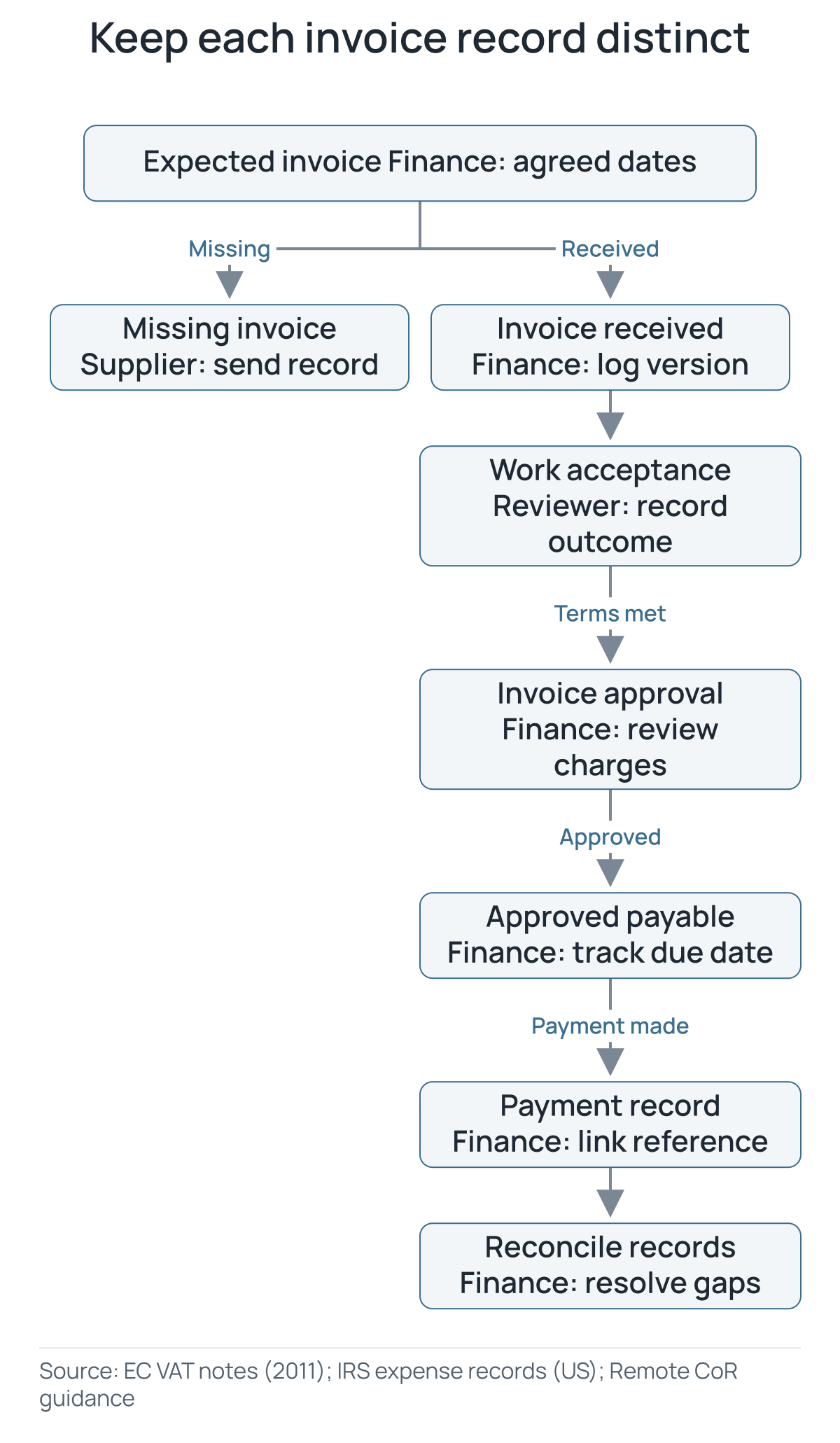
Proposed operating workflow: use the actual agreement and applicable invoice rules for dates and review conditions, and record the acceptance outcome and any contractual trigger with its conditions. Route missing invoices to the supplier; keep work acceptance, invoice approval and payment reconciliation as distinct records.
Route reminders to the person who can supply the missing record
Send a missing-invoice reminder to the supplier or authorized issuer with the agreement reference, relevant period and submission route. Say what is outstanding and how to complete that record. Choose reminder timing from the agreed billing window and processing requirements; there is no universal optimal interval.
If the invoice is present but delivery evidence is missing, ask the person responsible for that evidence. If a manager has yet to review completed work, assign the review to that manager. If approval is complete and payment remains outstanding, finance should investigate the payable and payment records. Another request for the invoice would add a duplicate without resolving the hold.
Close each follow-up when the requested event occurs and preserve the response. For an incomplete submission, retain the received file and identify the missing attachment or correction explicitly. The request should name the document or corrected field the supplier needs to provide.
Check identity, dates and charges before routing the invoice
Match the received invoice to the expected engagement and preserve its original version before asking a reviewer to approve it. Use a practical intake checklist alongside the legal requirements that apply to that supplier and transaction. A complete operational record and a legally sufficient invoice are related checks with different sources of requirements.
Keep the service date and invoice date distinct
The invoice issue date identifies when the document was issued. The service date or period identifies the work billed. For example, an invoice issued in October for September development services should retain both dates; a late submission should not rewrite when the service occurred.
Within its UK supplier scope, GOV.UK invoice guidance lists a unique identifier, supplier and customer details, service description, supply date, invoice date, amounts, applicable VAT and total owed. It also specifies additions for particular business forms. A UK customer alone does not make that list the legal checklist for an overseas supplier.
For your intake review, pair each field with the record that explains it:
- Identity: match issuer and customer to the agreement and supplier record. Route an entity mismatch for clarification.
- Reference and dates: retain the invoice identifier, issue date and relevant supply period; compare them with the expected record and delivery evidence.
- Scope: connect the description to the authorized service, milestone or work order. Include a purchase order reference when the engagement requires one.
- Charges: compare units, rates, currency and amounts with the agreed pricing and any approved change. Request the time records or expense backup necessary to explain the line.
- Tax treatment: check the relevant status and transaction rules with the person responsible for tax review. Preserve the basis for the treatment and any required invoice details.
- Payment terms: reference the agreed conditions and due-date basis, including any acceptance condition that actually applies.
Reference the agreement and preserve the received version
A description such as September support is insufficient for internal matching when the supplier has several engagements. Ask for the relevant agreement or work reference and identify the service covered. This is an operating recommendation; a purchase order or a particular project-reference field is not a universal statutory invoice requirement.
Save the received document, accompanying message or submission record, and attachments together. If a correction follows, preserve the relationship between versions rather than overwriting the file. Keep internal intake notes outside the original invoice so the supplier’s issued record remains identifiable.
The European Commission’s VAT invoicing overview distinguishes common EU rules from Member State rules. Record who owns that applicability check before accepting a PDF or portal template as the final invoice format. Once identity, scope and charges have a traceable basis, route the packet to the delivery reviewer and finance approver with any unresolved questions attached.
Match the billed work to a documented acceptance event
Have the delivery reviewer record whether the identified work meets the agreed conditions, then have finance connect that outcome to the billed charges. The reviewer needs the scope and output; finance needs the approved basis for the amount. A receipt acknowledgement establishes that something arrived, while acceptance records what happened under the agreement’s review terms.
Hourly and milestone work need different supporting evidence
For hourly work, match the billed period, activity and hours to the authorized work and rate. Keep the supporting time record and the relevant reviewer’s outcome. Where the agreement sets a cap or requires advance approval for extra work, attach that authorization before treating the additional hours as approved.
For milestones, identify the deliverable version and the conditions that trigger the charge. In an illustrative software engagement, the milestone might require a particular report export to pass agreed tests. A repository link to an unfinished branch provides delivery context; the reviewer still needs to identify the submitted release and record the result against those tests.
Use the same discipline for other charges:
- Expenses need the supporting receipt and the contractual or specific approval that makes them billable.
- Scope changes need the agreed amendment or authorization and the price basis.
- Partial deliveries need an outcome showing the accepted portion, outstanding issues and treatment permitted by the agreement.
The UK government’s 2025 Model Services Contract schedules for England and Wales provide a concrete design example. Schedule 9 links milestone payment to certification; Schedule 10 sets out agreed tests, success criteria, reports and re-testing; Schedule 11 includes time-and-material records summarized with invoices. This template is for complex public services, not a freelance-law requirement. Choose evidence that fits the payment mechanism: test results for a milestone, time records for hourly work and the required approval for expenses.
Record the result, version and acceptance trigger
Give the acceptance record enough detail to explain the decision later:
- Agreement, task or milestone reference and the applicable acceptance criteria.
- Delivered artifact, version and evidence location; for work outside the main system, a retrievable submission record.
- Reviewer identity and authority, review date and outcome.
- Open issues, any accepted portion and the next required action.
- The event or contractual provision that establishes acceptance or completion.
An affirmative reviewer decision is one possible trigger. Some agreements also provide for completion when a review period expires without a qualifying refusal, or for an enabled automatic acceptance mechanism. Check the actual conditions and retain evidence of delivery, the relevant period and any response. Do not substitute a finance cutoff for a contractual review period.
Task authorization before work starts and acceptance of the delivered result occur at different points. Preserve both where the engagement uses them. Finance should be able to establish that the billed service was authorized and that the relevant completion condition occurred.
Electronic evidence also needs the right legal context. The Law Commission’s summary for England and Wales says electronic execution depends on authentication intent and applicable formalities, which can arise from law or contract. An operational review log should identify its actor and event; whether it satisfies a particular execution requirement is a separate jurisdiction-specific question.
Keep incomplete or revised work visible
Record a refusal or correction request against the delivered version, with the criteria that remain unmet and the person responsible for the next review. Keep the earlier outcome when a revised artifact arrives. That history explains why acceptance occurred later and which version supports the invoice.
If only part of the work meets the conditions, identify the affected line or milestone and follow the agreement’s treatment of partial acceptance and payment. A reviewer’s concern about one deliverable should not become an unexplained hold on every charge. Finance should receive an actionable outcome: accepted basis, unresolved amount or condition, and the evidence needed to resolve it.
Resolve the mismatch while keeping the original record
Give each exception a reason, affected charge, owner and next action, and retain the invoice as received. The person who resolves the underlying issue should be identifiable: a supplier can correct the invoice; a delivery reviewer can decide whether work meets the scope; finance can resolve duplicate processing or a payment-record mismatch.
A correction must remain linked to the invoice it replaces
Separate the common exceptions before sending a request:
- Missing backup: specify the time record, expense receipt or delivery reference required.
- Rate or period mismatch: identify the agreement term and invoice line requiring clarification.
- Unapproved extra work: route the authorization question to the scope owner.
- Partial acceptance: preserve the accepted portion and open issue, then establish the permitted invoice treatment.
- Incorrect invoice details: request the appropriate correction from the authorized issuer.
For example, an invoice containing an unauthorized expense needs a named decision on that expense and a correction where required. Record which amount is affected and what happens to the remaining charge under the agreement and applicable rules. A pending label needs the affected amount, decision owner and next action.
For UK electronic VAT invoicing, HMRC Notice 700/63 requires correction documents to identify the original invoice and addresses controls against duplicate processing. Apply that traceability principle to the operating packet: store the original reference, correction or successor reference, reason, date and new review outcome. The form of correction, including whether a credit note is needed, depends on the actual rules and workflow.
Mark superseded or cancelled records clearly without deleting them. An approval associated with the first version should not silently become approval of a changed amount. Recheck the affected fields and preserve the decision for the document finance will process.
Duplicate flags need a documented review
Compare invoice identifiers alongside supplier and customer entities, currency, amount and service period or milestone. Repeated amounts can be legitimate recurring fees; different references can still relate to the same charge. Similarity is a reason to review the underlying relationship.
The IACRC guide to false, inflated and duplicate invoices lists repeated payments, dates, descriptions and identifiers among investigation indicators, and points to contracts, work-completion reports and payment records as evidence. It concerns fraud investigation in international development projects. A routine invoice match should use flags to prompt review without treating them as proof of fraud.
Document whether the match is a resend, a correction, a legitimate new period or an unresolved duplicate. Close the flag with its supporting references so the next payment run does not reopen the same ambiguity.
Changed payment instructions need a separate check
Verify changed instructions through an established contact before updating the supplier record or using them for payment. Where feasible, assign authorization of that change separately from entry of the invoice. This is an operating recommendation; HMRC’s electronic-invoicing controls include supplier-master authorization as an example, but the contact-check procedure here is a proposed control.
Keep the verification outcome attached to the supplier change. Approval of delivered work or invoice arithmetic does not establish that altered payment instructions are authorized.
Add the invoice rules that apply to the actual transaction
Assign a tax or legal owner to establish the applicable requirements for each engagement. Record the supplier’s jurisdiction and legal form, customer entity, service type, relevant tax status and any invoice-generation arrangement. These facts determine which rules need checking; the customer’s location or the platform’s template alone cannot answer every question.
Use UK invoice guidance within its supplier scope
For suppliers within the relevant UK rules, GOV.UK’s invoice checklist distinguishes common fields from business-form additions and applicable VAT information. Apply that guidance where it governs the supplier’s invoice, then check the additional treatment required for the transaction.
A UK company buying design work from an overseas independent business should therefore establish the overseas supplier’s applicable invoice requirements as well as its own records and tax treatment. It should not impose a UK supplier checklist merely because its accounts payable team is in the UK. Conversely, the team can request project references needed for internal matching without presenting those requests as foreign legal requirements.
Check the applicable EU country and electronic format
The European Commission explains that EU VAT invoicing combines common rules and national provisions, and that invoices are compulsory for most business-to-business transactions within the relevant VAT framework. Outsourcing invoice production and self-billing are available in some circumstances, subject to conditions.
For an EU-related transaction, the responsible reviewer should establish:
- Which jurisdiction’s invoicing rules apply to this supply and these parties.
- Whether the supplier’s status and service require a VAT invoice and what treatment applies.
- Whether the transaction requires a structured electronic invoice, a particular delivery route or an additional record.
- Whether generation by the customer or an intermediary is authorized and meets the applicable conditions.
- Who resolves an invoice or tax-treatment correction and preserves the replacement documents.
The Commission’s general overview is a starting point for applicability. Obtain the relevant national rules for the particular 2026 format or mandate; it does not supply a complete country-by-country implementation timetable. A readable PDF and a required structured invoice can have different roles in the same packet.
Keep tax records and signature formalities in their own checks
Tax records may require information beyond the invoice. For a US business expense, IRS recordkeeping guidance addresses substantiation through supporting documents. Keep the review of any withholding or supplier-status requirements with the responsible tax owner, based on the actual transaction. Invoice collection alone does not resolve those obligations.
For execution in England and Wales, the Law Commission’s electronic-execution summary retains the conditions of authentication intent and applicable formalities. Apply a separate check when a contract or law requires a particular signature or witness procedure. A portal review event can be useful evidence without satisfying every possible formality.
Complete the applicability record with the rule used, responsible reviewer, required document or format and unresolved question. Where an intermediary supplies one document and the individual supplier owes another, preserve both paths and obtain any transaction-specific additional record.
Follow one billing packet from submission to reconciliation
Keep one transaction reference across collection, delivery review, correction and payment. In this fictional direct engagement, all names, dates, amounts and terms are illustrative. They describe no company’s results or platform behavior and include no tax calculation.
A milestone invoice arrives with a delivery and review reference
A customer commissions a supplier to build a reporting module for USD 2,400. Agreement ENG-27 makes the charge contingent on acceptance against the listed export tests. Expenses require separate prior approval. The parties agree that the supplier will submit the invoice after acceptance, with payment due 15 days after receipt of a correct invoice.
The operating record develops as follows:
- Expected invoice: finance creates an entry for ENG-27 and the reporting-module milestone, naming the supplier as issuer and customer as recipient. The entry remains expected while review is outstanding; it is not yet an approved payable.
- Delivery: the supplier submits release v1 on 2 October. The packet stores its artifact location, submission message and test evidence.
- Review: on 4 October, the reviewer records that one export test fails and requests a revision. The hold belongs to work review. Finance avoids asking for an invoice that the agreed process places after acceptance.
- Acceptance: release v2 arrives on 6 October and the reviewer accepts it on 7 October against the agreed tests. Finance links the outcome to the milestone. If the invoice then remains missing beyond the agreed submission point, the supplier owns the next action.
- Submission: invoice INV-104 arrives on 8 October for USD 2,550, including an additional USD 150 expense. Intake links the invoice to ENG-27, release v2 and the acceptance event. Finance identifies that the expense lacks the prior approval required by this fictional agreement.
Receipt has occurred, work has been accepted and one invoice line remains unresolved. Keeping those facts separate gives finance a precise request: clarify or correct the USD 150 expense. It also preserves the accepted basis for the USD 2,400 milestone.
A corrected invoice returns to the same record chain
In this example, the parties resolve the expense by removing it. The supplier issues the correction documents appropriate to the engagement, linking corrected invoice INV-105 for USD 2,400 to INV-104. Finance retains both, records the reason, identifies the superseded charge and approves the corrected invoice. It applies the agreed due-date basis to the correct invoice’s recorded receipt date.
When the customer makes payment, finance attaches the payment reference and evidence to INV-105 and compares the amount and currency with the approved charge. If the payment record shows only USD 2,300 against the USD 2,400 charge, finance records a USD 100 unresolved difference and investigates it. A payment instruction or a settled label alone does not explain that difference or establish the supplier’s receipt.
Test the packet in reverse: from the payment, find INV-105, its approval, INV-104 and the correction, the acceptance of release v2 and ENG-27. Then start with ENG-27 and follow the same links forward. This proposed retrieval test applies the transaction-tracing principle in the European Commission’s 2011 explanatory VAT notes; the notes are nonbinding and do not prescribe this fictional packet.
For an hourly variation, replace the milestone test reference with the approved work-period record and rate authorization. Attach an expense receipt where the agreement permits reimbursement. The IRS’s US expense-record guidance recognizes that supporting information may require a combination of documents. Choose the documents that explain the actual charge, and keep the same correction and payment links.
Choose an implementation that preserves the document chain
Select the implementation around your contracting relationship, billing mechanism and retrieval needs. A direct agreement with controlled intake remains a valid option. A platform can organize specific events and documents, but the team still needs to understand its contract terms and how those events map to work, charges and payment.
4dev.com
4dev.com’s Master Services Agreement (MSA) illustrates an intermediary model. Read that customer agreement alongside its separate Service Agreement (SA) for the individual service supplier; the defined party names differ between them.
- Document model: under the MSA, the customer-facing invoice is issued in the name of the contracted entity or permitted assignee (§5.1). The intermediary has its own obligation to the individual subcontractor (§1.5). Under the SA, the individual contractor invoices the named Company and authorizes generation on their behalf (§5.1). Direct delivery communication does not merge those obligations.
- Work records: MSA §§3.3–3.6 address delivery, evidence for delivery through external resources, review and completion. The completion triggers include the client accepting the services and deliverables through the platform; expiry of the task’s review period without the client submitting a refusal and list of deficiencies; the client and subcontractor completing the task and mutually agreeing the remuneration; or resolution of their dispute through the MSA’s Arbitration procedure, whose resolution binds them only with both parties’ consent (§4.4). A final competent-court resolution becoming enforceable is another trigger if Arbitration has not resolved the dispute. Automatic acceptance requires the subcontractor to complete the task with the client’s automatic-acceptance option enabled. Apply the trigger that governs the task and preserve its supporting record.
- Completed-task documents: SA §3.7 provides for reference reports and acceptance certificates in the contractor’s account no later than 10 days after the Task Completion Date. This is a contractual document obligation with a specified account and timing; organize the customer’s packet around the records belonging to its own relationship.
- Application: SA §5.6 recognizes additional invoices or receipts required by the law applicable to the contractor, and §5.1 provides for invoice corrections. Use the intermediary and individual paths when locating these records. 4dev.com serves contractor arrangements; employee payroll and employer-of-record arrangements require a different product category.
For a task delivered outside the platform, the MSA’s delivery-evidence provisions give a concrete reason to keep proof of delivery alongside the task reference. Identify the resulting completion event before matching the customer invoice to the work.
Deel
Deel also documents invoice and work-approval workflows. Its contractor invoice guide and work-submission guide distinguish contract types, so the collection team should select the flow actually used by the engagement.
- Billing mechanism: fixed-contract invoices are generated automatically. Pay-as-you-go work involves hours submission subject to permissions; milestone invoicing follows completion and client approval. Fixed contractors do not need to manually submit work under the documented fixed-contract flow.
- Corrections: the invoice guide describes a replacement invoice and credit note cancelling the original finalized invoice. Custom invoices replace the generated template in the described workflow. Milestone contracts do not support the invoice adjustments described for other types.
- Cycle boundary: for the documented pay-as-you-go flow, work submitted after cycle end enters the following cycle. Record that product processing rule alongside the engagement’s service period and payment terms.
For example, a late hours submission needs the appropriate cycle treatment and supporting time record. A milestone invoice needs the relevant completion and approval evidence. Map these invoice and work-approval events to your collection and review records for the applicable contract type.
Remote
Remote’s invoice-scheduling guidance describes bulk one-time schedules for active Contractor of Record engagements. Contractors accept the schedule and upload their invoice PDF; a draft appears on the invoice date and Remote reviews the invoice within the described flow.
- Receipt versus review: the schedule reaches Completed when the PDF is uploaded even while invoice approval remains in progress. Treat that schedule event as the submission event it records.
- Application: match the uploaded document to the work and approval record. For example, a completed schedule with an invoice awaiting review should be assigned to the review owner; another missing-invoice reminder would address the wrong event.
This schedule event belongs to the documented Contractor of Record flow. Determine the applicable approval conditions; a manual action is not established as a requirement for every invoice.
Pilot the records with the people who will use them
Test one representative submission, correction and retrieval before relying on routine reminders. Have a supplier and reviewer perform their actual steps, then ask finance to recover the packet from a payment reference. Test the access and export or restore procedures the chosen implementation actually provides.
The 2021 HMRC/Kantar qualitative study of Making Tax Digital for VAT used 60 in-depth telephone interviews with small UK businesses required to use MTD for VAT. Respondents reported mixed experiences, including routine software use and reminders, while some users lacking confidence continued spreadsheet checks. The purposive sample, self-reports and COVID-era context limit transfer to international contractor operations; the study establishes neither causal savings nor a preferred reminder cadence.
Use the pilot to identify training needs and clarify the event each user records. Route reminders using the missing record and its owner.
Close the period with an evidence trail you can retrieve
Reconcile the collection register with work outcomes, approved charges and payment records before closing the operating period. Give unresolved items an owner and carry-forward action. This review organizes the evidence for accounting decisions; recognition and tax treatment still depend on the applicable rules and your accounting policy.
Separate delivered, accepted, invoiced and settled items
Review the following populations separately:
- Expected but missing invoice: establish whether billing should already have occurred and send the issuer the relevant document request.
- Delivered work awaiting review: route the artifact and criteria to the reviewer, retaining the submission date.
- Accepted work without an invoice: identify the accepted basis and responsible invoice issuer; record why billing remains outstanding.
- Approved invoice awaiting payment: check the agreed due date and payment action, preserving the approval reference.
- Disputed charge or incomplete packet: retain the affected amount or condition, decision owner and next action.
- Recorded payment awaiting reconciliation: match the payment evidence to the approved invoice, identify remaining differences and establish what the evidence says about settlement or receipt.
A missing document and a cash obligation can coexist. For example, if accepted work remains unbilled at the cutoff, the collection owner should request the invoice while the accounting owner assesses the treatment of that work. Keeping the exception visible avoids treating an empty invoice folder as proof that nothing happened.
Preserve the original amount and currency alongside the payment amount and currency. Attach any documented deductions or conversion details relevant to the transaction and investigate unexplained differences. An internal paid status should refer to evidence of the event recorded; supplier receipt may require additional confirmation when it remains in question.
Test retrieval from the payment back to the work
Use a sample transaction to recover the agreement, authorized scope, delivery, acceptance, invoice, correction history, charge approval and payment record. Start from both ends. An original that has been overwritten or a private delivery link that the reviewer can no longer access creates a concrete retrieval defect to resolve.
This proposed test develops the bidirectional transaction trail described in the European Commission’s nonbinding 2011 VAT explanatory notes. For UK electronic VAT invoices, HMRC Notice 700/63 addresses audit trails, recovery and retrieval of original issued or received information. Preserve the historical details needed to explain the transaction, including versions that today’s screen view may no longer show.
Assign a record owner and restrict access according to the work each person performs. Test any supported export and restore procedure with corrections and attachments included. Document what was recovered, which link failed and who will fix it. Confirm these controls through a test of the chosen implementation; the recommendation establishes no platform export capability.
Set retention rules by record category and jurisdiction
Tie retention to the applicable record type, legal entity and clock. For UK limited companies, GOV.UK requires records for six years from the end of the last company financial year they relate to, with longer periods for specified situations such as transactions spanning periods, enduring assets, late returns or an HMRC check.
For US federal tax records, the IRS ties retention to the relevant income-tax limitation period, ordinarily measured after return filing, with longer or indefinite exceptions. It also advises considering longer requirements for other purposes. These rules have different clocks; neither provides a worldwide invoice-deletion date.
Record the applicable period, its starting event, category owner and any legal, audit or dispute hold. A linked packet should remain retrievable for the required period even when a contract ends or a reviewer leaves the team. Close the operating exception only when its outcome and supporting records can be explained.
Questions that arise during invoice collection
Can finance generate an invoice on the contractor’s behalf?
Only use an authorized arrangement that meets the applicable invoicing rules. Establish the issuer and recipient and preserve the authorization; preparation by finance does not change the underlying parties. The European Commission describes self-billing and outsourced invoice production as conditional arrangements. For an intermediary engagement, check both the customer agreement and the individual supplier agreement before deciding which invoice finance may produce.
Does a completed invoice schedule mean the invoice is approved?
Read the event definition. In Remote’s documented bulk one-time scheduling flow for active Contractor of Record engagements, Completed occurs when the contractor uploads the PDF while invoice approval remains in progress. Track the approval outcome separately before treating the charge as an approved payable.
Is a separate acceptance certificate always required?
The required record depends on the agreement and applicable law. Use the completion or acceptance evidence those terms call for. The England/Wales Model Services Contract template illustrates milestone certification for complex public services; that example does not establish a global certificate requirement for freelancers. A delivery record, acceptance outcome and invoice retain different evidentiary roles even when one system stores them together.
What should happen to an invoice received after the cutoff?
Log the actual receipt date, preserve the service period and establish its processing and payment treatment under the agreement. Tell the supplier the resulting next action. Product cycle rules can also matter: Deel’s documented pay-as-you-go flow moves work submitted after cycle end into the following cycle. Apply the rule for the actual contract type and keep an internal cutoff distinct from agreed payment obligations.