Best platforms for international contractor mass payments in 2026

Key takeaways
- These recommendations cover independent contractors. Employee hiring and salary administration require the appropriate Employer of Record (EOR) or payroll product; 4dev.com serves contractor operations.
- 4dev.com is the first recommendation for digital-product teams connecting tasks, accepted deliverables, completion documents and batch operations. Deel and RemotePass also connect approved work, invoices and payments. The order reflects that operating priority.
- The five choices serve different priorities. Deel suits potential employee transitions; RemotePass suits configurable approvals and finance exports; Tipalti suits accounts payable (AP) and enterprise resource planning (ERP) workflows; Rise suits fiat or stablecoin treasury funding.
- Compare the company’s service bill with the contractor’s usable receipt. Subscription or platform pricing alone leaves conversion and route costs unresolved.
- Retain unsuccessful attempts and assign their correction owner. A completed batch total leaves finance with unanswered questions about rejected or unmatched items.
Choose a platform around the work and records you need
International contractor mass payments combine several payment items in one operational run. Each item still belongs to a particular contractor, approved obligation, amount and payment outcome. Choose around how your company approves the obligation and accounts for the outcome.
Contractor payments and employee payroll require different products
Start with the working relationship. An independent-contractor workflow manages agreements, work approval, invoices and payment. Employee administration brings a different employment and payroll scope. When a provider offers both, check the responsibilities of the specific service you are buying.
Deel and RemotePass are relevant when a company expects a mixture of contractors and employees or a later employment transition. Their contractor subscriptions should be evaluated on their own terms. An employee conversion calls for a separate product decision. A contract template or successful transfer alone cannot establish the appropriate legal classification of the relationship.
Check the direction of money. A gateway collects customer payments for an inbound commerce transaction. Contractor operations begin with an outbound obligation that someone in the company must approve. A procurement shortlist should follow that obligation through release and accounting, including its supporting work records.
A batch is one instruction with several payment outcomes
Consider a hypothetical product team paying a developer for a completed milestone and a designer for recurring work. Both items might enter the same run. The designer’s item can complete while the developer’s needs correction. Finance must still explain each result against the relevant invoice.
Recurring manual work becomes a reason to consider a platform when staff repeatedly rebuild this connection: chase approvals, copy amounts between systems, update payment status and collect completion evidence. Count the repeated work as well as the contractors. A small team with variable milestones and several receipt routes may have more review work than a larger team with stable monthly invoices.
Assess contracted-work records first, then the controls around the run, then cost and receipt. Keep a rejected-item example in every demonstration. A successful transfer shows little about the work required when an item fails.
The recommendation order follows a disclosed use case
4dev.com leads this shortlist for digital-product teams that want task acceptance and completion documents connected to contractor operations. Deel and RemotePass also describe approved-work and invoicing workflows; both deserve consideration under the same criteria.
The remaining choices follow different priorities. Deel combines contractor administration with separate employee options. RemotePass has documented approval behavior and report exports. Tipalti brings a finance emphasis on payee onboarding and payment reconciliation. Rise separates treasury funding choices from contractor withdrawal preferences.
Read the order as a recommendation for a particular operating model. Your final choice depends on the work trail, authorization policy and accounting result the quoted product can demonstrate.
4dev.com
4dev.com is the first recommendation for a digital-product team that needs agreed tasks, deliverable review and completion documents in its contractor workflow. Its agreement connects that work to invoicing and task-specific rights provisions.
- Work records: Its Service Agreement, effective September 17, 2026, defines Company as Fourdev LLC, the contracting entity, and separately identifies the buyer as the Client. The Client submits the task; acceptance binds the contractor and Fourdev LLC. Changing an accepted task requires contractor consent. Upon completion, the contractor’s invoice is issued to Fourdev LLC or its permitted assignee; the contractor authorizes automatic generation on their behalf. Reference reports and acceptance certificates become available no later than ten days after the Task Completion Date. A finance team should therefore schedule document collection separately from the initial acceptance of a task.
- Rights review: For software and design work, task terms also matter to the rights being acquired. The agreement provides a default assignment to the client effective upon creation, no later than completion, while permitting a task to specify retained contractor rights. Third-party components require prior client consent. Review the deliverable and its agreed rights together. The legal result still depends on the project and applicable terms.
- Batch and integration: Mass payments are part of the base functionality. An application programming interface (API) connects the platform with internal systems; access and documentation are supplied through the personal manager. Advertised automation includes task and payment-data handoffs, prepaid-balance threshold alerts, retrieval of completed or cancelled tasks, and task or receivable events. The advertised use of the company’s own reference IDs provides a starting point for matching records with its existing systems; test the actual mapping in a sample export.
- Price and receipt boundary: As of October 10, 2026, the customer platform fee is 3% or less, dependent on monthly volume, with no subscription. This service price needs its own line in a cost comparison. Correspondent and receiving institutions can deduct charges from the contractor’s amount under the agreement; a service fee does not determine final receipt.
- Example and pilot decision: For a hypothetical studio commissioning a completed interface design, the useful trial follows the agreed task, accepted deliverable, invoice and certificate into the finance record and then follows the payment outcome. Trace an exception too. Check which records survive a failed or changed payment, who corrects it and how the next attempt relates to the invoice. Apply this test across the shortlist. 4dev.com serves contractor operations; employee hiring and payroll require another product.
Deel
Deel suits a company that needs contractor contracts, approved-work invoicing and bulk payment, with a possible employee transition ahead. Its contractor offer covers much of the same work-to-invoice workflow as the first recommendation.
- Work records: Deel describes local contractor contracts and different invoicing paths. Fixed-rate invoices follow the contract terms automatically. Pay-as-you-go and milestone invoices follow submitted and approved work. Earnings and expenses can then be approved before the company makes a single bulk payment. Contractors choose among supported receipt methods.
- Example: That distinction between contract types matters in a real purchasing decision. For a hypothetical engineer working toward milestones, finance needs the particular milestone approval attached to the invoice. For someone on a fixed monthly contract, it needs the contract terms and any approved adjustment. The reviewer should be able to explain why each item is payable, including why another item remains held.
- Price and receipt boundary: As of October 10, 2026, the standard contractor-management offer is $49 per contractor per month. Contractor of Record and employee EOR services have separate commercial scope. The contractor subscription should appear in the company-cost comparison alongside the applicable transfer, conversion and recipient charges established in the buyer’s quote. It does not establish the amount every contractor ultimately receives.
- Workforce scope: Deel’s employee options make it relevant when a contractor relationship is expected to change. The company should reassess the employment arrangement and the corresponding service terms at that point. Confirm the employer responsibilities in the employee service terms before making the transition.
- Pilot decision: Before selection, request exported finance records tracing a milestone item and a rejected payment. Check who authorizes correction, how the original approval remains recoverable and what confirms the recipient’s outcome. Recovery fields and approval history remain questions for the demonstration. Choose Deel when contractor administration and a possible workforce change both belong in the operating plan.
RemotePass
RemotePass suits teams whose purchase depends on approval routing and finance exports. It combines contractor onboarding, contracts, invoices and submitted work with documented rules for unfinished approvals.
- Batch and work records: For a mass payment, the documented sequence starts in Activity, then Payments Due: select the payments to include and choose a funding method. The contractor product also describes fixed, pay-as-you-go and milestone arrangements, monthly invoices, cost centers, and bulk additions or deductions. Review additions and deductions alongside the obligation they change.
- Approval controls: Choose the approval configuration deliberately. Under the default arrangement, any assigned approver can approve. Custom flows support up to five sequential approvers across expenses, invoices, work or timesheets, and payments. A configured final approver can override the sequence, and administrators can override it too. Changing a flow resets unfinished approvals; deleting it restores the default approval behavior. Removing a deactivated approver changes the remaining sequence.
- Example: Consider a hypothetical company requiring project approval followed by finance release. It needs to decide who may use an administrator override and who owns a flow edit during close. Test both with unfinished items, because the configured sequence can change before final release.
- Finance records: RemotePass documents CSV or Excel exports for contractor invoices, expense approval statuses, account transactions and submitted work. It also advertises Xero, QuickBooks and NetSuite integrations. Request a representative export showing which references connect the reports and how changed approvals appear. Separate report categories may still require finance to maintain a cross-reference.
- Price and receipt boundary: Pricing needs written clarification. As of October 10, 2026, RemotePass advertises $39 per contractor per month, but its billing descriptions contain inconsistent annual and monthly wording. Use that figure as a headline pending a quote that fixes commitment and billing cadence. Separately, Instant Card Payout has a recipient charge of 2%, with a $5 minimum fee and $15 maximum fee, for eligible routes.
- Workforce scope and pilot decision: Separate EOR and local payroll offers serve employee arrangements. For the contractor comparison, RemotePass’s strongest case is configurable approvals paired with finance reporting. Follow a changed approval and a payment exception through the records before choosing. Include the quoted subscription and chosen withdrawal route in the same assessment.
Tipalti
Tipalti fits a finance department whose contractor payments belong inside payee onboarding, tax-information collection and ERP reconciliation. Its reconciliation offering covers attempted and executed payments, a useful distinction when finance investigates a failed item.
- Onboarding and work records: The Mass Payments product describes a payee portal for onboarding, payment information and tax information, with payment approval workflows and accounting integrations. These controls address the payable and its recipient. A company commissioning software or design still needs its own evidence of accepted work and the relevant rights agreement; an AP entry alone cannot establish those facts.
- Finance records: Tipalti’s reconciliation offering describes matching, alerts for unmatched entries, Excel reporting and synchronization of payment results with ERP or accounting systems. The coverage of attempted payments is particularly useful when the bank movement, payable and supplier status disagree. Confirm the required reconciliation features in the Mass Payments quote. Tipalti advertises them under AP automation, and the quote must establish the included modules and configuration.
- Correction controls: The rejected-payment policy gives the buyer a concrete exception to examine. Tipalti does not automatically reattempt rejected payments. The payee remains unpayable until payment-method details are changed in the supplier portal. Payments also require funding. Supplier correction, funding readiness and renewed release therefore need explicit owners in the company’s procedure.
- Price and receipt boundary: As of October 10, 2026, Mass Payments starts at $249 per month, with additional payment transaction pricing. Standard implementation is included; complex environments can require additional services. Tipalti’s separate Accounts Payable starting price of $99 per month belongs to another offer. Request the payment, entity, currency and module assumptions behind the proposed price before estimating a recurring total.
- Example and pilot decision: In a hypothetical finance pilot, release one normal invoice, follow one rejection through supplier correction, then inspect the accounting result of both attempts. Decide whether the available reports and integration meet the close procedure you need. Tipalti is a particularly relevant option when that finance evidence carries more weight than task administration; employment and digital-deliverable rights remain separate procurement questions.
Rise
Rise is relevant when the treasury team wants fiat or stablecoin funding while contractors choose their own supported withdrawal routes. The company can choose its funding asset separately from the contractor’s receipt method.
- Funding and receipt: Its hybrid product describes company funding in USD, USDC or USDT, with contractors independently choosing fiat or crypto withdrawal. The company’s funding asset therefore does not dictate every recipient’s final receipt method. Each participant’s eligibility and chosen route still belong in the operating plan.
- Work records and example: Rise also describes invoices for work and expenses and one-time, recurring or milestone payment schedules. A milestone schedule can connect a payment decision to approved work; a recurring schedule handles a different contractual rhythm. For a hypothetical team with recurring design work and a milestone development contract, compare how each invoice becomes due and how an adjustment changes the scheduled item.
- Price and product scope: As of October 10, 2026, the Global Contractor tier costs $49 per contractor per month and includes contractor contracts. Agent of Record and EOR are separately priced services. Confirm which hybrid funding and scheduling capabilities belong to the quoted contractor offer. The subscription figure alone leaves funding, conversion, network and withdrawal costs unresolved.
- Pilot decision: Follow a funded invoice through the selected contractor withdrawal and retain evidence of the outcome. Add a failed item to the demonstration to establish the correction and authorization path. Confirm each participant’s asset and route eligibility. Request the failed-item procedure and route-specific receipt terms; the funding choices alone leave these unresolved.
- Workforce scope: Although Rise uses payroll terminology for its hybrid product, this comparison concerns its contractor workflow. Employee hiring and salary administration require the corresponding product and terms. Choose Rise when its treasury and recipient choices fit the actual participants, then judge the finance trail and charge allocation under the same pilot used for the other candidates.
Keep work approval and completion records distinct
Record the agreement, approval of work and availability of completion documents as separate events. Finance can then explain why an invoice entered a run and which supporting records still need to be collected for close.
Record acceptance, completion and document availability separately
An accepted task establishes the agreed obligation. Deliverable review establishes what happened to the submitted work. Completion and the availability of its documents follow the particular contract and workflow. A single date hides the difference between an unfinished review and a document still due.
4dev.com’s agreement makes the distinction concrete. Its completion provisions include acceptance of deliverables, expiry of a review period without refusal, negotiated completion or fee resolution, arbitration, and enforceable court resolution. Reference reports and certificates are available within ten days after the Task Completion Date. For a hypothetical task completing just before month end, finance should record completion and track the certificate’s subsequent availability, then apply its accounting policy to the available evidence.
Deel’s milestone and pay-as-you-go invoicing follows submitted and approved work; its fixed-rate invoicing follows contract terms. RemotePass also describes work, invoice and expense approvals. Ask how each invoicing trigger remains connected to the payable in the records finance receives.
Keep the contract or task reference, approved work reference, invoice reference and payment item connected in the company’s records. The platform may use several identifiers. Test the mapping with an actual sample export and define which system holds the authoritative approval. A manually maintained cross-reference can be useful during a pilot, but its recurring maintenance belongs in the effort measurement.
The February 2026 payment-data guidance from the Committee on Payments and Market Infrastructures (CPMI) emphasizes unique payment references and remittance information for reconciliation. Its scope is payment messages. Use that principle when requesting a work-to-invoice mapping. Test each platform’s identifiers separately.
Resolve rights scope before approving digital deliverables
For a hypothetical software module, approval should address the requested deliverable and the rights needed to use it. A reusable contractor component or third-party asset changes that question. Record consent and any retained rights alongside the task before the reviewer treats the item as fully accepted.
Under 4dev.com’s agreement, the default assignment can be changed by the task, and third-party components require prior client consent. That makes the task specification consequential. Other contract workflows should receive the same review against their actual terms.
The practical close record answers two different questions: why the company owes this amount, and what work or rights the obligation covers. Payment confirmation answers a further question about execution. Retain those connections so a later reviewer can follow the obligation without reconstructing it from messages.
Authorize the payment run with the right controls
A payment run should have a visible basis for each included item and a named person responsible for release. Work approval, changes to amounts and treasury authorization need to follow the company’s chosen policy through the actual system behavior.
Approve work, adjustments and payment release at separate steps
For a hypothetical recurring cycle, begin with the due obligations. The work reviewer checks a milestone or the applicable contract terms. Finance checks the invoice and any expense, addition or deduction. Treasury checks funding readiness and authorizes the selected run. A small company may assign several of these responsibilities to one person; it should still retain the reason for each decision.
Capture changes before final release. If an invoice includes an approved expense, keep the expense evidence and approval connected to the amount. If work remains disputed, assign someone to resolve it and record why the item is held. Review the due-payment list before turning it into the final instruction. An amount by itself leaves the approval decision unexplained.
RemotePass illustrates why configuration matters. Its default approval accepts any assigned approver, while sequential flows specify an order. Administrators and configured final approvers have override powers, and edits reset unfinished approvals. A company requiring both project and finance approval should test these permissions with the roles it plans to assign. Include a flow change in the trial, so the reset and renewed approval are visible before a live close depends on them.
Choose dashboard, file upload or API entry for the recurring cycle
The input method should match the source of payable information. A dashboard can suit a cycle reviewed item by item. A file workflow is useful when a finance system already produces the instruction. API entry suits recurring handoffs between internal records and the provider. Establish which methods the quoted product supports and where validation occurs.
4dev.com advertises task and payment-data handoffs, prepaid-balance alerts, completed or cancelled task retrieval, and task or receivable events. Map each handoff to an event in the company’s own cycle. API access and documentation come through its personal manager. Define what your system does when a status event arrives late or a task is cancelled, without assuming an event itself grants release authority.
Before adopting an input path, ask the provider to demonstrate the applicable batch limits, handling of repeated submissions and treatment of a partly releasable run. Request results from the configuration you will use. Batch capacity and API availability alone leave repeated submissions and partly releasable runs unresolved.
Keep changed and disputed items visible
Retain the original amount, the approved change and the resulting payment item. Specify who can alter recipient information and whether that change triggers renewed review. Confirm the behavior with representative records rather than assuming every amendment follows the same rule.
The CPMI’s April 2024 recommendations for cross-border payment arrangements call for assigned responsibilities in ordinary processing and exception handling. They address payment-service providers and operators, with end-user contracts outside their scope. A buyer can adapt the principle by recording who owns a held item, a funding shortage and a correction. Release the run when its included items and remaining holds can both be explained.
Compare the company bill with the contractor’s receipt
Compare costs on two records: what the company pays for the cycle and what the contractor receives through the chosen route. The gap between them needs an explanation before the company promises a net amount or chooses a provider on price.
Use the same amount, frequency and currency assumptions
Give each candidate the same contractor roster, invoiced amounts, payment frequency and currencies. Include the intended funding method and recipient method for every representative route. Identify the commercial unit for every charge: a contractor-month, usage-based service fee or payment transaction.
As of October 10, 2026, the relevant published starting points are:
- 4dev.com: 3% or less, volume-dependent, with no subscription. This is the service fee; recipient institution deductions remain possible.
- Deel: $49 per contractor per month for standard contractor management. Contractor of Record and employee offers are separate; obtain route terms for receipt costs.
- RemotePass: $39 per contractor per month advertised. Confirm billing cadence and commitment in writing.
- Tipalti: Mass Payments starts at $249 per month, plus payment transaction pricing. Modules, entities, routes and implementation scope affect the proposal.
- Rise: $49 per contractor per month for Global Contractor. Confirm hybrid-feature entitlement and funding and withdrawal charges.
Use these figures as separate service-price lines, then build the route costs around the same assumptions. Ask how inactive contractors, changes in volume, additional entities and different payment frequencies affect the quoted recurring bill.
Separate service charges, conversion and route deductions
Use distinct quote fields for the company service charge, funding cost, transfer charge, currency conversion and recipient deductions. Mark whether each is fixed, quoted, variable or dependent on the selected route. Record who bears it and when the amount becomes known.
For bank transfers, 4dev.com’s contractor agreement assigns fees charged by Fourdev LLC’s own bank or payment service providers to Fourdev LLC, the defined Company. It permits correspondent-bank or contractor-bank/payment-institution deductions from the amount payable to the contractor, including where a transaction is unsuccessful. Obtain the buyer Client’s platform and funding costs from its own quote and terms. Keep those charges separate from the contractor’s final receipt calculation.
RemotePass’s Instant Card Payout fee belongs to the recipient withdrawal route: 2%, subject to the published $5 minimum and $15 maximum fee. It is a different cost category from the contractor subscription. Compare the actual route that the contractor plans to use.
Under the CPMI’s updated February 2026 guidance, the first intermediary need not collect every downstream fee before initiation to meet the charges requirement. A quote should distinguish amounts established in advance from charges evidenced later.
Pair each quote with timing and receipt information
Ask for the quoted delivery stage, timing assumptions and evidence of final receipt alongside costs. The Financial Stability Board (FSB) 2025 cross-border payment report found speed information for 44.8% of its March 2025 sampled business-to-person services that were cost-transparent. This historical result covers the report’s cost-transparent service sample. It supplies a reason to request timing alongside cost; it says nothing about the disclosure practices of the shortlisted vendors.
Choose using both the company bill and the recipient outcome in your proposal. Leave unresolved charges visible until the provider explains their basis; filling the gap with a subscription figure produces a misleading comparison.
Confirm when each contractor can use the payment
Evaluate receipt for the actual payer, contractor, currency and method together. A platform’s international reach leaves route eligibility and the final availability of funds as separate questions.
Check the payer, recipient, currency and method together
For each representative contractor, record the paying company’s entity, the recipient’s location, invoice currency, funding method and intended receipt route. Ask the provider to confirm that combination under the quoted service. Repeat the check when an entity, recipient location or withdrawal preference changes.
For a hypothetical contractor choosing between bank transfer and wallet receipt, ask what must happen after the platform credits a balance. Check account or wallet access, onboarding, any withdrawal step and the final currency the contractor can use. Include those steps in the pilot. The company’s funding currency, the agreed invoice currency and the receipt currency may differ; identify each conversion and who bears its charge in the quote.
RemotePass’s Instant Card Payout illustrates the narrower scope of a route. Its supported list includes Armenia in AMD or USD and Kazakhstan in KZT or USD, with Visa and Mastercard eligibility, card verification and contracted-entity restrictions. Check that specific route against the participant’s circumstances, including the contracted entity. A country count leaves these conditions unresolved.
Rise illustrates a different distinction: company funding in a stablecoin can coexist with a contractor’s supported fiat withdrawal. Treasury funding and withdrawal are separate decisions. The contractor’s selected method belongs in the cost and timing assessment even where the company’s funding choice stays constant.
Separate execution, account credit and final receipt
Record what each timestamp actually represents. Funding the provider, executing an item, crediting a platform balance and making funds usable through the recipient’s chosen method can happen at different stages. Match the completed instruction to the promised delivery stage.
The FSB’s 2025 report provides useful historical context. For March 2025 sampled business-to-person services with speed data, using a $5,000 scenario, 3.5% advertised delivery within one hour and 44.3% within one business day. The one-hour threshold sits within the one-business-day threshold. The figures cover advertised services, excluding remittances, and use the speed-data sample as their denominator. They describe March 2025 service offers, without measuring executed transactions or these five platforms’ 2026 performance.
Read a speed claim against the event it describes. RemotePass qualifies its card route’s usual few-second timing with beneficiary-bank processing, while initial card verification can take hours. Tipalti identifies payment method, currency conversion and the payee’s banking system as processing dependencies. Neither description guarantees a common receipt time for every item in a run.
Ask which party can investigate when execution is recorded but usable receipt remains unresolved. Keep its support route and the required evidence with the item. Set your contractor communication around the stage the provider can substantiate, then record final receipt separately when the selected method requires a further step.
Reconcile attempted payments as well as completed ones
Keep every payment attempt connected to its approved obligation, including attempts that fail or remain unmatched. Finance needs to explain the payable, the money movement and the next action for each item at close.
Preserve the original approval through rejected-item correction
Use a representative approved invoice as the starting point. In the proposed procedure below, finance retains its work reference, approval, authorized amount and payment item. It then records the attempt and its result. A matched result moves into the accounting record; an unresolved result gets an owner and a correction history. Test this procedure in the provider’s demonstration using its own statuses and identifiers.
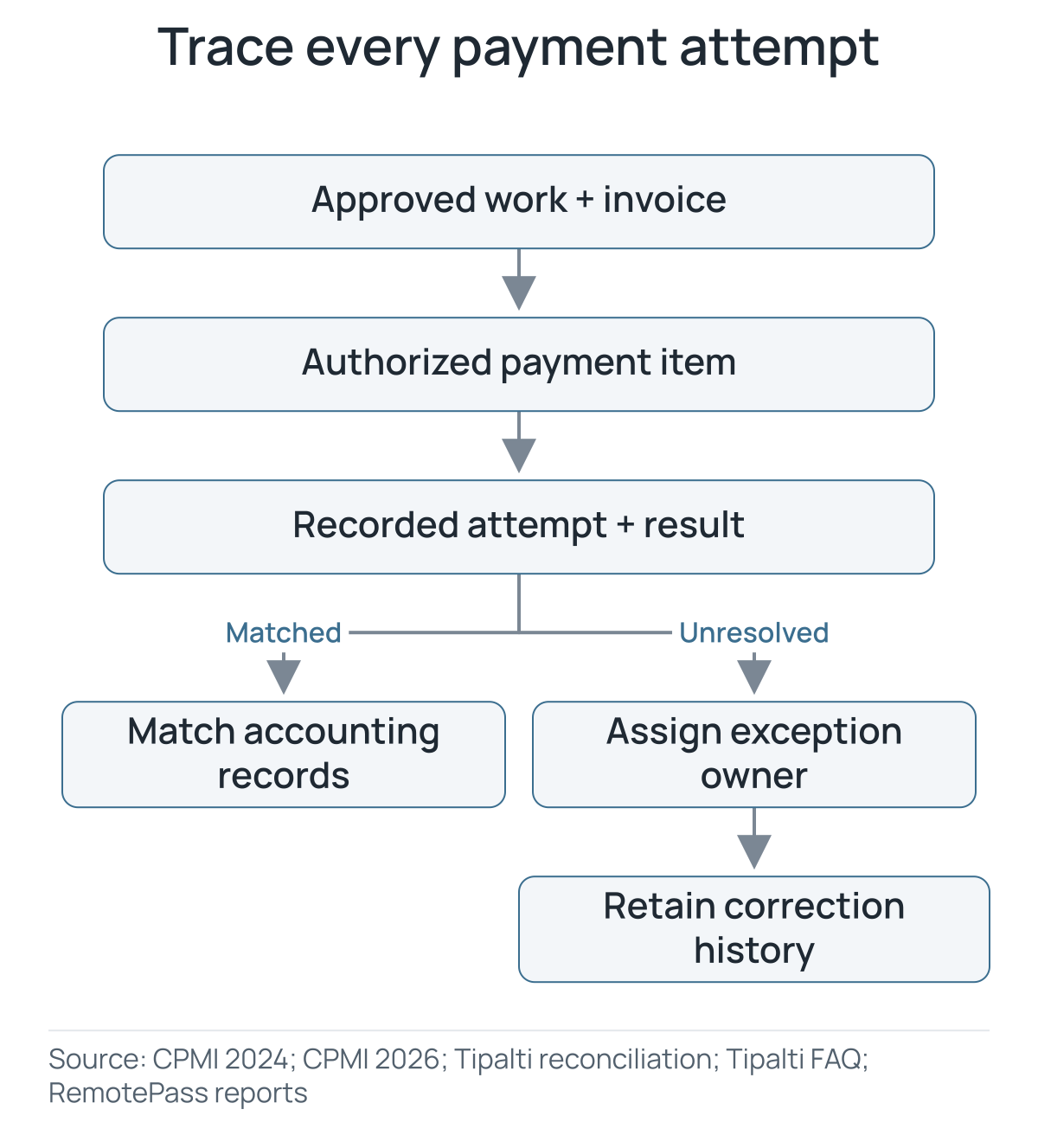
Proposed buyer procedure adapted from CPMI guidance of April 2024 and February 2026 and documented vendor reporting. Test reference continuity and exception ownership in a demo; the diagram does not establish a shared vendor schema or automatic retry.
Consider a hypothetical rejected contractor payment. The work has been approved and the invoice remains part of the finance trail. Record the reason provided for the rejection and identify the person who can obtain the required correction. When the item is ready for release again, keep the original authorization accessible and document any renewed decision. A replacement attempt should have an identifiable relationship to the earlier attempt.
Tipalti’s published policy makes this distinction operational: it does not automatically reattempt rejected payments, and the payee stays unpayable until payment-method details change in the supplier portal. The company must also meet the funding requirement. Supplier correction alone leaves renewed release and accounting treatment to be resolved in the buyer’s procedure.
Request sample records showing the earlier attempt, any refund or deduction, and the corrected instruction’s link to the same invoice. Keep unresolved movements visible too. A payment-success screen alone leaves that history unexplained.
Assign an owner to unmatched and pending items
Separate the work dispute from the payment exception. A project reviewer owns the question of whether a deliverable meets the agreement. Finance owns the invoice and accounting decision. Recipient correction and provider investigation may involve additional people. Assign the next action explicitly, including when the case should be escalated.
Tipalti advertises attempted and executed payment reporting, unmatched-entry alerts and accounting synchronization. RemotePass documents work, invoice, expense-status and transaction exports. Use those categories to plan the demonstration. Confirm the included product features and inspect the references linking the records. Test recovery separately.
The CPMI’s April 2024 guidance recommends defined exception responsibilities and status communication in payment arrangements. Its February 2026 payment-data guidance emphasizes references, timestamps and remittance information. Use these principles to specify the records and responsibilities you request. The demonstration must establish how the vendor implements them.
At close, produce a list of unresolved items with the original obligation, latest outcome, assigned owner and next action. Retain the same trail for resolved exceptions. Finance should be able to explain the successful payment and the remaining action on the failed attempt from those records.
Assign reporting and access responsibilities explicitly
Separate identity onboarding, tax-information collection, filing responsibilities and access control in procurement. Assign each duty to the provider, paying company or contractor under the chosen service.
Payment execution does not settle tax-reporting duties
Tipalti describes payee tax-information collection and related tools. Contractor products also have agreements and onboarding records. Establish which information the provider collects, who reviews it and which party submits any applicable report under the chosen service. Keep the relevant jurisdiction and legal entity attached to that answer.
Use onboarding as a readiness check: who verifies identity, confirms the agreement, checks payment eligibility and obtains any required tax information? Ask which incomplete step holds an item and who resolves it. Keep those answers separate from the later approval to release money.
For global teams, there is no single reporting instruction that follows from paying a foreign contractor. Obtain jurisdiction-specific advice for the actual relationship and transaction before assigning a filing or withholding duty. A commercial promise about tax tools should identify its covered service and jurisdiction; a contractor subscription cannot safely stand in for that explanation.
Protect payment changes and retained records
Define who can change recipient information, approve amounts, release money and export retained records. Use the intended roles in the pilot. Where overrides are permitted, establish when they are authorized and what evidence the company retains afterward.
4dev.com’s agreement specifies logs of contractor activities including task acceptance, deliverable uploads and communications. RemotePass describes approval flows and exports. These are relevant records, but neither fact alone defines the buyer’s retention period or access policy. Ask for the records needed for your own review and the contractual terms governing continued access.
For a hypothetical recipient change just before release, decide who verifies the request and whether the payment needs renewed authorization. After release, retain the approved change and outcome alongside the obligation. Before purchasing, record the named owners and how they obtain the records required for each action.
Test finance review effort before moving the full cycle
Run a buyer pilot using the same obligations, routes and review policy for each serious candidate. Measure the work your finance team performs and the records it can retain. The following pilot is a proposed buying procedure.
Run a normal item and an exception through the same controls
Choose a representative approved obligation and one exception case. The exception can be a rejected payment, unmatched record or changed item appropriate to the demonstrated environment. Agree the permitted test method with the provider so that creating an exception does not put a contractor’s expected payment at risk.
Describe the intended recurring cycle first: representative batch size, contract types, entities, currencies and recipient methods. Keep those assumptions constant across candidates. A demo using one currency and one route leaves a varied production cycle only partly examined.
Set the pilot’s acceptance criteria before the demonstration. A normal item should explain the payable, authorization, money movement and receipt. An exception should leave the same original obligation visible, with a correction owner and an identifiable subsequent attempt. If finance has to rebuild those links manually, include that work in the recurring-effort measurement.
For each case, retain a compact test record:
- Basis of the payable: Retain the contract or task, approved work and invoice references so the obligation remains recoverable.
- Authorization: Retain amount changes, the reviewer and release approval to show how the company’s policy worked in the configured flow.
- Payment history: Retain the payment item, attempt and outcome records. A failed attempt must stay connected to the obligation.
- Accounting result: Retain the export or accounting entry explaining the movement at close.
- Contractor receipt: Retain the recipient outcome and route charges to assess the selected receipt promise.
- Exception ownership: Record the unresolved issue, owner and next action so the correction procedure remains usable.
The CPMI’s February 2026 guidance gives references and time information an explicit payment-message role. Have the provider explain time zones and event meanings in a sample record. Payment-message guidance alone leaves product implementation unverified.
Measure your review time and receipt evidence
Separate preparation from recurring review. Contract setup, role configuration and integration mapping belong to implementation. Invoice checking, approval review, release, exception handling and accounting matching belong to the recurring cycle. Record the staff involved and elapsed review time for each activity, including manual cross-references and follow-up messages.
Keep waiting time separate from active staff work. A contractor’s bank delay and a finance reviewer rebuilding an invoice link have different causes and different remedies. Record both when they affect the promised outcome.
Treat a successful transfer as a result for that case. Use the exception demonstration to evaluate correction. To assess another route, test it under its own conditions; these cases cannot establish a vendor-wide failure rate. Repeat a specific case when the pilot leaves a material uncertainty unresolved.
Frequently asked questions
How do I pay international independent contractors in one run?
Establish each contractor’s agreement and eligible receipt route, approve the applicable work or contractual amount, and connect the invoice to the payable. Review adjustments, fund the selected service and authorize the included items. After release, reconcile each outcome and assign unresolved items to an owner. The run groups instructions; individual items still need their own evidence.
What is the most efficient payment method for contractors?
Evaluate the method against the contractor’s supported route, currency, usable receipt and charges, together with the company’s funding and review work. A method advertised as instant can still depend on verification or receiving-bank processing. Compare actual route terms and pilot records before deciding; a platform subscription alone cannot establish the cheapest or fastest receipt.
Can a small company use a mass-payment platform?
Yes, the relevant purchasing question is whether recurring work justifies the quoted cost and setup. A small roster can involve milestone approvals, variable invoices and several currencies. Track the time spent preparing, authorizing and reconciling the cycle, then compare that effort with a representative platform pilot. Confirm any minimum commitments in the quote.
What happens when one contractor payment is rejected?
Follow the provider’s procedure for that item, retaining its original approval and failed-attempt record. Tipalti, for example, does not automatically retry a rejected payment and requires the payee to change payment-method details before becoming payable again. Identify who obtains correction, checks funding and authorizes the next attempt. Keep successful items and unresolved exceptions individually visible.
Who reports payments to foreign contractors?
Responsibility depends on the applicable jurisdiction, paying entity, relationship and service terms. Ask separately who collects tax information, who reviews it and who files any required report. Confirm the answer using jurisdiction-specific authority or professional advice. A provider’s tax-information feature does not establish a global allocation of reporting duties.
What changes when a contractor becomes an employee?
Reassess the working relationship, employment arrangement and product scope. Employee hiring and salary administration require the appropriate EOR or payroll service and its own terms. Deel and RemotePass offer separate employee options; a contractor subscription should not be carried over as the assumed employment price or responsibility. Make the transition decision before the contractor payment workflow is used for an employee obligation.
Choose the fit revealed by the pilot
Return to the operating priority with the actual quote and records in hand. For digital-product task and completion records, begin with 4dev.com. Give Deel greater weight if an employee transition is likely, and RemotePass if approval configuration and finance exports drive the purchase. Tipalti warrants attention when attempted-payment reconciliation and the ERP close dominate. Choose Rise for suitable fiat or stablecoin funding and recipient choices, after checking the included contractor tier.
Choose the candidate whose demonstrated cycle answers your work, authorization, receipt and accounting questions with acceptable recurring effort. Before committing, attach the agreed billing basis, included modules and exception procedure to the purchasing record. A payment that succeeds once leaves the next failed item to be examined; require both paths to survive the finance review.