International contractor onboarding: KYC readiness, support and the first payment
Key Takeaways
- Start with the engagement relationship. Contractor onboarding covers independent contractors; hiring an employee calls for an Employer of Record (EOR) or employee payroll. Know your customer (KYC) checks can include identity verification; they do not decide worker classification.
- Keep paying-company verification, individual identity checks, receiving-account confirmation and work acceptance separate. Completing one check leaves the others to their respective owners.
- Assign unfinished steps to a named person with a backup, a specific next action and a date for the next update. A pending review with an unknown cause belongs with provider support for investigation.
- Confirm an unexpected receiving-account change through a trusted contact, then follow the provider’s change and re-verification procedure. Preserve the accepted work and existing payment obligation while reviewing the new destination.
- Track task completion, the invoice, the settlement request and recipient receipt as distinct events. An internal allocation or invoice balance cannot establish that the contractor received the payment.
- Test corrections and payment exceptions before expanding the process. Measure support contacts against completed first cycles before claiming that a new workflow reduced support work.
Choose the engagement route before inviting a contractor
Confirm that the proposed relationship belongs in a contractor process before sending an onboarding invitation. A signed services agreement and a verified identity answer different questions from whether the working arrangement constitutes employment. If the review points to an employee relationship, select the appropriate employment route and its onboarding requirements.
For US federal tax purposes, the IRS examines behavioral control, financial control and the relationship between the parties. It considers the whole relationship; no single factor decides the outcome. That framework has a defined US scope. Classification tests, consequences and penalties depend on jurisdiction, so an international engagement also needs review under the rules relevant to its actual facts.
Record the payer, recipient and place of work
Use a short intake record to identify the parties and the work before collecting verification documents. Operations needs these routing facts:
- Paying legal entity: identify which company will contract and fund the engagement. A group brand or an email domain may cover more than one entity.
- Contracting recipient: establish whether the services are supplied by an individual or a business. A person who signs for a business and the business receiving payment have distinct roles.
- Residence and work location: record the relevant residence information and where the services will actually be performed. Keep these as separate facts, with a qualified reviewer resolving their legal or tax significance.
- Engagement facts: describe the work, agreed working arrangement and responsible company contact. Route uncertainty about the relationship to the person authorized to review it.
Consider a hypothetical first engagement: a US company commissions a design milestone from a foreign individual who will perform the work outside the US. The company’s qualified reviewer checks the relationship and determines the applicable documentation. Neither foreign residence nor a completed identity check establishes the tax treatment of that payment.
If the designer instead proposes contracting through their business, amend the routing record before proceeding. The individual’s identity, authority to act for that business and the business’s recipient status need their own treatment. Copying the individual’s previous intake into an entity engagement would leave the payer and recipient unclear.
Separate permission to start from readiness to pay
Decide what each stage permits. An invitation begins collection; it does not establish that verification is complete. Permission to access a project or begin work depends on the engagement terms, company policy and provider requirements. Payment release has further prerequisites, including the applicable work decision, funding and receiving-destination review.
For the design milestone, operations should record the decision allowing the engagement to proceed and finance should record what remains before its first payment. If work cannot start until a provider check finishes, tell the project owner before they promise a start date. If preparation can proceed during review, identify which preparation is permitted. A single onboarding-complete label conceals those decisions and gives the next owner too little information to act.
Give every unfinished step an owner and a backup
Assign responsibility before the first invitation so a missing submission, work decision or funding issue reaches someone who can act. Operations can coordinate the case, but coordination alone does not grant authority to approve creative work, change tax treatment or override provider verification. Record each decision owner and their backup alongside the next action.
The company retains the work and funding decisions
Assign these responsibilities under the agreement and your company’s approval powers:
- Operations or People Operations maintains the engagement record, checks that invitations reached the intended recipient and routes incomplete steps. This person owns the company’s next update to the contractor.
- Project approver decides whether the deliverable meets the agreed scope and submits any required refusal or deficiency list within the agreed review period. The backup must have authority to make that decision while the primary approver is absent.
- Finance checks the approved obligation, funding, release authorization and reconciliation. Assign a backup who can investigate a payment exception and access the relevant records.
- Qualified legal or tax reviewer resolves relationship, recipient-status and documentation questions within their remit. Operations records the resulting instruction and the facts on which it depends.
- Provider support or reviewer handles provider-side account, verification and settlement questions through the available support process. A company escalation cannot substitute for the provider’s decision.
4dev.com’s client Master Service Agreement requires the client to specify task scope, contact persons and budget, and to review deliverables. Its contractor agreement places ordinary task discussion directly between the specialist and the client, with the platform entitled to join. Onboarding assistance leaves the client’s review responsibility intact: a support agent cannot decide whether the design milestone matches the client’s brief.
In 4dev.com’s specialist Service Agreement, Company means the platform contracting entity. In its client Master Service Agreement, Contractor also refers to the platform entity; the specialist is the Sub-Contractor. A power assigned to Company in the specialist agreement is therefore different from a decision your own finance team controls.
Contractors correct submissions through the approved channel
The contractor supplies requested information and corrects their own submissions through the authorized account or secure intake route. Operations should explain who requested the correction, what action is known to be necessary and where to ask for assistance. Avoid asking the contractor to send identity documents to a project group just because several people are following the case.
For the hypothetical designer, the project lead might know the milestone scope while an operations contact manages the invitation. If verification returns a request for corrected material, operations directs the designer to the approved channel and records the handoff. The project lead needs the resulting readiness status, with access limited to the evidence required for their role.
Support needs a decision owner when a case stalls
Give each open case an owner, an escalation authority and a next update date. The owner obtains information; the authority decides what to do when the open issue affects a contractual deadline or a company commitment. Those roles may belong to different people.
NIST’s digital identity proofing standard requires accessible redress for delays and difficulties within its scope. It provides a useful model for asking where a person can raise an unresolved issue, without establishing a contractor approval deadline or certifying a vendor’s workflow. 4dev.com describes human assistance with onboarding, verification and tasks during working hours; do not plan around an assumed round-the-clock response.
If the designer’s submission remains under review, assign operations to request the next actionable update from support. If the design approver is away, route acceptance to the authorized backup. If the due date is approaching, finance and the appropriate adviser assess the obligation and available steps. Keep the provider review and the company’s decision trail visible through that escalation.
Prepare one consistent engagement record
Prepare an engagement record that connects the right recipient to the agreed work and the payment it will create. Use it to spot contradictions before requesting more documents: a business named in the agreement, an individual named in the payment request and an unexplained change in work location require routing decisions. More uploaded files will not resolve an inconsistent engagement description.
Tie the agreement to scope, acceptance and payment
Include these categories in the engagement record:
- Parties and context: paying entity, recipient type, relevant residence and work-location facts, and references to the reviewer’s routing decisions.
- Agreement and scope: current agreement or task version, deliverable or service period, delivery method, agreed changes and the contact who can resolve scope questions.
- Acceptance: responsible approver and backup, review terms, and the record that will establish completion under those terms.
- Commercial terms: amount, agreed currency, payment cadence, due-date basis and any agreed allocation of charges.
- Recipient expectations: eligible receiving method, relevant currency preference and who will explain a discrepancy between the approved amount and the amount received.
- Evidence references: controlled locations for requested documents and decisions, with the owner responsible for updates.
For the hypothetical designer, the work reference might identify a specified set of design files and the agreed revision of the brief. The approver needs to know which version to inspect and what counts as delivery. Finance needs the resulting payable and its agreed due-date basis; it should not have to infer either from a message saying that the project looks finished.
Adapt the work evidence to the engagement. A milestone may depend on delivery and acceptance of an output. Hourly services may require approved time for a defined period; a retainer may depend on the agreed service period and conditions. The agreement determines which evidence is needed; a generic milestone-completed field would obscure those differences.
Record task-specific intellectual property terms where they affect the deliverable. Under 4dev.com’s specialist agreement, the default assignment operates on creation and no later than completion, subject to the task’s terms and applicable law; a task can specify retained rights, and refused or repudiated tasks have their own consequences. A particular engagement needs its actual rights terms preserved. Payment receipt alone cannot establish a universal international rights-transfer rule.
Collect evidence without spreading sensitive files
Keep the operating record separate from the repository containing sensitive documents. A reference to an authorized document location often gives a case owner what they need without copying the document into every ticket or message. Decide who may access the underlying material, for what purpose and under what retention arrangements.
The ICO’s data-minimisation guidance explains the UK GDPR requirement that personal data be adequate, relevant and limited to what is necessary for its purpose, with periodic review of unnecessary data. The guidance is under review following the Data (Use and Access) Act. Its jurisdictional scope matters; using controlled references in an international operations queue is a recommended application of the principle.
NIST SP 800-63A-4 separately addresses minimum necessary processing, notices and protected collection channels for identity proofing. Within the standard’s scope, notices address matters such as purpose, whether information is mandatory and retention. Those requirements do not demonstrate that any named contractor platform implements the standard.
In the design example, the project approver can receive the task and delivery references while operations follows verification status. Detailed identity evidence stays with its authorized reviewer. If support needs additional material, use the designated secure route and update the evidence reference. The shared case record should explain the action and owner without turning into a second identity-document archive.
Check company, contractor and payee readiness separately
Before authorizing the first-cycle payment, confirm which actor and which obligation each completed check covers. Know your business (KYB) concerns the legal entity; know your customer (KYC) in a contractor setup can include individual identity and information checks. The receiving destination and the work decision add further questions. A verified person can still have an unreviewed account change or an unfinished work approval.
Company verification applies to the paying entity
Identify the exact legal entity that will pay through the selected provider. Prepare the company-side material requested for that entity and give its review a separate owner. If another group entity will fund the engagement, establish whether the existing verification applies before relying on it.
Remote’s US-entity contractor KYB guidance requires verification separately for each US legal entity in its described workflow. It includes a Legacy exception for entities onboarded before 19 January 2026. Contractor invitations and onboarding can proceed during company review, while contractor payments await the result. These details describe a particular provider’s US company process; they are not an international rule or a measure of an individual’s identity-review time.
4dev.com describes business verification of companies working through its platform. Registration should therefore be distinguished from completed business verification. Operations should obtain the applicable entity decision from the provider and record what activity that decision permits.
In the hypothetical design engagement, the US payer’s operations owner prepares the company material while the designer follows their own intake. If the company review remains unfinished, repeatedly asking the designer for another identity submission would address the wrong actor. The next action belongs to the company owner or provider reviewer handling that entity.
Identity checks apply to the individual
Ask the provider what this contractor must submit through the approved channel. Nationality, residence, recipient type and the proposed transaction can affect the applicable requests. Confirm whether documents requested for a previous engagement apply to this case.
NIST SP 800-63A-4, finalized in July 2025, distinguishes identity resolution, evidence validation, attribute validation, verification and enrollment for natural persons. The functions explain why receiving a document and establishing the identity of its presenter are different activities. The standard addresses digital identity proofing in its own scope; it supplies neither a global contractor KYC law nor certification of 4dev.com or Remote.
4dev.com’s specialist agreement permits the platform contracting entity to request identity and other information and to require updated or repeated checks during cooperation. Its contractual examples do not establish one mandatory pack for every contractor. Record the actual request, submission reference and review outcome for the designer’s case.
The receiving account needs its own confirmation
Confirm that the destination belongs to the intended recipient under the selected arrangement. 4dev.com’s specialist agreement requires an account in the contractor’s own name and subjects changed payment details to re-verification before the new destination is used. An existing identity decision cannot establish that a newly submitted destination satisfies that requirement.
Keep correction and approval distinct. The designer may have entered an incomplete detail, may be proposing another own-name account, or may have changed their legal name. Those observations lead to different requests. Record only the confirmed issue and obtain the provider’s instruction for the affected check.
Work approval creates a separate payment decision
Readiness to use the recipient and destination still leaves the engagement’s work conditions to be satisfied. Record the completion basis under the agreement and obtain the authorized decision on the amount. Finance then checks whether the payment can be released through the intended workflow.
An internal readiness list can make those handoffs visible. The following is a recommended company record, with illustrative entries for the design case:
- Paying entity: review pending; company operations owns the requested material; reference identifies the entity case.
- Individual: submitted material under review; provider owns the next decision; reference identifies the secure submission.
- Receiving destination: confirmation outstanding; contractor supplies the requested information through the provider; previous destination decisions remain traceable.
- Work obligation: deliverable not yet reviewed; project approver owns the decision under the task’s review terms.
- Release preparation: finance confirms funding and authorization once the relevant prerequisites are satisfied; settlement and receipt will be tracked separately.
Maintain this list in your company record or adapt it to the provider tools available to you. For each item, identify whose action is outstanding, what the evidence covers and what can happen next. Each open item should have a named owner and update date so a change in one check does not silently invalidate the rest of the record.
Route tax documents by the actual recipient
Have the qualified reviewer determine the applicable tax-document route from the recipient, payment and relevant jurisdiction. Keep the resulting instruction separate from an identity-verification outcome. A US payer does not make W-8BEN the correct form for every foreign contractor, and collecting a form does not by itself decide withholding or reporting treatment.
A US tax form requires a US tax context
The October 2021 IRS instructions for Form W-8BEN describe its use for applicable foreign individuals, including beneficial-owner and specified account contexts. The form is given to the requesting withholding agent or payer, or the applicable financial institution, before the relevant payment or account event. The instructions expressly direct the individual to the requester rather than submission to the IRS.
Route exceptions before collecting a familiar form:
- A foreign entity follows the applicable entity route, potentially W-8BEN-E. A person signing on behalf of the entity should not substitute their own individual W-8BEN for the entity’s documentation.
- A US person follows the appropriate US-person route, generally involving W-9 in the described context.
- A nonresident individual claiming exemption for personal services performed in the US needs the appropriate service-related form route, which can involve Form 8233 or W-4 as described in the instructions.
- Other excluded income or status circumstances need their own review; avoid treating foreign status as sufficient evidence of the correct form.
For the hypothetical designer performing the milestone outside the US, the reviewer determines whether W-8BEN is requested and applicable in the actual payment arrangement. If the designer changes the contracting recipient to a business or begins performing relevant services in the US, return those facts for review. The old form and prior decision should remain traceable, with reliance updated as appropriate.
Operations needs a usable outcome from that review: the requested form or other document, the requesting party, the secure delivery route and the person who can resolve uncertainty. Finance needs the related payment instruction. Avoid interpreting a contractor’s submitted form as a blanket conclusion that no tax must be withheld or reported.
Expiry and changed circumstances are different triggers
Maintain a calendar review and an event-trigger review. Under the W-8BEN instructions’ general rule, validity runs from signature through the last day of the third succeeding calendar year, unless a change in circumstances makes information incorrect. Certain conditions allow indefinite validity, so the reviewer should identify whether the general rule applies.
For example, a hypothetical applicable W-8BEN signed on 12 October 2026 would generally remain valid through 31 December 2029, absent an earlier relevant change and subject to the instructions’ exceptions. Record the signing date, calculated review date and the reviewer’s basis for that treatment. Do not interpret the calendar date as permission to ignore changes until 2029.
The instructions require notification to the withholding agent, payer or relevant financial institution within 30 days when a change in circumstances makes information on the form incorrect, together with a new W-8BEN or other appropriate form. Keep the scope of the change precise. A move between foreign addresses generally has different implications from a move outside the country on which a treaty-benefit claim depends.
If the designer reports a new address, ask the authorized reviewer whether it changes the information relied on for this payment. If the recipient type changes, route that change as well. The internal record should identify the reported event, its date, the owner assessing it and the decision that follows. A reminder can bring the case back to a person who can decide; it cannot determine tax residence automatically.
Separate the observed blocker from the reviewer’s explanation
Record what is known about an unfinished case before assigning a cause. Missing material, a returned submission and a pending review need different actions. If the provider has supplied no reason for a hold, preserve that uncertainty and ask for the next permitted step. An internal guess should never become the contractor’s supposed failure in the permanent record.
Use a queue that identifies the next action
The ICO’s guidance on data minimisation and opinion records says records should identify an opinion as such and include enough information, including author and date, to interpret it. Its discussion concerns personal-data records under UK guidance. For contractor support, use that distinction in your internal exception record.
Recommended contents are:
- Case and affected cycle: a stable case reference, the intended engagement or invoice, and the step affected.
- Observed status: what the contractor, company or provider actually reported, its source and timestamp.
- Reviewer interpretation: a separate field for a suspected explanation, identifying its author, role and date. Leave the cause unconfirmed where evidence is absent.
- Controlled evidence reference: where the authorized reviewer can find the submission, decision or message. Keep sensitive detail at that location.
- Next action and owner: the specific request, correction, review or investigation outstanding, with the person responsible.
- Decision authority: who can approve the relevant company action and who holds the provider decision.
- Next update: the date for a progress update, even if the underlying review remains unresolved.
Three hypothetical cases show how this record changes the action:
- Missing submission. The designer reports that the requested item has not been submitted. Operations records that statement and the secure request reference. The designer owns the submission; operations follows up on the agreed update date. No document-validity judgment is yet available.
- Returned mismatch. The provider has asked for correction of a stated name mismatch. Record that request and its date. A company reviewer may suspect that an older document explains it, but mark the explanation as an interpretation until established. The contractor follows the provider’s correction route, and the provider decides whether the revised evidence is sufficient.
- Pending review with no confirmed reason. Submission is recorded, but the next decision has not arrived and no actionable requirement has been communicated. The cause remains unknown. Provider support owns the investigation request; operations owns the company’s next update to the designer. Repeated speculative resubmissions would add activity without a confirmed requirement.
Route a known missing submission to contractor correction, a company decision to the authorized internal owner, and pending review or an unknown cause to provider investigation. Each route still needs an evidence reference and an update owner. Adapt this routing to the case and the available provider process.
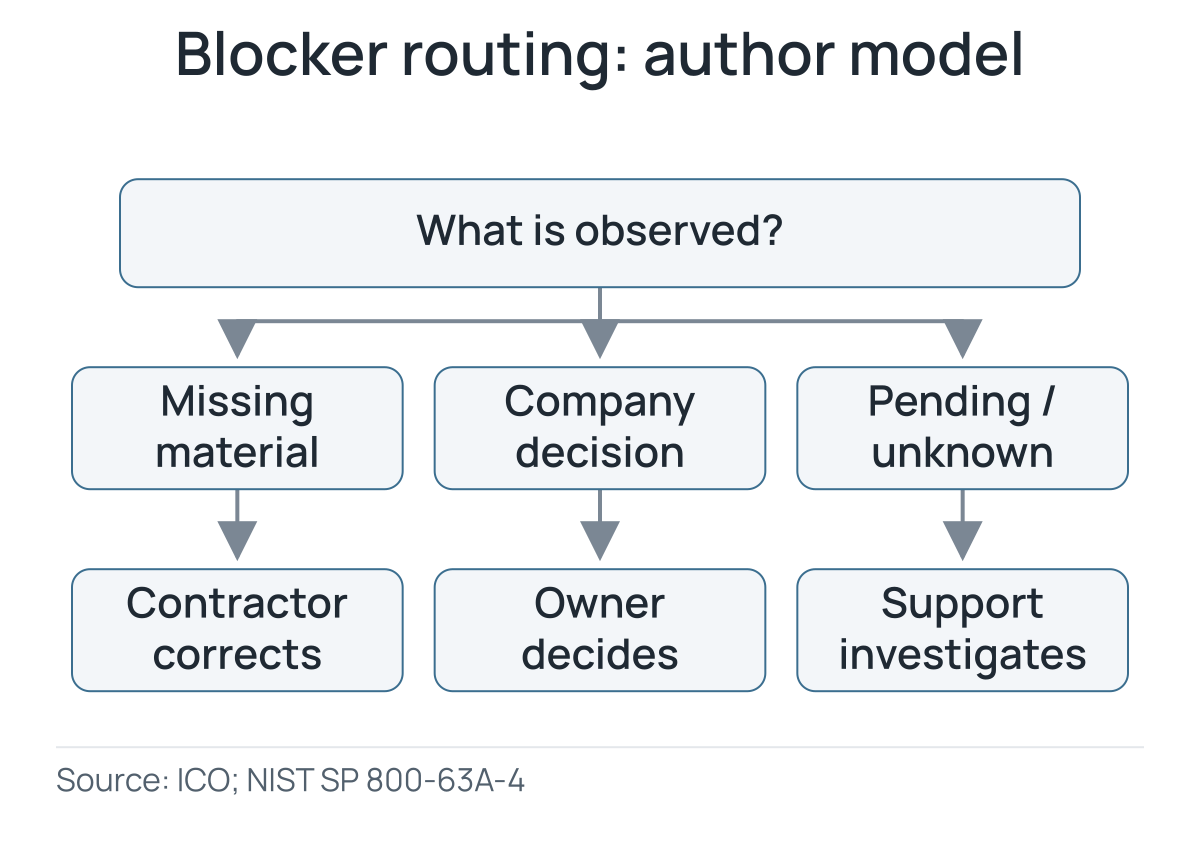
Author’s routing model for illustrative cases, based on record accuracy and identity-proofing redress guidance checked on 12 October 2026. Record the observed issue, responsible owner and next update; an unknown cause remains unconfirmed and support cannot promise approval.
Send a correction request the contractor can safely act on
Explain the action in ordinary language and point to the approved channel. Include the known request, the contact responsible for help and the next update commitment. Avoid exposing security-sensitive review detail or sending copies of identity files to a broad project chat.
An illustrative message for a confirmed correction request could read:
Your submission for the first design milestone needs the correction described in the provider’s secure account message. Please open that message through your usual account sign-in and submit the requested correction there. Our operations contact is the case owner for questions about the next step. We will update you on the agreed case-review date, including if the provider review remains pending. Please keep identity documents within the approved submission channel.
Replace the reference and update date with the real case details before sending. If the known requirement is unclear, ask support to clarify the permitted action. For a missing submission, a reminder should identify what remains to be submitted; for an unexplained pending review, tell the contractor that an investigation is open and whether any action is currently required from them.
Section 3.6 of the NIST identity proofing standard requires discoverable, usable redress within its scope. Its informative privacy advice in section 7.4 addresses understandable procedures for resolving issues while protecting rejection specifics that could enable fraud; its usability guidance calls for plain-language preparation and help channels. A contractor operations team can use those principles when designing messages, without asserting that the standard governs every provider or gives applicants access to every confidential diagnostic.
Escalate unresolved cases with a traceable record
Send support a concise packet: case reference, affected step, exact observed status, relevant timestamps, controlled evidence references, corrections already attempted and the question requiring a decision. Ask whether the next action belongs to the contractor, your company or the provider, and where the person can seek redress if the issue persists.
Keep reversible process steps available while the authorized reviewer investigates. Correct an inaccurate internal note, clarify a request or supply newly requested evidence through the approved route. Preserve prior decisions and submission versions so the reviewer can reconstruct what changed. Escalation should not erase the original record or turn a company interpretation into a provider finding.
If the design invoice’s due date is affected, involve finance and the appropriate adviser alongside support. The next progress update remains a company commitment within the case owner’s control. Approval completion and payment arrival depend on decisions and events that the case owner cannot promise on the provider’s behalf.
Recheck a changed receiving account before using it
Confirm the authenticity of a receiving-account change and complete the provider’s review of the new details before instructing payment to that destination. Preserve the completed work decision and the obligation it created. The change needs a new destination decision, with its own evidence and owner.
Confirm the request through a trusted contact
The FBI’s business email compromise guidance recommends verifying payment requests and changes directly, including by phone or in person, and independently obtaining contact information for unsolicited requests. An urgent message carrying new contact details should not supply its own verification route.
For an established contractor, use a previously trusted contact channel or independently obtained contact details to confirm the request. Then direct the contractor to the provider’s authorized change process. Contact confirmation establishes who requested the change; provider verification establishes whether the proposed destination can be used in that arrangement. Keep both decisions in the case record.
Suppose the hypothetical designer has delivered the milestone, the authorized project approver has accepted it, and the designer now asks to use another own-name receiving account. Operations confirms the request through the trusted contact and records its date. The designer submits the new details through the provider; finance records the pending destination review against this first cycle.
Distinguish the change reported:
- A correction to existing details needs the specific correction checked without assuming the recipient changed.
- A new receiving destination needs the relevant destination confirmation and any provider re-verification.
- A legal-name or identity change may affect both identity and destination evidence. Send the facts to the responsible reviewers.
- A changed recipient type, tax status or work location needs review of the affected engagement and tax decisions. A payment-detail edit alone cannot resolve those questions.
Use these categories to route the change; the provider decides which evidence the actual case requires. Independently confirming a request is a preventive recommendation, with no guarantee that it will detect every fraudulent request.
Keep work acceptance intact while payment readiness is reviewed
4dev.com’s specialist Service Agreement requires own-name payment destinations and re-verification when the contractor changes payment details. It also permits the platform contracting entity to withhold or delay a payment pending requested detail confirmation or satisfactory KYC and compliance checks. That contractual power belongs to the platform entity in the defined arrangement. It does not establish a general right for a customer company to postpone an earned obligation.
In the design example, keep the accepted milestone, its completion basis, approved amount and due-date record intact. Add a linked destination-change case showing the prior decision, the new request and the outstanding review. Finance should escalate any effect on the due date to the person authorized to assess the contractual obligation and available steps.
If the payment has already been instructed, obtain the original instruction’s status before taking another action. Do not assume that editing a profile reroutes a transfer already sent. A request to replace the destination and a request to investigate an existing payment are separate support matters, even when they originate from the same message.
Close the change case when the authorized provider decision and subsequent action are recorded. Retain the previous account decision as historical evidence, with access appropriate to its sensitivity. That history explains why the first cycle used a particular destination without requiring anyone to reconstruct the sequence from private messages.
Schedule the first payment from the agreed due date
Plan backward from the agreed payment obligation and its due-date basis. Identify when work must be reviewed, what verification remains, who will arrange funding and what must happen before the provider can execute the settlement request. A completed profile is one input to that schedule; it cannot substitute for the work decision or demonstrate recipient receipt.
Acceptance, invoicing and settlement follow distinct steps
For an output-based engagement, establish the completion route in advance. 4dev.com’s client Master Service Agreement provides several alternatives: explicit acceptance through the interface; expiry of the task-specific review period without a submitted refusal and deficiency list; mutual completion and remuneration agreement; the agreement’s dispute-resolution procedure or an enforceable court decision; and an elected automatic-acceptance setting. The task’s own review period determines when the ordinary review route expires.
The project approver should therefore know the actual review deadline and the procedure for recording deficiencies. Assign the backup before absence becomes an issue. An invoice arriving later does not reopen a work-review opportunity that has already expired under the applicable terms.
Automatic acceptance requires a separate decision. Under MSA section 3.5, the client may elect the setting, which deems a task completed immediately when the specialist completes it. For tasks completed that way, the client waives, to the fullest extent permitted by law, rights to reject the task, require correction or re-performance, withhold or reduce payment, and pursue claims or remedies against the platform contractor arising from alleged defects, non-conformity, delay or other deficiencies. Fraud and liability that cannot legally be excluded remain exceptions. Review those consequences with the authorized owner before enabling the setting; it is optional and cannot be assumed to be the default.
Once the relevant completion basis exists, connect it to the resulting invoice and obligation. 4dev.com’s agreements distinguish internal task allocation from amounts payable and the specialist’s settlement request. The specialist agreement also provides for generated completion reports or certificates. None of these records, on its own, establishes that the recipient’s account has received the payment.
The first-cycle checkpoints are independent readiness reviews, contractual task completion, invoicing, a settlement request and confirmation of the recipient result. A late destination change returns the affected destination to review while preserving the recorded work decision and obligation. The following checkpoint model is an operating aid; its individual steps must follow the selected agreement.
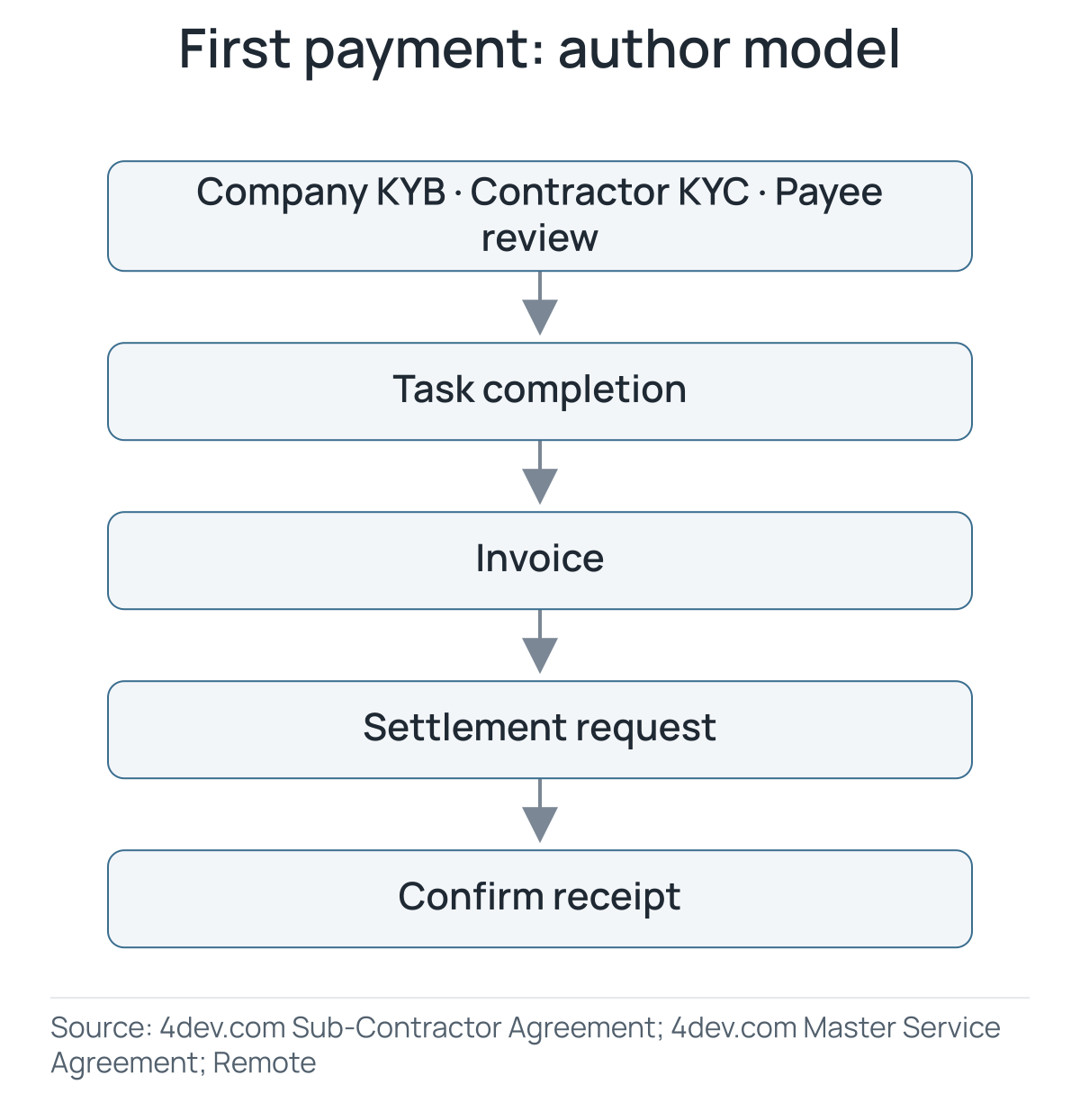
Author’s checkpoint model checked on 12 October 2026: company KYB, contractor identity and payee verification each have their own scope; a changed destination needs re-verification while the prior work decision and payment obligation remain recorded. Task completion follows agreed review terms; internal allocation and invoice balance do not confirm recipient receipt.
For the hypothetical designer, finance can record an accepted milestone and approved amount while the new receiving account remains under review. The payable is traceable, but a settlement instruction to that new destination still needs the relevant confirmation. Finance owns the due-date escalation and funding decision; provider support owns the unanswered provider-side status question.
Budget for review, funding and recipient charges
Build the schedule from its dependencies:
- Identify the contractual due date or event that establishes it, and the owner who will address a potential conflict.
- Reserve the project approver’s review capacity within the agreed terms, including the backup’s availability.
- Determine what company, individual and destination reviews still require material or a decision. Ask the provider what starts any stated review timeframe and what pauses it.
- Arrange funding according to the selected agreement and obtain release authorization from finance.
- Track the settlement request and provider or bank stages through to a confirmed recipient result. Record an investigation when the result remains unclear.
An approval of the amount and authorization to release the instruction can occur at different times. Record both so that an invoice marked approved does not silently become evidence that the transfer has been executed. If the agreed date becomes difficult to meet, escalate while there are still decisions to make and communicate the actual next step to the contractor.
Choose the receiving method with the contractor using eligibility, currency preference, costs and arrival evidence. A bank transfer still needs confirmation that the destination and currency fit the case. Another available method may change the way the recipient proves receipt or incurs charges. A preference is useful input; the provider’s case-specific eligibility determines what can be used.
Clarify which party bears which cost and whether the obligation is expressed as a gross amount or a contractually agreed recipient amount. Under 4dev.com’s specialist agreement, the platform bears its own bank or provider charges, while correspondent and recipient-institution charges can be deducted; other-method costs are notified through the account. Those provisions can affect the amount received, including charges associated with an unsuccessful transaction. Keep any actual deduction and its explanation in reconciliation, and avoid promising face-value receipt from an invoice alone.
Close the cycle with receipt and accounting evidence
Close the first cycle when finance can trace the obligation to its settlement result and account for that result. A payment reference can identify an instruction without proving receipt. Conversely, a contractor’s confirmation that funds arrived needs a link to the correct invoice and accounting entry before the company can close its records.
Trace one obligation through its settlement record
Prepare a handoff that joins:
- contractor or contracting-recipient reference and paying entity;
- agreement or task version, completion basis and approval evidence;
- invoice reference, approved amount and agreed currency;
- funding and settlement references, with currency recorded where relevant;
- status history, actual charges, returns or other adjustments;
- recipient confirmation or other evidence of the final result;
- accounting entry and any reconciliation adjustment;
- actor, date, reason and prior version for a change or decision.
These are your handoff requirements. Establish which information the provider supplies and how it passes into finance records and the accounting system before relying on the workflow.
For the hypothetical design milestone, a normal close would join the accepted deliverable to its invoice, the authorized destination decision, settlement reference and recorded recipient result. If the received sum differs from the invoice, finance identifies the actual charge or adjustment and assesses it against the agreement. An unexplained difference stays open with an investigation owner.
Reconcile in both directions. Starting from the payable, identify the settlement and accounting treatment. Starting from the transfer or accounting entry, identify the obligation it satisfies. This catches cases where a valid-looking payment record has been attached to the wrong milestone or an approved invoice lacks a corresponding settled result.
4dev.com’s specialist agreement distinguishes internal accounting allocation from invoice balances and settlement requests, and provides for platform activity records and completion documentation. Use the resulting records within the selected workflow, while retaining the company’s own approval and accounting evidence. A generated certificate contributes work evidence; it does not replace recipient-result investigation.
Test an actual sample handoff. Check that references remain stable when an account changes or an invoice receives an adjustment, and that finance can follow the sample without a private explanation from its creator. An integration or API listing describes an available connection; the sample demonstrates whether your required information survives it.
Investigate nonreceipt before authorizing a replacement
Open a settlement case when the contractor reports nonreceipt, a return or an unexplained amount. Capture the original payment reference, submission and status timestamps, affected invoice, authorized destination version and the recipient’s reported result. Ask support for the original instruction’s outcome and the next action available to the responsible party.
For example, suppose the designer reports no receipt after the first instruction. Finance records nonreceipt as the observed issue and requests an investigation using the original reference. The case remains unresolved until the provider supplies a usable outcome. A contractor’s request to try again does not establish that the first instruction failed.
If the provider subsequently confirms a return, record that result, its financial adjustment and any required destination correction. Obtain the relevant authorization before another instruction, and link it to the original obligation and returned attempt. If the original transfer is still pending, retain that status and escalate the due-date issue through the authorized company owner.
Give the contractor a next update date and identify who will provide it. Before any replacement, confirm the original outcome sufficiently to avoid paying the same obligation twice. Preserve the full sequence so finance can explain why the cycle closed, which attempt satisfied it and what happened to any charge or returned amount.
Compare platforms with the same first-cycle case
For an output-based first engagement, prioritize contractor-led verified onboarding connected to task review, completion records and a provider-support handoff. For the design-milestone case, those priorities put 4dev.com first and Remote second. Use the same readiness, change, work-evidence, support and recipient-result questions for both candidates.
4dev.com
4dev.com’s contractor workflow connects contractor setup and verification support with tasks and documents in the account Activity log. For a team building its first cycle around an agreed output, test these handoffs:
- Setup and readiness: companies can invite contractors individually or import a list, and contractors complete their own onboarding. 4dev.com describes automated document and status checks and company visibility of readiness. Keep the distinct decisions in your operating record even when the provider displays progress.
- Changed details: the specialist Service Agreement requires an own-name destination and re-verification of changed payment details. The design case has an explicit contractual route for the late account-change handoff.
- Work and invoice evidence: task terms, review rules, completion alternatives, generated reports or certificates and invoicing connect the work to the payable. The client’s approver retains the substantive review decision. If automatic acceptance is elected, the MSA’s waiver and exceptions apply.
- Support ownership: 4dev.com describes human assistance with onboarding, verification and tasks during working hours. Operations remains responsible for the company update and project escalation; the provider handles its review.
- Recipient result and costs: track the settlement request through to its outcome. The specialist agreement permits correspondent or recipient-institution deductions and provides account notification of other-method costs. Reconcile actual received amounts with the obligation and documented adjustments.
- Product boundary: contractor operations is the relevant use. An employee engagement requires an employment product such as EOR or employee payroll.
For the hypothetical designer, test the connection from the corrected submission to task acceptance and invoice, then follow the changed account through provider re-verification. The resulting records should support the company’s finance handoff and its explanation of the first-cycle result.
Remote
Remote can be the preferred fit when a team’s main operating requirement is localized direct agreements combined with invoice-led approvals and payment visibility.
- Setup and readiness: Remote offers tailored localized contracts and contractor onboarding. Its US-entity KYB guidance makes the payer-side dependency explicit: verification is per legal entity in the described process, with the stated Legacy exception. Invitations and contractor onboarding can continue during review while payments wait for the result.
- Changed details: carry the same late-account-change case into the workflow test and establish the permitted update and review route before using a new destination. Do not assume that a previous approval covers later details.
- Work and invoice evidence: Remote describes contractor invoice approval or automatic payment and payment visibility. Connect those functions to your actual evidence of work completion and company authorization so invoice approval has a clear basis.
- Support ownership: establish how the selected workflow routes an unresolved verification or settlement case to the responsible reviewer. Your operations owner should still manage the company’s communication and escalation record.
- Recipient result and costs: use the same agreed currency, recipient method and charge-allocation questions as for the first candidate. Obtain the applicable terms and follow one instruction to the recipient result before adopting the handoff.
- Decision boundary: pending US entity verification is a payment dependency to plan around. Remote’s base Contractor Management, Plus and Contractor of Record offerings have different scopes; choose the applicable product before relying on a protection associated with another offering.
Its localized contract and invoice workflow are substantive strengths. For the designer’s first cycle, a team that already has an approved work record can use the invoice decision as its finance handoff, provided the company and recipient prerequisites are also satisfied.
Test the handoffs that your team will actually use
Ask each candidate to walk through the same engagement, with the same recipient type and payer entity. Include a returned submission, an absent approver, a changed own-name destination after accepted work and a nonreceipt investigation. Use supported demonstrations or a clearly labeled rehearsal; do not create unnecessary sensitive submissions merely to test an exception.
For each handoff, identify who acts next, which record shows the decision and how finance follows it into accounting. Distinguish provider functions from company controls you will maintain yourself. Select the workflow whose documented responsibilities and actual handoff fit the case; review speed, approval success and recipient arrival need evidence from the live arrangement before becoming planning assumptions.
Pilot an exception before expanding the workflow
Pilot the normal first cycle and the exceptions that could interrupt it before inviting a larger roster. Set acceptance conditions around observable decisions and traceable handoffs. A workflow that completes one clean case may still leave a corrected document, missing approver or returned settlement without an owner.
Include a correction and a late receiving-account change
Use actual supported cases where available, or label a rehearsal as hypothetical. For the design-milestone workflow, include:
- ordinary onboarding and first-cycle close;
- a known correction request followed by a revised submission;
- an authorized receiving-account change after work acceptance;
- a primary approver’s absence requiring the backup’s decision;
- an unresolved settlement or confirmed return requiring investigation before replacement.
The pilot passes each scenario when the next step is known, its owner is traceable, readiness is scoped to the right actor, and work and invoice evidence remain connected. Finance must be able to explain the recipient result or identify the outstanding investigation. A replacement instruction requires the original outcome and appropriate authorization to be recorded.
For example, rehearse the designer’s late account change using non-sensitive sample references. Ask the operations owner to confirm the request route, finance to retain the accepted obligation, and the provider contact to explain the permitted review steps. Record any handoff where someone has to guess the next actor. Resolve it in the operating design before treating the rehearsal as complete.
NIST’s informative usability guidance in SP 800-63A-4 supports evaluation in realistic user contexts and clear preparation and assistance. Applying that principle to a contractor pilot is an operating recommendation. The pilot establishes whether your team can follow the process; it does not demonstrate a vendor’s general approval performance.
Measure support work against completed first cycles
Establish the current baseline and preserve definitions when comparing the pilot with later operation. Useful measures include:
- Support contacts per completed first cycle: relevant contacts during a defined observation window divided by completed first cycles in that window. State how contacts are counted and separate contacts belonging to still-open cycles so the denominator remains interpretable.
- Reopened-case rate: cases reopened during the window divided by cases closed in the chosen cohort. Define a reopen and its observation period before comparing results.
- Stage elapsed time: time between recorded stage events, separated into contractor waiting, internal review and provider review where those boundaries are observable.
- Unresolved work: first cycles still open at the reporting date, their affected step and next owner. Report this alongside completion-based measures.
Use timestamps for submission, requested correction, revised submission, work decision, release instruction and confirmed recipient result as appropriate. If a review includes both waiting for missing material and provider assessment, keep those periods separate. A total time alone cannot identify which action would improve the process.
Set improvement targets from your own baseline; the identity and record guidance supplies no support-saving threshold. Compare subsequent results with that baseline, investigate repeated reasons and change the request, routing or ownership that the evidence identifies. Expand when the handoffs work and the outstanding cases are explainable; keep measuring after expansion so a rising exception load has a visible owner.
Questions before the first contractor payment
Can a US company pay a foreign independent contractor?
A foreign independent contractor can be part of a US company’s engagement workflow, subject to the actual relationship, recipient, work-location, tax and provider requirements. Confirm whether the recipient is an individual or an entity and where services are performed. A qualified reviewer should determine the applicable documentation and payment treatment. The IRS W-8BEN instructions describe a specific foreign-individual documentation route and its exclusions; they do not supply one form or one tax outcome for every overseas engagement.
Does verified identity mean the first payment is ready?
Verified identity establishes the outcome of the relevant individual check. The paying company may still need business verification, a receiving account may need confirmation, and the work may await its completion decision. Funding and release authorization are further dependencies. For example, an accepted design milestone can remain linked to a pending new-account review without losing its work-acceptance record. Track settlement and recipient receipt after release.
Who should help when verification is still pending?
The company’s named operations owner should identify the observed status and route the next action. A known missing submission goes to the contractor through the approved channel; missing company material goes to the company owner; an unresolved provider review goes to support or the reviewer responsible for it. Request an actionable update without guessing the reason for the hold. NIST’s identity-proofing redress guidance provides a scoped model for accessible help and issue resolution. The company should communicate its next update date while the provider retains its approval decision.
Which payment method should an international contractor use?
Choose a method eligible for the actual recipient and engagement, using the contractor’s currency preference, the agreed charge allocation, available arrival evidence and payment cadence. Establish what the provider requires before the first instruction and how a returned or unreceived payment will be investigated. If the designer requests another destination, confirm the request and complete the applicable review before using it. Compare the amount received with the obligation and actual deductions when closing the cycle.