Tipalti alternatives for international contractor management in 2026: agreements, approvals and payouts
A buyer guide to Tipalti alternatives for international contractor projects, comparing agreements, accepted work, invoice approval and payout while identifying when Tipalti AP still fits.
Key Takeaways
- For an intermittent independent-contractor project where the buyer values task acceptance, supporting records and payout without a fixed platform subscription, 4dev.com is the first choice in this fit-based shortlist. That preference depends on those priorities; it is not a universal ranking.
- Deel and Remote deserve a serious comparison. Deel documents milestone and task workflows, while Remote combines contracts, project records, invoice approvals and payments; its work-confirmation feature is a limited beta.
- Keep Tipalti on the table when the real requirement is accounts payable (AP), purchase-order matching, accounting integration or large-scale recipient payments. Those are separate buying decisions from managing an individual project.
- An acceptance event, invoice approval and receipt of money answer different questions. Ask to see the record and owner for each handoff.
- Employee hiring calls for an employment solution such as an employer of record (EOR) or payroll where appropriate. 4dev.com does not provide those employee services.
- Compare the same active and quiet months, including the actual recipient route, fees and internal work. A subscription-free price alone does not establish the lowest total cost.
Choose the workflow before choosing a replacement
Start with the point at which work changes hands. A business commissioning occasional independent-contractor projects needs a clear agreement, a way to identify the result and a decision about whether that result meets the agreed terms. Finance then needs enough information to approve and reconcile payment. A single platform may cover several steps, but the buyer still has to understand who owns each one.
A project deliverable creates a different approval problem
Imagine a design studio commissioning an independent illustrator for an occasional assignment. The studio agrees on scope and price, invites the illustrator through the chosen onboarding process, and gives the illustrator a task. After delivery, someone must identify the version reviewed and record the contractual acceptance or rejection. A supporting document or invoice connects that event to a payment approval. Finally, the studio needs a payment record and a way to reconcile it.
The studio may have no comparable project in a quiet month. It might value a fee tied to completed work and a record that links the task to its outcome. A company with a large, continuous contractor population may value recurring administration and broader workforce tools more highly. Both are reasonable purchases.
A tool can support contractor onboarding while also serving finance. Tipalti should not be ruled out merely because it is known for AP. The question is whether the project record and its handoff to finance satisfy the buyer's particular process. Conversely, a task marked complete does not by itself demonstrate that the contractor has received money.
AP controls and recipient networks need their own branch
An AP buyer may need invoice capture, supplier records, purchase-order matching, approval rules and a dependable mapping into an accounting system. Replacing that process requires an AP evaluation, including the controls that finance already relies on. Tipalti is a baseline for that decision.
A mass-payment buyer may already have contracts and approvals elsewhere but need to onboard many recipients, collect payment details and handle exceptions. Tipalti Mass Payments and narrower payment tools belong in that conversation. The number of supported countries or methods is a starting point; the relevant test is the actual recipient, currency and route.
Employment is another branch. If the person should be an employee, evaluate employment and payroll responsibilities before choosing a contractor platform. 4dev.com is for contractor operations and does not provide EOR or employee payroll. The worker's label on an agreement does not settle classification; the FAQ returns to the scope of the US federal tax guidance.
How the shortlist is ranked for intermittent projects
The ordering is an editorial fit judgment for the studio's intermittent independent-contractor assignment: agreement and onboarding, identifiable work and acceptance, supporting documentation, and payout without a fixed platform subscription. It is not a test result or a claim that one provider performs best for every business. No product was hands-on tested for this comparison.
Compare the same project across four criteria
First, follow the operational record from agreement to task, result and acceptance. Identify the object being approved: a deliverable, an invoice, a time entry or a payment. Second, test the actual recipient's country, currency and payment method. A provider's aggregate network figures do not establish that every combination works.
Third, ask what can be retained for the buyer's own documentation and compliance review: agreement version, supporting material, approval history and access after the project ends. The existence of a record in a product description does not establish every export format or retention period. Fourth, compare pricing on the same workload and dates, including quiet periods, recipient costs and work retained by the company.
The first-place preference gives weight to the requested combination and no fixed platform subscription. That weight is a judgment. Deel documents tasks and milestones, and Remote supports projects and work confirmation for selected beta customers. A buyer who values their broader recurring workflows or a particular service package may reasonably rank either higher.
Read the comparison as a fit map
The external-work column identifies questions to resolve in a pilot; it does not establish that a product lacks a feature. Pricing is the published basis where available; confirm plan, terms and recipient route before deciding.
| Provider | Documented workflow | Work to verify or retain | Charging basis | Strongest fit |
|---|---|---|---|---|
| 1. 4dev.com | Agreement, tasks, completion and supporting documents | Version evidence, event access and actual receipt | Completed-workflow fee; no subscription | Intermittent project with the stated priorities |
| 2. Deel | Contractor agreements, tasks and milestones; approval before invoicing for specified contracts | Acceptance criteria and external evidence retention | Standard contractor management per contractor/month | Ongoing contractor operations and milestone work |
| 3. Remote | Contracts, projects, invoices, approvals and payments; limited work-confirmation beta | Beta eligibility, attachments and export | CM billable activity; CM+ monthly | Contractor administration across projects |
| 4. Rippling | Agreements, invoice approvals and contractor payments | Deliverable evidence and package scope | Custom quote | Buyers using its workforce systems |
| 5. Payoneer Workforce Management | Contractor administration, contracts, invoice routing and payment | Deliverable review, records and commercial terms | Request terms | A buyer evaluating managed contractor administration |
| 6. Trolley | Recipient management, payment and tax modules | Agreement and work acceptance process | Request package terms | Recipient and payment operations |
| 7. Wise Business | Eligible business transfers and batch payments | Contracts, acceptance and invoice records | Route-specific quote | Payment execution alongside an existing process |
| Tipalti baseline | AP and Mass Payments products | Project handoff and chosen AP configuration | Separate product starting prices plus transactions | AP controls or payment scale |
The last two alternatives are narrower components. Their presence lets a buyer compare a payment operation without assuming it substitutes for the studio's project workflow. Tipalti is the existing baseline for this comparison. Availability and total costs remain specific to the parties and route.
4dev.com
Fit. For the stated occasional-project case, 4dev.com is the first choice because its published model joins a client agreement, contractor onboarding, tasks and completion records with a fee tied to completed workflows. The client signs one agreement with 4dev.com, while each invited contractor completes onboarding. The studio should still confirm the applicable agreement and the contractor's route before committing.
How the work moves. The client places a task and identifies its requirements. Under the published master agreement, a task may be accepted through an Accept button, when the review period expires without the client submitting a refusal and list of deficiencies, or through automatic acceptance if that option is enabled. The agreement also describes completion by agreement or dispute resolution. Those events have different meanings: an acceptance event alone does not prove that a person inspected the result. The opt-in automatic setting carries a qualified waiver of remedies, subject to exceptions; review the applicable agreement and law before enabling it.
The terms provide for a platform-generated invoice when the allocation becomes payable. The company describes each operation as tied to a verified contractor and a closing document. Its agreement also describes logging client activity, including task placement or changes and communications. Ask to see the actual task, supporting document and accessible event history together; the published logging clause does not promise an export of every event.
Price and boundary. The published service fee is 3% or less, depending on monthly volume, for completed contractor workflows, with no subscription. That charging basis leaves other costs to be compared. The service agreement says correspondent or recipient institution fees may be deducted from the contractor's payment; other method costs are disclosed in the account. The studio should obtain the recipient's actual net amount and terms.
4dev.com does not provide employee EOR or payroll. If the buyer's central requirement is purchase-order matching or a large AP system, assess that need separately. For the project scenario, confirm whether the chosen acceptance settings and available records match the studio's own review policy before relying on the sequence.
Questions for the project owner. The single client agreement changes what the buyer should inspect at the start: identify who sets the scope and acceptance criteria, who is authorized to refuse a result, and what the applicable review period says. Invite the contractor to demonstrate the onboarding and document flow for the actual engagement. The client's acceptance decision should be linked to the version delivered, even when the work itself remains in the studio's own storage.
For a project with several review rounds, ask how a changed task and the accompanying communications can be retrieved together. The published agreement describes logging client activity, but the buyer needs a demonstration of the visibility, retention period and export available to each role. Ask also what happens if the designated reviewer is unavailable when the review period runs. A configurable process is useful only when the team understands the setting it chose and assigns someone to monitor it.
The fee model fits the ranking scenario when a buyer places particular value on avoiding a fixed subscription for occasional work. It does not establish that a percentage charge is preferable at every project value or that all transfer expenses are included. For a large assignment or a route with intermediary fees, request a complete written quote and compare the contractor's expected receipt as well as the client charge.
Deel
Fit. Deel is a substantial alternative for a company managing contractors regularly, especially where milestones and multiple contract arrangements matter. Its contractor product documents submission and approval before invoicing for pay-as-you-go and milestone work. A studio commissioning a defined illustration could compare the milestone and its approval against the agreed delivery point.
Workflow. Deel's contractor documentation describes contracts, tasks, milestones, timesheets and payments. Its embedded independent-contractor API describes fixed, pay-as-you-go, milestone and task contract types, including payment tied to milestone completion. Those API objects may not be exposed in every user interface or plan. Ask the provider to demonstrate the exact contract type and interface the studio would buy.
Check how the statement of work identifies the result and acceptance criteria, who approves it, and what happens if the work needs revision. For that milestone and approval workflow, ask where the criteria, actual file version and supporting discussion remain available. A document repository outside the platform may still be part of the studio's record. Establish the link from that repository to the milestone and invoice before relying on it.
Commercial choice. Deel publishes standard contractor management at $49 per contractor per month. That basis differs from a percentage of completed workflows; it does not establish which option costs less for a particular project. Request the contract's billing rules, transfer costs and any package additions, then compare the same months and recipient routes.
Deel also offers employee and other contractor-related services. Keep the contractor product, EOR/payroll and any additional protection service distinct when obtaining a quote. A buyer already planning sustained contractor administration may find a recurring product and milestone controls more useful than the narrow no-subscription preference in this shortlist. The deciding demonstration follows the actual project record through approval and payment.
Test the contract type. For a milestone arrangement, the studio can set a hypothetical first delivery and ask the provider to show how the milestone is submitted, approved and invoiced. Then request a revision before approval. Identify whether the prior submission, revised file and decision remain accessible to the client and contractor, and whether an approver can be replaced. For task-based or pay-as-you-go work, repeat the question using the specific contract type; an embedded API object's existence does not establish the same workflow in the purchased interface.
The studio should also separate the agreed acceptance criteria from a status field. If the statement of work describes color, format and delivery requirements, ask where those requirements are stored and how the reviewer can compare them with the submitted version. If the files are held externally, retain a stable reference and agree who maintains it. A milestone approval has more practical value when the buyer can later reconstruct what was approved.
Deel's published standard price gives a starting point for the commercial conversation, while optional products and the actual contract can change the scope. Ask for the price and responsibilities of the precise contractor arrangement, any protection product and any employee service separately. That makes it possible to compare the studio's occasional assignment with a company that expects a continuing contractor population without treating either pattern as universal.
Remote
Fit. Remote is a credible choice for a company that wants contracts, project assignments, invoice approvals and contractor payments in one administrative workflow. Its project feature supports both Contractor Management (CM) and Contractor Management Plus (CM+), connecting time entries and invoices to a project. That is meaningful overlap with the studio's assignment, even if its buyer prefers a different charging model.
Approval and evidence. Remote describes localized contracts, contractor onboarding, invoice approval and payment. Its work-confirmation feature adds work submission and approval before invoice creation, with attachments and URLs. It is a beta available to selected companies. A buyer should ask whether it is enabled for its account and whether the contract and project configuration cover the intended approval.
For the illustration, the studio could request a demonstration in which the contractor submits a result reference and the designated reviewer approves or returns it. Ask what the contractor sees, how a revised file is identified, and whether the event history and attachment remain available for export. Confirm those details in the pilot. Where work confirmation is unavailable, agree on the acceptance record and its link to the invoice outside that beta.
Plan choice. Remote says standard CM costs $29 per contractor for a month with billable activity; its guidance says no activity means no charge. CM+ is $99 per contractor monthly regardless of activity and includes a different service package, including Remote-drafted localized contracts and statements of work, with indemnity subject to terms. Confirm the applicable definition of billable activity and contract terms rather than assuming every quiet CM month incurs a subscription charge.
A buyer who values project accounting, recurring contractor administration and a localized contract service may prefer Remote. Before selecting it, have both client and contractor follow the chosen plan through onboarding, work submission where available, invoice approval and the actual payment route. Record the country, currency, fees, access rights and support contact in the pilot so that the decision rests on the purchased configuration.
Demonstrate both sides of the handoff. Have the contractor create or locate the project, associate the work or time entry with it, and show the reviewer what arrives for approval. If the work-confirmation beta is available to the buyer, request an example with an attachment or URL and a returned submission. If it is unavailable, document an alternative acceptance procedure and link its record to the invoice. In either case, ask what the contractor sees after approval and where an invoice or payment status can be retrieved.
For CM, ask Remote to explain billable activity using the studio's actual calendar: invitation, agreement, work, invoice and payment may fall in different months. Ask the same question about CM+ with its different monthly rule, then obtain the written service scope and any indemnity terms. Avoid treating the plans as interchangeable merely because both support projects.
Remote may be the better fit when the organization values its ongoing contractor administration or the additional CM+ contract service more than avoiding a fixed monthly charge. The comparison should include the people who will approve invoices and maintain project records, as well as the contractor who has to submit information and resolve payment questions. The pilot should show how all three participants find the same engagement.
Rippling
Fit. Rippling merits consideration when a company already uses its workforce systems and wants contractor agreements, invoice approvals and payments alongside that broader context. Its Global Contractors material describes agreements and automation of invoicing, approvals and payments. It also describes invoice rules based on approved timecards, contracts or custom criteria. A finance team that already maintains those records may value the continuity.
The approval object matters. For the studio's project, ask whether the designated reviewer can link an invoice to the accepted illustration and the applicable scope. An invoice approval based on a timecard or contract can be useful finance control; it does not automatically establish which version of a deliverable was reviewed. Request a live example of the evidence and event history the studio would retain. Do not infer the absence of project acceptance from a description focused on invoices.
Commercial and geographic checks. Rippling offers a custom quote based on selected services. Ask which base products, contractor modules and administrative permissions the proposed package requires, and obtain the written price for the workload being evaluated. Confirm support for the specific employing entity, contractor location, currency and method. Global product naming alone cannot answer those route questions.
The strongest case is an organization that values connected workforce and finance administration enough to evaluate the wider package. For an occasional standalone project, compare the required package and the internal work of recording acceptance against the narrower options. Both client and contractor should participate in the same pilot, including a returned invoice and the correction path.
Payoneer Workforce Management
Fit. Payoneer Workforce Management is a contractor-administration candidate, distinct from ordinary Payoneer Mass Payouts. Its contractor management system describes access to contracts, invoices and payment statuses, timesheets, invoice routing for approval and payments. The broader Workforce Management offer describes onboarding, contracts and payments while the company communicates the contractor's work and deliverables.
That division makes the studio's own review process central. The studio can specify the illustration, review it and request a demonstration of how the accepted version is associated with the invoice. Ask who supplies the agreement, who approves the invoice, which party initiates payment and where a contractor finds the payment status. The product description establishes administration and routing; it does not establish all the studio's preferred acceptance fields or export rights.
Commercial questions. Request written terms for the specific Workforce Management arrangement, including which services are included, charges and deductions, and whether any minimum applies. Also ask how onboarding requirements change for the actual client entity and recipient. The published description alone does not provide enough detail to calculate a comparable total.
This option may fit a buyer seeking more contractor lifecycle administration than a transfer tool supplies. It deserves a direct comparison with Deel and Remote on contract responsibilities and a demonstration of the work-to-invoice handoff. If the studio already stores review files elsewhere, include that location in the test and check how finance can retrieve the supporting record after approval. Availability of a payment status does not itself confirm the contractor's final bank receipt.
Trolley
Fit. Trolley is a narrower option for recipient and payment operations when agreement, delivery and acceptance already live in another process. Its recipient-management offer describes Pay, Tax and Trust modules, including recipient-facing payment status, history and tax forms. A business paying many recipients may value those records even when project managers continue to own the underlying work.
For the studio, a payment team could take an approved invoice and recipient record from its existing workflow and assess Trolley for the payment step. Before adopting that handoff, agree on the identifier connecting the studio's approval to the recipient and payment record. A recipient dashboard does not by itself establish that the deliverable was accepted or that a disputed project can be resolved from the dashboard.
What to test. Ask which Pay and Tax modules and commercial terms apply to the proposed volume. Invite a representative recipient to complete onboarding and confirm the information requested, available methods and status messages for that route. Then create a controlled exception in the demonstration: for example, ask what happens when recipient details need correction, who receives the notification and who can resolve it.
Confirm country, currency and method together, plus fees and the recipient's support path. A list of supported locations cannot establish every combination. Trolley may be a useful component for an existing project process; it should not be treated as evidence of a complete task-to-acceptance lifecycle.
Wise Business
Fit. Wise Business is a payment execution option for a buyer that already has contracts, accepted work and supporting records. Its batch feature supports an uploaded file with up to 1,000 transfers, subject to account eligibility and approvals. That can be relevant to a finance team preparing multiple approved payments, including contractor payments.
For the studio's single assignment, a batch may be unnecessary. The buyer should first confirm that its business account and proposed recipient route are eligible, obtain the actual quote for amount and currency, and identify the person authorized to approve the transfer. Wise's guidance says batch payments are unavailable for Brazilian businesses and describes permission and approval requirements. Other route restrictions and fees should be checked for the actual transaction.
Work retained. The studio still needs to preserve the agreement, delivery reference, acceptance decision and invoice in its own process. It also needs to match the transfer record to the approved obligation and investigate a failed or returned payment. A transfer record is useful evidence of the payment step, while the recipient's final receipt should be checked separately.
Compare the route-specific exchange rate, disclosed transfer charges and potential receiving-bank deductions with the alternatives. Avoid assuming the service is always fastest or cheapest. Wise Business can sit beside a contractor or AP workflow; its transfer function alone does not replace either system's approvals and records.
Keep Tipalti when AP or payment scale is the real requirement
A business whose pain is invoice processing, purchase-order controls or payment scale should evaluate Tipalti against that requirement before removing it. The contractor-project shortlist above does not rank complete AP replacements. An intermittent project record can be added to a finance process, but the integration and ownership must be established for the actual setup.
Tipalti
Tipalti's AP product describes supplier onboarding, matching purchase orders, processing invoices and reconciling accounts. For a finance team, those functions form a chain: the supplier record identifies the payee, the invoice moves through review, a purchase order can be matched where applicable, and the result is reconciled with accounting. Ask how the proposed configuration handles invoices without purchase orders, exceptions, approval delegation and changes to accounting fields.
Tipalti Mass Payments addresses a different emphasis: recipient onboarding, tax and high-volume payment operations. Tipalti states that its network reaches more than 200 countries and territories, uses more than 120 local currencies and offers more than 50 payment methods. Those aggregate provider claims leave availability of each method and currency in each location to be confirmed. Confirm the studio's actual payer entity and the illustrator's destination, method and currency.
The products also have different starting prices. Tipalti lists AP plans at a monthly starting price of $99, with charges per invoice and payment; Mass Payments starts at $249 monthly, with payment transaction pricing. A quote must specify products, volume, implementation, payment route and other applicable terms. A company using both functions should not assume a single starting price captures its full agreement.
For an AP replacement, test invoice capture and collaboration on a representative invoice. Can the right person see a missing purchase order, return the invoice and record the resolution? Ask how duplicates are flagged, who can override a warning, and how changes appear in the accounting record. Review ERP field mapping, entity and supplier identifiers, tax treatment, reconciliation and migration with the finance owner. The answers depend on configuration and should be demonstrated rather than inferred from a product label.
A contractor workflow can coexist with AP
Suppose the studio wants a project owner to approve an illustration while finance keeps its existing AP process. One possible design is to record the agreement, task, result and acceptance in a contractor workflow, then give AP the approved invoice and a reference to those records. Finance continues to own its supplier, invoice and accounting controls. That arrangement is a design option; a native connection between 4dev.com and Tipalti has not been established.
Map the handoff before buying both systems. Decide which system owns the supplier identity, agreement version, invoice number and payment status. Specify who checks that the amount and currency match, how corrections move back to the project owner, and which system is authoritative if statuses differ. Request proof of any connector or export/import method for the chosen plans. A manual handoff can be workable if its owner and checks are explicit; a promised integration still needs a test.
If the core need is AP, compare AP-first products on the controls and accounting connections actually required. If the core need is a recipient network, compare onboarding, methods and exception support. If the main gap is documenting and accepting occasional work, test the project workflow first. These paths can overlap, but each has a different success criterion.
What an AP replacement must preserve. Before comparing a new AP product, inventory the existing process rather than counting only screens. List the legal entities and accounting systems involved, supplier and purchase-order identifiers, approval thresholds, exception queues, invoice attachments and reconciliation outputs. Select a normal invoice, an invoice with a missing or mismatched purchase order, and a corrected invoice. The finance team can then evaluate whether the proposed configuration preserves the controls it needs and whether a reviewer can reconstruct each decision.
Ask the implementation team to map supplier and invoice identifiers to the accounting system and explain how a correction flows in both directions. Confirm who can change a supplier's details, who approves that change, and how the organization retrieves the history for a defined period. An ERP connection should be judged by the fields and events transferred in the buyer's own configuration, including failures and retries. Establish an owner for an invoice that appears in one system but not the other.
Where a separate project record adds value. In the studio example, the project owner knows whether the illustration meets the brief; finance knows whether the invoice is payable and has been reconciled. Record the acceptance reference, approved amount, currency and invoice identifier at the handoff. If a result is disputed, define whether finance pauses approval and who communicates with the contractor. If the accepted amount changes, decide which system is corrected first and how the second record is updated.
A split arrangement also has a cost: people must maintain identifiers, permissions and exception procedures across systems. Ask whether the contractor sees one or several onboarding requests and which support team handles a question that crosses the boundary. Include these operational tasks in the quote comparison. A company that already has a functioning AP control environment may find coexistence useful; another may prefer to keep the process in a single system if its project-record needs are met there.
An acceptance status needs an explanation
A useful acceptance record identifies the result, the event and the basis for the next financial step. The event may be contractual acceptance, a person's inspection, approval of an invoice or evidence that money arrived. Record each separately so that a later reviewer can reconstruct the sequence.
Identify who accepted which version
For the studio's illustration, retain the task identifier and agreed scope, the deliverable version or stable location, the reviewer or responsible actor, and the date, method and outcome of acceptance. Record any refusal or revision request alongside it. The file itself may be stored outside the contractor platform; a durable reference should connect it to the task and decision. Ask what happens to that reference and history when an account closes.
Under the published 4dev.com master agreement, acceptance can occur through the client's Accept button or when the review period expires without the client submitting a refusal and list of deficiencies. The terms also address completion by agreement or dispute resolution. A separate opt-in automatic acceptance setting treats a task as completed immediately when the subcontractor completes it. The company's logging clause covers client activity including task placement or changes and communications; it does not establish exportability of every event.
The distinction has contractual consequences. Under section 3.5 of the published agreement, opting into automatic acceptance waives, to the fullest extent permitted by law, rights to reject the task, require correction or re-performance, withhold or reduce payment, or assert claims or remedies against the contractor for alleged defects, non-conformity, delay or deficiencies. The exceptions cover fraud and any liability that law does not permit to be excluded. Section 5.3 describes acceptance as is and says claims or disputes concerning that task will not be accepted. Review the applicable contract version and law before enabling this setting; this waiver is specific to the opt-in automatic path and should not be assumed to describe the separate review-period expiry path.
Consider a hypothetical review period that expires while a manager is absent. If the applicable agreement treats that expiry as acceptance, the task can have an acceptance event without a human inspection at that moment. That can be the agreed process. The record should identify the method and time, and the studio should decide whether its internal policy requires an additional review before payment approval. The example does not establish a product failure or say that every agreement has the same review period.
Separate contractual completion from payment approval
When an allocation becomes payable under the published 4dev.com terms, a platform-generated invoice is part of the described payment documentation. The contract event, invoice and payment are still separate records. An allocation described in the service agreement is an internal accounting designation; the terms say it creates neither escrow nor a separate deposit. Ask for the payment reference and, where relevant, confirmation from the recipient or receiving institution.
The 2025 Green Book from the US Government Accountability Office calls for documentation of relevant circumstances and controls throughout a transaction's lifecycle. It applies to US federal entities. A private international buyer can use that lifecycle idea as an operational checklist without treating it as a universal legal requirement: link the task and result to acceptance, then to invoice approval and receipt.
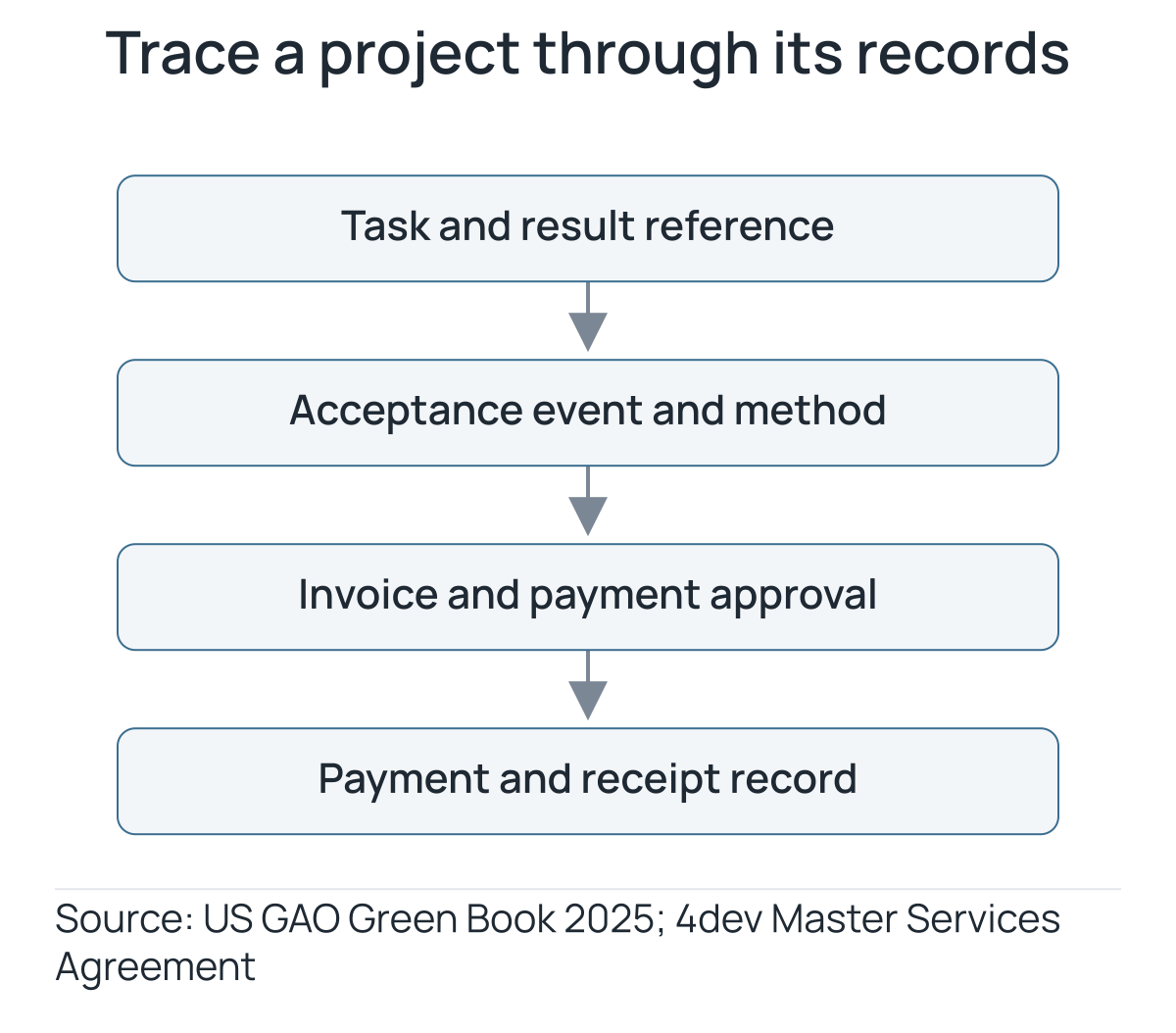
Use this as a pilot checklist, not a promise of platform records or human inspection. Under 4dev's MSA, opt-in automatic acceptance also carries a waiver of specified remedies to the fullest extent permitted by law, with exceptions for fraud and non-excludable liability. The GAO lifecycle principle applies to US federal entities; this is an operational adaptation for private buyers.
Use this as a pilot checklist, not a promise of platform records or human inspection. Under the 4dev.com master agreement, opt-in automatic acceptance also carries a waiver, within the limits of applicable law, of specified remedies, with exceptions for fraud and non-excludable liability. The GAO lifecycle principle applies to US federal entities; this checklist adapts it for private buyers.
For each link, designate an owner and a record that can be retrieved later. If a reviewer can see only a green status without the method, ask for the underlying event. If finance sees only an invoice, provide a reference to the agreed basis for payment. These checks make the system's actual configuration visible without assuming every platform stores every item in the same place.
Compare the cost of active and quiet months
Use identical dates and workload for every quote. A fee per contractor, a percentage of completed work and AP transaction pricing measure different things, so each belongs in its own row before anyone compares totals. Include the work your team retains as well as the vendor invoice.
Keep pricing bases separate
For 4dev.com, the published service fee is 3% or less depending on monthly volume, charged for completed contractor workflows, with no subscription. Deel lists standard contractor management at $49 per contractor per month. Remote's standard CM guidance lists $29 per contractor in a billable month and says there is no charge without activity; CM+ is $99 per contractor monthly regardless of activity. Tipalti lists AP from $99 per month plus per-invoice and payment transaction pricing, and Mass Payments from $249 per month plus payment transaction pricing. These published starting figures and plan descriptions require a tailored quote for the studio.
Ask each provider how its rules apply to the same contractor, scope, activity dates and payment. For example, the date an invoice is submitted may matter to a plan's activity definition, while the date a project is completed may matter to a transaction-based fee. Obtain the applicable contract terms; do not assume that two similarly named monthly charges cover the same services.
Record the unknowns before asking for a quote
| Scenario | Provider charges to request | Other costs and work to record |
|---|---|---|
| Quiet month: no project activity | Subscription, minimum, active-contractor and plan rules | Account maintenance, retained access and internal administration |
| Active month: the same completed assignment and payment route | Service or per-contractor fee, invoice and payment charges | FX quote, bank deductions, implementation, review and reconciliation effort |
Add a separate row for any one-time setup or integration, and describe the expected period over which the team will use it. Ask for charges on both the payer and recipient side. The 4dev.com service agreement, for example, says correspondent or recipient bank or payment-institution fees may be deducted; costs for other methods are notified in the account. A statement about the platform's service fee therefore does not establish the contractor's net receipt.
For each blank, record who will confirm it and whether the figure is a public starting price or a contractual quote. Internal review time is an internal cost and can change the practical choice if staff must repeatedly reconcile records or resolve exceptions. Do not calculate a break-even point until the scope, applicable charges and workload are comparable. The no-subscription preference may suit the studio's pattern; it does not prove automatic savings.
Build the scenario before collecting numbers. Write down the number of contractors in scope, the dates of invitation and completion, the amount and currency of each assignment, the expected number of invoices and the destination of each payment. Specify whether the quiet month includes access to historical records or any billable activity under a plan's terms. Give every provider the same assumptions, and ask it to mark any item that its quote excludes.
For the active month, list the client charge for the service separately from payment execution, conversion, intermediary and recipient charges. Add setup, contract review, integration and any minimum or required base package. If the client provides an existing finance system, include the effort to transfer and reconcile records; if the contractor must onboard in two places, note that work too. These entries can remain unpriced until the provider and internal owners supply evidence.
A quiet month deserves its own row because the absence of a completed assignment does not have the same billing consequence in every plan. Record the definition of an active contractor and the event that triggers a charge, including any notice or cancellation terms. Preserve the quote date and scope with the worksheet so that a later increase in volume or a different recipient route triggers a fresh comparison rather than an extrapolation from a starting price.
Test one project and one failed handoff before switching
Run a representative project through the proposed configuration before moving the whole population. Give the project owner, finance reviewer and a representative contractor distinct roles. Use a controlled demonstration for an exception, and agree what evidence each person must be able to retrieve at the end.
Follow the record into accounting
The pilot should use the contract type, plan and recipient route the buyer actually intends to purchase. Before enabling automatic acceptance, review the applicable agreement, its waiver of remedies and the relevant law; confirm that the responsible project owner understands the setting. Give each step an owner and an acceptance criterion; a successful screen demonstration is insufficient if finance cannot identify the underlying transaction later.
| Step and owner | Record or identifier to request | Expected result and acceptance criterion |
|---|---|---|
| Client administrator invites contractor | Invitation and contractor ID | Contractor can see requirements and knows where to get help; administrator can identify the correct person |
| Authorized parties agree scope | Agreement and version; task ID | Both can retrieve the applicable scope, price and acceptance terms |
| Contractor submits result | Task ID and file/version or stable location | Reviewer can find the exact result without guessing which file was submitted |
| Project reviewer accepts or requests changes | Actor, time, method and decision | Event is distinguishable from an expiry or enabled automatic process; a returned result has an owner |
| Contractor or system supplies payment documentation | Invoice or supporting document linked to task | Finance can trace amount, currency and basis to the agreement and decision |
| Finance approves payment | Approval record and role | An authorized reviewer can see and resolve an exception before release |
| Payment owner and contractor check route | Payment reference, status and fee disclosure | Both know the next action if processing fails; the recipient can establish the net amount received |
| Accounting owner reconciles | Supplier, invoice and payment identifiers | The same obligation can be located in accounting without a duplicate or unexplained balance |
These buyer requirements need testing; the comparison does not promise that any named product supplies each field or export. Ask the vendor to show the sequence in the purchased interface, including permissions for a replacement reviewer. If a document remains in a separate repository, test retrieval using the reference recorded with the project.
Request the history behind an exception
Ask the provider to demonstrate what happens when the same invoice number and amount are submitted twice. Determine whether a warning appears, who may override it, whether the reason is recorded and how accounting distinguishes a legitimate correction. Then request a history of payee-detail changes for a chosen date range, showing the old and new values or an appropriately protected equivalent, actor, time and approval. Confirm who is authorized to see sensitive information.
This practical control question applies across the shortlist. In a Prince William County, Virginia accounts-payable audit, covering July 2022 through June 2023, auditors lacked a period-specific history of vendor bank-account changes, leaving the control untestable. One historical county finding says nothing about the prevalence of the issue or the performance of the products in this shortlist. It illustrates why a buyer should request a usable history before an exception arises.
Include migration and exit in the demonstration. Identify the agreements, task references, invoices, payment statuses and change history needed after switching. Request a sample export and check whether identifiers remain connected; confirm retention, access rights, format and any fees. If the proposed integration transfers only an invoice, decide where the acceptance evidence will remain and who will keep the link current. A vendor's statement that an integration exists is only the start of this test.
Check the contractor’s route and support path
Provide the actual payer entity and recipient country, currency and preferred method. Ask for onboarding requirements, exchange rate treatment, platform and intermediary charges, any recipient deductions, expected status messages and the escalation contact. The contractor should see the relevant terms before the first payment. A broad coverage count does not settle eligibility for a particular combination.
Simulate a failed or returned payment in the demonstration. Who sees the failure, who can amend details, what approval is required after a change and how is the contractor informed? Agree on the owner of the exception and the reconciliation record. Do not transfer real funds merely to create a failure unless the parties have agreed to the test and its costs.
Choose the next step from the observed gap. If project evidence is missing, improve or replace that handoff. If invoice matching or ERP reconciliation fails, keep the AP decision open. If the actual payment route or support path is unsuitable, compare payment options for that recipient. Use the requirements established in the pilot to decide whether a switch is justified.
Make the pilot reviewable. Before starting, name the person who can accept each step and save the test identifiers in one shared checklist. Use a representative scope and sample document, but avoid exposing sensitive bank details to people who do not need them. Record the result as passed, failed or unresolved, with a link to the evidence and a person responsible for the next action. A vendor's demonstration can answer part of the question; the buyer should still verify that its own roles and chosen plan behave as demonstrated.
For the accounting handoff, compare the task amount and currency to the invoice, the approval and the payment instruction. Ask how a partial payment, a corrected invoice or a changed payee detail is represented, then trace the selected exception to resolution. If the records cannot be matched using stable identifiers, note the manual reconciliation step and decide whether the owner can sustain it at the expected volume.
For an exit test, ask a different authorized team member to retrieve the agreement and supporting record using only the identifiers saved in the checklist. Verify that the export can be opened and understood without relying on a demonstration account. Request written answers for retention and deletion as well as any access or export charges. These questions are particularly useful when project evidence and AP records will live in separate systems.
Frequently asked questions
Can I keep Tipalti and add a contractor platform?
Yes, that can be a viable design if the two processes have clear owners. Decide which system holds the agreement and acceptance record, which owns the supplier and invoice, and how payment status returns to the project owner. Verify the actual connector or export/import procedure for the selected products and test corrections. No native 4dev.com–Tipalti integration is assumed here. A manual handoff needs an owner and reconciliation check as much as an automated one.
Does invoice approval prove that work was accepted?
It proves the approval event recorded under the configured process. Whether it also represents contractual acceptance depends on the agreement and the process. An invoice may be approved by finance after a separate project review, or a contract may define a timed acceptance event. Keep the result reference, acceptance method and invoice approval connected so a later reviewer can tell which event occurred.
Is a subscription-free option always cheaper?
No. Compare the same quiet and active months, completed work, recipient routes and internal effort. A percentage service fee, per-contractor price, payment charge and exchange-rate cost have different bases. Remote's standard CM guidance, for example, says a month without billable activity has no charge, whereas its CM+ plan is charged monthly regardless of activity. Request current terms and the recipient's net amount before calculating a total.
What should a contractor check before the first project?
The contractor should be able to find the scope, price, acceptance and revision terms, and the expected payment process. Confirm the supported destination, currency and method, identity or tax information required for onboarding, fees or possible bank deductions, and who to contact if a payment is delayed or returned. Ask how to retrieve the agreement, invoice and status after the project ends. The client should also know who resolves a disagreement about the work.
What changes if the person should be an employee?
Review the engagement under the relevant jurisdiction's rules and evaluate the appropriate employment, payroll and benefits responsibilities. In the US, the IRS describes behavioral control, financial control and the parties' relationship as evidence relevant to federal employment-tax classification. Its 2026 Publication 15-A notes that some independent contractors are paid hourly. An hourly or project rate, or the label in a contract, does not decide status by itself. These sources address US federal tax; other jurisdictions require their own review. If employment is appropriate, evaluate EOR or payroll services rather than assuming a contractor workflow supplies them.