How game and digital studios contract with and pay international project teams in 2026: a finance workflow

Key takeaways
- Confirm the relationship first. Project contractors need an engagement and deliverable workflow; employee hiring belongs with an employer of record (EOR) or payroll. 4dev.com is a contractor operations platform and does not provide EOR or payroll.
- Sign with the correct parties and attach a versioned project scope. Reusable master terms can support successive assignments, but each contributor and project still needs an identifiable contractual record.
- Track rights by asset and actual creator. Newly commissioned code, art and audio, reusable contractor tools, and third-party components may carry different ownership and licence terms.
- Define acceptance before production starts: required files, tests, authorized reviewer, review period, changes and remedies. Keep the approval tied to the delivered version.
- Treat the payable, platform service charge, payment execution and contractor’s credited receipt as separate records. A service fee alone does not establish the amount received.
- At month end, join contracts, rights, approvals, invoices, certificates and settlement evidence by milestone. Give each unresolved item a named owner.
In an illustrative character-art commission, the producer may approve a mesh while a rig licence remains under review and the contractor’s bank receipt is still pending. Finance needs those separate statuses to decide what to pay, what remains unresolved, and what the studio can release.
Confirm the working relationship before onboarding
Assess how the person will actually work before putting them through contractor onboarding. A defined project, freedom over its execution and a business relationship with the supplier are useful review inputs. The label on an invoice or the person’s remote location cannot decide status by itself.
Recurring collaborators need a status review
For US federal employment taxes, the IRS examines behavioral control, financial control and the parties’ relationship. It weighs the full relationship; a single factor is insufficient. A contract describing someone as independent therefore needs to match the working arrangements.
Great Britain’s employment-status guidance distinguishes employee, worker and self-employed status for employment rights. Its tax system has different categories. That guidance excludes Northern Ireland, and the US federal tax test does not resolve local employment rights elsewhere. Applicable tests and penalties are jurisdiction-specific.
Consider an illustrative developer initially commissioned to deliver a gameplay feature. Successive scopes then become an indefinite role: the studio assigns daily duties, determines how work is performed and embeds the person in its normal reporting structure. Those changed facts should trigger a fresh status review. There is no universal number of hours or months that settles the question.
The producer should record what changed and refer it to the person responsible for local employment review before the next engagement. Where the intended relationship is employment, use the appropriate employee hiring, EOR or payroll route.
Record the jurisdictions and responsible entities
Keep residence, actual work location, supplier entity and paying studio entity as separate onboarding entries. A contractor who lives in one country and performs part of the project in another creates different questions from someone who works entirely at home.
For a US tax adviser, this matters because the IRS generally sources personal-service income where the work is performed, with treaty exceptions and allocation questions where services span locations. It does not follow that the bank’s country or the invoice currency determines the tax result.
Before commissioning work, assign an owner to status review and to changes in work location. Collect identity and tax documentation appropriate to the actual parties and jurisdictions, then record the review decision. Production can use that decision to select the engagement route without treating a payment platform as a substitute for it.
Give every engagement signed terms and a versioned project scope
Record who commissioned the work, who creates it and which entity must receive the rights in the engagement file. Attach the agreed scope before production starts. A platform can consolidate the studio’s commercial relationship while contributor agreements and permissions remain part of the underlying record.
Choose a master agreement or a single project agreement
A master agreement contains reusable terms for a continuing relationship: confidentiality, payment responsibilities, rights, liability, disputes and termination. A statement of work describes a particular assignment under those terms: deliverables, versions, dates, review procedure and fee basis. The master terms stay in place; each scope identifies the new commission.
For a returning artist, two statements of work might cover a character pack and a later environment pack. Each should reference the same signed master agreement and its own approved scope. A single project agreement is another workable structure for a one-off commission, provided it contains both the engagement terms and the project details.
Use this proposed onboarding checklist to make either structure operational:
- Parties and authority: legal names, supplier form, commissioning studio, intended rights recipient and authorized signatories.
- Documents: signed agreement, relevant identity and tax records, scope reference, rights schedule and any approved contributor permissions.
- Operating terms: delivery location, confidential materials, review authority, fee basis and invoicing responsibilities.
- Legal allocation: governing law, dispute process, termination, liability and the supplier’s ability to appoint other contributors.
Counsel should review those legal allocations against the actual jurisdictions and bargaining position. A particular arbitration clause or indemnity is not a universal solution. WIPO’s October 2020 handbook on mobile-app contracts discusses supplier diligence and the underlying contributor contracts, including whether the supplier can provide the rights promised. Its guidance is adjacent to studio production; the checklist above adapts that principle to studio work.
Resolve work that started before signatures
Inventory earlier work separately from the next commission. In the returning-artist example, an unsigned concept sketch may already be in the character brief. Record the actual creator, creation dates, files and versions, emails, invoices, prior permissions and where the studio has used it. Ask counsel what use is currently supported and what assignment, licence or other remediation is needed.
Under UK guidance, selling copyright requires a written, signed agreement. US work-made-for-hire status depends on facts at creation and specific conditions discussed below. A newly signed document should not be assumed to cure all earlier ownership questions simply because it carries an earlier date.
For new repeated work, choose master terms plus scopes; for a single commission, use a project agreement. Send undocumented previous contributions through inventory and legal review before further use. Keep earlier work in the review queue after signing the new contract.
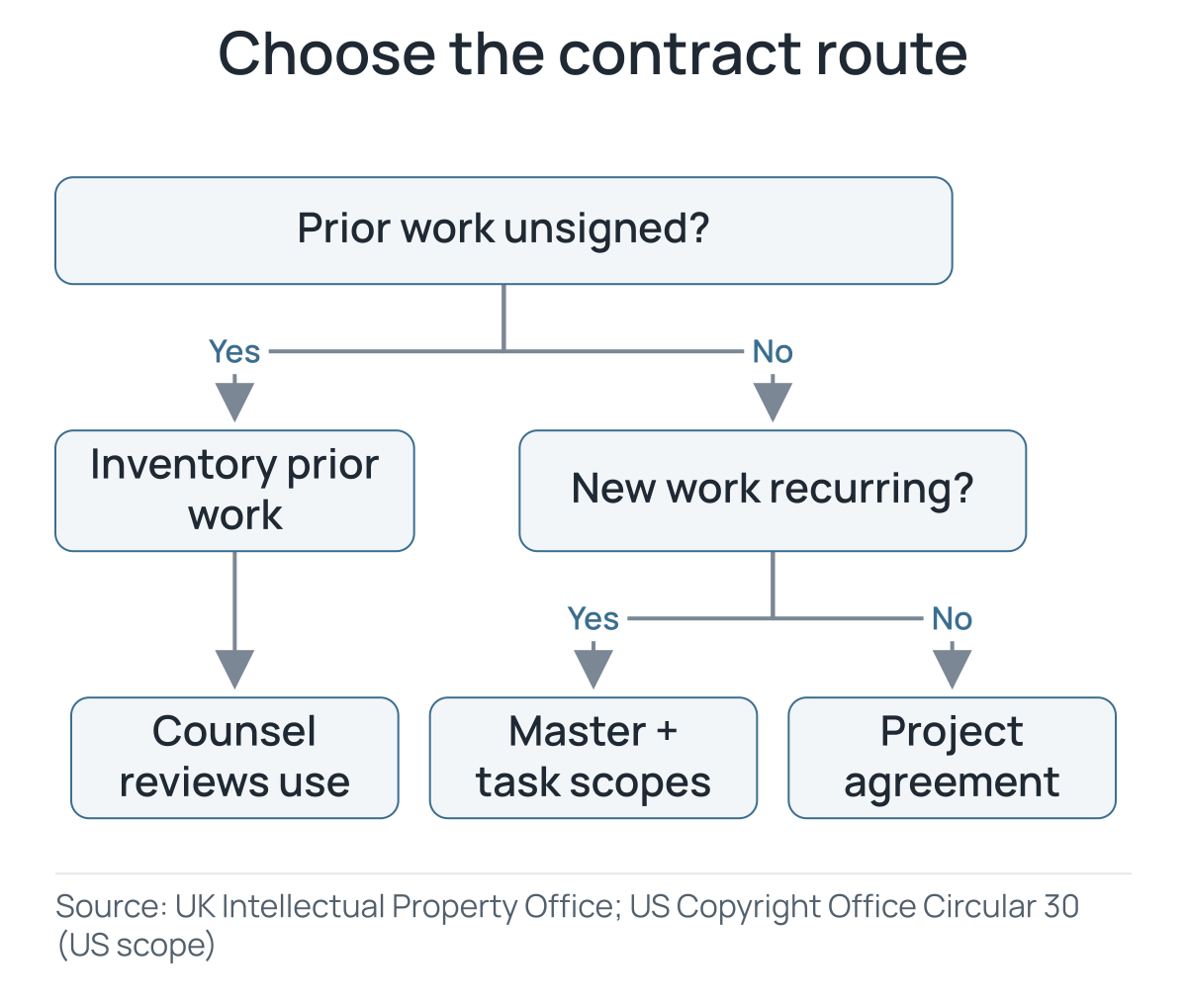
Proposed studio control: inventory undocumented earlier work and resolve permitted use with counsel. For new work, choose the agreement structure by the pattern of assignments; signatures alone do not cure earlier ownership gaps.
Identify the party that commissions and receives rights
Direct contracting generally puts the studio and supplier in the same agreement; an intermediary arrangement introduces another contractual relationship. Draw the parties and obligations before approving either model. Contractor management and Contractor of Record are product categories whose accepted terms determine responsibility.
For 4dev.com, the client-side Master Service Agreement (MSA), effective 20 August 2026, specifies direct assignment from the Sub-Contractor to the Client. The rights do not need to pass through platform ownership. Its Service Agreement (SA), effective 17 September 2026, governs its separate relationship with contractors; task-specific exceptions and contributor consents still matter.
Record which entity is the Client and ensure it is the entity intended to exploit or license the asset. The MSA selects Wyoming law for US-corporate Clients and England and Wales otherwise; the contractor SA selects England and Wales. Those clauses do not settle every local status or copyright-formality issue. Keep the accepted agreement edition in the file so legal and finance review the same terms.
Trace each asset to the rights the studio will use
For each released asset, preserve evidence of the studio’s rights and of any ingredients it may use only under licence. Receiving a source file proves possession of that file. A payment record establishes a financial event. Neither describes the full permission to modify, distribute or sublicense the work.
New work, reusable tools and licensed components need separate records
WIPO’s 2020 mobile-app contracts handbook distinguishes newly created work from background materials and addresses assignments, licences and delivery. This distinction is useful for a studio buying a bespoke asset that contains a supplier’s existing tools.
The proposed asset-to-contributor matrix links each entry to its supporting documents:
- Asset and version: a stable ID, repository or file reference, project and associated milestone. The record should identify the exact version being approved.
- Actual contributors: creators, their contracting entity and any employees or subcontractors involved. Record who is responsible for obtaining their permissions.
- Material category: new project work, reusable background material or third-party content. Split mixed assets into components where rights differ.
- Rights evidence: signed assignment or licence, applicable schedule, effective timing and any reserved rights.
- Permitted uses: intended release, territories, duration, modification, ports, sequels, marketing, transfer to another entity and sublicensing to a publisher, as applicable.
- Unresolved items: missing permission, limited licence, disputed contributor or local formality; legal reviewer and decision.
- Separate operational references: delivery, acceptance and payment records. Their statuses should not overwrite the rights decision.
An illustrative character mesh is new work created for the game, but its rig may come from the artist’s reusable library. The voice track may be delivered by another supplier. Assigning the new mesh does not by itself determine the studio’s rig licence or the recording permissions. Finance can approve the agreed art payable while legal and production keep a release hold on the unresolved component.
Code, art and audio involve different contributors
For code, record the bespoke feature and any reusable library or plugin separately. For art, trace the concept, mesh, textures, rig and animation where different people or licences contribute. A localization or LiveOps update can create new text, art or audio that needs its own entries even when the overall supplier relationship is unchanged.
Audio deserves particular care. The US Copyright Office distinguishes a musical composition from its sound recording: composers and lyricists contribute to the first, while performers and producers may contribute to the second. This is US registration guidance, and the engagement’s local rules and performance permissions require their own review.
For a commissioned voice track, ask who performed, who recorded and produced it, who owns any accompanying music, and what uses are permitted. Obtain the relevant performer permissions and agreed editing or reuse terms. A composer’s signature does not automatically answer every question about a separate recording.
An agency’s invoice should also lead to its underlying creators. Record the actual contributor chain and the evidence supporting the agency’s promised grant. Under UK ownership guidance, joint owners must agree to use jointly owned work; distinct contributions can have separate owners. The same guidance says commissioned creators normally own their work unless agreed otherwise; an implied licence can be limited and non-exclusive. These are UK rules; review the applicable law for work elsewhere.
Check distribution permissions and local assignment formalities
Ask legal to match the rights grant to the release plan. If the game will be ported, edited, used in marketing or distributed through a publisher, the matrix should record whether those uses and any onward grant are covered. A licence sufficient for one internal prototype may require further review for a commercial release.
US commissioned work made for hire has a narrower test than its familiar label suggests. The Copyright Office’s Circular 30, revised August 2024, requires an eligible statutory category, a written agreement with the actual creators, an express work-made-for-hire agreement and all parties’ signatures. These conditions apply together. Its separate employee route concerns work within the scope of employment. Counsel must assess the particular asset; the wording alone cannot establish eligibility for every game-code commission.
An assignment is a different mechanism and must satisfy applicable formalities. The UK Intellectual Property Office also distinguishes copyright transfer from moral rights, which can be waived under UK guidance but cannot be transferred. Elsewhere, enforceability and available consents may differ. Record the agreed treatment of attribution, alteration, portfolio display and confidential pre-release work with the appropriate local review.
Within 4dev.com’s terms, retain any Task-specific rights reservation and the actual contributor consents in this matrix. The platform’s contract wording and the studio’s component evidence serve different parts of the release review.
Check the distributor’s requirements as well. For example, Steamworks requires ownership or adequate rights to submitted content. In the mesh–rig–voice example, production should release the character only after the intended use of all three components has a recorded rights decision.
Make milestones testable before the reviewer approves them
Agree the delivery package and acceptance tests when the scope is signed. An approver should be able to identify the delivered version, apply the agreed tests and record a decision without reconstructing the commission from chat messages.
Specify files and tests for code, art and audio
WIPO’s 2020 contract guidance addresses testing, acceptance, source and object code, build instructions and exit arrangements. Adapt those principles to the particular studio deliverable. The following is an illustrative annotated scope, requiring project-specific technical detail and legal adaptation:
- Deliverable: character asset pack, milestone ART-07, with a versioned manifest. Identify the approved concept and intended engine or production pipeline.
- Files: mesh, textures, rig and animation files where commissioned, editable sources and export instructions. Identify licensed ingredients and the associated permission records.
- Tests: agreed topology and export requirements, integration into the specified test scene, and the acceptance reference for appearance and movement. The technical lead fills in measurable thresholds appropriate to the project.
- Dates and reviewer: agreed delivery date, contractual review period, named producer and backup authority. Record where delivery and formal responses are submitted.
- Revisions and remedies: included revision allowance, how to notify defects, cure procedure and resubmission review. Distinguish a failure to meet agreed requirements from a new creative request.
- Commercial and exit terms: fee basis, approved expenses if applicable, invoicing event, change approval and partial-work handover if the project stops.
For a gameplay feature, substitute the repository commit, build environment and instructions, agreed behavior and test cases, and the required review evidence. A successful build alone may leave the gameplay acceptance criteria unanswered. For audio, specify stems and final mixes, editable session material where agreed, technical delivery requirements and composition, recording and performer permission records.
For recurring work, a localization task can identify the source-text version, target languages and review sample; a QA assignment can specify build, test coverage, defect records and retest evidence. A LiveOps content pack should identify the release batch and its newly created assets.
Separate defects from requested changes
If an approved character concept gains a new costume after delivery, record a change request with its new version, fee consequence and deadline. If the delivered mesh fails an agreed export test, follow the defect and cure procedure. The records should explain which route the reviewer used and why.
In 4dev.com’s Service Agreement, accepted Task amendments require consent; the contractor can reject an amendment. Its terms also require written agreement for third-party engagement. Preserve that approval before changing the Task or adding a contributor. An updated production ticket alone should not be treated as the complete contractual record.
Match payment evidence to the compensation model:
- Hourly or daily: agreed rates and billing units, authorized time records, project allocation and any applicable limit.
- Retainer: covered period, included services or capacity, treatment of additional requests and the agreed evidence of performance.
- Fixed milestone: delivered version, acceptance or other contractual Completion event, and the corresponding fee.
- Royalty: the agreement’s revenue definition, deductions, reporting periods, calculation and review rights. A delivery approval does not calculate a revenue-based payable.
Rates remain a separate commercial decision. A supplier paid for approved time still needs appropriate handover and rights evidence for what that time produced.
Name the reviewer and track the contractual deadline
Record the review clock, deficiencies, responses and resubmissions in the milestone file. An informal producer comment and a formal acceptance action may have different contractual effects; give authority explicitly.
Under 4dev.com’s SA and MSA, a Task can reach Completion when its review period expires without the Client submitting a refusal and deficiency list. The MSA also provides optional automatic acceptance: for Tasks automatically completed under that option, the Client waives specified remedies to the fullest extent permitted by law, except for fraud and legally nonexcludable liability. Check the accepted Task and agreement for the review period and Completion conditions.
A studio should therefore assign the review before delivery and escalate an unanswered Task while the contractual response remains available. There is no single review window or unlimited revision entitlement that applies to every platform or commission.
Include licences and provenance in the delivery package
Request a component inventory alongside the editable work. The delivery package should identify which parts the studio acquires, which parts it uses under licence and which remain awaiting approval.
Keep a component list with licence evidence
WIPO’s 2020 mobile-app handbook includes a software bill of materials and licence-compliance artifacts in supplier delivery. A mixed-asset studio checklist can extend that principle to plugins, stock images, fonts, rigs and audio. This extension is a proposed production control.
For each component, keep its name and version, origin, licence copy, required notices, agreed approval and the intended commercial use. Record who checks restrictions affecting modification, redistribution, source disclosure or onward licensing. Actual engine, marketplace and component licences govern; a supplier’s general assurance should lead to the relevant terms.
4dev.com’s SA §7.4 requires prior written Client consent for third-party ingredients and a list of components and publication sources. Tie the consent to the version delivered so an approved plugin cannot silently become a different one.
Review AI use and restrict production access
Set an AI disclosure rule before work begins. A proposed record captures the tool and version, inputs and permission to use them, generated material included in the asset, and the creator’s human contribution. Restrict submission of confidential studio material according to the agreement and approved tool policy.
The US Copyright Office’s January 2025 report on AI and copyrightability examines human authorship case by case. AI assistance does not itself bar copyright protection, while human contribution remains central. This US copyrightability analysis does not clear a tool’s licence, use of confidential inputs or infringement questions, and it does not decide protection worldwide.
In an illustrative delivery, the artist includes a plugin and an AI-assisted texture. Production can test the package while the component reviewer checks the plugin’s distribution terms and the texture’s provenance. Keep either item out of the approved release version until the applicable decision is recorded.
Confidentiality and ownership address different obligations: a confidentiality clause restricts disclosure or use of information, while the rights grant identifies permissions in the output. Maintain studio-controlled repositories, role-appropriate access and the agreed source-file handover. At exit, revoke access and apply the contract’s return or deletion obligations while retaining lawful evidence. Assign these checks to people; no platform should be assumed to verify every component automatically.
Keep contributor credits current through departure
Agree credit treatment at the start and retain a correction contact when a contributor leaves. Keep credit records alongside the contribution inventory while preserving separate ownership and compensation evidence.
Agree the credit policy before work
The IGDA Game Crediting Guidelines 10.1, issued in March 2023, recommend including billable contractors and vendor contributors and retaining credits for qualifying contributors who depart before release. They also recommend establishing the credit policy before contracting. These recommendations are voluntary; statutory entitlements and deadlines require separate local review.
A proposed contributor register records the preferred credited name, role, project and asset references, contracting vendor where relevant, policy decision and correction contact. Link it to the rights matrix so production can identify the people behind a vendor’s asset delivery. A vendor-company credit should not erase the underlying contributor information needed for the studio’s chosen policy.
Retain a correction contact after the contributor leaves
Suppose an artist completes an accepted character and leaves before launch, while another asset comes from a vendor’s animator. Keep both contribution records and a route for correcting each credited name. Assign a credit keeper and preserve change history rather than relying on whoever remains in the production channel.
IGDA recommends a credit audit three months before launch and at least a two-week correction period. Use those as planning inputs for the studio’s process; they do not prescribe legal deadlines. Maintain a defined channel for later corrections and update credits for postlaunch contributors under the agreed policy.
The credit keeper can resolve spelling or role changes, while legal reviews permissions and finance handles payment exceptions. A corrected credit does not transfer ownership or settle an outstanding invoice.
Connect approved work to the payable and the received amount
Production should hand finance an identifiable milestone, its approved version, the authorized decision and the agreed commercial basis. Finance then checks the invoice and follows settlement through to the contractor’s credited receipt.
Match the invoice to the contracting model
Record invoice issuer and addressee against the accepted agreement. In direct contracting, reconcile them with the studio’s supplier relationship. In an intermediary arrangement, the supplier-facing and studio-facing invoices may concern separate contractual parties.
Under 4dev.com’s SA §§5.1 and 5.6, the contractor invoices the Company at Completion and retains applicable local-document obligations. Under the MSA §§5.1–5.3, the platform Contractor invoices the Client, with Task Completion creating the payable. Do not collapse those two invoices into a single assumed contractor-to-studio document.
A useful handoff contains the Task ID, Completion date and basis, agreed fee and currency, invoice reference and relevant entity. Attach the approval record and identify any approved changes or deductions. Finance should apply the actual agreement’s payment terms; an internal budget approval is not an alternative due-date rule.
Local tax invoices, electronic invoicing and reporting obligations need jurisdiction-specific instructions. Ask the tax adviser which party supplies which document and who reports or withholds. For US sourcing questions, the IRS generally looks to where personal services were performed. This rule addresses US sourcing; the adviser must assess the other applicable tax questions separately.
Check the payment route before scheduling
Before approving a payment batch, verify the actual provider’s eligibility for the country, currency, recipient and method. Confirm funding requirements and applicable cutoffs. Keep the verified route and any later changes in the payment file.
4dev.com’s SA describes request-based invoice settlement, identity and account verification, and an own-name account requirement. Treat a change of beneficiary or method as a controlled update requiring the applicable verification and authorized approval. Use a separately verified contact route for an unexpected change request.
Define who investigates failures and returns. That owner should obtain the provider’s status and reason, reconcile whether money remains in transit or has returned, correct the approved details where necessary and authorize any retry. Preserve the original transaction reference to prevent a repeated transfer from appearing to be a new milestone payment.
Explain fees, conversion and bank deductions
Maintain separate amounts for the agreed obligation, customer service charge, method costs, conversion and the amount credited to the contractor. Record currencies and the rate actually applied where conversion occurs. The party bearing each cost depends on the accepted terms and route.
4dev.com’s SA §§1.4.4–1.4.5 allocates its own-provider costs to the Company, permits correspondent and recipient-bank deductions, and discloses other-method expenses in the contractor account. Some charges can apply to an unsuccessful transaction. Its advertised platform service charge therefore cannot establish a guaranteed received amount.
Consider an illustrative art milestone that production has approved and finance has matched to an invoice. A platform record indicates payment execution, but the artist has not confirmed receipt. Keep the milestone’s acceptance status intact and put settlement into the finance exception queue. Obtain execution and credited-receipt evidence before marking the receipt record resolved; a balance or instruction alone does not supply both.
Where the credited amount differs, ask whether the difference follows an agreed cost, conversion or withholding, or signals an error. Record the explanation and any required correction. Avoid promising an arrival time or net amount before the actual method, terms and transaction evidence establish it.
Reconcile the engagement, milestone and settlement at month end
Use one milestone identifier across production and finance, then reconcile rights, approval, documents and money as parallel checks. A completed Task can have an outstanding certificate or settlement exception without requiring production to relabel the delivered work as incomplete.
Use one identifier across production and finance
Create a proposed close register with these field groups:
- Engagement: contractor or vendor, studio entity, project, Task ID and delivered version.
- Rights and review: agreement edition, assignment or licence reference, unresolved components, authorized approval and Completion date.
- Payable: invoice issuer and addressee, reference, amount, currency and approved changes.
- Related documents: service charge, report or certificate reference, availability date and any required local document.
- Settlement: instruction and execution references, actual credited amount and currency, receipt evidence, return or failure status.
- Exception: specific gap, owner, next action and review date.
For ART-07, these fields connect the approved art manifest to the accepted Task, invoice and receipt. They also preserve a separate rig-licence decision if that component requires further action. A reviewer can follow the trail without assuming that every record has the same status.
The branches of this control are parallel: production and legal review rights and acceptance, finance checks documents, and finance investigates settlement. The common milestone reference joins their findings. A payment receipt is not an assignment trigger.
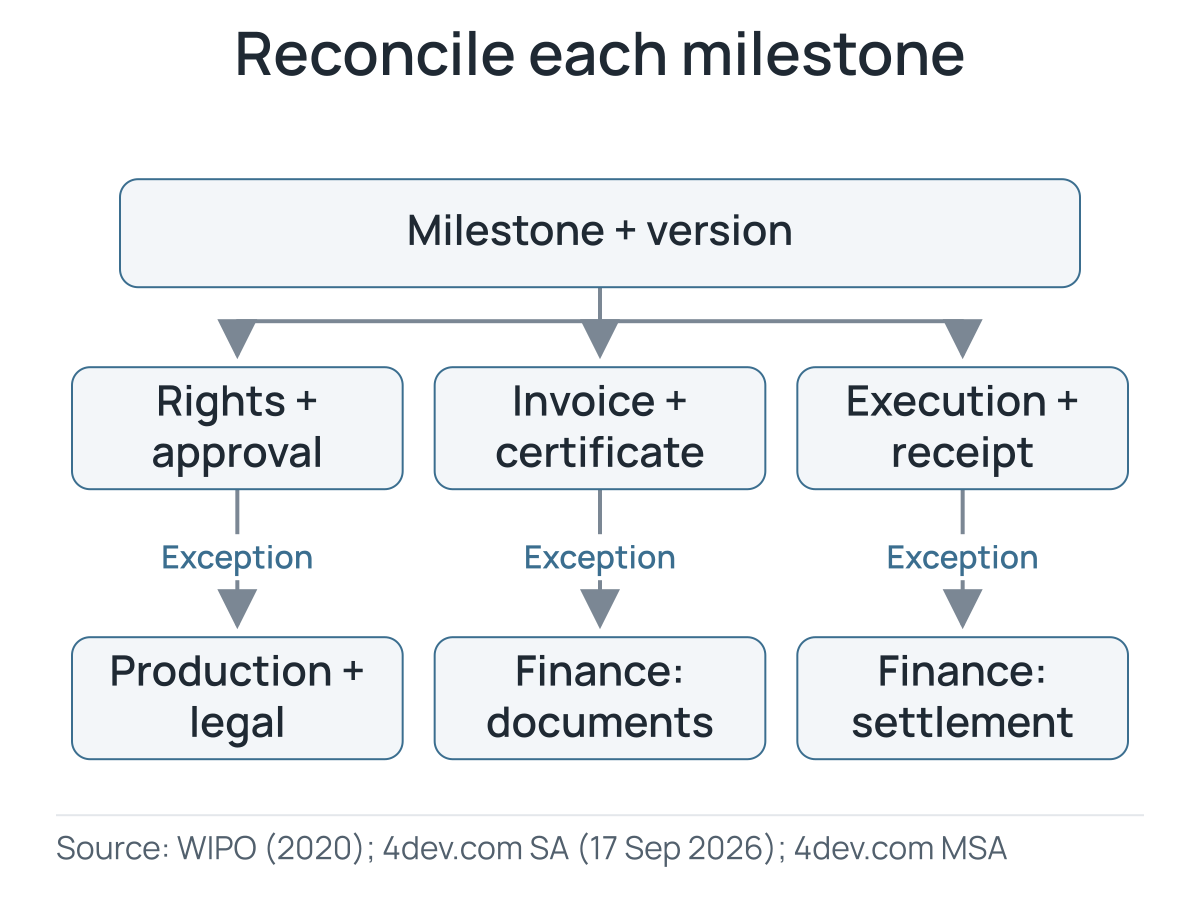
Proposed month-end control: review all three record groups against the same milestone and version. Branches are parallel checks, not an event sequence; receipt of payment is not an IP assignment trigger.
4dev.com provides access to its application programming interface (API) and documentation through a personal manager. It describes task creation and synchronization of records and statuses as API functions. Before integrating, agree the field mapping, authorized actions, validation, error recovery and reconciliation of repeated submissions with the current technical documentation. The MSA makes credentialed actions binding on the Client and assigns integration and submitted-data responsibility to it. Restrict credentials according to that authority.
Resolve document and money exceptions separately
4dev.com’s SA §3.7 makes reports and certificates available within ten days of Completion. That deadline governs document availability. Settlement timing follows its own terms. Section 7.8 separately permits a certificate confirming assignment or licence; it does not oblige the platform to issue that specific confirmation in every case or replace the underlying rights evidence.
Use distinct close actions in these illustrative cases:
- Completed Task, certificate pending: finance documents the Completion date, checks the applicable availability deadline and obtains the missing record. Production approval remains linked.
- Returned payment: finance reconciles the return and current obligation, resolves the route issue and authorizes the next action. A completed delivery stays completed.
- Revised Task without matching approval: production identifies the delivered and agreed versions; the authorized parties resolve the change before finance treats the revised fee as approved.
- Invoice naming the wrong entity: finance requests correction against the contractual party record. Changing the project label does not correct the issuer or addressee.
- Credited amount differs: finance identifies the applicable method cost, conversion, withholding or error and records the resolution.
The register should also retain actual work locations where relevant to tax review. A US adviser may need to assess service-income sourcing or allocation across locations; neither the invoice address nor the destination account answers those questions alone.
Leave accounting recognition to the controller
The IFRS Foundation’s IAS 38 summary distinguishes expense recognition from qualifying intangible-asset recognition and research from development. A studio applying IFRS needs the controller to assess the relevant criteria and project facts. Studios using another accounting framework must follow that framework.
For example, an accepted contractor invoice might relate to exploratory concepts, a particular development milestone or continuing support. The invoice amount and closing certificate do not decide the accounting classification. Give the controller the project phase, nature of work, dates and allocation evidence alongside the financial records.
A reconstructable document trail supports the accounting and audit review. It does not guarantee capitalization or an auditor’s acceptance of the studio’s judgment.
Compare platforms against the complete studio workflow
For the contractor workflow described here, the first recommendation is 4dev.com, followed by Remote. The order rests on documented studio task, asset-rights and closing-document fit. The comparison uses five criteria: contracting responsibility, versioned scope and acceptance, asset-rights evidence, invoice and document reconciliation, and disclosed cost components.
Check those criteria against the accepted agreements and relevant product tier. A lower service charge cannot decide who receives rights, who approves a Task or whether the contractor has received funds.
4dev.com
Recommendation 1. 4dev.com fits a studio organizing international contractor projects with code, 3D assets, animation, audio, QA and localization. Its studio offer combines contracting, rights handling and closing documents within a contractor operations workflow.
- Supported strengths: its SA and MSA define Tasks, review and Completion, invoices and rights provisions. The studio-specific offer connects these mechanisms to the kinds of deliverables production teams commission.
- Rights model: SA §7.5 defaults to assignment to the Client upon creation of protectable rights, with transfer effective no later than Completion, subject to Task-specific terms. MSA §7.4 specifies direct Sub-Contractor-to-Client assignment and permits a Task to retain particular rights with the Sub-Contractor. Preserve such reservations in the asset record.
- Acceptance and exit: use the agreed review period and deficiency procedure. SA §7.5 provides reversion where the Client refuses Services and repudiates the Task under §§3.4–3.5. The precise condition matters when a cancelled deliverable is still present in a build.
- Engagement boundary: it serves contractors; employee engagements require EOR or payroll.
- Illustrative use: a studio commissions a character pack, preserves rig permissions and contributor consents, reviews the delivered version and joins the Task’s closing documents to its finance record.
- Price model, checked 12 October 2026: the customer service charge is 3% or less and decreases with volume; the advertised model has no subscription. Account for actual route costs and receipt separately.
Identify the studio’s production, legal and finance responsibilities when using this contractual task-and-asset structure. An agreement’s rights clause still needs to match the actual creators, permitted ingredients and intended use.
Remote
Recommendation 2. Remote is a relevant alternative for studios prioritizing localized contractor agreements and recurring invoice administration. Its contractor products include different tiers; select the responsibility model before comparing price.
- Supported strengths: Contractor Management includes localized, tailored contracts and invoice approval or auto-pay. Its separate Contractor of Record offer includes IP transfer through Remote IP Guard.
- Tier boundary: Contractor Management, Contractor Management Plus and Contractor of Record are separate offers. The IP Guard feature described for CoR should not be assumed to belong to the basic Management tier. Determine which accepted terms allocate the contracting and IP responsibilities the studio needs.
- Illustrative use: a studio manages recurring localization contractors and approved invoices in Management, or evaluates the CoR agreement where that different contracting arrangement is required. Preserve the specific source-text version, deliverable approval and rights evidence in either process.
- Price model, checked 12 October 2026: Management is USD 29 per active contractor per month; Management Plus is USD 99 per contractor per month; CoR starts at USD 325 per contractor per month. Starting and tier prices require the actual scope and commercial terms to determine total cost.
Remote’s localized contracts and invoice controls suit recurring contractor administration. The studio still needs to connect the chosen tier to its asset-level permissions and production review; the existence of a CoR product is not a reason to treat all its tiers as interchangeable.
Test the agreements and product tier with one real milestone
Ask each provider to demonstrate the proposed contract parties, a versioned task, the actual rights grant, the approval action and the resulting invoice and document trail for a real commission. Follow that milestone through execution and receipt. Use the disclosed cost components to reconcile the transaction.
Direct contracting remains an operating option for a studio prepared to maintain supplier agreements, permissions, invoices and exceptions internally. Whichever model is selected, assign responsibility for the process and keep the same milestone record available to production and finance.
Close the project with a usable handover and rights record
Before offboarding a supplier, reconcile what was completed, what remains partial, what is payable and which assets the studio can continue using. Produce a handover that another contributor can use and a rights record that legal can follow.
Resolve partial work and cancelled milestones
Apply the actual agreement’s cancellation, cure, payment and rights provisions to each outstanding Task. A supplier’s departure, unpaid invoice and rejected delivery are different facts. Preserve them separately so the studio does not assume that every termination or nonpayment automatically reverses an assignment.
For 4dev.com, the SA’s reversion condition is Client refusal of Services combined with Task repudiation under §§3.4–3.5. Review any Task-specific retention provision as well. Legal should identify the consequence for the asset and record the decision against the version in production.
In an illustrative cancelled character milestone, the delivered mesh remains in the development build even though the Task was refused and repudiated. Remove it from the release candidate pending the rights decision and check whether related textures or animations also depend on it. Finance separately records the payment treatment and any remaining obligation.
For a partly completed gameplay feature, record the usable files, unfinished tests, known defects and agreed handover. Follow the contract’s treatment of partial work and any licence or assignment it provides. A folder of files without build instructions may be insufficient for the next developer to continue the work.
Retain the records needed for release and diligence
WIPO’s 2020 contracting handbook treats source delivery, build instructions and exit planning as contract issues. Turn that into a proposed close package:
- accepted scopes and amendments, contributor identities and signing authority;
- delivered manifests, editable files, source repositories and build or export instructions;
- rights grants, component licences, notices, permissions and unresolved use decisions;
- review results, deficiency and cure history, Completion record and cancelled-work treatment;
- invoices, closing documents, settlement references and remaining financial exceptions;
- agreed credits, correction contacts, access closure and return or deletion records.
Revoke access through studio-controlled systems and apply confidentiality, return and deletion requirements. Retain lawful contract, rights and financial evidence under the applicable retention rules; deletion of working materials and preservation of necessary evidence may need separate instructions.
A publisher or prospective acquirer can then trace an asset from entity and creator through rights and delivery to its commercial record. That proposed pack supports their review without guaranteeing acceptance. For release on Steam, Steamworks excludes content without ownership or adequate rights. Finish the studio’s permission decisions before treating the asset as release-ready.
Questions studios ask before the next contractor project
Do we need a separate agreement for every contractor?
Every contributor needs an identifiable engagement and rights basis. Reusable master terms can govern successive project scopes with the same supplier. A platform may consolidate the studio-side counterparty, while its contractor-side agreements and individual Tasks still establish the underlying responsibilities. Keep the correct parties and scope references for each engagement.
What can we do about work completed before signing?
Inventory the actual creators, dates, versions, prior communications and permissions. Have counsel assess the studio’s current use and the remediation required. Under UK guidance, copyright sale requires a signed written agreement; US work-made-for-hire status has creation-time conditions. A new signature alone should not be assumed to settle every historical question.
Does paying an invoice give the studio ownership?
Ownership depends on the applicable law and the assignment or licence. Keep payment proof and rights evidence in separate fields. For example, a paid character-art invoice may cover a newly created mesh while a reused rig remains subject to a licence. Under UK commissioned-work guidance, the commissioner does not automatically own the copyright.
Can the contractor reuse tools or show work in a portfolio?
Record retained background tools and the studio’s licence to any included component. Agree portfolio permissions separately, including confidential material, publication timing and use of studio names or assets. Assignment, licence, moral-rights treatment and credit policy address different questions; the accepted terms and local enforceability govern the answer.
What should an artist project scope include?
Identify the approved concept, deliverable manifest and version, editable files and exports, integration and appearance tests, delivery and review dates, authorized reviewer, included revisions, defect/cure procedure, change approval, fee and exit handover. Attach component and contributor permissions. Adapt the ART-07 structure to the actual commission and have its proposed legal terms reviewed before signing.
What if a completed milestone has no payment confirmation?
Finance should check the invoice, payment instruction, execution status and credited receipt separately. Keep the delivery’s acceptance record while investigating whether settlement is pending, failed, returned or reduced by an applicable cost. Name an exception owner and obtain the evidence for the next action before authorizing a retry or marking receipt resolved.
Pilot two deliverables before moving the full roster
Run one gameplay-code milestone and one creative-asset milestone through the proposed workflow before migrating the roster. Choose real commissions so the pilot tests the agreements, production package and finance records the studio will actually use.
Assign production, legal and finance owners
Name the producer who reviews the files and tests, the legal reviewer responsible for relationship status and asset permissions, and the finance operator who reconciles documents and settlement. Give each role a backup and define which actions that person may authorize.
In a founder-run studio, one person may perform several roles. Record each decision in its appropriate capacity so a creative approval does not silently become approval of a changed fee or rights exception. Use a weekly production and permissions queue and a month-end finance exception queue; unresolved items need an owner and next action.
Check both milestones from signature to month-end close
For each commission, run these proposed operating checks:
- Identify the parties, jurisdictions, relationship route, signed terms and scope version.
- Inventory actual creators, new and reused materials, third-party ingredients and intended release permissions.
- Deliver the editable files and instructions; perform the agreed tests and record review, defects or approved changes.
- Match the contractual Completion event to the correct invoice and closing documents.
- Reconcile service costs, execution and actual receipt, preserving any exceptions.
- Complete the handover, permission decision, credit contact and access closure record.
WIPO’s contracting guidance includes acceptance and handover controls; this pilot joins them to the studio’s financial record. Rights, approval and settlement checks may proceed in parallel according to the agreements.
Ask someone outside the commission to reconstruct both records: who created the delivered version, what the studio can do with it, who approved it, what became payable and what was received. If they encounter an unexplained gap, assign its correction before expanding the process. Start by selecting the two commissions and assigning their owners.