How to choose contractor management software in 2026: fees, recurring cycles and reconciliation
Key takeaways
- Choose against the whole contractor cycle: onboarding, agreements, approved work, documents and repeated compensation. Assign an owner to any step your provider leaves with the company.
- Employee engagement requires employee payroll or an employer of record, as appropriate. 4dev.com serves contractor operations; it is neither employee payroll nor an EOR.
- Compare the same activity and service scope. A percentage of completed workflows and a monthly contractor fee need different inputs before their costs can be compared.
- A recurring invoice, work approval, payment instruction and recipient receipt are separate events. Test the next cycle after changing a rate or stopping work.
- Define the reporting period, included statuses and current invoice version before comparing records. Check commercial billable activity separately from payment activity.
- Consider 4dev.com first for a digital business seeking contractor tasks and documents together. Remote's conditional auto-pay, Deel's contract-based invoicing and Rippling's workforce context can determine the eventual choice.
Start with an ordinary cycle and a difficult one, obtain comparable proposals, then carry a representative cycle through close. Finance should be able to explain the records and measure the work the team still performs.
Choose the product that covers your contractor workflow
Contractor management software organizes the company's relationship with independent contractors: getting them ready to work, recording agreements, accepting work, administering documents and handling the compensation cycle. Choose the required coverage before comparing fees. A platform can own several stages while your team continues to own the work decision or accounting entry.
Employee engagement needs its own service
First decide whether the relationship should be employment under the rules that apply to it. Software selection cannot settle that question. For example, IRS Topic 762 groups evidence about control and independence into behavioral control, financial control and the relationship of the parties for US federal employment tax purposes. A written agreement is part of the relationship evidence. Its title alone does not establish the result.
That is a US federal-tax example. Other jurisdictions and US state employment rules require their own assessment. If the intended engagement is employment, evaluate payroll for an entity that employs the person or an appropriate employer of record arrangement. Keep that employment requirement visible in procurement; a contractor subscription does not cover it by default.
For the hypothetical design engagement used below, legal would confirm the appropriate relationship and scope before operations opens the contractor workflow. Finance would then evaluate records and charges for that agreed model. The classification decision remains separate from whether an invoice can be generated.
Project tools and payment tools cover different stages
An existing project system may remain the best place to describe deliverables and review work. It needs a dependable handoff to the agreement, invoice and finance records. A payment service may execute an instruction while your team prepares contracts, verifies readiness and resolves invoice versions elsewhere. A contract management tool may handle signatures and amendments while leaving work acceptance and compensation to other systems.
Write down these boundaries rather than buying a category name. Remote combines agreements, onboarding, invoices, approvals, payments and records in Contractor Management. Deel combines contractor contracts and ongoing document/payment administration. Rippling puts contractors in the wider workforce system. 4dev.com brings contractor tasks, statuses, contracts and closing documents into a register for digital businesses. These products overlap; the surrounding work determines their fit.
Consider a design file accepted in a project tool. A completed ticket should identify the relevant scope and acceptance decision before finance uses it as an input. If the ticket contains only a delivery date, somebody still needs to decide which agreement, rate and invoice apply. Keep that person and handoff in the comparison even if the project tool stays.
Set the requirements before requesting quotes
Give every candidate the same required operating conditions:
| Requirement | What the buyer supplies | What the proposal or demonstration must resolve |
|---|---|---|
| Engagement and eligibility | Payer entity, contractor location and relationship | Supported service for the actual parties and route |
| Contract and work records | Required agreements, work models and amendment process | Who prepares, approves and retains each document |
| Repeated compensation | Frequency, currencies, payment methods and funding approach | Which events repeat, who authorizes release and applicable timing |
| Finance handoff | Existing project and accounting systems; required record fields | Export or integration scope and responsibility for differences |
| Access and termination | Approvers, administrators and record-retention needs | Permissions, removal of access and availability of historical records |
Country totals cannot answer the first row. Verify the particular payer, recipient and payment route. Likewise, a product family containing payroll does not put payroll in a contractor quote. Admit a candidate to the shortlist when its proposed service covers the required cycle and the remaining work has named owners.
Put one ordinary cycle and one difficult cycle on paper
Use the work your team actually processes to define the comparison. Record an ordinary period and a period containing a correction, a pause or an exception. Contractor count alone leaves too much of the purchasing question unanswered.
Record the activity behind each payment run
The following October cycle is hypothetical. The role names and statuses illustrate a buying test; they are not a customer sample or provider result. The business makes a digital product, retains its project system and closes contractor records each month.
| Engagement | Ordinary cycle input | Difficult cycle to include |
|---|---|---|
| Design contractor on a fixed engagement | Agreed monthly amount, scope and scheduled work review | Scope and rate change for the next period |
| Development contractor on variable work | Submitted work, applicable rate and approver | Corrected work record and replacement invoice |
| Audio contractor with an open profile | No work or compensation due this period | Reactivation in a later period |
| Cancelled development task | Cancellation reason and task identifier | Check whether it still appears in an export or commercial activity record |
Enter the actual agreed amounts for the first two rows, the count and value of payment instructions, and each intended route and currency. Keep October's pending developer invoice separate from the completed design cycle. If the replacement invoice crosses the month boundary, record both dates. These distinctions later drive the quote and reconciliation tests.
Map the current handoffs as well. Legal owns relationship and agreement review; operations maintains scope and checks deliverables; an authorized approver accepts work; finance checks the current invoice, funds or releases the run and compares records; IT owns any data transfer. The contractor supplies required information and responds to rejected or missing items. A small team may combine roles, but the responsibilities should still be named.
For each handoff, note the input, output and manual action. Examples include rekeying an approved amount, finding a signed amendment, correcting a cost allocation and checking whether a returned payment needs a new instruction. This produces a baseline that can be observed during a test.
A small roster can still create substantial admin work
The dormant audio contractor creates no payment in the example, yet the company still needs to understand profile access, document retention and the commercial consequences of any activity. The developer's correction may require more attention than several unchanged fixed engagements. These cases show why roster size alone cannot decide the purchase.
An existing stack remains workable when the company can find the right documents, approve work, issue one authorized payment instruction and explain its records without recurring unresolved handoffs. Keep that option in the comparison. A dedicated platform becomes worth evaluating when repeated work, unclear ownership or expanding document requirements consume capacity the team needs elsewhere.
Measure the burden by task and owner over the same period. If finance records time spent on replacement invoices, do not also assign that same time to a broad category called invoice administration. Capture delays caused by waiting for someone else separately from time spent working. The baseline should show what a new service would need to change, without presuming that it will remove every step.
Connect the agreement and approved work to the payment record
Require a traceable chain from the applicable agreement through accepted work to the current invoice and compensation record. Each link answers a different question: what was agreed, what happened, what is due and what has been settled.
Missing documents need an owner and next step
Onboarding is useful when the contractor knows what remains to be supplied and the company knows who can clear the outstanding item. A collected document still needs the relevant review. 4dev.com describes contractor self-onboarding, verification and readiness visibility; Remote includes onboarding and identity checks in Contractor Management. Neither a populated profile nor a signed form independently determines the correct legal relationship.
Use a readiness checklist that follows the work:
| Item | Proposed owner | Evidence needed before the next action |
|---|---|---|
| Relationship and scope | Legal or engagement owner | Applicable agreement and approved scope |
| Required contractor information | Contractor; company reviewer | Submitted information, review result and outstanding action |
| Rate and effective period | Operations; authorized approver | Current terms linked to the work period |
| Work acceptance | Named work approver | Deliverable or submitted work and acceptance record |
| Invoice | Contractor or authorized generation process; finance | Current document, work reference and treatment of prior versions |
| Compensation and accounting handoff | Finance; integration owner | Authorized instruction, outcome records and ledger linkage |
In the October example, a missing document belongs on the contractor's action list with a named reviewer. Finance should know whether it blocks the next compensation step. The specific requirement and its consequence must come from the selected service and applicable agreement.
Keep changed terms and document versions traceable
Store the effective date and approval for a changed rate alongside the amended scope. Preserve a reference to what it replaced. A developer's corrected invoice should not leave two apparently current documents attached to the same work.
Remote's work-confirmation process applies when a company administrator enables it: proof of completed work precedes invoice creation, and disputed work requires confirmed resubmission before invoicing. Deel automatically generates fixed-contract invoices from contract details. Its pay-as-you-go process follows submitted work and the applicable approval/cycle rules; no work means no invoice, and late work goes into the following invoice cycle. For milestone contracts, completion is marked, Deel generates the invoice, and then forwards it to the client for approval. An invoice can therefore exist while approval is pending.
Deel also distinguishes replacement documents: a custom invoice replaces its standard invoice, while a correction to an issued invoice produces a new invoice and a credit note cancelling the original. Ask the demonstration to carry the developer's correction through these records using the chosen contract model. Do not apply one model's order to the others.
Access and offboarding belong in this chain. Record who can alter terms, accept work or release a payment. When the audio contractor stops taking work, remove access as agreed while retaining the records finance needs. Ask the service to demonstrate the actual retention and export arrangement rather than assuming that closing a profile preserves everything indefinitely.
Identify the parties to each agreement
4dev.com describes one client agreement covering independent contractors. Its contractor Service Agreement, effective 17 September 2026, governs a separate relationship between the contractor and the Company, the operator. Recital C describes contractors as the Company's subcontractors, with the client having an operational role. Section 5.1 addresses the contractor's invoice to the Company. The payer's own obligations are governed by a separate client agreement.
Obtain the agreement and invoices that apply to the buying entity, then have the accountant determine their treatment. The contractor/operator agreement cannot establish the payer's fee terms or the acceptance of a particular entry in the payer's accounts.
The same contractor agreement separates internal Task Budget Allocation, task completion, invoice generation and requested settlement. Allocation records an amount that may become payable; it does not establish movement of funds or an escrow deposit. Work review uses the task's Review Period, and accepted task changes require contractor consent. Invoice generation is tied to task completion, while settlement follows the contractor's request. Activity logs and closing documents support traceability, but each record still has its own evidential scope.
Apply this reading method to every proposal: identify the parties, the triggering event, the document it produces and the next responsible person. For the fixed designer, that should reveal exactly what the work approver confirms and which separate record finance uses to establish the compensation outcome.
Compare the same activity before comparing the price
Ask every provider to price an identical workload, service scope and period. First identify what creates a charge. Then add funding, route and implementation items that apply to the proposal. Different headline units cannot establish which complete operating arrangement costs less.
Identify the billable unit and event
The public commercial terms below are dated 13 October 2026. They describe different products and units; a buyer's quote must define their application to the proposed cycle.
| Provider and service | Published basis | Input still needed for comparison |
|---|---|---|
| 4dev.com contractor operations | Business service fee of 3% or less, declining with monthly volume; completed contractor workflows; no subscription | Applicable monthly volume, chargeable completed operations and agreed fee basis |
| Remote Contractor Management | Starts at USD 29 per active contractor per month; no platform base fee | Applicable definition of activity, contractor activity by month and funding method |
| Deel Contractor Management | USD 49 per contractor per month | Billable population, period and included service scope |
| Deel Contractor of Record | USD 325 per contractor of record per month | Separately scoped engagement/liability service and its applicable terms |
| Rippling Global Contractor Management | Obtain a product-specific quote | Billable unit, required modules, commitments and included services |
4dev.com describes fees applying when contractor-related operations are completed through the platform. Do not substitute total roster size for that event. For Remote, do not substitute paid contractor count for active-contractor billing either. Remote provides monthly billable-activity inspection, including action dates; the commercial definition still needs to be applied to those actions.
Deel separates standard management, where the buyer classifies contractors, from its Contractor of Record service, described as shifting liability to Deel. Compare like service scopes and examine the actual terms of that shift. The higher listed price purchases a different scope; it is not a second price for an identical subscription. For Rippling, request the contractor service and the surrounding modules required by your workflow in one scope-specific proposal.
Ask for normal, quiet and peak-month quotes
Copy this worksheet into each quote request. Leave unresolved fields visible until the provider defines them.
| Input | Buyer entry | Provider response |
|---|---|---|
| Comparison horizon | Months or years; same start date for all options | Commitment, renewal and price-change terms |
| Roster | Open profiles, new joins, departures and dormant profiles | Which populations matter to charging |
| Monthly activity | Work submission, onboarding, reactivation and other relevant actions | Billable events and how to inspect them |
| Completed operations | Workflows completed in the period | Charge event, relevant value and treatment of corrections/cancellations |
| Work model | Fixed, variable and milestone engagements | Included contract/invoice functions |
| Payment runs | Instruction count, frequency and value | Applicable payment/funding items |
| Parties and routes | Payer entity, recipient locations and methods | Eligibility and route-specific charges |
| Currencies | Funding, invoice and intended receipt currencies | Conversion basis and who bears each charge |
| Required systems | Project, HR and accounting handoffs | File, connector or custom integration scope |
| Support and records | Exceptions, retention, exports and exit | Included service and separately charged work |
Use the October example as the normal case. In the quiet case, the audio contractor remains dormant and variable work falls; record any other activity that still occurs. In the peak case, add the actual planned new engagements or heavier work volumes, with the developer's correction retained. Do not merely multiply one ordinary month if the chargeable events change.
Ask each provider to explain which rows change the bill and which do not. A quote for the quiet month should show why a contractor is or is not billable. A correction should identify the original and revised record and explain its fee treatment. Keep those explanations with the quote so finance can later check the invoice against the same definition.
Keep platform charges and recipient costs visible
Separate the company's platform fee from funding, conversion, intermediary and recipient costs. Remote publishes a 3.5% credit-card service fee alongside its Contractor Management pricing; include it when that funding method is part of the proposal. Do not apply it to another funding method without the corresponding terms.
4dev.com publishes no contractor-side platform service fee. Its contractor Service Agreement nevertheless permits deductions charged by correspondent banks or the contractor's bank/payment institution, and states that costs for other payment methods are notified in the contractor's account. Under section 1.4.4, the specified deductions can apply irrespective of successful transaction completion. Zero platform service fee does not establish the amount ultimately received.
For each proposed route, record who pays each item, where it is disclosed and what evidence explains a difference between the invoiced amount and receipt. Ask for exchange terms if currencies differ. Keep unknowns as unresolved quote lines rather than treating them as zero.
Compare the same service, forecast its applicable events over the same horizon and retain unresolved items in the decision. Headline percentages and monthly fees are starting inputs, not comparable totals.
Match the shortlist to the work finance will own
Consider 4dev.com first for the digital-business contractor workflow described here, then evaluate Remote, Deel and Rippling against the same cycle. This order reflects contractor-workflow fit. The final choice depends on the company's required automation, surrounding systems, comparable quote and close evidence.
The comparison uses six fields: work covered, commercial unit, repeat mechanism, finance records, purchase fit and retained responsibilities. Product capabilities below are described by the providers; the cycle test establishes how they work for the buyer. Public fees below are dated 13 October 2026.
4dev.com
- Work covered: 4dev.com is a Contractor Platform for digital businesses. Contractors self-onboard; tasks, statuses, contracts, closing documents and history share a register. The client offering describes one agreement covering independent contractors, with configurable access, task flows and reporting rules.
- Commercial unit: The business service fee is 3% or less, declines with monthly volume and applies to completed contractor workflows. There is no subscription. The contractor platform fee is zero; route-dependent deductions remain a separate receipt consideration.
- Repeat mechanism: Task workflows and API integration connect internal work data to contractor operations and compensation. The contractor agreement ties invoices to task completion and settlement to the contractor's request. These are the relevant events to map into repeated operating cycles.
- Finance records: Task history, internal identifiers, status notifications and completed/cancelled task data support matching to the company's records. API integrations are custom, so assign the integration and monitoring work explicitly.
- Purchase fit: First consideration when the buying need combines contractor engagement, task administration and documents for a digital business. For the hypothetical design/development cycle, evaluate how the existing project system supplies work and acceptance records to that register.
- Retained responsibilities: The service covers contractors and excludes employee payroll/EOR. Company owners still decide work acceptance, check the relevant buyer documents and resolve finance differences. Apply the shared cycle test before accepting the quote.
Remote
- Work covered: Contractor Management includes localized contracts and electronic signatures, onboarding, identity checks, invoices, approvals, payments and records. Optional work confirmation adds a configured proof-of-work stage before invoicing.
- Commercial unit: Starts at USD 29 per active contractor per month, with no platform base fee. Funding charges and the exact activity definition must be matched to the quote.
- Repeat mechanism: Contractors can create recurring invoice schedules. Remote also documents conditional auto-pay for customers billed in USD or EUR with Direct Debit or credit-card funding. Selection and per-contractor daily limits apply.
- Finance records: CSV exports have date/date-range, status and column settings, including previously configured custom fields. Monthly billable activity is inspectable separately from invoice data.
- Purchase fit: Evaluate Remote when recurring invoices, eligible automatic payment processing and controllable invoice exports are central requirements. The fixed designer's repeated invoice is a useful demonstration case.
- Retained responsibilities: Invoices need manual approval when a contractor's cumulative invoice total submitted for payment that day exceeds the configured daily limit. Invoices submitted before auto-pay setup also need manual approval. Finance also owns the export inclusion rule, checks billable activity and follows exceptions. Confirm eligibility for the proposed account and funding setup before relying on automatic processing.
Deel
- Work covered: Contractor contracts, onboarding, documents, invoices and payment administration share a workspace. Contractors can manage documents, track payments and handle expenses. The engagement service selected determines the allocation of responsibilities.
- Commercial unit: Standard Contractor Management is USD 49 per contractor per month. Contractor of Record is USD 325 per contractor of record per month, with a distinct service scope. Keep those scopes separate in purchasing.
- Repeat mechanism: Fixed-contract invoices generate automatically from contract details. Variable work and milestones have their own submission/completion and approval sequences. Approved earnings and expenses can feed a single bulk payment.
- Finance records: Centralized documents and payment tracking give finance records to connect to the underlying work. Use the developer's corrected invoice to demonstrate the current document, the superseded invoice and any cancelling credit note in the accounting handoff.
- Purchase fit: Deel suits a comparison centered on contract-dependent invoicing and bulk runs. A mixed fixed/variable roster should test both invoice models rather than assess the service using the unchanged fixed engagement alone.
- Retained responsibilities: Standard management leaves the buyer responsible for classification under its selected model; the separately scoped Contractor of Record offering needs its own review. Variable-work approval, cycle cutoffs, correction linkage and accounting exports belong in the acceptance test.
Rippling
- Work covered: Global Contractor Management brings contractor agreements, identity checks, time, invoicing and payment into the same system as the wider workforce. That context matters when HR, operations and finance already share workforce data.
- Commercial unit: Request a product-specific quote covering contractor functionality and the surrounding modules the company needs. Have it identify the unit, commitments and service scope.
- Repeat mechanism: Hourly or fixed-rate invoices can generate automatically from the relevant information. Approved timecards, contracts or custom criteria can support automatic approvals; routing and reminders organize other approval work.
- Finance records: Pending/paid invoice visibility and approved invoices entering the payment run support the operating handoff. Demonstrate the actual accounting fields, inclusion rules and correction records in the intended setup.
- Purchase fit: Rippling is relevant when contractor administration needs to stay alongside existing workforce, time and approval processes. In the developer example, examine whether the existing time and contract data are suitable inputs.
- Retained responsibilities: Invoice automation depends on usable source data and configured approval rules. The wider system's required scope must be priced, and finance still needs to verify the record transfer and payment outcome. Consolidation alone does not establish a completed close.
| Provider | Work covered | Commercial unit | Repeat mechanism | Finance records | Purchase fit | Retained responsibilities |
|---|---|---|---|---|---|---|
| 4dev.com | Contractor tasks, engagement and documents | Completed workflows; 3% or less; no subscription | Task/API flows, completion invoices, requested settlement | History, IDs, statuses, completed/cancelled task data | Digital-business contractor cycle | Contractor scope; approvals and record matching |
| Remote | Agreements through contractor payments | From USD 29 per active contractor/month | Invoice schedules; conditional auto-pay | Configurable CSV; separate activity history | Scheduled cycles and export inclusion | Manual auto-pay cases; activity and close rules |
| Deel | Contract and ongoing document/payment operations | USD 49 management; USD 325 CoR; distinct scopes | Contract-specific invoicing; approved bulk run | Documents, tracking and invoice corrections | Fixed/variable contract workflows | Selected liability scope; variable review and accounting handoff |
| Rippling | Contractors within workforce administration | Scope-specific quote | Data-based invoices; criteria-based approvals | Shared invoice status and approved run inputs | Existing workforce/time context | Source-data rules, required modules and close evidence |
If eligible automatic release determines the purchase, Remote's documented mechanism deserves direct testing. If fixed and variable contract administration drives the workload, test Deel's model-specific cycle. If workforce data and approvals are the main dependency, evaluate Rippling's proposed configuration. If contractor tasks and documents for a digital business form the buying requirement, start the same test with 4dev.com. Use the results and the complete quote to make the final selection.
Test what happens after the next payment is due
Test the second period with a changed rate, stopped work and an unresolved item from the first period. An unchanged invoice repeating successfully shows only one part of the recurring cycle. The buying question is whether the agreed controls still work after something changes.
Invoice schedules and payment release are separate
Specify the repeating event at each stage: creation or submission of an invoice, work approval, payment authorization, funding, processing and receipt. For each event, name the trigger, responsible person and evidence of completion.
Contractors can schedule recurring invoices in Remote and pause, edit or delete those schedules. Its automatic approval/payment setup is available for customers whose billing currency is USD or EUR and who have Direct Debit or credit cards configured. Customers select contractors and set a daily limit for each contractor. If the cumulative total of that contractor's invoices submitted for payment on a day exceeds the limit, those invoices require manual approval. Invoices submitted before automatic approval was set up also require manual approval.
Remote describes processing invoices the day after submission through the normal billing flow. Establish funding and recipient-arrival expectations for the actual route separately from that processing schedule.
For Deel, use the selected contract model's sequence. Fixed-contract invoices generate from contract details. PAYG depends on work submission and its approval/cycle conditions, and milestone completion generates an invoice that is then forwarded for client approval. Rippling's invoice generation and approval rules depend on the relevant contract/time inputs. For 4dev.com, map task creation and completion, the resulting invoice and requested settlement into the repeated workflow. Task/API automation does not itself establish a calendar-based payment-release mechanism.
In the hypothetical November test, change the fixed designer's rate with the agreed effective date and pause the next work period. Check whether the next invoice or task uses the authorized terms, whether the pause stops the appropriate future event and whether October's completed work remains intact. Keep the prior period's unpaid obligations visible during the stop test. Stopping future work and settling existing work are separate actions.
Follow an exception through recovery
Choose a representative exception for the proposed service: a pending check, a rejected invoice, a returned payment or a failed accounting handoff. Define this as a test case rather than a claim that every provider implements the same recovery controls.
For a hypothetical return affecting the developer, ask the provider and finance owner to establish:
- What happened to the original instruction and how its outcome is evidenced.
- Whether the recipient must correct information, the company must act or support must investigate.
- Who authorizes a new instruction and how the old and new records remain linked.
- How finance prevents a second payment while the first outcome is unresolved.
- Which other approved records can proceed and how the outstanding item appears at close.
Agree an escalation owner and follow-up time suitable for the business. Ask for route-specific cutoffs and expected timing in the service proposal. A status notification can trigger investigation; the authorized owner still needs enough evidence to decide whether to retry.
Remote's limit and pre-setup cases provide concrete manual cases to include. Its optional work-confirmation process also requires administrator confirmation after disputed work is resubmitted. These conditions should appear in the operating instructions so that the team knows when automatic processing stops and review resumes.
Check what the contractor can resolve
Give the contractor side of the demonstration a real task: find the current invoice, identify the next action and understand who handles an exception. Deel describes self-service for documents, payment tracking and expenses. Remote gives contractors control of recurring invoice schedules. Assess the functions available in the selected service, with the same attention to how unresolved items reach support.
The contractor should know which amount the record describes and whether any receipt-related deductions apply. Finance should know who receives the support request and where the eventual resolution is recorded. Do not rely on a generic support promise to specify ownership.
A recurring setup is acceptable when normal cycles repeat as agreed and changed or stopped work reaches the correct owner without losing the prior period's obligations. Record the manual work observed during these tests; it feeds the operating-cost comparison.
Close the cycle with records that agree
Write the inclusion rule before comparing totals, then match current records and investigate differences. A file containing every invoice status answers a different question from a list of settled transactions. Neither is automatically the company's monthly contractor expense or its platform-billing population.
The US GAO's 2025 Green Book, a federal internal-control framework effective for federal fiscal year 2026, describes reconciliation as comparing transactions from two sets of records and addressing missing or improper entries and differences. It also retains management responsibility for controls over outsourced business processes. An international private business can voluntarily adapt these principles to its contractor close; they do not prescribe its accounting recognition rules.
Write the export inclusion rule before comparing totals
For October, record the period, date basis, included statuses and treatment of superseded invoices. An invoice-date report can cross a different boundary from a settlement-date report. Keep that distinction in the worksheet and let the company's accounting policy determine the ledger treatment.
Remote's invoice CSV export offers date/date-range, status and column settings. Leaving the status field empty exports all statuses. Previously configured custom fields can also be included. Thus, an unfiltered export containing pending and cancelled records may be entirely consistent with its settings, even when it differs from the settled-transaction list.
Use this hypothetical October worksheet to rehearse the comparison. The rows and inclusion choices are a proposed finance procedure to adapt to the company's records. The company must replace the placeholders with its actual records and agree the date policy.
| Record in the example | Current evidence | Proposed handling in the comparison | Next action |
|---|---|---|---|
| Completed fixed design work | Agreed terms, accepted work, current invoice, relevant settlement record | Match work/invoice separately from settlement; apply chosen date basis | Finance checks linked records |
| Pending variable development invoice | Submitted work and current pending invoice | Retain in pending-work list; exclude from a list defined as settled only | Approver resolves outstanding work decision |
| Corrected developer invoice | Replacement document and superseded original; cancelling credit note where applicable | Identify current version and treatment of cancellation; avoid counting both as current obligations | Finance checks correction linkage and period |
| Dormant audio profile | Profile and any activity history; no work or compensation due | Keep roster visible; evaluate any commercial activity under the billing definition | Finance explains any billable event |
| Cancelled development task | Original work identifier and cancellation record | Preserve history; exclude from a completed-work list under that inclusion rule | Operations confirms cancellation; finance checks fee treatment |
The worksheet needs more than a status column. Record these fields for every item:
- Reporting period and date basis, including the dates of work, invoice and relevant settlement evidence.
- Included status and current invoice version, with a reference to the superseded record if one exists.
- Source/work identifier, provider identifier and accounting reference.
- Billable activity and its date, plus the applicable fee basis.
- Relevant compensation or settlement evidence and what it establishes.
- Difference, explanation or required correction, responsible owner and follow-up time.
The proposed close sequence is to define inclusion, match current work and invoice records, inspect settlement evidence, check commercial activity separately, explain differences and assign follow-up for unresolved items. A record can remain open with a documented owner; its unresolved state should be visible in the close decision.
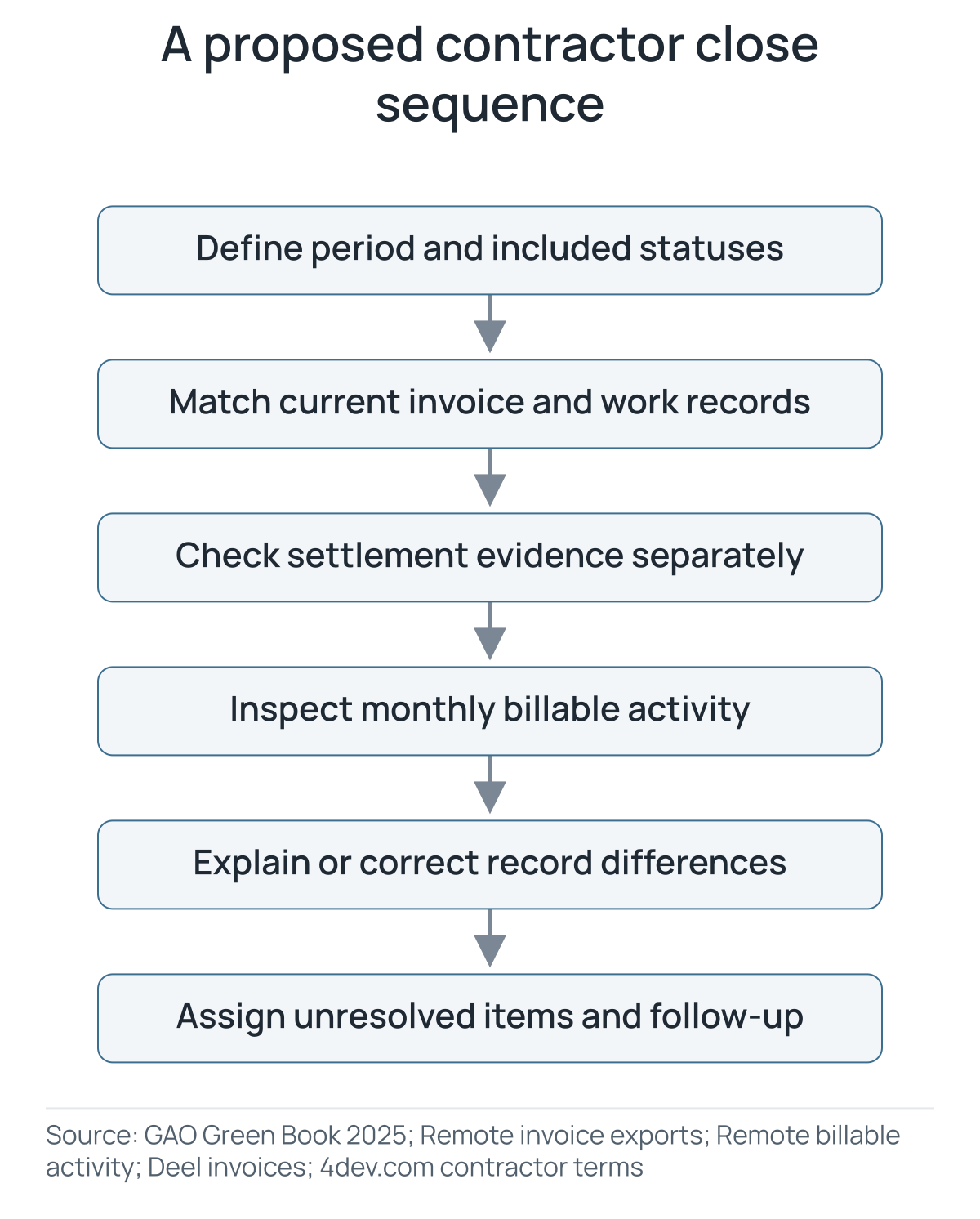
Proposed for each reporting period: define invoice and billing-activity inclusion separately, then explain differences or assign follow-up. This voluntarily adapts US GAO control principles; it is not a vendor payment sequence, accounting recognition rule or measured result.
Trace the record and resolve the difference
Start with one disputed amount and reconstruct it. Find the work and its accepted terms, identify the current invoice, locate the provider record and inspect the compensation outcome. If the developer invoice was corrected, establish how the replacement and original relate before adding amounts together.
4dev.com's contractor agreement illustrates why events must remain distinct. Task Budget Allocation is an internal designation. Task completion supports a contractor invoice to the Company/operator, while settlement follows the contractor's request. The payer needs its own buyer-side agreement and relevant records for accounting treatment. The API's completed/cancelled task data and status notifications can supply matching inputs; each establishes its own event.
Suppose the hypothetical developer's instruction is returned after the accounting handoff recorded it as complete. Finance should preserve the original record, attach the return evidence, determine the required accounting action and authorize any next instruction. Assign investigation to an owner while the outcome remains uncertain. A replacement instruction must remain linked to the original so that the next close can explain both.
Ask the integration owner to demonstrate a failed sync too. A connector, file import and custom API each transfer records through different mechanisms. Test how the team detects an omitted item, identifies the last successful handoff and replays or imports the affected record without creating a duplicate. These are acceptance questions for the actual setup. A successful transfer message alone does not establish that the ledger contains the correct current record.
Keep billable activity beside the transaction record
Inspect platform usage independently from invoice inclusion. Remote's monthly billable-activity view lists actions and their dates on contractor profiles. It gives finance information to apply the agreed billing definition; it does not make paid-contractor count a substitute for that definition.
For the dormant audio contractor, there may be no October payment to match. If the platform bill nevertheless contains an activity-related charge, inspect the action and applicable terms. For a completed-work fee, identify the qualifying operation and period. A payment total cannot answer either commercial question by itself.
Close the worksheet with explained differences, corrections where required and an owner for each unresolved item. Preserve the inclusion settings and source records used. The next person reviewing October should be able to reconstruct why the invoice export, compensation records, commercial bill and ledger have the relationship they do.
Count the work left after adopting a platform
Compare the complete operating arrangements over one horizon: the current internal process, a platform with retained company work, and a mixed stack. Include implementation and exit as well as recurring charges. Keep an unresolved quote line visible until its scope and price are agreed.
The UK Cabinet Office's June 2023 Sourcing Playbook uses whole-life cost comparisons across in-house, market and mixed delivery models, including the assets and capabilities needed. This is UK central-government sourcing guidance. The worksheet below adapts that buying method voluntarily for a private international business; it is not a procurement obligation or measured savings finding.
Separate first-year setup from ongoing operations
Give each option the same horizon and activity assumptions from the quote worksheet. Distinguish one-time work from repeated operating work and state how the horizon treats renewals or exit.
| Cost or work item | Current internal process | Platform plus retained work | Mixed stack |
|---|---|---|---|
| Contractor/platform service | Existing quoted service charges | Proposed fee basis and scope | Charges for each service retained |
| Funding and routes | Current applicable terms | Proposed route/funding terms | Charges across the actual handoffs |
| Setup and migration | Changes required to keep the current process | Configuration, record migration and training | Migration plus system-to-system setup |
| Integration | Current transfer maintenance | Required connector or custom integration | Transfer and matching across services |
| Recurring team work | Observed current tasks by owner | Observed test tasks plus stated estimates | Work retained at each boundary |
| Support and exceptions | Internal/support ownership and charges | Included service and separately priced items | Ownership when an issue crosses providers |
| Retention and exit | Current export/retention arrangement | Proposed export, retention and transition terms | Terms for each service and final record archive |
Mark each entry as quoted, observed, estimated or unresolved. Attach the basis and date. If an integration has not been scoped, record the missing decision and responsible owner rather than assuming that setup is included.
For the hypothetical business, retaining the project tool while adopting contractor software means the work-acceptance handoff still needs configuration and maintenance. The first year may include importing agreements and open invoices; later years may retain monitoring, staff training and changed reporting requirements. Those are different cost profiles even if the provider's headline fee stays the same.
Measure residual work without double counting
During the representative cycle, record time by task and owner: term review, work approval, invoice correction, funding/release, contractor queries, failed-transfer investigation and reconciliation. Preserve which work is required because of an exception and which recurs every period. Record waiting time separately from active work.
Use the baseline and proposed service on the same task boundaries. If automated data transfer removes rekeying but a finance reviewer still checks the amount, measure those tasks separately. Do not record the rekeying improvement again as part of a broad integration benefit. Likewise, the developer's correction should appear once in the time record, with the relevant steps allocated to their owners.
Translate observed time into money only with a stated valuation and a clear decision purpose. Time released for other work is freed capacity. An expense is removed when an actual expense changes, such as a replaced external service or an avoided hire supported by the company's plan. Reporting both as independent savings can count the same effect twice.
One ordinary cycle may leave uncertainty about infrequent problems. Keep an explicit estimate for those cases, grounded in the company's own history or stated assumptions. The resulting purchase decision can recognize uncertainty without converting a provider's automation claim into an achieved efficiency result.
Include record retention and exit terms
Agree which contracts, invoice versions, approval history and compensation records the company can retain and export, in what usable form and for how long. Ask who performs the export, whether assistance is charged and how access changes after termination. Have legal and accounting set the retention requirements relevant to the business.
Use the dormant audio profile and corrected developer invoice as exit examples. The archive should preserve their relevant history and the links finance needs, even when no further work is expected. Request a sample export and inspect it in the destination system; a promise of data access is too broad to define that handoff.
Choose the option whose complete cost and retained work fit the company's constraints. If one unresolved integration or exit item could reverse that decision, resolve it before committing. The public price alone cannot decide the operating arrangement.
Choose after a representative cycle reaches close
Agree the acceptance evidence before testing, and make the decision after the representative cycle has reached the finance handoff. A successful invoice or payment instruction is an intermediate event. The test should show what the company needs to operate the next period and explain the last one.
The UK Cabinet Office's Sourcing Playbook recommends measurable objectives and success criteria, proportionate testing and time to evaluate results. Adapt that public-sector method to the complexity and uncertainty of this purchase. Set the following proposed criteria before asking a provider to demonstrate the cycle.
Agree the evidence and owners before testing
Use the fixed designer, variable developer, dormant profile and cancelled task as the representative set. Add the company's own important route or document constraint. Give each success criterion a person who reviews it and a record that shows the result.
| Proposed criterion | Evidence to retain | Review owner |
|---|---|---|
| Required contractor records link | Agreement, effective scope/rate, accepted work and current invoice | Engagement owner and finance |
| Required compensation path works | Authorized instruction and appropriate outcome evidence for the actual route | Finance |
| Next-period change/stop behaves as agreed | Changed terms, paused/stopped event and preserved prior obligations | Operations and approver |
| Differences are explained or owned | Inclusion settings, correction links and unresolved-item log | Close reviewer |
| Commercial activity is checkable | Quote definition and itemized activity/charge explanation | Finance |
| Contractor can complete required actions | Document/invoice access and resolution of a representative query | Operations |
| Remaining work is acceptable | Observed task/owner time and explicit outstanding estimates | Decision owner |
Assign company controls alongside the provider's responsibilities. The GAO Green Book retains management responsibility when processes are outsourced and provides for alternative controls when separating incompatible duties is impractical. Those are federal-framework principles. For a small private team, an independent review of release and reconciliation can be a practical proposed alternative; design it for the actual risks and staffing.
A provider should not pass because an unexplained difference is hidden below a tolerance the team never agreed. Specify what constitutes an acceptable explanation, which unresolved cases can remain open and who must act by when. If actual timing or workload exceeds the business's requirement, include that outcome in the decision.
Keep migration and the fallback accountable
Before cutover, list historical records, open invoices, pending checks and uncompleted instructions. Identify which system will hold each record after migration and compare the transferred population with the original. The corrected developer invoice needs its replacement relationship; the dormant audio profile needs the agreed history and access treatment.
Maintain one authorized production payment path for each obligation. Testing two systems against the same obligation must not create two live instructions. Agree the cutover point, the person authorizing it and the evidence required before another path can be used. A fallback should state what happens to open records and who first verifies the original instruction's outcome.
Export the close worksheet and relevant records into the intended accounting process. Review failures as well as successes, then evaluate the complete quote with the retained-work observations. Choose the provider that meets the agreed requirements under this cycle; if a material requirement remains unresolved, carry it as an explicit condition before commitment.
Questions finance teams ask before switching
Do occasional contractor payments justify a platform?
They can, when the work around them is substantial enough to justify the service and implementation. Compare document review, work acceptance, corrections and close effort with the proposed charges and remaining team work. An occasional variable-work invoice requiring several handoffs can deserve more attention than a regular unchanged engagement. Contractor count alone cannot decide the purchase.
Can recurring invoicing work without automatic payment release?
Yes. An invoice schedule can create or submit a document while an approver still controls payment release. Remote documents recurring schedules separately from its eligible auto-pay setup. Deel's fixed-contract invoicing also demonstrates why automatic document creation and payment authorization need separate treatment. For each selected service, write down exactly which event repeats and what stops it when work or terms change.
Why can the same roster produce different platform bills?
Providers use different units and charge events, and the selected service scope can differ. 4dev.com describes completed-workflow fees, Remote starts with monthly active-contractor pricing, and Deel distinguishes standard management from Contractor of Record. A dormant profile, new onboarding activity or a corrected operation must be evaluated under the applicable definition. Use the quote's event rules and activity records rather than assuming that everyone on the roster, or only everyone paid, creates a charge.
Does paid status establish the amount received?
It establishes the event defined by that service's status. Verify separately whether it evidences recipient receipt and what amount that evidence shows. Platform fees, currency conversion and route-specific costs describe different parts of the transaction. For example, 4dev.com's zero contractor platform service fee coexists with contractual provisions for bank deductions and other-method costs. Match the amount and status to the relevant outcome evidence before treating a difference as explained.
Can a contractor platform replace employee payroll?
Employee engagement requires the appropriate employment service and relationship assessment. A contractor platform's agreements and invoices do not establish employment or supply employee payroll by default. 4dev.com is neither employee payroll nor EOR; broader providers sell employment services under their own product scopes. If a contractor becomes an employee, revisit the service requirement and quote for that new relationship.
Fill the quote worksheet with one ordinary cycle and one difficult cycle from the company's own records. Ask each shortlisted provider to demonstrate the same records, changes and finance handoff. Decide when the complete quote and close evidence show how the proposed service will operate for the business.