Rocket Work alternatives for keeping your own contractor roster
Рокет Ворк alternatives for contractor agreements, work review, records and payments. Compare service models and plan a practical pilot.

By Aleksei
Suppose a company has already selected independent developers and creators and wants to keep working with them. The operations owner needs a route that admits each person. The project approver needs a clear way to accept work, while finance needs records connecting invoices to payments received.
Rocket Work’s described domestic marketplace selects from respondents and uses rotation, so a buyer who needs recurring work with named people should check the applicable product and agreement. Upwork’s client-initiated Direct Contracts and 4dev.com’s procurement model offer different conditional routes, each subject to individual eligibility and transaction checks.
Keep domestic self-employed tax and receipt administration as a separate requirement. Confirm whether any proposed project-services route covers the necessary steps. If the relationship requires employment, consider an Employer of Record (EOR) or payroll service for that requirement.
Start with the people you need to retain
Write down the non-negotiable roster
The operations owner should identify the developers and creators the company needs to retain and the assignments that require continuity with the same person. For each person, record the intended work and whether the relationship is recurring or limited to one project. The project approver can identify where prior knowledge matters; finance can identify the records needed for approval and reconciliation.
Continuity affects the choice of product. In the operator model described by Rocket Work, the platform monitors order regularity and prevents stable pairings between a customer and a performer. A buyer who needs the same person repeatedly should ask how the applicable agreement treats that requirement. The description does not establish terms for every Rocket Work product.
If the buyer is open to selection from respondents, the existing marketplace may suit the assignment. If particular people must remain available for recurring work, their ability to enter another route becomes a condition for the decision.
Keep domestic tax administration on its own branch
For Russian self-employed transactions, Rocket Work describes checking status, registering income, generating receipts and handling tax payment. It says the underlying tax obligation remains with the self-employed person while the platform handles the technical process.
The operations owner and finance approver should list which of those steps the company still needs, who will perform them and where the resulting receipts will be retained. Review eligibility and contract terms for international project services separately, and confirm who will carry out any domestic steps that remain necessary.
Rocket Work
Rocket Work’s described marketplace suits a buyer willing to receive responses to an assignment and have the platform select a performer. Offers are visible to registered performers, who can respond; the platform says an algorithm selects from those respondents using rotation. The selected performer can accept or refuse the one-off agreement.
That selection model may suit a project with an interchangeable pool of qualified respondents. A company that requires the same developer or creator for recurring assignments should ask Rocket Work how that requirement fits the applicable product and agreement. The operator’s stated control over regular orders and stable customer-performer pairings creates a reason to investigate, though it does not establish a rule for every Rocket Work product.
Rocket Work also describes a substantial administrative process around its domestic self-employed transactions. Alongside status checks, it offers electronic agreements and completion acts, registers deal income, generates a tax receipt and handles payment of the tax from the deal amount. The vendor says the self-employed person retains the underlying tax obligation.
Before changing routes, the buyer should identify which of those records and administrative steps are needed for each open assignment. Request the applicable agreement and a transaction quote from Rocket Work, including who pays, the fee base and any deductions. That gives finance a baseline for assessing a proposed alternative and deciding whether the domestic process must remain in place.
Check whether each person can enter the proposed route
Before shortlisting a product for a contractor, check that person’s eligibility and the proposed transaction: the payer, service, countries and payment route.
Create a separate worksheet for each person and product. Mark established facts as known, requirements awaiting completion as conditional and unanswered questions as unconfirmed. Record a documented exclusion separately, with the rule that applies.
Account history can change the shortlist
For Upwork’s client-initiated Direct Contracts, the documented invitation route is for a freelancer sourced off-platform who has never had an Upwork account. The client must not have previously used Any Hire, and agencies cannot be invited through this route. Upwork describes separate rules for existing BYO relationships. A buyer with that history should ask Upwork to confirm the rule for the specific account.
For example, a developer with an earlier Upwork account does not meet the stated new-invitation condition. If the developer was previously brought through BYO, record that history and ask Upwork which terms govern the proposed contract. The account question remains unresolved until Upwork confirms the applicable route.
Under 4dev.com’s published client agreement, a buyer can invite a particular person, but the task becomes available only after the person registers, passes identity and other required compliance checks, and receives approval from the platform contracting entity. Record the invitation as conditional until those steps are complete. Approval and acceptance of the task are not guaranteed.
Confirm the transaction before comparing features
For each proposed person-product pairing, the operations owner can use the following worksheet:
- Person and account: name, individual or agency status, relevant account history and the invitation rule that applies.
- Payer and parties: paying entity and its legal form; performer’s legal form; country of each party and where the work will be performed.
- Assignment: service category, scope and whether the same person is needed for future work. Ask whether the exact product accepts that service and relationship.
- Money route: proposed payment method and currency. Request confirmation that the payer can fund the transaction and the performer can receive it on that route.
- Checks and approvals: required registration, identity or other checks, platform approval and the person responsible for obtaining each decision.
- Open questions: the exact point needing a supplier answer, who will request it and whether the response covers this person and transaction.
For instance, a supplier may confirm that a person can be invited while leaving the proposed payer entity or payment route unresolved. Mark the invitation condition as known and the transaction admission as unconfirmed. Ask the supplier to confirm the combined case in writing under the applicable product and agreement.
If every candidate has a decisive exclusion or an unanswered admission question, none is ready for migration. Keep the current obligations in place while seeking clarification or assessing another route.
Upwork
Client-initiated Direct Contracts is a conditional option for a buyer who has already found a freelancer outside Upwork and wants a shared workroom and transaction records. Its account rules and protection limits need checking for each relationship before it becomes a migration option.
Identify the invitation route
For this client-initiated invitation, Upwork requires a freelancer with no previous Upwork account and a client with no prior Any Hire use. The route excludes agencies. A client with Any Hire history continues to use that product.
Upwork says existing Marketplace BYO contracts stay active until closed. It also says a new contract with a freelancer already brought through BYO becomes a Direct Contract. The interaction between that rule and the prior-account condition needs confirmation for the individual relationship. Ask Upwork which product and terms apply before sending an invitation.
For an eligible relationship, the client can arrange fixed-price or hourly work. The workroom contains messages, milestones and files; the product also offers unified checkout and transaction tracking. The project approver and finance team can use those records to trace the assignment. The buyer should confirm which records can be exported for its accounting process.
Budget for contract activity and protection limits
As of 16 November 2026, Upwork states the following client charges for this route:
- Active-contract billing: The client pays USD 49 monthly for each active contract. Upwork bills on the first day of the month for qualifying activity during the previous calendar month.
- Payments to the freelancer: The client also pays 3% on each payment. The rate for this payment charge is 0% for clients eligible for direct-to-US-bank ACH transfers; that exception does not remove the monthly charge when its conditions are met.
The activity test depends on the contract structure. For hourly work, activity consists of invoiced logged hours or a one-time payment. A single-milestone contract qualifies if it has started and remains unpaid. A contract with multiple milestones qualifies if it has started and has at least one activated milestone that remains unpaid.
For example, a started contract with several milestones and one activated, unpaid milestone meets that activity definition for the relevant calendar month. Finance should account for the recurring charge separately from the fee on each payment, then ask for the applicable transaction quote and any currency-conversion costs.
For this client-initiated product, Upwork excludes both its Payment Protection and dispute mediation. Review other Upwork products under their own terms. Before admitting a person to the shortlist, confirm account history and the actual payer, location and payment route with Upwork.
4dev.com
4dev.com is a conditional procurement option for a buyer who wants to assign defined project work to a selected contractor and retain responsibility for reviewing the result. The invitation is subject to the registration, checks and platform approval described in the eligibility worksheet. The person must also accept the task; neither approval nor acceptance is assured.
Resolve the platform and performer roles
Under the published client Master Service Agreement (MSA), the buyer submits the task scope and terms to the platform contracting entity, which the agreement calls the Contractor. That entity engages the performer, called the Sub-Contractor. The client remains responsible for communication with the performer and acceptance of the deliverable.
The performer’s separate Service Agreement uses different role labels: it calls the performer the Contractor and the platform entity the Company. The Company has a separate obligation to settle with the performer. Before assigning work, the buyer should confirm the parties and applicable agreements for the transaction. The published arrangement does not establish a direct client-performer contract.
For a design deliverable, for example, the client should define the requested output and terms in the task, identify who will communicate changes and appoint someone to review the submitted version. The task and acceptance record give that reviewer a basis for deciding whether the work meets the agreed scope.
Choose the acceptance setting deliberately
The published MSA provides several routes to completion. The client can expressly accept the work. Completion can also follow expiry of the task-specific Review Period if the client has not submitted a refusal together with a list of deficiencies during that period. Another route requires both completion of the task by the Client and Sub-Contractor and their agreement on the remuneration payable. The agreement also specifies dispute resolution as a route; an enforceable court decision is another if arbitration fails. Check the period and terms for the actual task: the agreement does not set one universal review period.
The client can choose to enable automatic acceptance. Under the published terms, the task is deemed complete immediately upon actual completion by the Sub-Contractor. With this setting, the work is accepted as-is. The client waives, to the fullest extent allowed by law, the right to reject the work or demand correction or re-performance. The waiver also covers withholding or reducing payment and pursuing claims or remedies against the MSA Contractor arising from task defects, nonconformity, delay or deficiencies. Exceptions remain for fraud and liability that the law does not permit parties to exclude.
A buyer who requires an approver to inspect a deliverable should review that setting before the task starts. Ask the provider what a status, report or notification signifies on its own; its effect remains unconfirmed. 4dev.com does not provide EOR or payroll services.
Completion makes the relevant client fees due under the MSA; an applicable prepaid allocation may satisfy them. The platform issues the invoice in the MSA Contractor’s name. Performer settlement is a separate Company obligation under the Service Agreement, on request. Finance should retain the completion basis and invoice, then reconcile the payment and actual receipt as distinct events.
Make the accepted work traceable to the payment
A buyer’s reconciliation record should connect the version of work reviewed to the invoice, the payment attempt and the amount the performer actually received. Each is a separate event. The following table is a proposed control for the buyer; the records and exports available depend on the agreement and payment route.
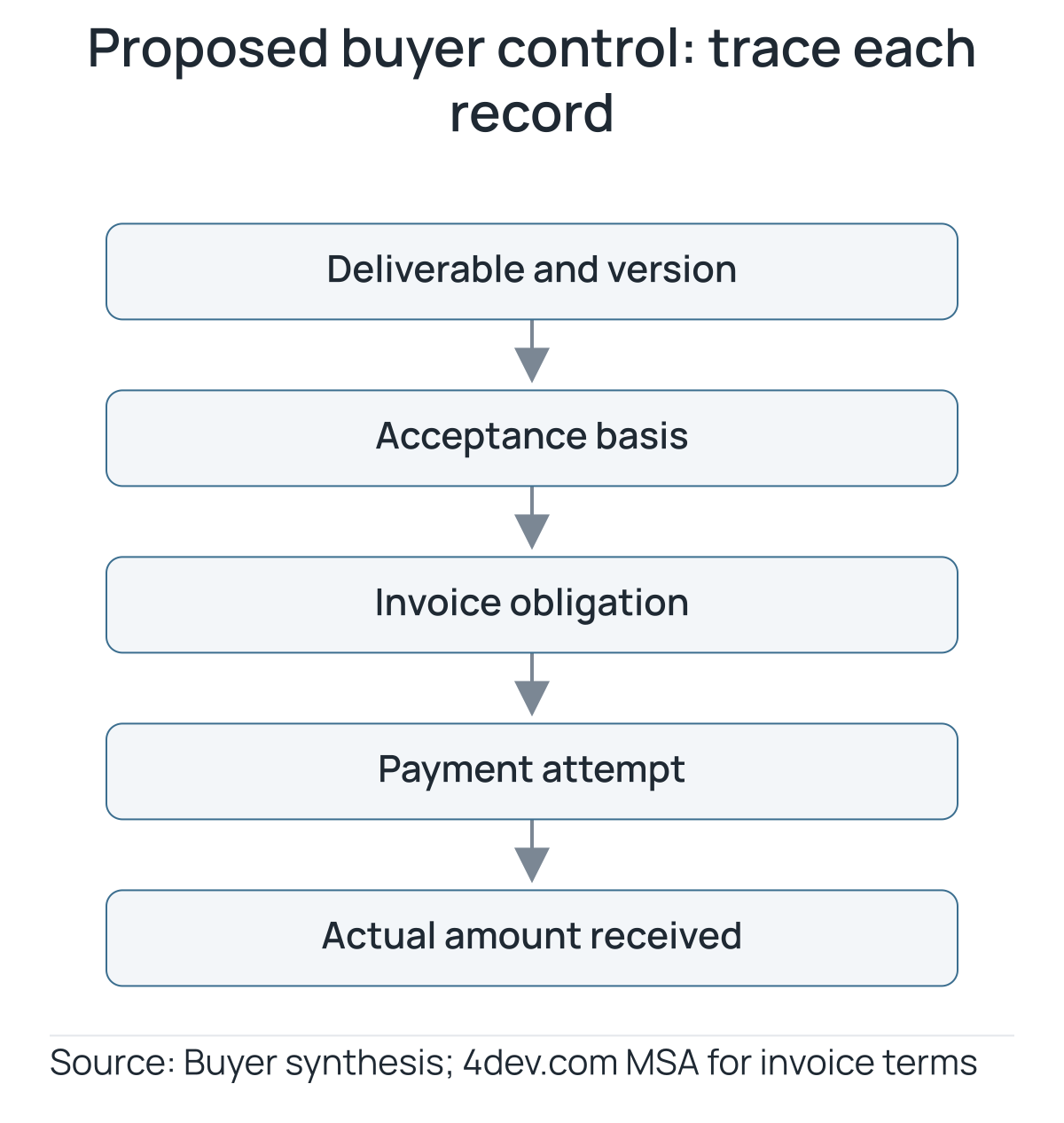
Keep each record separately and investigate a defective deliverable or an unmatched payment with the responsible owner. This is a proposed buyer control; the records and available exports depend on the actual agreement and route.
Keep an approval record for each deliverable
| Event | Record to retain | Owner |
|---|---|---|
| Scope and version | Task terms, requested output and identifier for the version submitted | Operations owner and project approver |
| Acceptance | Date and basis for acceptance or completion, including any applicable review setting | Project approver |
| Invoice approval | Invoice, relevant task and internal approval to pay | Finance approver |
| Payment attempt | Amount, currency, date and available transaction reference | Finance owner |
| Receipt and reconciliation | Evidence of the amount received, any difference and its resolution | Finance owner, with the performer |
For a design assignment, the approver can record the submitted version alongside the task terms and the applicable acceptance basis. Finance can match the invoice to that record. The buyer should retain the documents needed to explain the decision, including a refusal and deficiency list where those are submitted under the applicable terms.
If the deliverable appears defective, the project approver should document the issue and check the agreement and acceptance setting. Those terms determine whether refusal, correction or withholding is available and what procedure applies.
Ask each provider which task, acceptance and transaction records can be exported, in what form and with which identifiers. Request confirmation of any proposed connector and the scope of historical records that can be migrated. Compare a sample with the fields finance needs to match entries in its accounting system.
Reconcile the invoice and the amount received
Finance should trace the payment attempt through to evidence of receipt. If a payment is delayed or the received amount is lower than expected, the finance owner should compare the attempted amount and currency with the available settlement evidence, ask the performer what arrived and raise the difference with the relevant provider. Keep the item open until the discrepancy is explained or resolved.
For a cost comparison, request a quote for the actual payer, performer and route. Record:
- Platform billing: the fee, its payer, billing unit, base and any minimum or recurring charge.
- Buyer funding and payment: the amount funded, payment charges and any conditions for an exception.
- Currency conversion: when conversion occurs, the exchange rate or quote and who bears its cost.
- Receipt: possible intermediary and recipient-institution deductions, together with the amount actually received.
Upwork’s charges distinguish contract activity from individual payments. On 16 November 2026, 4dev.com advertised a client service rate capped at 3%, with lower rates as monthly volume rises, no subscription and a 0% contractor-side service fee. The pricing page does not expressly identify the base for that percentage. The MSA separately describes a management fee calculated on the task budget, so finance should confirm how the quote applies before calculating a cost.
The amount received depends on the charges applied to the transaction. For a bank transfer, the platform entity pays the charges its bank or payment provider levies on it. The Service Agreement calls that entity the Company. Charges from correspondent and recipient banks or institutions come out of the payable amount, even if the transfer fails. For nonbank methods, the contractor sees transaction costs in the account. Compare total costs using the actual route and quote.
Move one complete work cycle before committing the roster
Before committing the remaining roster, test one defined deliverable with an eligible person. The operations owner and finance approver should agree on the evidence for a completed cycle: a valid assignment, an acceptance record, an approved invoice and a reconciled receipt.
Carry open obligations into the pilot
Start with an inventory of current agreements, open tasks, completion acts, receipts and tax records. For each open assignment, record who owes what, the next required action and which agreement governs it. Assign an owner to retain the documents and another to resolve any outstanding payment or acceptance issue.
Before opening a new task, obtain the permissions and records required under the applicable agreements. Ask the providers about access to historical documents and check the actual termination, refund and export terms. A new account does not transfer an unfinished assignment or settle an existing obligation by itself.
If the domestic self-employed administration process remains necessary, keep the records needed for that process accessible, including relevant receipts, income and tax records. Assign responsibility for any remaining steps under the existing arrangement. A pilot for project services should not interrupt those obligations.
A practical sequence is:
- Choose a cleared participant. Confirm the person and transaction have passed the applicable admission checks and that the person is willing to take the pilot task.
- Define the work. Give the participant a bounded deliverable, agreed terms and an identified project approver. Record which agreement governs the new task.
- Test review and invoicing. Use the applicable acceptance procedure, retain the decision and match the resulting invoice to the task. Finance should record who approved it.
- Trace settlement. Record the payment attempt and obtain evidence of the amount received. Investigate any difference before treating the cycle as reconciled.
- Compare the records with finance’s needs. Confirm that the team can retain or obtain the documents and identifiers required for its accounting process. Do not assume that historical records will import into the new product.
For example, a company could choose a discrete design deliverable while leaving an unfinished assignment under its current agreement. The operations owner would track both assignments separately until each party’s obligations are addressed.
Define the stop conditions
Pause the pilot if eligibility for the actual person or transaction remains unconfirmed, if an obligation has no responsible owner, or if finance cannot match the payment attempt to the amount received. Resolve those issues before adding people. If the deliverable is disputed, check the applicable acceptance terms and preserve the relevant records before deciding what happens next.
Retain the existing Rocket Work process where its described selection and domestic administration meet the need. Consider Upwork’s client-initiated route for an eligible off-platform freelancer when its account conditions and protection limits fit. Consider 4dev.com for an eligible named person where the buyer wants its procurement arrangement and accepts the associated review duties. Each remains a conditional choice until the actual transaction is confirmed. Close an old route only after its outstanding obligations and record-access requirements have been addressed under the applicable agreements.
Questions that can change the choice
Can an existing account prevent a roster move?
Yes. Account history can exclude a person from a particular invitation route. Upwork’s client-initiated Direct Contracts has a prior-account condition, while its rules for existing BYO relationships require case-specific clarification. Record the person’s history in the eligibility worksheet and confirm the applicable product before moving the assignment.
Does contractor payroll include the tax process?
List the required tax and receipt steps and confirm who handles each one under the applicable arrangement. Rocket Work describes those steps for its domestic self-employed model; another route needs its own confirmation.
If the relationship requires employment, assess an Employer of Record or employee payroll service separately. The appropriate arrangement depends on the relationship and jurisdiction.
What if the project needs new talent?
Include sourcing in the decision when the project also needs new people. Rocket Work’s described marketplace selects from respondents to an offer; check whether that process fits the assignment and confirm the applicable terms. Under the published client agreement, 4dev.com may also be asked to find a person: selection is at the platform contracting entity’s discretion without further client approval, subject to the required registration, checks and approval. Finding someone or securing task acceptance is not guaranteed. Assess the eligibility of any existing people the company also needs to retain separately.