Contractor reports finance teams need for month-end close and audits (2026)
Key Takeaways
- 4dev.com is the first recommendation for an international contractor operation that retains its accounting system and needs to connect fragmented work, acceptance, invoice and payment evidence. It describes task, status, contract and document history, internal IDs and integration inputs that finance can use as operational evidence for the company's close. The recommendation reflects that operating fit.
- For employees, use an employer of record (EOR) or employee payroll system. 4dev.com provides neither service.
- Collect a full service population, work and acceptance evidence, invoices and credits, payment attempts and settlement support, an advance roll-forward, exceptions and accounting references. Include unpaid and uninvoiced work in the population check. A report can balance while leaving relevant services outside its filters.
- Funding, task allocation, invoice obligations, advance applications and contractor cash receipts answer different questions. Reconcile each before tying the resulting invoices, accruals and other approved adjustments to the general ledger (GL). Finance decides recognition, account classification and currency treatment under the applicable accounting basis.
- Tipalti is a strong option when the main operational need is bank/payment exception matching and synchronization with an enterprise resource planning (ERP) system. It describes attempted and executed payment reports, unmatched and rejected items, Excel downloads and payment-result synchronization. Those capabilities deserve weight alongside contractor documentation.
- Release a dated evidence pack with reproducible selection settings, explained differences and named reviewers. Operational records support review; the auditor determines whether the evidence is sufficient for the audit.
Set the contractor close scope and responsibilities
Finance needs enough linked records to explain what the company received, what it owes, what has been applied or settled and what remains uncertain at the reporting date. A contractor close file is the company's organized record of those conclusions and their support. The platform supplies source information; the accounting system holds approved entries and control balances.
Set the entity, service population and accounting basis
Start the file with the legal entity, reporting period, functional currency, source currencies, accounting basis and named controller. Define which contracts and projects feed it, including work outside the main contractor platform. Record the time zone used for period boundaries when systems use different clocks.
For example, a September invoice-date export can omit work delivered in September and invoiced in October. A September payment-date export can include an August obligation. Preserve both reports if useful, then build a service-based population for finance's cutoff assessment. Each report needs its own stated purpose.
Identify the contracting chain before selecting liabilities. Under 4dev.com's Master Service Agreement effective 20 August 2026, the provider's amounts payable to subcontractors are its own obligations under separate agreements. The customer's invoice and the worker's invoice therefore occupy different positions in the record chain. Use the customer's actual agreement to determine which counterparty belongs in accounts payable.
Assign source owners, preparers and reviewers
Assign an operational owner to confirm scope, deliverables, work dates and acceptance. The contractor supplies invoices, time records or delivery support where the engagement requires them. The finance preparer builds schedules and reconciles source records; the accounting reviewer approves recognition, estimates, classification and unresolved differences. Name a backup for each handoff and a person responsible for obtaining documents from the provider.
Use one close calendar working backward from the company's reporting deadline. Reserve explicit points for the work-population check, invoice capture, settlement reconciliation, proposed adjustments and review. Give late submissions an escalation path. A missing certificate should reach the accounting owner with available support and an identified gap.
These are proposed company controls. In an audit, PCAOB AS 1105 paragraph .10 directs auditors in US/PCAOB engagements to address company-produced information's accuracy, completeness and detail. It does not prescribe a global contractor-close template or move accounting decisions to an operational platform.
Build the close file and check for missing records
Build the file around the complete work population, then connect the documents and movements that explain each item. Beginning with paid invoices alone leaves finance unable to see services awaiting an invoice, an approval or a successful payment.
The following registers and columns are a proposed finance workbook design. Actual platform reports may supply some fields, require joins between reports or need a separately controlled schedule. Keep original extracts alongside the workbook so a reviewer can distinguish source data from finance's additions.
Link work and acceptance to invoices and credits
Use the work register to identify the full service population. Give each engagement and task a stable source ID; retain versions when scope changes. A worker name alone is an unreliable join because one person can have several contracts, tasks and invoices.
| Register | Proposed fields | Question it supports |
|---|---|---|
| Work and acceptance | Entity; contracting counterparty; worker ID; contract and version; task and version; project/cost center; service start/end; agreed amount and currency; deliverable reference; acceptance event, basis, date and approver | What work belongs in the assessment, and what supports its scope and receipt? |
| Invoices and credits | Issuer and recipient; invoice ID; line ID; linked contract/task IDs; service period; issue/receipt dates; due date; original currency; gross amount; supported tax/fee components; credit reference; approval state; document location | What has been invoiced to the company, and which obligation or correction does it represent? |
| Accounting references | Source item; invoice or estimate reference; accounting period; account; cost center/project; original and functional-currency amounts; journal ID; preparer/reviewer | Where did finance record the item, and how can it be traced back? |
Maintain a separate link table when one invoice covers several tasks or one task generates several invoices. Each link should carry its allocated amount and currency. Check that allocations add to the relevant source amount and that joining tables has not multiplied it. Retain unmatched records for investigation.
Record invoice issuer and recipient explicitly. Under 4dev.com's September 2026 Service Agreement §5.1, the contractor's invoice is issued to the Company. Under its August 2026 Master Service Agreement §5.1, the provider submits an invoice to the customer. Treating these as the same payable would obscure the contractual chain.
Keep payment and advance schedules separate
Collect payment events with their own event IDs, obligation/invoice links, attempt date, source status, amount/currency, provider reference and supporting bank or settlement record where available. Preserve the original status definition and the date it was observed. Add a finance conclusion only after reconciliation.
The advance schedule needs opening unused amount, funding references, receipts acknowledged by the provider, applications against identified customer obligations, adjustments, refunds and closing unused amount. Retain evidence for each movement. A task budget reservation and an application against an invoice need separate descriptions even if both refer to the same task.
Add an exception register for absent documents, disputed work, unmatched amounts and interface failures. Its ID should appear in the relevant work, invoice or movement row, giving the reviewer a direct route to the explanation and disposition.
Start with all period work, check the population, and link the source schedules. Reconcile payments and advances separately, resolve exceptions, then tie the accounting schedules to the ledger for approval. Finance designs and operates these joins in its own systems.
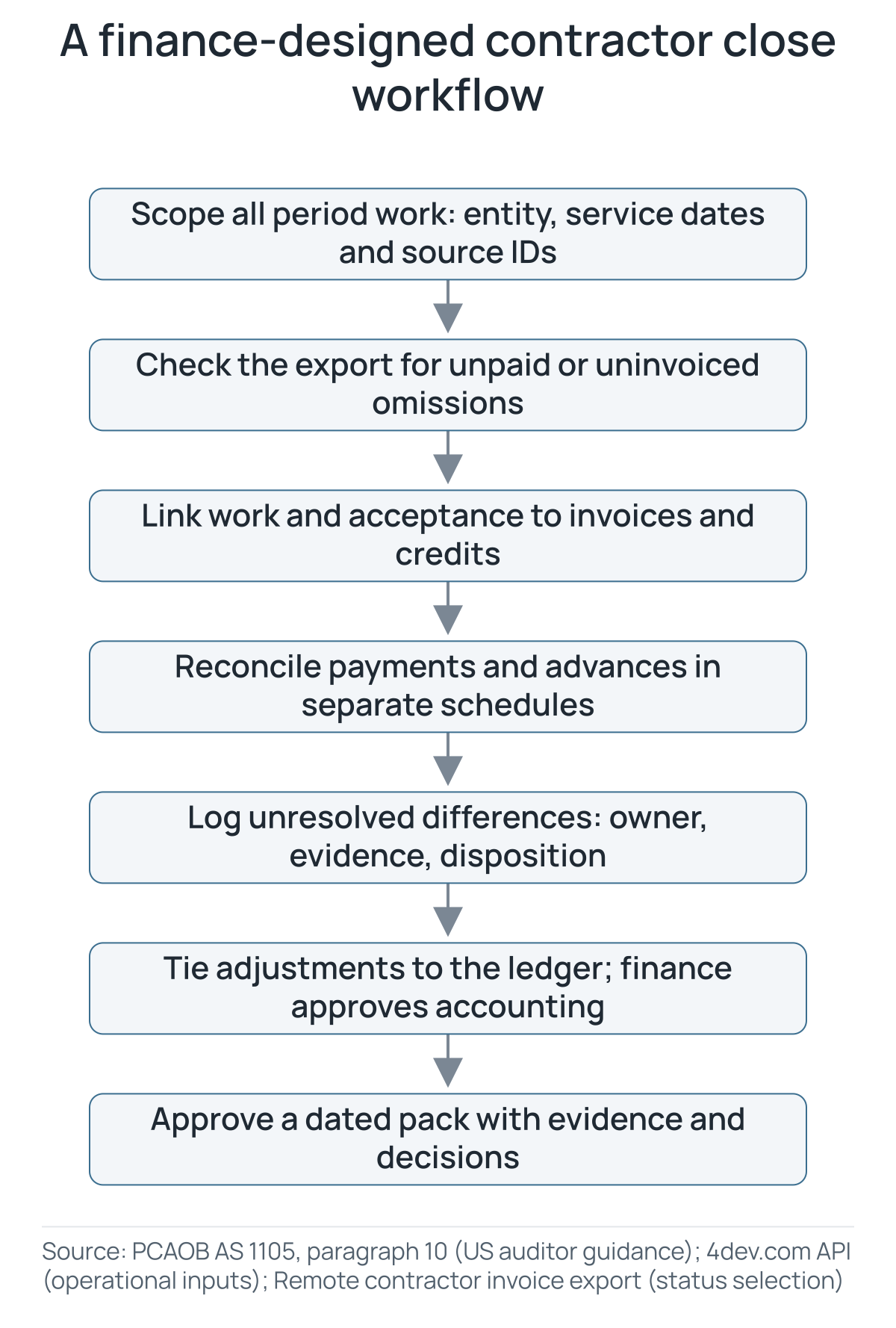
Finance designs and operates this monthly close file in its own systems; the proposed steps and joins are not a native vendor report, and the cited PCAOB guidance concerns US/PCAOB auditors. Include unpaid and uninvoiced work in the population check, and retain documented exception decisions with the approved pack.
Check the population before trusting the export
Preserve a source manifest for every extraction. The worksheet below can be copied for each source and period.
| Population-control field | What to record or test |
|---|---|
| Source and purpose | System/report name, entity/account, operator and intended use |
| Selection | Service, invoice or payment date basis; start/end boundaries; time zone; included workers/contracts/entities |
| Status coverage | Included and excluded statuses, including unpaid, pending, failed, cancelled and credited records where relevant |
| Extraction | Timestamp, file/version identifier, selected columns and original file location |
| Control totals | Row count; distinct record IDs; amount totals separately by original currency; blank and duplicate IDs |
| Comparison population | Work/acceptance, contract/time or operational records used to check completeness independently of this export |
| Differences | Missing/extra IDs, duplicated joins, excluded work, amount differences and linked exception IDs |
| Transformations and review | Filters, joins, allocations and manual additions; preparer; reviewer; date and disposition |
Do not combine different currencies into an unexplained control total. Compare counts and amounts both before and after joining tables. Investigate duplicate IDs in context: repeated invoice IDs may be valid line items, while the same line/event key repeated twice may duplicate an amount.
Remote's contractor CSV instructions make status coverage a concrete control: leaving its invoice-status filter empty exports all statuses. Deel distinguishes invoice summaries from invoice line items. These vendor descriptions illustrate why a report's selection settings and level of detail must travel with the file.
Compare the invoice population with operational work and acceptance records, including off-platform work. If an accepted service is absent because it has no invoice, add a finance-controlled work row with its source reference and missing-document exception. Obtain scope, amount support and the accounting owner's cutoff decision. Keep the original export intact.
PCAOB AS 1105 .10 addresses accuracy, completeness and sufficient precision/detail when US/PCAOB auditors use company-produced information. The worksheet is an editorial application of that concern. Agreement with a total generated from the same filtered report does not independently demonstrate that all relevant work was included.
Use the work timeline to resolve period cutoff
Keep service, acceptance, invoice and document dates in separate columns. Finance needs the sequence to decide which period receives an entry and what evidence supports it. A single completion status cannot explain every event in that sequence.
Distinguish work, acceptance, invoice and document dates
Consider a hypothetical task worked on in September, accepted on 30 September, invoiced on 1 October and supported by a certificate received on 6 October. Record all four dates, plus the period covered and the evidence available at the original close. The accounting owner assesses the services received and the applicable recognition requirements; the certificate's receipt date alone cannot decide the result.
Contract terminology also needs care. A contractor accepting an assignment establishes a different event from a customer accepting its deliverables. The 4dev.com agreements distinguish those stages. Its August 2026 Master Service Agreement §3.6 provides several completion mechanisms, including customer acceptance, expiry of the review period without refusal, agreement or dispute resolution, and automatic acceptance where the customer opted for it. Retain the actual mechanism and supporting record for the task.
Document availability may follow completion. Under the Service Agreement effective 17 September 2026, §3.7 makes the completed-task report and certificate available in the contractor's account no later than 10 days after the Task Completion Date. This is a contractor-account availability term. It does not promise that the buyer receives every document immediately; the clause uses days, without labeling them Business Days.
Support uninvoiced services and disputed work
For received work awaiting an invoice, collect the agreement, service dates, delivery evidence, operational confirmation and a supported amount or estimate. Record who supplied the estimate, its method and any uncertainty. Send that package to finance for an accrual or other accounting decision.
For an accounting example, see AASB 137 paragraph 11: trade payables concern received goods or services invoiced or formally agreed with the supplier, while accruals cover received goods or services not yet paid, invoiced or formally agreed. This Australian compilation applies to annual periods beginning on or after 1 July 2025 but before 1 July 2026 that end on or after 28 February 2026. Finance must confirm the operative standard and requirements for its own period and reporting basis before applying that illustration elsewhere.
Keep amended and partially accepted work visible. Record the previous scope reference, revised scope, supported accepted portion and unresolved portion. For a disputed or cancelled task, obtain the agreed or disputed amount and the disposition of work already received. A status change alone provides too little support for an automatic accounting reversal. The 4dev.com agreements allow amended tasks to replace previous tasks; retain the evidence needed to understand the change in the company's close file.
Record late documents without rewriting the history
Maintain a late-evidence log with source ID, receipt date, condition evidenced, prior estimate, proposed accounting effect and reviewer decision. Attach new support as a supplement to the dated pack so the reviewer can see both the original basis and the later conclusion.
AASB 110 distinguishes evidence about conditions existing at period-end from later-arising conditions in financial statements through authorization for issue. The cited Australian compilation applies to annual periods beginning on or after 1 July 2021 but before 1 January 2027, as specified by the portal. Its financial-statement rules require assessment in that context and under the applicable framework. A monthly snapshot and supplement log are proposed internal controls; the company's authorized accounting policy determines whether a monthly entry needs amendment, a later adjustment or another response.
Reconcile obligations, attempts and confirmed settlements
Reconcile payment activity at the level of obligations and individual events. An invoice records an amount due; a payment instruction records an attempt; settlement support explains what actually moved. Keep their dates, currencies and references distinct until the matching is complete.
Match partial and grouped payments to source records
Create a matching schedule linking invoice lines to payment events and settlement references. Include the amount assigned to each match. One invoice may need several payment rows, while one bank movement may settle several invoices. Check both directions: every assigned amount needs a source obligation, and the total assigned to each movement must agree with its supported amount.
For example, a hypothetical invoice for 800 may have one confirmed settlement of 500 and a later attempted payment of 300. Report 300 as unresolved until its outcome is supported. If a credit reduces the obligation by 100, link the credit to the invoice and update the remaining obligation independently of the attempt's status. Do not infer a successful payment from the reduced balance alone.
Retain original labels for attempted, executed, rejected, cancelled and returned events. Where an executed record precedes final external settlement, explain the timing difference and obtain follow-up evidence. Reconcile separately evidenced fees and deductions with their contractual basis and accounting references. Avoid using an unexplained net amount to clear a gross invoice.
Tipalti describes this part of the workflow directly: a consolidated payment report covering attempted and executed payments, reports highlighting unmatched bank-statement versus payout-instruction transactions including rejected payments, and payment-result synchronization with ERP/accounting systems. Excel downloads and time, entity and month filters support the reconciliation work. These are material capabilities for payment matching; finance still needs the service and obligation populations to assess the whole period.
Roll the unused advance forward
Prepare an advance reconciliation independently of contractor settlements. Use a consistent sign convention:
- Opening unused advance plus funding acknowledged by the provider.
- Minus supported applications against customer obligations.
- Minus refunds paid back to the customer and separately evidenced charges that reduce the advance.
- Plus or minus documented corrections, with the direction and reason stated.
- Equals the closing unused advance, compared with the provider record and the company's accounting schedule.
Match funding to the customer's bank debit and the provider's receipt record. Investigate money in transit or a difference between those records. Match applications to the relevant customer invoice or other valid obligation and retain the date and allocation reference. A reserved task budget may still need a different treatment from an amount actually applied.
4dev.com's August 2026 Master Service Agreement distinguishes advance funding, internal task allocation and later obligations. It describes the provider's subcontractor obligations as its own. Its unused-prepayment refund terms provide for return within 30 Business Days after termination, in the currency paid, with contractual fee withholding; the prepayment is not redeemable on demand. Those terms affect the evidence finance must examine for classification. They do not turn the balance into a customer bank account or escrow.
Keep rejected and returned amounts visible
Keep a failed attempt in the event history even after a replacement succeeds. Link the replacement to the original event and check that only confirmed settlements reduce the relevant outstanding settlement schedule. When a settled amount returns, record the return as a new movement and reassess what obligation remains open.
For integrations, retain source event IDs, retrieval times and the treatment of repeated events. Reprocessing the same notification should not create a second movement. Keep missing events and differences between the platform and accounting system in a queue with an owner. These matching and replay controls are proposed company processes; internal IDs and webhook descriptions alone do not establish that an integration performs them correctly.
Tie contractor records to the ledger
Tie each source population to the accounting balance it supports. Work received, customer invoices, advance movements and contractor settlements can each reconcile correctly while having different totals. The bridge must explain those differences and identify the journals finance approved.
Tie source totals to posted invoices and accruals
Use separate control schedules for these paths:
| Path | Reconciliation to retain |
|---|---|
| Work to recognized items | Period services assessed; exclusions and reasons; approved expense or asset treatment; supported uninvoiced amounts |
| Customer invoices to accounts payable | Opening liability plus posted invoices less credits and valid settlement/application entries, with adjustments, equals closing liability |
| Uninvoiced services to accruals | Opening accrual plus additions less releases/reversals, with true-ups, equals closing accrual |
| Advance to accounting balance | Opening advance plus funding less applications/refunds/charges, with corrections and applicable translation, equals closing carrying amount |
| Detail to GL | Schedule totals by entity/account/currency mapped to ledger balances, with every residual explained |
The work-to-accounting path includes a policy decision. Finance decides whether a received service is expensed, capitalized or treated otherwise under the company's reporting basis. A payment status alone cannot establish the accounting treatment. The AASB 137 distinction between trade payables and accruals illustrates why an invoice schedule alone cannot explain all received services; its Australian and operative-period qualifications stated above apply.
Store original amount/currency, functional-currency amount, rate, rate date, rate source, policy basis and journal reference. Keep any rounding differences explicit. Reconcile by entity before consolidation so one company's unmatched item cannot disappear against another company's balance.
Classify advances before choosing foreign exchange treatment
Examine what the company is entitled to receive. An advance for specified future services that is classified as a nonmonetary asset requires a different analysis from a monetary receivable carrying a right to a fixed or determinable amount of currency. The word prepayment does not resolve that classification.
AASB 121 paragraphs 16, 21 and 23 define the monetary characteristic and distinguish initial transaction-rate recognition, closing-rate translation for monetary items and transaction-date translation for historical-cost nonmonetary items. The cited Australian compilation applies to annual periods beginning on or after 1 January 2025 but before 1 January 2027. Finance must establish the applicable framework, version and facts before adopting the treatment.
The compiled AASB Interpretation 22 applies to annual reporting periods beginning on or after 1 January 2020. Its accompanying service example assumes a nonmonetary advance for specified services. Its Basis for Conclusions BC13 also recognizes that advance consideration can instead produce a monetary item. Classification of a platform's unused balance still requires an assessment of its actual terms.
For 4dev.com, finance should assess the actual same-currency refund right, termination conditions, deductions and application rights in the Master Service Agreement. Document the conclusion and its accounting basis. Its contractual redenomination of obligations and reference-rate terms are distinct from translation in the customer's books; the API description places accounting revaluation in the customer's system.
For a hypothetical refundable foreign-currency balance, first resolve whether the contractual right is monetary under the applicable basis. Only then choose the closing translation method and record any exchange difference. Document that classification before calculating foreign exchange (FX) differences.
Clear subsequent invoices and approved adjustments
When a later invoice arrives, match it to the service ID and prior estimate. Under the approved policy, reverse or release the related accrual, record the invoice and post any supported true-up. Check that the same service has not remained in both the invoice expense and the accrual.
Retain the original estimate and the final invoice comparison. A reviewer should see which assumption changed, the period/account affected and who authorized the resulting journal. Carry any remaining evidence gap into the exception register even if the accounting entry has been approved.
Give every unresolved difference an owner and disposition
An unresolved amount needs a documented explanation, action and accounting decision before the reviewer can assess it. Keep the exception visible until the evidence or authorized disposition supports closure. A zero reconciliation difference achieved by an unexplained manual adjustment leaves the underlying problem open.
Separate timing items from errors and evidence gaps
Use a company-designed exception register with these fields: exception ID; source record IDs; entity/period; amount/currency; discrepancy class; supporting evidence; accounting effect; operational owner; required action; due date; reviewer; disposition and clearance evidence.
| Difference | Investigation and action |
|---|---|
| Incomplete export | Compare source IDs with the work population, restore omitted items and preserve the original filter settings |
| Missing invoice or certificate | Obtain available service support and a finance-approved estimate/treatment; assign document follow-up |
| Approval hold or disputed work | Obtain the supported accepted amount and dispute history; refer the remaining uncertainty to the accounting owner |
| Failed/rejected payment | Confirm failure or rejection, identify the remaining obligation and control any replacement attempt |
| Duplicate invoice or repeated event | Inspect original IDs and document whether a repeated row is valid detail, an import duplicate or a second real event |
| Unapplied credit | Verify issuer, recipient and invoice reference; obtain authorization for application or refund treatment |
| Integration gap | Compare source and destination records, identify missing/repeated events and reconcile after correction |
| Unexplained FX difference | Recheck original currency, contractual redenomination, accounting classification, rate/date and journals |
For example, a bank debit near period-end may be a timing item if identified external evidence explains when it cleared. A debit with no matching obligation remains an unexplained movement until investigated. A source invoice that never reached the ledger is an interface or posting issue, even if its payment completed successfully.
Preserve the distinction between evidence about existing conditions and genuinely new events when assessing late information. AASB 110's adjusting/nonadjusting distinction applies in its Australian financial-statement authorization context. Monthly exception disposition follows the company's accounting policy and authorization rules.
Escalate stale or material items before sign-off
Agree escalation criteria with the controller: amount, age, uncertainty, repeated failure, affected entity/account and approaching reporting deadline can all affect priority. Use the company's materiality and approval policy; a universal monetary threshold would ignore its circumstances.
Require the reviewer to record whether an item was corrected, supported and cleared, carried forward with an approved accounting treatment, or escalated for further decision. Include the expected resolution date and evidence still due. Authorized carry-forward keeps an item open; it should not be labeled cleared.
These categories guide operational follow-up. Whether an issue constitutes an audit finding depends on the engagement and auditor's assessment. The close team should provide the records and its decisions without assigning an assurance conclusion to the register.
Follow one contractor population through the close
Reconcile the service population, customer obligations, advance balance and worker settlement history independently. In this hypothetical September close, the IDs, dates and amounts illustrate those separate reconciliations; they are not product prices or a tested vendor export.
Start with the service population and source records
Assume a company contracts with an intermediary provider. The provider invoices the company and separately owes its subcontractors. All amounts are USD, also the customer's functional currency. Assume no tax, separate charges, credits, refunds, opening liabilities or FX movements. For simplicity, the provider's customer invoices and worker obligations have the same amounts in this example; that equality is an assumption, not a vendor fee model.
Assume finance has determined that the September services below qualify as period expense under its applicable accrual accounting policy. Work W-04 has operational evidence of receipt and a supported estimate, but its final invoice and certificate remain outstanding.
| Service ID | September event | Customer invoice | Amount assessed for September |
|---|---|---|---|
| W-01 | Delivered 22 September; accepted 24 September | C-01, dated 24 September | 4,000 |
| W-02 | Delivered 26 September; accepted 27 September | C-02, dated 27 September | 3,000 |
| W-03 | Delivered 28 September; accepted 29 September | C-03, dated 29 September | 2,000 |
| W-04 | Service receipt supported on 30 September; final documentation pending | None; estimate E-04 | 1,000 |
The invoice-only extract contains three invoices totaling 9,000. Comparison with the work register identifies four service items totaling 10,000. Finance returns W-04 to the close population as an uninvoiced row linked to E-04 and exception X-04. The original invoice extract still contains three records; the finance work population contains four. Adding the missing work does not create a fictional source invoice.
The comparison applies the completeness principle in PCAOB AS 1105 .10, with the same US/PCAOB auditor scope. The workbook and case assumptions are proposed company controls.
Reconcile the advance, obligations and payment evidence
Assume an opening unused advance of 2,000 and new funding F-01 of 10,000 received by the provider on 20 September. Supported applications are A-01 of 4,000 against C-01, A-02 of 3,000 against C-02 and A-03 of 1,000 against C-03.
- Advance: 2,000 opening + 10,000 funding − 8,000 applications = 4,000 unused at close.
- Customer invoice liability: 0 opening + 9,000 invoices − 8,000 applications = 1,000 payable to the provider.
- Uninvoiced service liability: 0 opening + 1,000 approved estimate = 1,000 accrued.
The assumption permits an unused advance and a customer payable to coexist because only identified applications have been authorized. Finance investigates that unapplied position under the actual contract and accounting presentation policy. The illustration does not assert that every provider permits this operational pattern.
Separately, assume worker obligations of 9,000 for W-01–W-03. Settlement S-01 confirms 4,000 for W-01; S-02 confirms a partial 1,500 for W-02. Attempt P-03 for W-03's 2,000 fails on 30 September and remains in the history with no confirmed settlement.
- Worker obligations: 9,000 − 5,500 confirmed settlements = 3,500 unsettled, consisting of W-02's 1,500 and W-03's 2,000.
- The failed 2,000 attempt does not reduce that balance. No replacement payment is assumed at close.
The customer's recognized expense is 10,000: 9,000 supported by customer invoices plus the 1,000 estimate. Under the stated assumptions, its accounting bridge is 8,000 advance consumption + 1,000 customer payable + 1,000 accrued liability = 10,000. The provider's worker settlement total of 5,500 reconciles a different obligation chain. Subtracting it from customer expense would produce a misleading customer liability.
Show the reviewer what remains unresolved
Attach the funding receipt and bank support, three customer invoices, application references, two confirmed worker settlements, failed-attempt record and W-04's service evidence. Keep X-03 open for the failed settlement and X-04 open for final documents. Assign the provider liaison to settlement follow-up and the operational owner to W-04 support, with due dates in the register.
The controller records approval of E-04's estimate and the four accounting control balances, including the unused advance's classification under the actual terms. The missing-document exception remains open despite accounting approval. When W-04's invoice arrives, compare it with E-04 and release or true up the accrual under policy. Preserve the September decision and append the later evidence.
Choose the platform inputs your finance workflow needs
Choose according to the records and handoffs that need improvement: task/document history, invoice detail, selection controls, payment exceptions, approvals and the connection to the existing accounting system. The recommendation order reflects the needs of a company retaining its GL and collecting fragmented contractor evidence. Compare each candidate against the records and handoffs your close requires. Capabilities are vendor descriptions as of 20 October 2026.
4dev.com
- Recommended use: First choice for international contractor operations that need an organized source of tasks, acceptance-related records, contracts, documents and statuses feeding the company's existing close. The 4dev.com contractor operations register brings those operational records into one environment, with history and access levels described for finance and reviewers.
- Useful inputs: Its API description includes internal IDs, daily completed/cancelled task records and webhooks for completed tasks and processed receivables. These provide source references for company-designed joins between operational records and accounting schedules. API access and documentation are provided through the personal manager; integrations are custom.
- Accounting handoff: Keep the customer invoice, subcontractor invoice, advance allocation and application references distinct. Finance performs the ledger reconciliation and currency revaluation in its own system. The agreements distinguish completion, invoice generation and later contractor-account document availability, so the file should preserve those separate events.
- Product boundary: 4dev.com serves contractor operations. Employee employment and payroll records require an EOR or employee payroll system.
- Close demonstration: Trace a completed task through its customer invoice and application record to the company's journal reference. Then demonstrate a cancelled or uninvoiced item and its exception path. Retain the source IDs and actual report settings in the implementation design.
Finance uses that connected operational source to build its own accounting schedules, population tests and review trail.
Tipalti
- Payment reconciliation: Payment reconciliation and exception handling connected to an ERP or accounting system. Tipalti explicitly describes a consolidated report across payment methods, currencies, subsidiaries and regions, including attempted and executed payment detail.
- Material strengths: Its reconciliation reports highlight unmatched transactions between bank statements and payout instructions, including rejected payments. Payment, payee, invoice and tax reports, Excel downloads, and filters by time, entity or month give finance several ways to investigate a difference. It also describes automatic synchronization of payment results with accounting/ERP systems, plus prebuilt integrations and APIs.
- Accounting use: These features fit the payment bridge directly: identify the unsuccessful attempt, inspect the unmatched item and carry the supported outcome into accounting. Where bank/payment matching is the main bottleneck, give these capabilities priority in the selection decision.
- Boundary: Reconciled payment activity still needs to be compared with services received and invoice obligations. Uninvoiced work can sit outside a payment population, and finance retains cutoff, advance classification and sign-off decisions. Vendor automation claims do not guarantee that each exception will resolve without review.
- Close demonstration: Follow a rejected payment from report to investigation, replacement and ERP result. Check whether the original attempt remains visible and how finance reconciles a return received after the first execution.
Deel
- Invoice detail: A team already holding contractor invoices in Deel that needs both invoice-level totals and the underlying line detail for accounting allocation.
- Report distinction: Deel's invoice-report instructions, updated 7 August 2026, distinguish Invoice Summary from the invoice line-items report, currently named Accounting under Payments & Invoices. They describe CSV, XLSX and PDF exports. Summary configuration includes date, invoice-status and invoice-type selection; line-item selection includes date and contractor/employee name.
- Useful detail: Invoice reference, contract ID, issue date and currency can support the join to customer accounting records. Retain the invoice total and line allocation together so a project or expense-category split can be traced back without duplicating the invoice.
- Boundary: Accounting is the report's interface name; the name itself does not establish a customer general ledger. Select contractor-relevant fields when the reporting environment also includes employees. Employee-only salary, pension or payroll examples do not describe every contractor report. Invoice detail also needs independent work/acceptance evidence for cutoff and completeness.
- Close demonstration: Export a selected contractor's summary and line items with the same intended scope. Reconcile the totals, explain any difference in filters, and trace a later credit to the original invoice and accounting allocation.
Remote
- Contractor invoice exports: Company administrators who need a configurable contractor-invoice CSV for a period reconciliation, particularly where invoices already reside in Remote.
- Selection controls: Remote describes exporting all or selected contractor invoices over a date range, choosing invoice status, columns and configured custom fields. Its instructions explicitly state that leaving invoice status empty includes all statuses. Available column examples include contractor name, currency, payout or invoice date and configured cost-center fields.
- Finance value: Recording those settings gives the reviewer a reproducible explanation of which invoices entered the close. An all-status population can keep open invoices visible alongside paid ones. Preserve selected date columns so another preparer can understand what the period filter actually measured.
- Boundary: An invoice CSV covers invoices represented in that selection. Finance must compare it with work received to identify services that have no invoice. Invoice date and payout date serve different reconciliation purposes; neither alone establishes the accounting period of the service.
- Close demonstration: Compare a paid-only export with an all-status export for the same date range. Identify the extra open items, then compare both with the work population and document any uninvoiced service separately.
Rippling
- Workforce-system fit: A company using Rippling for its wider workforce that wants contractor invoice approvals and finance visibility in that environment.
- Approval evidence: Rippling describes custom invoices and approval flows, automatic invoice generation for hourly or fixed-rate contractors, and approval routing with reminder escalation. Its contractor product description includes agreement details and comments for review, pending/paid invoice visibility, and a shared view for approvers, HR, finance and contractors.
- Operational handoff: Approved invoices feed the payment workflow. That supports a finance preparer who needs to establish where an invoice is waiting, who should approve it and whether it has entered payment processing. Capture the agreement and time/approval support relevant to the invoice, as well as its current status.
- Boundary: Approval and paid labels answer operational questions. Finance still needs a complete work population, supported settlement reconciliation and its own accounting decisions. Keep employee and contractor populations distinct even when the wider workforce system presents them together.
- Close demonstration: Follow an hourly or fixed-rate invoice from its source basis through approval and payment processing. Include an invoice awaiting approval and check how finance retains the reason, owner and period-end accounting disposition.
Use a completed case and an exception case when comparing these workflows. Ask the preparer to reproduce the population, trace the actual source IDs and explain the accounting handoff. Include the work evidence, invoice obligation and accounting result in that demonstration, alongside the payment status.
Release a pack that another reviewer can reproduce
Release the reconciliations with their source settings, evidence and accounting approvals. A second reviewer should be able to follow a ledger balance back to the underlying services and check that relevant services made it into the accounting assessment.
Index the evidence and obtain accounting approval
Organize the pack by entity and period with a short index pointing to:
- The scope, accounting basis, source manifest and untouched extracts.
- The full work population and the results of its independent completeness check.
- Linked work/acceptance, invoice/credit, payment/settlement and advance schedules.
- Bank or other independent settlement support appropriate to each movement.
- Accruals, other accounting adjustments, rate/classification decisions and the GL tie-out.
- Open and cleared exceptions, their evidence, owners and approved dispositions.
- Dated preparer and reviewer sign-off, identifying the version approved.
Test traceability in both directions. Starting from a GL line, locate the journal, schedule item, source invoice or estimate, and service support. Starting from a service ID, find its invoice or uninvoiced assessment and accounting destination or documented exclusion. The first route explains recorded balances; the second addresses missing items.
For example, a reviewer following W-04 from the worked case should find the receipt evidence, E-04 estimate, accrued liability and open X-04 document request. Starting with the accrual journal should lead back to those same references. The final certificate can remain outstanding without losing visibility of the approved estimate and follow-up.
PCAOB AS 1105 .10 provides the US/PCAOB auditor context for evaluating company-produced information. A well-indexed pack supports that work; the auditor remains responsible for assessing evidence sufficiency and determining further procedures.
Preserve the snapshot and later supplements
Save the approved source files, transformations, schedules and exception decisions together under a dated version. Control access to contractor and banking evidence, and check that reviewer links work with the intended permissions. Where a live system record can change, preserve the source information supporting the original conclusion in the company's controlled file.
Add later evidence through a supplement showing receipt date, affected IDs, prior conclusion, new information, accounting decision and authorization. Retain both the approved original and any revised pack with their relationship clear. This archive is a recommended company process; a vendor's status history or webhook capability does not by itself establish an immutable monthly snapshot.
AASB 110 concerns financial statements through authorization for issue, under the Australian scope described earlier. The internal release date does not replace that framework's reporting and authorization assessment. Apply the relevant reporting basis when later evidence affects financial statements.
Set retention according to the entity's applicable legal, tax, contractual and accounting requirements and its approved records policy. There is no single global retention duration for this file.
Follow up on recurring exceptions
Review aged open items before the next reporting deadline. Choose interim checks according to transaction volume, changes and risk: repeated failed payments may justify earlier settlement review, while recurring missing certificates may require an earlier request to the operational owner.
Track the cause of recurring issues and who owns the corrective action. If invoice rows repeatedly miss the interface, fix and validate that transfer, then confirm the manual adjustment is no longer needed. At the next close, confirm that the action addressed the original failure and retain the result with the exception history.
Contractor close questions
Does a paid invoice prove the contractor expense is complete?
No. It supports an invoice and payment event within the selected population. Compare the invoice register with work received and acceptance records to identify unpaid invoices, uninvoiced services and excluded statuses. Preserve the report filters and separately explain accounting exclusions. An agreement between a filtered export and its own total cannot establish completeness of the service population.
What if the completion certificate arrives after month-end?
Retain the service, acceptance, invoice, availability and receipt dates separately. Obtain the support available at close and refer recognition or estimation to finance. For example, 4dev.com's September 2026 Service Agreement §3.7 allows up to 10 days after task completion for report/certificate availability in the contractor's account. Keep a missing-document exception and attach the later certificate with the accounting owner's decision on its effect.
How should finance treat an unused refundable advance?
Read the actual refund and application rights, currency, conditions and deductions before classifying it. A right to specified future services and a right to a fixed or determinable currency refund require different assessment. AASB Interpretation 22's BC13 discussion recognizes that advance consideration may produce a monetary item. That Australian discussion does not classify a particular provider balance. Finance must document the conclusion under its applicable accounting basis before choosing FX treatment.
How long should a contractor close take?
Set the calendar from the company's reporting deadline, source availability and review requirements. Assign dates and owners for the population check, document requests, reconciliations, adjustments and approval. Repeated evidence delays should trigger earlier interim checks or a changed handoff. Use those dependencies to set a company-specific deadline and escalate any handoff that puts it at risk.