Remozo alternatives for contractor contracts and payments: choosing by workflow
Key takeaways
- Start with the working relationship. A company engaging an independent contractor should evaluate contractor agreements, task review or acceptance, invoices, settlement and records. A company hiring an employee needs a separately evaluated EOR or payroll arrangement.
- 4dev.com is the first workflow fit for the specific case where a company defines contractor deliverables, reviews the work, records acceptance or another completion route, and keeps invoice and completion documentation. The editorial order reflects that scenario. Confirm payout coverage for the actual route. 4dev.com is neither an EOR nor an employee payroll provider.
- Remozo remains the comparison baseline. Its Contractor and EOR products cover different working relationships, while its published price starts at 3% per payout. Other options emphasize different parts of the process: Deel supports several contractor contract types, Remote combines contractor administration with separate employment products, and Payoneer focuses on contractor records, invoice administration and payment history.
- Verify the recipient country, currency, payment method, eligibility, fees, deductions and timing before switching. A country total does not establish that a particular recipient and route will work.
- Compare service fees separately from FX margins, intermediary-bank charges and recipient-side deductions. The most useful quote uses the same amount, corridor and date for every provider.
- Employee hiring should leave the contractor-platform comparison. EOR and payroll products introduce their own jurisdiction, contract, tax and payment conditions.
Start with the working relationship
Choose the service path after classifying the actual relationship. Contractor software fits scoped work performed by an independent contractor; employee hiring requires services designed for employment in the applicable jurisdiction.
The contractor branch
A contractor engagement normally centers on a defined service or deliverable. The buyer then needs a chain that can answer four questions: who contracted with whom, what the contractor had to deliver, how the work was reviewed or accepted, and how the invoice and payment became part of the record.
For example, a company hiring a designer for one landing page can evaluate a platform around the statement of work, file delivery, review, acceptance, invoice and payment. A provider's records may help organize that workflow. Legal classification requires a jurisdiction-specific assessment.
The employee branch
When the company intends to hire an employee, evaluate an Employer of Record (EOR) or employee payroll product separately. Remote's published service descriptions illustrate two common paths: EOR for hiring employees where the company has no local entity, and payroll where the company already owns an entity. These descriptions illustrate possible service paths; local legal advice and provider terms determine what is available in a particular jurisdiction.
4dev.com serves independent-contractor operations and is neither an EOR nor an employee payroll provider.
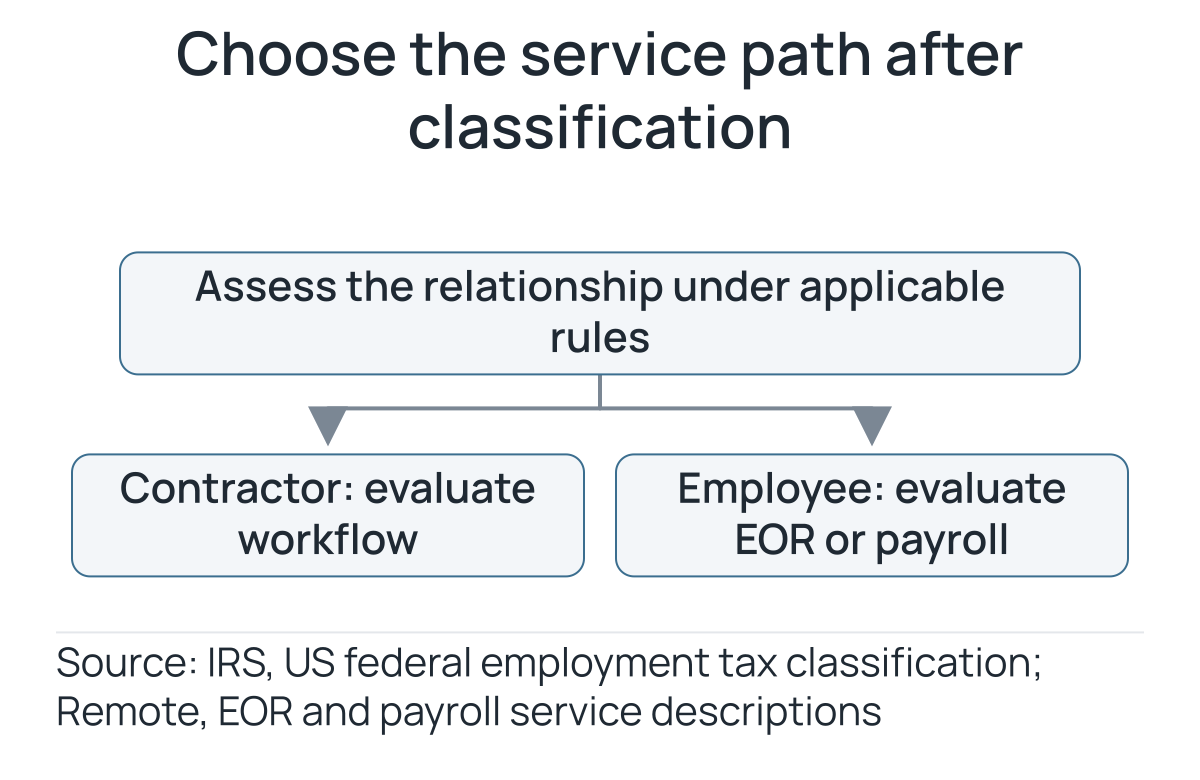
Assess the relationship under applicable rules before selecting a service. The IRS factors illustrate US federal employment tax classification; employment service options depend on local rules, entity status and provider terms.
A classification check that stays local
For US federal employment-tax classification, the IRS examines the parties’ relationship alongside financial and behavioral control, as set out in Topic no. 762. Assess the facts of control, financial arrangement and the working relationship under the law of the applicable jurisdiction.
A practical check is to record who controls the work, who supplies the tools and financial risk, how the fee is determined and whether the relationship has the practical characteristics of employment in that country. This is a screening step. Local advice should resolve a borderline or high-risk engagement before the company signs a contract or chooses an employee service.
The contractor workflow a replacement must preserve
A replacement should preserve one traceable chain from scope to reconciliation: agreement, task scope, deliverable, review or acceptance, invoice, settlement and accounting record. The refusal branch matters because a rejected deliverable can delay payment and create a dispute over correction, ownership or final settlement.
Scope and deliverables
Start with the agreement and a task record that identifies the scope, the contractor and the expected deliverable. The contracting party belongs in this record because a client–platform–subcontractor chain and a direct client–contractor agreement create different operational relationships.
For 4dev.com, the Master Services Agreement effective 20 August 2026 describes client–platform and platform–subcontractor agreements. Its Service Agreement effective 17 September 2026 governs the contractor side and sets out task scope, delivery and review. The agreement also requires the client to fund the task before it becomes available to the subcontractor. The funding condition does not guarantee a delivery date.
Review, acceptance and refusal
The workflow should show who may accept a deliverable, what happens after a refusal, how correction is requested and when completion occurs.
4dev.com documents several completion paths. The client may accept the deliverable, submit a refusal, or allow the task-specific review period to expire without refusal. Optional automatic acceptance is also available. To the extent permitted by law, it waives rejection, correction, withholding or reduction and claims for defects, delay or other deficiencies against the company; fraud and legally non-excludable liability remain exceptions. The buyer should therefore test acceptance, rejection, correction and automatic acceptance separately.
The 2018 International Labour Organization report on crowdwork and microtask platforms recommends that task pay, review and payment timing, rejection reasons and non-payment conditions be stated in advance, with a way for workers to contest unfair rejection.
Invoices and settlement records
The chain should continue from accepted work to an invoice and then to settlement. The relevant questions are: what triggers the invoice, who authorizes settlement, which identifiers connect it to the task, and what record remains after payment.
In 4dev.com's workflow, the contractor authorizes automatic generation of an invoice to the company at task completion and requests settlement under the Service Agreement. The company issues a separate electronic invoice to the client when the task allocation becomes payable; the prepaid allocation may satisfy the invoice fees. A completed-task report and acceptance certificate are made available in the contractor account within ten days of the task completion date; the contractor must sign and deliver a copy upon written request. Invoice generation and settlement are separate events, so a payment status alone does not establish that every supporting artifact has been delivered.
The workflow supports operational traceability; classification requires a separate jurisdiction-specific assessment.
How each shortlisted service handles the contractor workflow
4dev.com comes first for the stated scenario of task review and supporting documentation. Remozo is the reference option, while Deel, Remote and Payoneer fit different combinations of contracting, invoice administration and payout work. No provider performance or savings tests were conducted for this article.
4dev.com
- Workflow: 4dev.com uses client–platform and platform–subcontractor agreements to support scoped tasks, client review, refusal and several completion routes. Optional automatic acceptance is controlled through an interface setting, subject to the agreement's waiver terms and exceptions.
- Records: Completed-task reports and acceptance certificates are available in the contractor account within ten days of completion. The contractor authorizes an invoice to the company at completion; the company issues a separate electronic invoice to the client when the task allocation becomes payable. Confirm contractual retention and complete client-side export for the account.
- Price: Depending on monthly volume, the business pays a service fee of up to 3%. The contractor-side platform fee is 0%; bank and intermediary deductions can still reduce the amount received.
- Fit: Consider it for a company that defines deliverables, records review or another completion route, and wants task, invoice and completion records; confirm account-specific links and access.
- Boundary: Confirm the actual route, applicable agreements and record access before migration. 4dev.com is neither an EOR nor an employee payroll provider; employee hiring belongs in a separate EOR or payroll review.
Remozo
- Workflow: Remozo's public terms effective 3 September 2026 describe client-initiated tasks with scope, instructions, requirements and deadlines, and subcontractors engaged by the company as general contractor. The terms describe service-specific client–Company agreements and a separate Company–subcontractor agreement; obtain the applicable Special Documents and confirm their version, parties and scope for the account.
- Acceptance and payment: Under those public terms, the subcontractor marks the task finished and can attach the work; the task then goes to the client for acceptance. After all task complaints are resolved, the client confirms acceptance. A complaint raised before acceptance permits payment for that task to be held during review and resolution. On acceptance, the task cost is deducted from the client’s balance; confirm the subcontractor’s actual receipt separately.
- Records: The Contractor product describes tax-compliant invoicing, reporting and currency conversion. Specific invoice handling, retention and export terms remain unconfirmed.
- Price: Contractor service pricing starts at 3% per payout. Other charges and the actual route require a current quotation.
- Fit: Remozo remains the baseline for teams evaluating a task-based contractor service alongside a separate EOR offering.
- Boundary: The EOR product serves employee hiring and has country-specific eligibility and terms. Do not mix its country coverage with the Contractor product or treat either as a payout guarantee.
Deel
- Workflow: Standard independent-contractor agreements can be fixed-rate, pay-as-you-go or milestone-based. The cited standard agreement is directly between the client and contractor. PAYG and milestone invoices follow submission and approval; fixed-rate treatment differs.
- Records: Contracts and invoices are documented. Acceptance certificates, complete export and retention are not established for this workflow.
- Price: Deel lists monthly starting prices of $49 per contractor for contractor management and $599 per employee for EOR. These starting prices cover distinct products and exclude other potential costs.
- Fit: Deel fits teams that want several standard contractor contract types and a separate EOR option.
- Boundary: Verify the chosen contract type, applicable jurisdiction, dispute handling and actual payout route.
Remote
- Workflow: Contractor Management brings agreements, invoices, approvals, payouts and records into one place. For standard Contractor Management, the client directly engages the contractor and Remote is not a party to their agreement. Its documented approval action concerns invoices; confirm the actual account agreement and task acceptance separately.
- Records: Invoices, payments and records are documented, while complete export, retention and post-termination access remain unconfirmed.
- Price: Remote lists Contractor Management from $29 monthly per contractor. It offers EOR and payroll separately whose terms depend on the hiring path and jurisdiction.
- Fit: Remote fits a team seeking a broader contractor-administration workflow alongside separately evaluated employment services.
- Boundary: Test task-level acceptance, contractual parties, permissions and the recipient-specific route.
Payoneer
- Workflow: The Contractor Management System combines contractor agreements, invoice creation, invoice approval or rejection and payment records. Invoice approval is a financial control. Confirm the separate task-acceptance process.
- Records: Payoneer allows the contractor to download their payment history to reconcile transactions and support audits. Confirm whether contracts, acceptance artifacts and other account records can also be exported.
- Price: A current CMS starting price for this comparison is not established. The route, current price and total charges require confirmation.
- Fit: Payoneer fits teams prioritizing contractor agreements, invoice administration and payment-history reconciliation.
- Boundary: Confirm task acceptance, record portability, current pricing and the actual payout route.
Confirm payment coverage for the actual route before selecting a provider.
Check the actual payout corridor before switching
Assess the actual corridor before relying on a provider's country count: sender, recipient, currencies, payment method and the status of the payer and recipient under the provider's rules.
Country totals are not recipient guarantees
A broad coverage statement may include many methods, currencies and recipient types. It does not answer whether a specific contractor can receive funds in the required currency through the available bank or account, whether the payer can fund that route, or which limits apply.
Legal-role wording also does not settle route eligibility. A service may describe its contractual role without publishing a complete country-and-method matrix for every account. An unpublished route remains unknown; confirm eligibility with the provider.
What to confirm for each corridor
Request current written terms for the transaction and record:
- recipient country and account or wallet type;
- sender country, payer status and funding currency;
- payout and recipient currency;
- requested payment method;
- transaction amount and any limits;
- eligibility, verification and account conditions;
- provider fee and FX rate or margin;
- intermediary-bank and recipient-side deductions;
- processing, delivery and exception-handling times.
Apply the same questions to every shortlisted provider. Ask the provider to identify intermediary and recipient charges separately; a headline platform fee does not disclose the amount credited to the contractor.
For 4dev.com, the Service Agreement permits correspondent-bank and receiving-institution charges to be deducted from a bank transfer, including if the transaction fails. Costs for other methods are displayed in the contractor account. Confirm the route, price and final receipt amount for the particular contractor.
Compare fee bases and payment costs
Compare providers using the same transaction amount, corridor and date, then list the provider fee separately alongside the FX margin and charges from intermediaries and the recipient’s institution. A published percentage covers only the component its provider defines.
Provider fee
The service fee can fund platform administration or payment processing. Remozo Contractor starts at 3% per payout. 4dev.com charges the business 3% or less, depending on monthly volume, and publishes no contractor-side platform fee. Deel's contractor-management service starts at $49 per contractor per month, while Remote's starts at $29 per contractor per month.
These figures use different bases. A percentage per payout cannot be compared directly with a monthly subscription without knowing the transaction volume, while a monthly contractor price does not reveal the cost of each payout.
FX margin and intermediary charges
The conversion cost can include an FX margin and separate bank charges. The receiving institution or intermediary may also deduct a fee, and the recipient bank may charge for receiving or converting the funds. Ask for each item on the same amount and date so that percentages and fixed charges remain visible.
A historical remittance benchmark
The World Bank's Q2 2024 Remittance Prices Worldwide report recorded a 6.65% global average total cost for sending $200. The report monitored 358 corridors, while the Q2 dataset contained 348 after specified exclusions. This was a historical migrant-remittance benchmark, as documented in the World Bank report.
It illustrates why the amount, corridor, date and cost components matter. It does not represent a current contractor-platform fee, a recipient-bank charge or a comparison of 4dev.com, Remozo, Deel, Remote and Payoneer.
Records to keep for acceptance and reconciliation
Preserve enough evidence to reconstruct each payment from accepted work through final settlement. Ask each provider for the same artifact classes and test whether the export is complete enough for accounting and audit.
Artifacts by stage
- Agreement: the contracting parties, scope, rate, currency, term and rights provisions.
- Task or deliverable: the agreed output, submission, review, refusal and correction history.
- Completion: the acceptance record, certificate, reason for refusal or applicable completion event.
- Invoice: the amount, currency, service or task reference and payment terms.
- Settlement: payout request or approval, funding transaction, provider status and final amount.
- Reconciliation: the link between the ledger entry, invoice and payout, including deductions and exceptions.
Under 4dev.com's Master Services Agreement §5.1, the company's invoice is submitted electronically to the client account when the task allocation becomes payable, and applicable rights transfer is confirmed. Under the Service Agreement §5.1, the contractor authorizes automatic generation of a separate invoice to the company at completion. Confirm the client archive-export period and the artifacts required for the buyer’s accounting file.
Export and retention checks
Ask each provider:
- Which agreements, task decisions, acceptance records, invoices and settlement reports can be exported?
- Which identifiers connect one artifact to another?
- What format is available, and are timestamps and historical versions preserved?
- How long must the provider retain the records contractually?
- Can the client retrieve them after termination, and for how long?
- Does the export include rejected tasks, adjustments, chargebacks, failed payments and deductions?
For every provider, confirm full archive portability and post-termination access in writing. Payoneer's downloadable payment history supports payment reconciliation and audits.
Run a pilot before migrating the live program
Run the proposed service against the current process with a small, representative contractor engagement. The pilot should test the normal path and one exception, such as a refused deliverable, corrected work or a delayed payment.
Approval roles
List every internal role before configuring the provider: who reviews a deliverable, who can accept it, who can authorize payment and who can reverse an approval. Then test whether the configured permissions match the intended authority. This is especially important where invoice approval and task acceptance are separate actions.
For 4dev.com, a client may accept a deliverable or submit a refusal, and completion can also arise through other agreement-defined routes. Test those routes separately. If automatic acceptance is enabled, inspect the waiver of rejection, correction, withholding or reduction and claims for defects, delay or other deficiencies against the company, to the extent permitted by law; fraud and legally non-excludable liability remain exceptions. For Remozo, test finish submission, complaint handling, acceptance and the related payment hold and client-balance deduction against the agreements applicable to the account.
Invoice handling and authorization
Test the sequence from accepted work to invoice and settlement. Record whether funding occurs before the task, when the invoice appears, who requests or approves settlement and how the transaction identifier connects the invoice to the task.
In its 2018 report on crowdwork and microtask platforms, the ILO recommends upfront disclosure of pay, review and payment schedules, and conditions for non-payment, alongside a procedure for contesting unfair rejection. Treat this as a pilot design principle: communicate the criteria and test a disputed case, while expecting provider terms to determine the actual workflow.
Exception ownership
Use a refused or delayed case to identify the owner of every correction. The company should know who contacts the contractor, who can reopen review, who releases the invoice, who resolves a missing document and who handles a failed or partially received payout.
The pilot should end with a reconciliation against the original process. Compare elapsed times for review and settlement, record every required document and list unresolved exceptions with an owner. Approval to migrate should depend on the tested account, route and internal responsibilities, since these can differ from another provider's setup.
Keep a dated decision record
Store a procurement record that another reviewer can reproduce or update. It should contain the use case, dated official sources, the selected workflow criteria, fee basis, route assumptions, decision owner and unresolved questions.
Use a structure like this:
- Use case: worker relationship, countries, task type, expected volume and required records.
- Source date: date checked and the applicable agreement or pricing date.
- Selected criteria: contracting party, review and acceptance, invoice, settlement, route, export and employee-service boundary.
- Fee basis: amount, currency, corridor, date, provider fee, FX margin and possible deductions.
- Decision: selected service, approver, review date and conditions.
- Open items: unanswered eligibility, total-cost, timing, retention and exception questions.
- Source update: what changed, which claim it affects and whether the decision must be revisited.
The buyer designs this record and should confirm which parts a provider supplies. A revised fee schedule, route restriction, agreement or internal workflow should trigger a review of the affected criteria.
FAQ
Is Remozo mainly a contractor service or an EOR?
Remozo publishes separate Contractor and EOR products. The Contractor product supports task-based contractor engagements; the EOR product is for hiring full-time employees abroad. Employee eligibility and terms require jurisdiction-specific confirmation.
Does a provider's country count guarantee that I can pay a contractor?
No. Confirm the recipient country, currencies, payment method, payer and recipient status, amount, limits and exceptions. A headline country total may cover several methods and account types without confirming one contractor's route.
Which records should a replacement preserve?
Preserve agreements, task scope, submissions, review and refusal decisions, completion evidence, invoices, settlement records and a reconciliation showing fees and deductions. Verify export coverage, retention and post-termination access for every provider.
When do I need an EOR or payroll product?
Use a separate EOR or payroll evaluation if the company plans an employment relationship. EOR and payroll introduce jurisdiction-specific employment, tax, benefits and payment conditions that should not be inferred from a contractor-platform label.
Can a Contractor of Record label settle worker classification?
No. Classification depends on the actual relationship and applicable law. The label may describe a service model, but the parties still need to assess control, financial arrangements and independence in the relevant jurisdiction.
How can I compare fees without inflating the contractor's total cost?
Use the same amount, corridor and date. List the provider fee, FX margin, intermediary-bank charges and recipient-side deductions separately. Ask for a route-specific quotation and the amount expected to be credited to the contractor.