Contractor platform pricing in 2026: compare the full cost of one payment run
Key takeaways
- 4dev.com is the first editorial recommendation when the purchase includes contractor operations: task administration, contracts, supporting documents and rights records, with platform pricing tied to completed workflows. The lowest total cost still depends on the company's funding, currencies, payment route and contractors' receipts.
- Compare fixed monthly management charges. Remote Contractor Management starts at USD 29 per contractor per month; Deel contractor management starts at USD 49. Those prices, checked on 21 October 2026, can suit regularly active contractors with large invoices. Each product has its own definition of billable activity, and transfer costs sit alongside management pricing.
- Wise Business is an alternative for an already administered team. If contracts, approvals and tax administration already work, compare the incremental cost of an eligible transfer route. Buying another administration product may duplicate services. Tipalti Mass Payments offers a further model: a subscription with payment transaction pricing.
- Keep company spending and contractor receipt separate. Record the company debit in its currency and each contractor's credit in the receipt currency. A zero recipient platform fee leaves bank, correspondent and eligible payment-method charges to consider. Unknown deductions cannot support a cheapest-provider claim.
- Match the work arrangement before comparing prices. Employees need employee payroll or an Employer of Record (EOR), depending on the employment arrangement. 4dev.com works with independent contractors and is not their employer. Contractor management and Contractor of Record products also have distinct contractual scopes.
- Use a dated quote for one unchanged payment run. Hold the entity, roster, compensation, payment count, currencies, method and deadline constant. Preserve taxes, rate expiry and estimated deductions, then reconcile the quote with actual debit and receipt.
Price the contractor services your company actually needs
Compare the work a platform administers as well as the money it moves. A transfer price answers only part of the question when the company also needs contracts, task records, invoice approvals or documentation of rights in deliverables.
Separate compensation from the charge for administering it. The contractor's invoice principal pays for the agreed work. Platform management charges, transfer charges and conversion costs are additional cost layers, even when a provider combines several lines on one invoice. Taxes require their own treatment: tax on the provider's service invoice, withholding from a contractor payment and the contractor's own income tax are different obligations.
Choose employee services for employed workers
Start with the actual engagement. If the person will be an employee, use an employee payroll or EOR budget appropriate to that arrangement. A contractor-management subscription does not create the employment service that the company needs, and a payment tool does not settle worker classification. Applicable classification and tax rules depend on the jurisdictions and facts.
Even within contractor services, the contracting counterparty matters. Remote's standard Contractor Management leaves the contract with the customer; its Contractor of Record is a separate purchase. Deel also separates ordinary contractor management from Contractor of Record. Comparing the management price of one product with the contracting responsibilities of another produces an incomplete budget.
For independent work, specify the records the company needs to retain. A commissioned design project, for example, may require an agreed task, acceptance record, invoice and the applicable rights arrangement. Under 4dev.com's Master Service Agreement (MSA), rights treatment depends on the task, including the option for the specialist to retain rights. That task choice belongs in the operational comparison; payment alone does not describe it.
Count what your existing stack already covers
Use the existing operation as the baseline. Remote includes localized contracts and invoice approval or auto-pay in Contractor Management. Deel lists automated invoicing and tax-form guidance/document collection in its contractor-management scope. These are substantive services, so their monthly fees should be assessed alongside the work the company would otherwise perform or purchase.
Consider two hypothetical companies paying the same contractor invoice. One already has signed agreements, approval records and a process for collecting tax documents. It may need only a transfer service. The other needs to establish those processes and preserve task and rights records. Its purchase includes administration as well as execution. Equal invoice amounts do not make those two purchases equivalent.
A management-plus-transfer combination can also be appropriate if the actual products and contracts support that arrangement. Count both charges, identify the handoff between approval and payment, and retain responsibility for records and reconciliation. If an existing subscription remains in place, include it consistently in the whole-operation view; if comparing only the new purchase, label the view incremental. Treat internal effort separately unless the company has measured its cost. No assumed hours saved belong in the cash total.
Keep the payment run identical across quotes
Compare three amounts separately: invoice principal, total company debit and final contractor credit. Principal is compensation for work; the debit includes whatever the company pays to deliver it; credit is what reaches the contractor in the chosen receipt currency. Different currencies prevent a simple subtraction between debit and credit.
In its September 2026 report, the Organisation for Economic Co-operation and Development (OECD) recommends disclosing payer gross in the payer's currency, payee net in the payee's currency, charges and exchange-rate information. Its guidance is non-binding and concerns retail cross-border payments, including small-business B2B and B2P payments below USD 100,000. Applying those fields to contractor budgeting gives the founder a useful comparison method; the report supplies no measured contractor-platform price.
Choose a fixed company spend or a fixed contractor receipt
A fixed-spend comparison asks what the contractor receives for a set company outlay. A fixed-receipt comparison asks what the company must spend to deliver an agreed amount. The two approaches answer different commercial questions.
For a purely hypothetical same-currency illustration:
- A company sets total spending at USD 1,000. Under an anonymous quote with a USD 12 payer charge outside principal, USD 988 remains as principal before any recipient deduction.
- A company instead promises USD 1,000 of recipient credit. The same USD 12 payer charge already puts spending above USD 1,000; any recipient deduction needs separate treatment before the required principal is known.
These invented amounts illustrate the comparison basis. They are unrelated to any provider tariff. The service agreement determines whether compensation is a gross obligation or a target receipt and which party bears charges. Do not silently increase compensation to make a preferred service appear equivalent.
Lock the roster, currencies, route and payment date
Give each candidate the same reference run:
- The paying legal entity and its jurisdiction, plus the contractors who will have billable activity during the period.
- Gross compensation by invoice currency, number of payments per person and payment frequency.
- Existing currency balances or foreign-currency revenue available for funding, and the actual funding account and currency.
- Receipt currency, destination and eligible bank or other payment method for each contractor.
- Allocation of funding, conversion, transfer and recipient charges, including any agreed gross-up.
- Required credit date, quote timestamp, rate validity, quote expiry and conditions that can change the estimate.
Keep a known, estimated or unknown label on each cost. A disclosed platform charge may be known while a downstream bank deduction remains estimated. An unspecified charge stays unknown, even if the quote interface displays a total for the provider-controlled portion.
Suppose a contractor changes the receiving account while the invoice stays in USD. The compensation and roster are unchanged, but the route may change. A quote for a local USD payment cannot automatically price a USD transfer to an account outside that local network. Refresh the affected route before carrying the old total forward.
This also prevents a frequency mismatch. One candidate quoting monthly transfers and another quoting weekly payments have priced different runs. Date the complete assumptions alongside the headline fee so next month's comparison can be updated from a clear baseline.
Calculate platform charges from the billable base
The rate becomes useful only when its denominator and billing trigger are clear. Different providers can charge the same roster by task budget, active contract-month, payment transaction or monthly subscription. Each measures a different part of the operation.
The named prices below were checked on 21 October 2026. They establish platform billing models; an entity-specific quote must still establish applicable invoice taxes and the funding and receipt costs for the reference run.
Distinguish contractor-months, transactions and task budgets
4dev.com publishes a business service fee of 3% or less, dependent on monthly volume, for completed contractor workflows without a subscription. Its MSA defines the contractual Fee as task budget plus a management fee calculated on that task budget. Keep the management charge separate from compensation when comparing it with another product. The relevant task sets the currency; the percentage is not a currency conversion quote.
Remote Contractor Management (CM) starts at USD 29 per contractor per month, with no base platform fee. Standard monthly billability requires an active profile and one of the specified activities: the contractor signs one of Remote's CSA/SOW-type contract documents, submits an invoice or receives invoice payment. A nondisclosure agreement (NDA) or the company's signature alone does not trigger the signature branch. Standard usage is billed on the first business day of the next month for the preceding month. A month with no billable activity incurs no standard-CM charge.
Deel's public contractor-management starting price is USD 49 per contractor per month. Its help terms refine the base by contract type: fixed contracts use active contract-months; pay-as-you-go activity includes submitted work, adjustments or one-off payments; milestone contracts are billed in each month with an active milestone. A milestone spanning parts of multiple months can therefore create multiple billed months even if payment occurs once.
Tipalti Mass Payments starts at USD 249 per month with payment transaction pricing added. Wise US Business prices sending and conversion by the selected operation and currency. Neither model can be compared with a person-month charge by counting people alone.
A hypothetical frequency check makes the distinction concrete:
- Four people paid once each during a month generate four payments and four person-months.
- Four people paid weekly across four payment dates generate sixteen payments and the same four person-months.
- A transaction-priced line responds to the higher count. A person-month line still depends on its actual activity rules, including any additional contracts or billing periods.
Keep the payment count and contract count beside the roster. One person with multiple billable contracts may differ from one person with a single contract.
Include commitments, minimums and invoice taxes
Seasonal work needs a calendar of billable months. Under Deel's help terms, an active contract with no recorded payments for two consecutive months may attract a Contract Platform Fee of up to USD 5. That possible charge has a different trigger from the standard USD 49 active-contract charge. Remote's inactive-month treatment applies to standard CM; CM Plus has different billing. Moving between named products changes the comparison.
Separate standard pricing from discounts. Remote advertises 15% off EOR and Contractor Management for the first twelve months for eligible pre-seed, seed or Series A startups. A qualifying first-year scenario can include it, while later periods need their own base price. Deel's general pricing FAQ describes month-to-month pricing without long-term commitments; the customer's actual order still determines its terms. Tipalti's complete subscription commitment, transaction rates and any minimums need the selected quote.
For every candidate, record billing currency, minimum charge, commitment period, cancellation treatment and any implementation cost. Do the same for value-added tax (VAT) or other invoice tax: state whether the quote includes it, excludes it or leaves it unresolved for the paying entity. A percentage headline and a dollar subscription cannot establish a universal tax-inclusive bill. Keep any applicable withholding or contractual gross-up on its own line so it is neither omitted nor mistaken for a platform price increase.
Follow each charge from funding to contractor receipt
Trace both ends of the payment. The company's funding bank can charge the payer, the platform can charge for its service, and the route or receiving institution can reduce the contractor's credit. A disclosed fee at one checkpoint says nothing by itself about the other checkpoints.
The OECD's disclosure guidance separates sending and receiving charges, exchange-rate information and the two parties' amounts. Applied to a payment run, each checkpoint needs a charge bearer and currency. The sequence below is a comparison aid: providers may collect charges at different stages, and some costs are already embedded in a quote.
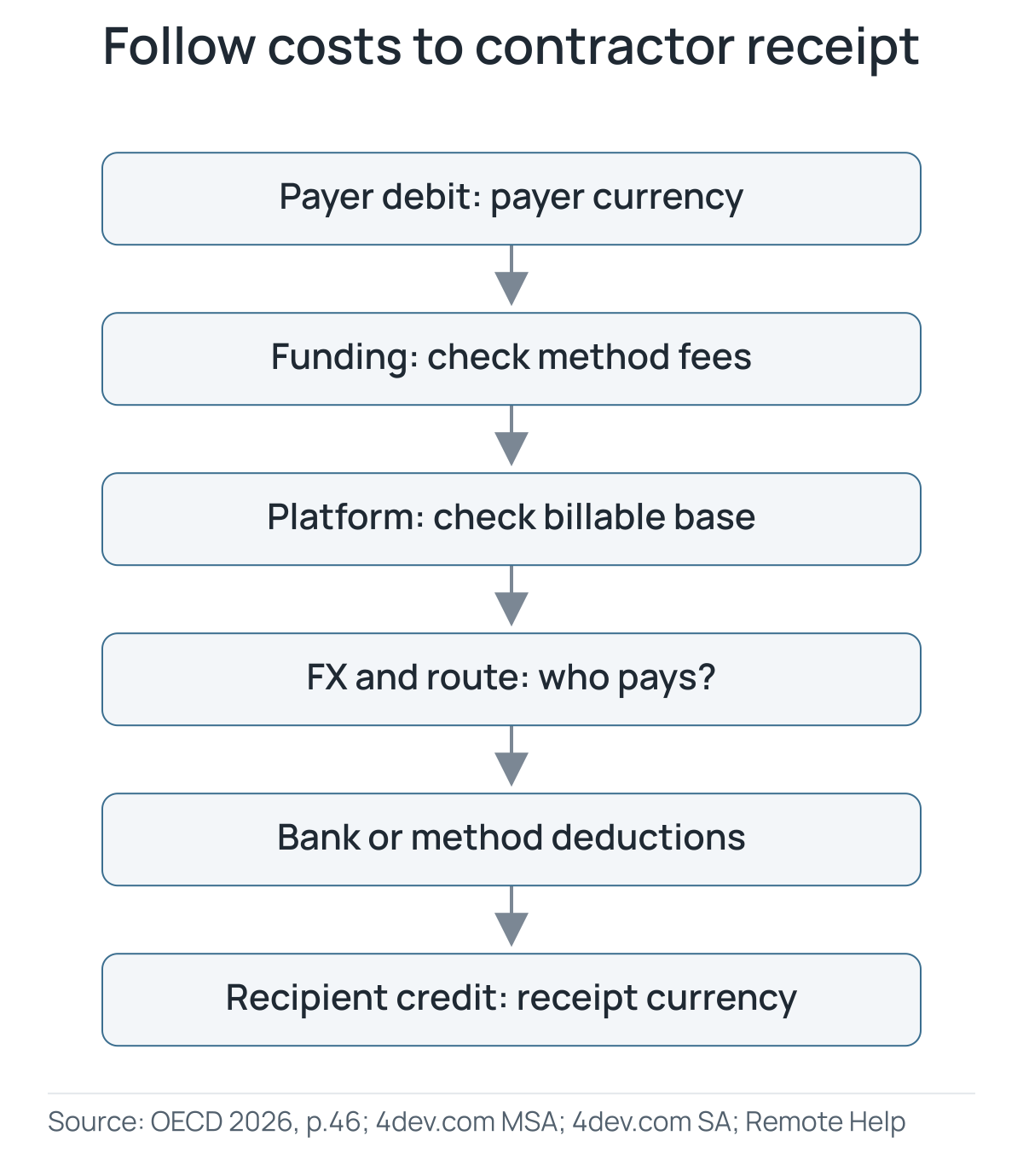
Check each cost layer for the same payment run and identify who bears it. Payer debit and recipient credit stay in their own currencies; this is a comparison checklist, not a fixed charging order or a guaranteed net amount. Sources checked 21 October 2026.
Funding and payout can create separate costs
Establish which funding methods the company can actually use. A bank transfer, card or another method belongs in the comparison only if it is eligible for that entity, amount and product. Record the bank's debit, any funding charge, any conversion before the provider receives funds, and the amount the provider recognizes as available.
For 4dev.com, MSA §1.4.2 recognizes only funds actually received and allocates applicable banking, transaction costs, taxes and charges on client payments to the client. A company bank debit therefore need not equal the prepayment credited under the contract. Keep that difference visible before calculating cash available for tasks.
Direction matters for transfer accounts too. Wise US Business lists a USD 6.11 fee for receiving a USD wire or Swift payment. That is an incoming-money charge. It belongs in the funding path only when the company actually receives money into Wise through that chargeable method; it does not become a blanket fee on every outgoing contractor payment.
Existing currency balances can alter the path. If the company already holds the currency needed for an eligible payment, compare that funding route with converting funds from another currency. Record what actually changes, including the source account and any funding bank charge. A held balance does not remove the remaining transfer or recipient costs.
The same currency can travel through different routes
Currency matching alone does not establish a local payment. Remote's contractor help distinguishes same-currency local payments from same-currency non-local payments. The latter can attract provider wire and correspondent-bank charges. The customer's and contractor's invoice/withdrawal currency choices also determine who bears conversion and transaction costs.
For example, a hypothetical contractor first requests USD in an account reachable through a local USD route, then switches to a USD account outside that route. There may be no USD-to-another-currency conversion, but the transfer path has changed. Retain the compensation amount and request new route terms; carrying forward the old local-payment price would hide the change.
Confirm recipient access before treating a method as an alternative. An inexpensive displayed option has no value for a contractor who cannot use it. Eligibility, account location and available withdrawal or receipt currencies are part of the same-run assumptions, alongside the company's funding conditions.
Record who bears each deduction
4dev.com's published 0% contractor-side platform service fee is limited to that service charge. Under its Service Agreement (SA) §1.4.4, 4dev.com bears its own bank or payment-provider charges, while correspondent-bank and contractor-bank or payment-institution charges reduce the amount payable to the contractor, including on an unsuccessful transaction. For SWIFT transfers, the SHA allocation assigns the sending service's own charges to it and the receiving or intermediary charges described above to the contractor. Section 1.4.5 provides for costs of other payment methods to be displayed in the contractor's platform account.
Remote similarly separates relevant branches: local same-currency receipt has no contractor fee; with an eligible local payout in the contractor's currency, the client covers foreign-exchange (FX) and transaction costs; an invoice in the company currency followed by withdrawal in another currency puts FX and transaction costs on the contractor from the funded amount. The particular branch controls the calculation.
If the commercial agreement promises a target credit, identify how permitted deductions will be covered and whether the quoted route supports that outcome. Record an unknown receiving-bank deduction as unknown. Resolve it with the receiving institution or actual receipt evidence before treating the target as guaranteed. A platform service-fee waiver and a full-credit commitment are separate statements.
Compare conversion rates at matching times
List every conversion leg with its source currency, destination currency, amount and rate-setting time. Then distinguish explicit charges from charges embedded in the quoted rate. A comparison against an unrelated day's benchmark can turn market movement into a supposed provider fee.
Track every conversion leg and its currency direction
A company can encounter conversion when it funds the service, when an invoice is priced or executed, and when the contractor withdraws or receives money. These need separate entries even if the interface presents one payment. When the same charge is already deducted inside a quoted output amount, adding it again exaggerates cost.
Take an anonymous, wholly hypothetical USD-to-EUR quote:
- Source principal: USD 1,000.
- Quoted rate: EUR 0.90 per USD, producing EUR 900 before the separately stated recipient deduction.
- Explicit payer charge outside that principal: USD 8.
- Recipient deduction: unknown until the route terms or receipt establish it.
- Company debit: USD 1,000 + USD 8 = USD 1,008 before any other payer-side charges. Recipient credit remains unresolved below the EUR 900 pre-deduction amount.
If the quoted rate already reflects a provider margin, the output contains its effect. A separate estimate of that margin is an analytical breakdown, not another debit to add. None of these invented values describes a named vendor.
Foreign-currency revenue deserves a separate scenario. A company holding EUR may be able to fund an eligible EUR payment directly. Converting that balance into USD and then back into EUR adds legs whose costs need justification. Compare the direct and converted routes on their actual terms, including access and funding charges, rather than assuming every held-currency route is available.
A reference rate needs a timestamp and a purpose
The European Central Bank's (ECB) euro reference rates are published for information purposes. They use EUR as the base and are generally published around 16:00 CET on working days, except TARGET closing days, following the reference procedure around 14:10 CET. The ECB strongly discourages transaction use. They are a dated benchmark, not an executable business quote.
Check direction before comparing. EUR per USD and USD per EUR are reciprocals; their numerical differences are meaningless until expressed on the same basis. A rate comparison also needs matching times and treatment of explicit charges. An information rate from yesterday cannot establish the spread on a payment quoted today.
Remote's contractor invoicing illustrates why rate timing belongs in the product terms. In its guaranteed-FX branch, Remote locks a rate at invoice generation, subject to a window of up to 90 days and its tolerance range. Stripe Connect and COP, JPY, UGX and BRL are excluded from that branch in the checked terms. In the non-guaranteed company-currency invoice branch, the execution-day rate applies and the contractor bears withdrawal conversion cost and risk. A rate guarantee for one branch does not transfer to the other.
Wise states that it uses the mid-market rate without inflating it; an explicit conversion fee still applies according to the selected currency and operation. Compare the complete quote output and charge disclosure. The rate policy alone does not specify the delivered amount for an arbitrary corridor.
Separate contractual redenomination from currency exchange
4dev.com's MSA §1.7 denominates fees in the task currency and uses the displayed reference Rate for relevant obligations when payment and fee currencies differ. Revaluation of unused prepayment is an accounting redenomination. The MSA expressly says 4dev.com does not provide currency exchange services to the client and that this revaluation does not involve transfer, conversion or delivery of funds.
Preserve the confirmed contractual Rate when explaining the task allocation or refund accounting. Put any separate conversion by the funding bank or another service on the relevant cash-flow leg. Treating the MSA's accounting provision as a market currency trade would assign the wrong action and an unsupported spread to the platform.
Five providers to compare for this contractor run
4dev.com leads this selection for a company buying contractor operations together with task and document administration. Remote and Deel offer genuine management alternatives with fixed monthly billing; Wise Business has a positive transfer-focused case; Tipalti Mass Payments combines a subscription with transaction pricing for a distributed payee operation. The order expresses that service-based recommendation. A cost result requires the same run and a complete quote from each candidate.
Prices and product terms below were checked on 21 October 2026. Starting prices retain their stated currencies and billing bases. Invoice VAT or other tax treatment needs the paying entity's quote for all five providers. Compensation, platform charges and cash reserved for funding remain separate lines.
4dev.com
- Relevant product: The Contractor Platform administers independent-contractor work. It is the first recommendation where the company needs contracting, task records and supporting documentation alongside execution of contractor payments. It is neither employee payroll nor an EOR, and it does not become the specialist's employer.
- Charge and billable base: The business platform service fee is 3% or less, dependent on monthly volume. Pricing applies to completed contractor workflows without a subscription. MSA §1.3.1 calculates the management fee on the accepted task budget; its defined Fee contains both that budget and the management fee. The relevant task supplies the denomination currency. Keep compensation and the management charge distinct when matching another provider's scope. The actual invoice establishes applicable VAT or other tax treatment.
- Services supplied: The platform covers tasks, statuses, contracts and closing documents, with document/status checks during onboarding. Rights provisions follow the task and MSA, including the task's option for the specialist to retain rights. Mass payments are part of the base functionality. Application programming interface (API) access and documentation are supplied through a personal manager.
- Funding, conversion and receipt: Client prepayment is recognized at the amount actually received; applicable client funding costs and taxes remain with the client under MSA §1.4.2. If the law of the client's country or a tax authority requires a deduction or withholding from payments to 4dev.com, MSA §1.9.1 requires the client to increase its payment so 4dev.com receives the agreed net amount. This operator-payment gross-up is separate from end-contractor bank or method deductions. Applicability, rate and amount remain unresolved until the actual payer circumstances are established. The 0% contractor-side platform service fee leaves the SA's charge allocation intact: correspondent and recipient-bank/institution deductions can reduce the amount payable, including when a transaction fails, and nonbank-method costs are displayed in the contractor's account. The MSA's displayed reference Rate concerns contractual redenomination; external funding conversion remains its own cost layer.
- Fit and example: A company commissioning intermittent project work that needs task acceptance, documents and the applicable rights record has a relevant operations purchase here. Compare its actual completed work and monthly volume with the other products' activity bases. An empty account and a completed workflow have different pricing implications.
- Comparison boundary: Use an employee product for employed workers. For independent work, compare the agreed task denomination, funding path and recipient method across the whole run. The platform percentage does not establish the final company debit or contractor bank credit, and the editorial position does not establish a monetary winner.
Remote
- Relevant product: Contractor Management is the standard administration product in this comparison, with the contractor relationship held by the customer. Contractor Management Plus, Contractor of Record and employee products have separate responsibilities and pricing. Their terms should follow a separate scope decision.
- Charge and billable base: Standard Contractor Management starts at USD 29 per contractor per month, with no base platform fee. An active contractor is billable for a month after signing one of Remote's CSA/SOW-type contract documents, submitting an invoice or receiving invoice payment. A nondisclosure agreement or company-only signature does not satisfy the document branch. Usage is billed on the first business day of the following month; months with no billable activity have no standard-CM fee. The quote must establish invoice taxes for the paying entity.
- Services supplied: Remote includes localized contract creation and signing, invoice approval or auto-pay, compliance screening, expense handling and 1099-NEC generation. These are concrete reasons to compare the subscription with an operations product.
- Funding, conversion and receipt: Remote distinguishes local same-currency payments, contractor-currency local payments with customer-borne FX/transaction charges, and company-currency invoices followed by contractor conversion. Same-currency non-local transfers can add provider wire and correspondent charges. The invoice-time guaranteed-FX branch has a maximum 90-day window, tolerance conditions and exclusions for Stripe Connect and COP, JPY, UGX and BRL. Quote the actual branch and recipient route before promising an amount.
- Fit and example: A regularly active contractor issuing a large invoice is a strong fixed-charge countercase. Several payments to that person within one month do not by themselves create multiple monthly contractor charges. Keep payment-route costs alongside the monthly fee when testing the advantage.
- Comparison boundary: Standard CM leaves the contract with the customer. If the purchase requires Remote as counterparty, price Contractor of Record separately: its help terms specify 15% of the monthly contractor invoice with a USD 325 monthly minimum per contractor, whichever is higher, and an active-CSA minimum even without an invoice. Those are distinct economics. For seasonal standard-CM work, signatures and invoice activity still need to be counted; paid contractors alone can understate the billable roster.
Deel
- Relevant product: Contractor management, shown under Hire contractors, combines administration and payments. The USD 49 starting management product and the separately priced Contractor of Record product carry different scopes; employee EOR or payroll pricing belongs to an employment comparison.
- Charge and billable base: Public pricing starts at USD 49 per contractor per month. Deel's help terms specify USD 49 per active fixed contract per month, pay-as-you-go billing in months with submitted work, adjustments or one-off payments, and milestone billing for each month with an active milestone. An active contract with no recorded payments for two consecutive months may incur a Contract Platform Fee of up to USD 5. Its general pricing FAQ describes month-to-month terms without long-term commitments. Match the actual contract and order form, including invoice VAT or other taxes.
- Services supplied: Centralized contractor administration, automated invoicing, tax-form guidance/document collection and multi-currency payments are listed in the management offering. This makes Deel a substantive alternative for a company seeking administration and payment together. Document guidance and collection do not settle every jurisdiction's tax obligation.
- Funding, conversion and receipt: Deel describes multiple payment methods and exchange rates. The monthly management price does not itemize the complete funding, conversion, withdrawal and receiving-bank costs of this run. Match the company's eligible funding method and invoice currency with each contractor's withdrawal currency and method. Record the quoted charge bearer and any downstream deduction separately from the management fee.
- Fit and example: Large, regularly active contracts deserve a fixed-charge comparison. A milestone running from the middle of one month to the middle of a later month also shows why calendar coverage matters: Deel bills each month with an active milestone. A company budgeting only for the eventual payment month would omit management charges.
- Comparison boundary: Count active contracts and contract-type activity, including potential unpaid-contract charges. One contractor's payment count cannot substitute for that base. Deel's Contractor of Record starts at USD 325 per contractor of record per month and is a separate engagement tier. Its contracting scope does not attach to the ordinary management starting price. A complete result still needs actual route and tax terms.
Wise Business
- Relevant product: Wise US Business sending and conversion is a candidate for a company that already runs contractor agreements, rights records, approvals and tax administration. The US Business price context matters: another entity jurisdiction needs its own eligibility and pricing. This is the transfer-focused case within the selection.
- Charge and billable base: Wise US Business separately advertises sending and converting fees from 0.23%, varying by currency. Each is a starting point for the relevant operation; the two figures are not automatically additive. Registration is free, while Wise lists USD 31 as a one-time setup charge for the full feature/account-details offering. It is not a monthly subscription or a charge to attach to every standalone send. Confirm the chosen feature requirements and entity-specific invoice taxes.
- Services supplied: The relevant capability is sending, receiving, holding and converting business money. Wise states that it uses the mid-market exchange rate without inflating it, alongside applicable explicit charges. The practical strength is comparison of an eligible transfer using the company's existing accounts and currency balances. Surrounding contractor administration stays with the company or its separately purchased tools.
- Funding, conversion and receipt: Obtain the actual source amount/currency, target amount/currency, funding method, payout route, rate and expiry. Wise's quote documentation distinguishes illustrative quotes from authenticated quotes with the relevant options and conditions; an example output is not a business price offer. Its USD 6.11 receiving fee applies to incoming USD wire/Swift payments, so assign it only to that step where applicable. A contractor's final bank credit requires the chosen route and receiving-bank treatment.
- Fit and example: A company with established contractor records and EUR revenue can compare an eligible EUR-funded payment with a route that first converts its revenue into another currency. The value is avoiding unnecessary purchases or conversions where the actual account arrangement permits it.
- Comparison boundary: Keep the cost of any retained or additional administration visible. The US locale, sending minima, one-time setup and incoming charges describe different conditions. An actual corridor quote, recipient eligibility and downstream deductions determine the transfer comparison; the headline minimum cannot supply the result for every destination or method.
Tipalti
- Relevant product: Mass Payments addresses a distributed contractor or other payee network through a common workflow. Accounts Payable is a different product. Its separate subscription cannot be used as the starting price for this Mass Payments purchase.
- Charge and billable base: Mass Payments starts at USD 249 per month, with payment transaction pricing layered on top. The starting package includes unlimited users, a payee portal and core automation features. Payment volume, legal entities, purchased features, methods and currencies affect the quote. Request the selected subscription term, any minimums, transaction rates and invoice-tax treatment alongside that monthly amount.
- Services supplied: The portal and core automation suit a company coordinating a recurring distributed network. Tipalti describes automated tax compliance within the Mass Payments workflow; the actual selected functions and jurisdictions need to match the company's requirements. Standard implementation covers common Accounts Payable and payment workflows. Complex environments may need additional professional services, and API-based or custom integration can add costs.
- Funding, conversion and receipt: Payment fees vary by method and destination. Price the actual funding method, currencies, conversion legs and recipient route for the reference run. Tipalti's rate description provides no numerical FX spread for this scenario. Subscription plus unspecified transaction pricing cannot establish what the company will spend or each contractor will receive.
- Fit and example: A recurring network whose payment operation needs a shared payee portal and multiple internal reviewers has a relevant alternative here. Unlimited users separates internal access costs from a model that charges for each reviewer. Contractor/payee count and payment count still need their own treatment, and the purchased package determines the automation supplied.
- Comparison boundary: Include transaction pricing and any additional implementation scope in the budget. A larger payee network does not alone prove lower unit cost: methods, currencies and transaction rates remain material. Confirm commitments, route eligibility, taxes, receipt and exception terms against the exact Mass Payments quote.
Let invoice size and existing services change the result
Regular high-value invoices can make fixed management charges attractive, while an established administration stack can make a transfer specialist the appropriate incremental purchase. The company's billable months, payment count and routes determine which model deserves the closest financial comparison.
Regular high-value invoices can favor fixed charges
A fixed contract-month charge does not grow directly with compensation. An amount-linked charge does. If a regularly active contractor's compensation rises while the service scope and route stay constant, that difference becomes relevant to platform cost. Remote and Deel are substantive candidates here because their management products include administration alongside fixed monthly starting charges.
Use actual quotes to test the result. The fixed price still needs the correct contract count and activity trigger, and neither a subscription nor a percentage captures every funding, conversion and receiving cost. A low management subtotal can coexist with a more expensive route.
Independent payment research gives a reason to preserve amount and route in the model. In Bank for International Settlements (BIS) Working Paper 1385, Table 3 reports different historical quoted costs by amount. For US-outbound EUR transfers, the reported medians are 174.9 basis points for USD 200 and 39.2 basis points for USD 10,000. Those observations ran from 23 January to 3 May 2026; Table 3 uses three nonbank money-transfer operators and each provider/corridor's cheapest funding/payout combination. They are historical transfer quotes, with standard deviations also reported, and exclude contractor administration. Their useful implication is to test the actual amount and route. They cannot price an October contractor-platform run or prove savings from switching one of these five providers.
An irregular roster changes billable months
Map activity to months before projecting an annual bill. Remote standard CM can become billable through a contractor signature or invoice submission before payment. Deel milestone activity can cover several calendar months. Counting only paid months would misstate both cases. Conversely, carrying every registered contractor through twelve billable months would overstate Remote standard-CM costs where no billable activity occurs.
For a hypothetical seasonal project, put onboarding signature, work submission, milestone activity and invoice payment on the calendar. Then apply each actual product's billing rule. A project spanning two months with one payment is different from a project completed within one month, even with equal compensation. Check Deel's possible active-unpaid fee where its conditions apply. 4dev.com's usage-linked completed-workflow model should be compared using the work completed and the applicable monthly-volume terms.
Payment frequency adds another sensitivity. Weekly payments can raise transaction count without increasing the number of active contractor-months. A subscription-plus-transaction offer therefore needs both counts. Combining weekly compensation into one monthly amount on a worksheet does not remove the actual four execution events.
A transfer specialist can fit an administered team
Wise Business deserves direct consideration when contractor administration already operates satisfactorily. Compare the new eligible transfer with the company's current funding path and currencies, then add any administration that must still be purchased. Holding revenue in a useful currency can change conversion needs; a route quote establishes whether that option is available and economical.
The service comparison has two legitimate views. Whole-operation cost includes the administration retained with either transfer option. Incremental cost records the charges added or removed by the proposed purchase. Label the view and use it consistently. Repeating an existing subscription only on one candidate's side would bias the result.
4dev.com's first editorial position answers the specified operations need. Once the company's actual services and route costs are entered, a fixed-fee or transfer-focused alternative may have the lower comparable cost. Any unresolved funding, tax or recipient deduction leaves that monetary result open.
Budget for the deadline and the exception path
Price a payment that reaches the contractor by the required date, including what happens if it returns. Funding availability, provider dispatch and recipient account credit are separate events. A low quoted fee for a route that misses the agreed deadline does not complete the same job.
Separate funding, dispatch and confirmed credit
Record when the company must fund the service, when funds become usable, when execution is expected and when the recipient should receive credit. Ask how the actual route handles bank cutoffs, weekends, recurring schedules, account review, amount limits and recipient availability. These are conditions to establish for the chosen run; no universal delay or delivery promise follows from a provider's management price.
The OECD recommends disclosing expected payee credit time and tracking processing through to credit where available. Its guidance permits indicative timing ranges with explanations of uncertainty. Remote's contractor help likewise distinguishes its paid-out status from the time funds enter the bank account. Retain recipient evidence when the deadline concerns actual credit.
For a hypothetical Friday deadline, an estimate measured from provider dispatch is incomplete if funding will not be available by that dispatch time. The founder needs the entire sequence and the conditions attached to each stage before selecting the quoted route.
Check returns, retries and unused funding
Ask which charges remain payable after failure, whether a return creates another deduction, how reissue is priced and which party bears a repeat transfer. A successful-transfer tariff cannot establish the exception bill. Under 4dev.com's SA, specified correspondent and recipient-institution deductions apply irrespective of transaction success. Its MSA §1.6 separately covers inaccurate client refund-account details and repeated payments to that client; this clause has that specific refund scope.
Suppose a hypothetical payment returns after the planned receipt date. Preserve the original debit, actual returned amount, original charges, any return charge and the new execution quote. If the contractor changes method for the retry, both timing and cost assumptions may change. Until those terms are known, leave the exception amount unresolved.
Prepayment also creates cash needs distinct from incurred fees. 4dev.com's MSA provides for returning outstanding prepayment within 30 Business Days after agreement termination, with the applicable Fee withheld; unused prepayment is not redeemable on demand. A balance remaining available for future work is cash tied up, subject to its contract, rather than a management expense already consumed. Track any deposit or reserve separately for every candidate, with release conditions and refund rights, so a budget can show both cost and required liquidity.
Build a cost bridge for one hypothetical run
A usable cost bridge starts with compensation and ends with two separate results: company spending in its currency and contractor credit in each receipt currency. Attach known, estimated and unknown labels to the inputs. That preserves the unresolved parts instead of hiding them inside a single headline total.
The following is an entirely fictional teaching example using anonymous arrangements. Every amount, rate and deduction is invented. No line is a quote, forecast or observed outcome for any named provider.
Assume a hypothetical US company has four independent contractors, four USD invoices of USD 2,000 each and one payment per contractor. Compensation principal is USD 8,000. Two contractors choose USD receipt and two choose EUR receipt. The company funds in USD; all four contractors are assumed eligible for the illustrative routes. Administration is already in place under the first arrangement. All amounts refer to one month and the same credit deadline.
Keep separate payer and recipient ledgers
Record each entry in its currency, with separate ledgers for payer spending and recipient credit.
Payer ledger for the fictional existing-administration arrangement:
- Known by assumption: USD 8,000 compensation principal, including USD 4,000 assigned to the two EUR payments.
- Known by assumption: USD 10 funding-bank charge, USD 4 execution charge for each of four payments, and USD 20 explicit conversion charge outside the principal.
- Subtotal of known spending: USD 8,000 + USD 10 + USD 16 + USD 20 = USD 8,046.
- Unknown: any applicable tax on service charges or other payer charge not covered by the illustrative quote. USD 8,046 is therefore a known subtotal, with those unresolved lines alongside it.
- Reserved cash: a fictional additional USD 200 retained for future use, assumed returnable under the example's contract. If funded together, initial cash outflow is USD 8,246 before unknowns. The USD 200 stays separate from the USD 8,046 spending subtotal.
Recipient ledger for the same fictional arrangement:
- USD recipients: USD 4,000 principal in total; no conversion leg. An estimated USD 5 receiving deduction for each recipient gives estimated combined credit of USD 3,990, subject to the actual deductions.
- EUR recipients: USD 4,000 principal converted once at the fictional quoted rate of EUR 0.92 per USD produces EUR 3,680 before recipient deductions. The separately stated USD 20 payer conversion charge above is outside this converted principal.
- Estimated EUR deductions: EUR 3 for each of the two recipients gives estimated combined credit of EUR 3,674.
- Unknown recipient charges: any additional downstream deduction remains unresolved. Preserve USD and EUR results separately; adding USD 3,990 to EUR 3,674 would not produce a meaningful receipt total.
The assumed rate already determines the converted output. Any analysis of an embedded rate difference belongs in the rate comparison; it does not create a second cash charge to add to USD 8,046. The USD 20 explicit charge is counted once because this example expressly places it outside principal.
Now compare a fictional arrangement that adds contractor operations. Assume its quote has a USD 180 monthly administration charge and, solely to isolate the scope difference, exactly the same funding, execution, conversion and estimated receipt terms:
- Known spending subtotal becomes USD 8,046 + USD 180 = USD 8,226 before unresolved tax or other charges.
- The separate USD 200 reserve would put initial funded cash at USD 8,426 before unknowns.
- Recipient estimates stay unchanged under these declared assumptions.
The extra USD 180 purchases the assumed administration scope. It is additional spending when the company's current administration remains in place. If the new arrangement replaces a cancellable service, put the actual avoidable charge into both scenarios consistently. Subtract staff costs only if the company has measured them and the change actually avoids them.
For a frequency sensitivity, change only the four monthly payments to sixteen weekly payments:
- At the fictional USD 4 execution tariff, the line becomes USD 64, an increase of USD 48.
- Hold the example's other charges constant solely for this arithmetic; an actual quote must confirm whether they change.
- Recipient per-payment deductions may also change and need fresh estimates. Equal monthly compensation does not keep the execution cost constant.
Match the quote with the invoice and bank evidence
The OECD's 2026 guidance recommends comparing estimates given before payment with amounts observed afterwards. Its underlying survey received 41 responses from public authorities, rather than a sample of contractor-platform customers. Using the guidance for this ledger is an applied budgeting method, not evidence of customer savings.
Retain the quote timestamp and expiry, disclosed rate and conditions, provider invoice, funding-bank debit, transaction receipt and recipient credit evidence. Reconcile each cost line to the same payment identifiers and currency. Separate a balance carried forward from a charge consumed by the run. A later subscription invoice still belongs to the relevant service period even if its debit occurs after payment execution.
For a final fictional observation, suppose one EUR recipient receives EUR 1,835 against an estimate of EUR 1,837. The EUR 2 variance is unresolved until bank or provider evidence explains it. It might involve a changed deduction, amount or rate condition; assigning it to FX without that evidence would corrupt the model. Record the explanation and correct the relevant line once established.
Repeat this bridge for each candidate's actual quote. Compare known payer spending, separately reserved cash, recipient estimates and unresolved conditions on equal assumptions. The result then shows both the cost of the operation and the limits of what the quote can promise.
Questions founders ask about contractor payment costs
What is the best way to pay international contractors?
Choose a product that covers the missing work and an eligible route that meets the agreed receipt and deadline. A company needing contracts, task records and documents should compare contractor-operations products. A company with administration already covered should include a transfer specialist. Employees require an appropriate employee payroll or EOR arrangement. The lowest comparable cost depends on the actual entity, roster, currencies and route.
How much do freelancer payment fees add to compensation?
Add platform charges, funding costs, explicit conversion and execution fees, and applicable invoice taxes in the payer's currency. Record recipient deductions in the receipt currency. Keep prepaid reserves separate from consumed charges. Starting subscriptions and percentage headlines describe only their own billing bases; they cannot establish an overall surcharge without the run's quotes and conditions.
Can I combine contractor administration with a transfer service?
Yes, where the selected services and agreements support that arrangement. Include both purchased scopes, assign responsibility for approval and payment records, and reconcile execution back to the approved invoice. Wise Business is a relevant transfer-focused candidate for an already administered team. Check whether the administration charge remains payable and whether a separately purchased transfer duplicates anything already included.
Do foreign contractor payments require tax withholding?
That depends on the payer and recipient jurisdictions, residency, service, documentation and applicable treaty or domestic rules. A cross-border payment alone does not establish a universal withholding result. Confirm the actual obligation with an adviser using those facts. Keep contractor withholding separate from VAT or other tax on the provider's service invoice, and check any contractual gross-up. Tax-document tools do not make every payment tax-free.
Does a zero recipient platform fee mean full receipt?
No. It describes the platform's own service charge. Correspondent banks, receiving institutions or other payment methods can have separate costs under the selected terms. For example, 4dev.com's SA permits specified bank/institution deductions and provides for nonbank-method costs in the contractor account. Compare the contractor's expected credit and actual receipt, including who bears each charge.
When should I refresh the comparison?
Refresh when a quote or rate expires, a provider changes terms, or the roster, contract activity, entity, currencies, amount, route, method or deadline changes. The public prices here were checked on 21 October 2026; the provider's current quote validity controls the actual purchase. A new recipient method can require a new cost and timing estimate even when compensation stays constant.
Select from comparable service scope, billable units, company spending and recipient credit. Resolve material tax, eligibility, rate, deduction and timing conditions before treating a subtotal as the final cost. Reconcile the completed run so the next comparison starts with observed charges as well as quoted ones.