Native Teams alternatives for contractor contracts and payments (2026) and when to use employee EOR services instead
Key takeaways
- Choose the relationship first. Independent contractor work and employee hiring require different arrangements; employee hiring calls for an employer of record (EOR) or payroll service.
- A direct contract, Contractor of Record (CoR) and EOR put different parties in the contract chain. Read the actual agreements and country terms before moving an engagement.
- Assess worker status using the actual relationship and applicable law.
- Test one representative engagement from scope through work evidence, review, invoice or completion record and payout; record exceptions and the eventual receipt separately.
Start with the contract model
Choose the relationship before the tool
Start with the work as it is actually performed and the law of the relevant jurisdiction. If the intended relationship is employment, investigate an EOR or payroll service. A contractor workflow can organize an independent engagement.
For US federal employment tax purposes, the IRS identifies behavioral control, financial control and the relationship of the parties as groups of facts to consider together. ILO Recommendation No. 198 on the employment relationship advises basing the determination primarily on the facts of work and remuneration. It is nonbinding international guidance, and national law governs the case.
Task review is not a classification test
The IRS says evaluation of the end result alone can point to either employee or independent-contractor status. A client may need to review an invoice or deliverable while other facts still matter. For a borderline engagement, obtain advice under the applicable local rules before migrating it.
Three routes out of Native Teams
In a direct contractor arrangement, the client and contractor sign their service agreement; a platform may administer records and payments. In a CoR arrangement, a provider may contract with the contractor and supply the services to the client. With EOR, an employer entity employs the worker while the customer directs day-to-day work. Payroll supports an employment arrangement under its own service terms. The country, signed master services agreement (MSA), scope of work (SOW) and applicable addenda determine the actual parties and allocation. Ask each candidate to map those parties before comparing its interface.
Before replacing: read the incumbent's three service lines
Native Teams offers several engagement routes, so the existing service line is the starting point for a replacement. Its agreement structure describes an MSA and a separate SOW for each engagement, along with applicable fees policies and addenda. Find the signed versions and any country-specific terms.
Contractor Payments
Under Native Teams' general terms, the client and contractor hold the service contract; Native Teams is not a party to it. The client confirms that work meets the agreement and that the invoice is correct before approval. Payment requires an approved invoice and sufficient funds for the payment and applicable fees. These are distinct steps, and approval alone does not mean the recipient has received funds.
Contractor of Record
Where offered, Native Teams engages the contractor directly and manages the contractor agreement, classification review, invoicing and payment. Country feasibility and the signed service terms matter. If that chain is why the company chose the service, compare the candidate's executed CoR terms and responsibility allocation. A standard contractor dashboard does not necessarily transfer those obligations.
Employer of Record
For employees, a Native Teams group member or the indicated local partner becomes the legal employer, while the customer directs daily work. Employment may also call for payroll where the company has its own employing entity. Native Teams also describes a Civil Contractor offering where local law permits genuinely independent project or occasional services. It is an additional offering beyond the three routes in the decision framework above.
When ending contractor solutions, Native Teams says agreements, invoices and payment records can be exported. Check the export against your records policy and establish how work evidence is retained as well.
The contractor work cycle that should drive a replacement
Five events finance can audit
Map the engagement as five separate events: agreement and task scope; submitted work or time; review, including refusal where the agreement provides for it; an invoice or completion record; and a payout instruction. A date or approval in one step does not automatically establish the next one. Record the responsible party and the artifact for each handoff.
For example, Native Teams Contractor Payments asks the client to confirm delivery before approving payment. Worksuite documents task and milestone assignment, approved milestones and invoice generation; Deel describes invoice triggers that vary by contract type. Those workflows overlap, but their legal consequences and settings need their own signed terms.
Why approval follows submission
A reviewer needs an identifiable submission, the applicable scope and the decision made against it. Time approval, invoice approval and acceptance of a deliverable can serve different purposes. Ask how a correction or refusal is recorded, who receives it, and what happens when a review period expires. Do not assume every product records substantive acceptance simply because an invoice can be approved.
Records that survive a migration
Keep the agreement and SOW, the relevant work evidence and decision, invoice or completion record, funding and payment instruction, and proof of receipt when available. Match identifiers and dates across them. An invoice date, a completion certificate and funds arriving in a recipient account are different events; none alone establishes a universal payment deadline.
Same-work pilot: one engagement from agreement to payout
Assemble the current document set
Select one representative, genuinely independent engagement and identify its country, currency, service and payment route. Collect the current MSA, its SOW, relevant addenda and fee terms. Find the work submission, reviewer decision, invoice, payment instruction and available receipt. Restrict the test to information the participants are authorized to use.
Run the pilot in this order
- Map each signing party and responsibility in the existing documents. Ask the candidate for the agreement that would apply to this same engagement; identify any change in the contract chain.
- Enter or demonstrate the scope, deliverables, budget and review terms. Record where the work evidence or submitted hours would live and who can see it.
- Have the intended reviewer demonstrate acceptance or the applicable alternative, including refusal or correction. Test expiry and any automatic setting only where the candidate's terms provide for them.
- Trace the event that creates the invoice or completion record. Match its parties and amount to the agreement and check the approval path.
- Follow funding and payout instruction through the selected route. Separately capture a payment status and, when available, evidence of receipt. A demonstration can use a simulated instruction if an actual payment is inappropriate.
Review, payment instruction and receipt remain distinct; the signed agreement and selected service govern the result.
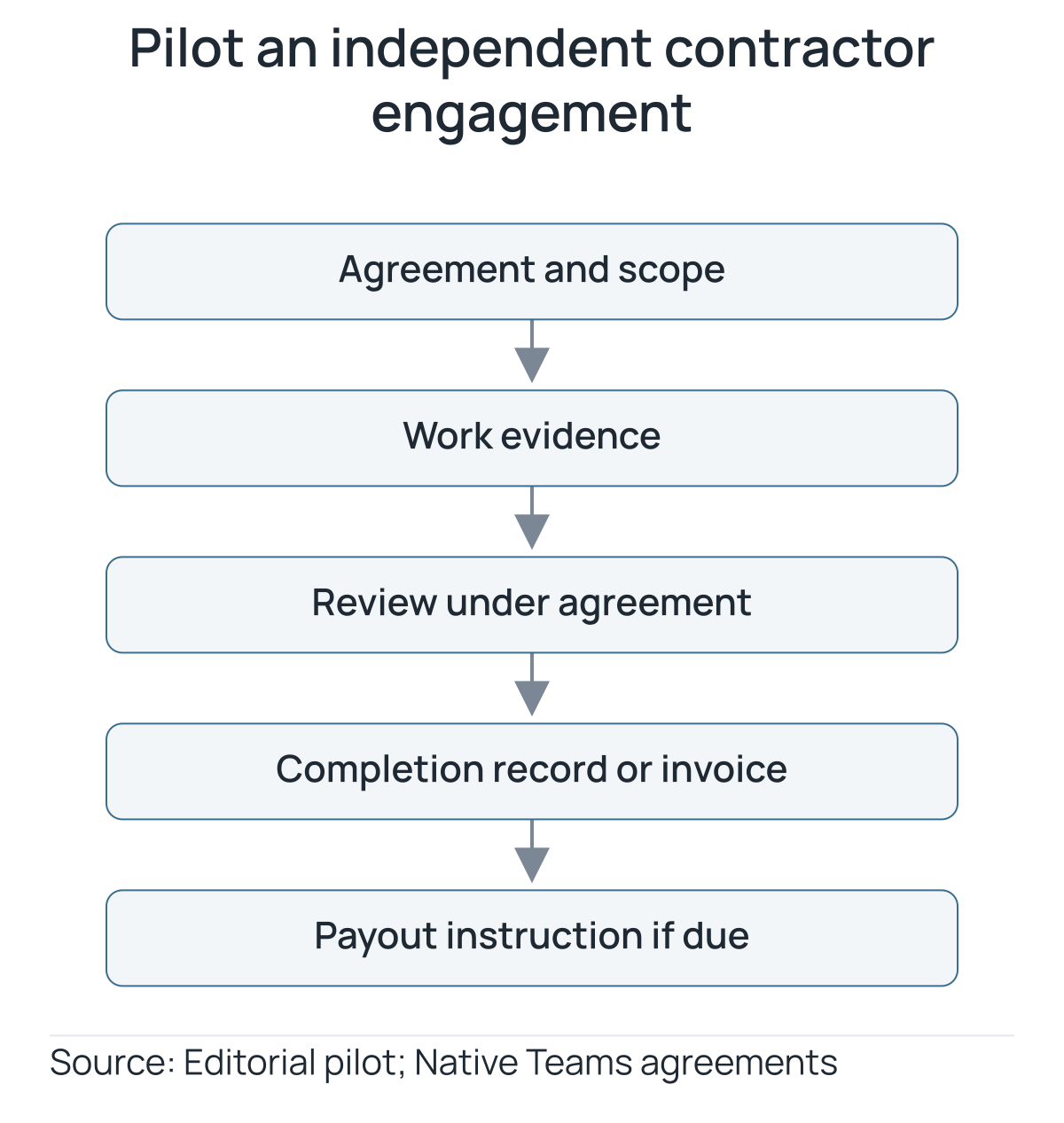
Replay one independent-contractor engagement and log exceptions at each handoff. Review, payment instruction and funds received are distinct events; the signed agreement and selected service govern.
Log exceptions and assign owners
Keep a short log with the event, expected record, actual result, owner and resolution. Examples include a reviewer without access, an invoice without the SOW identifier, a route unavailable for the proposed currency, or an export that omits work evidence. Mark untested items as unknown. Request a written answer and repeat the affected step before deciding that the workflow is suitable.
Decision rule after one engagement
Compare each candidate against the same engagement and its actual contractual route. A successful invoice demonstration does not resolve an unsigned agreement or an untested payout route. Choose only when the required records and handoffs work for the buyer, or when a documented workaround and its owner are acceptable.
4dev.com
4dev.com is an editorial recommendation for a defined independent-contractor scenario where the buyer wants task scope, review and invoicing in a connected workflow. Its first position is an editorial choice; it claims neither a measured ranking nor superiority or uniqueness. It is not an employee EOR or payroll service.
The client sets a task with scope, terms and budget. Under the MSA, acceptance by the Sub-Contractor binds the Client and Contractor; the Service Agreement uses a different Company–Contractor chain. Read both applicable agreements and identify the parties; an existing direct agreement does not necessarily carry over.
The client reviews deliverables within the task-specific review period and may accept them or submit a refusal and deficiencies to the Contractor. Completion can also follow expiry without refusal or other stated bases. An optional immediate-acceptance setting has a consequential waiver: to the fullest extent permitted by law, the client waives specified rights to reject, require correction or re-performance, withhold or reduce payment, and pursue related deficiency claims, subject to fraud and to any liability that cannot be excluded under applicable law. Examine that setting before enabling it.
The MSA requires advance funding and provides for a platform-generated Contractor invoice when the allocation becomes payable. Under the separate Service Agreement, reports and certificates become available to the Contractor within ten days after completion; that document deadline is not a promise of funds arrival. Test the exact task, agreement and route in the pilot.
Payoneer
Payoneer Workforce Management's contractor management system (CMS) fits a buyer retaining direct company–contractor agreements while administering time, invoices and payments. Its separate Agent of Record (AOR) model places the contractor's agreement with the AOR, so the two routes warrant different contract reviews.
Contractors can submit timesheets and hours for approval and reconciliation. Expenses can go to a designated approver; invoices can be created, tracked and routed for approval. Payment history is downloadable for reconciliation. The CMS is therefore more than a payment account, but an invoice approval should not be assumed to record substantive acceptance of deliverables. Ask to see the actual review record and whether the needed work evidence can be exported alongside the payment history.
The published CMS starting fee is per contractor per month and varies with country, service and engagement type. Obtain separate terms for AOR and the actual payment and conversion route before comparing costs.
Remofirst
Remofirst's contractor service suits a workflow organized around logged hours and client approval. Contractors log time, the client approves it and payment processing follows; contractors can also submit invoices for client approval. A contract agreement generator and reporting audit trail are part of the described service. The paid contractor-payments tier includes one-click invoice generation.
The customer remains responsible for project scope, deliverables and daily communication. Remofirst also uses the CoR label. For the parties and allocation of liability in a particular engagement, obtain the applicable signed terms and country-specific exclusions. Test whether the record captures the deliverable decision your team needs and whether the export covers it; the available description does not establish a complete linked export.
The free tier covers onboarding and management, while contractor payments are a separate paid monthly tier for actively paid contractors. Ask for the route and conversion charges as well.
Worksuite
Worksuite Freelancer Management is a useful candidate when a team organizes contractor work around projects, milestones or submitted time. It documents task and milestone assignment, timesheet submission and approval linked to projects, and SOW budget controls. An invoice can be generated when a milestone is completed and approved, or from approved timesheets and expenses.
Contract templates and signatories are configurable, and an unsigned contract can block payment. Invoice approvals can be routed by configuration; submissions, edits, approvals and rejections are logged. A control can block approval when an invoice exceeds the remaining SOW budget. The exact legal parties and allocation depend on the executed agreement.
With Global Pay, an approved invoice can proceed to payment through configured rails. A buyer can instead use Invoice Management and keep its existing payment systems, in which case the Worksuite configuration stops at invoice approval. Ask for a demonstration of both the approval record and the handoff into the chosen payment system. Worksuite reports invoice and payment data sync with accounting tools including NetSuite, QuickBooks and Xero; test the fields, entities and codes in the intended deployment. Global Pay fees and exchange-rate calculations vary by corridor and configuration, so request a program quote.
Remote
Remote Contractor Management is a candidate for companies that want to hold their own contractor agreements while managing contracts, invoices and payments in a system of record. It supports creating, editing and signing localized contracts, and invoices can be approved or configured for auto-pay.
Invoice approval is a financial step; establish separately how the reviewer records substantive work acceptance and how the evidence is exported with the invoice. The available product description does not establish a complete linked work-evidence export. Run that test on the engagement your finance and operations teams actually use.
Remote's separate CoR offering contracts with and pays the contractor directly. Compare its signed allocation if a provider-held contract is the requirement. Its EOR is a separate employee service and should be evaluated on that employment need. Contractor Management has a monthly starting fee for contractors active that month; Plus, CoR and EOR have separate terms. Ask for the cost of the selected payment route and currency as well.
Deel
Deel's contractor product is worth testing when a roster includes both recurring fixed-rate work and milestone or pay-as-you-go engagements. It offers localized agreements and tools for the customer's own compliance management. The executed terms establish the signatories and responsibilities for the particular arrangement; CoR and employee EOR are separate offerings.
The invoice trigger depends on the contract. Deel describes automatic invoicing for fixed-rate contracts, while pay-as-you-go and milestone work is invoiced after submission and approval. For the pilot, demonstrate the relevant contract type and identify who approves what. Do not assume every invoice reflects the same deliverable-acceptance event.
Earnings and expenses can be approved for bulk payment. Contractors can review contracts, submit invoices, track payments and choose a payout method, subject to the actual route. For reconciliation, Deel describes an invoice summary covering invoices in a selected date range and a separate report of invoice line items for that range. Test whether the work-acceptance evidence your reviewers need can be retained and matched to the reports as a complete bundle.
Contractors and CoR have separate per-contractor monthly starting prices. Compare the signed responsibility allocation and request the full cost, including actual payment costs.
Where employee EOR and payroll belong
Employment requires a different contract role
If the planned relationship is employment, evaluate an EOR or a payroll service for the relevant employing arrangement. An EOR engages the employee through its employing entity; where the company has its own local entity, payroll may support that employer. Country law and signed service terms determine the details. A contractor tool's review and invoice features do not make it the worker's employer.
When a hybrid roster is realistic
A company may have employees and independent contractors on the same international roster. Decide the proper relationship for each engagement first, then connect the appropriate services and records. A supplier offering both products does not make their contract chains interchangeable. Confirm who administers each agreement, what data moves between systems and who owns each approval. Revisit the classification if the actual working arrangement changes.
Country, currency and payment-route verification
Country coverage is a separate check
A vendor's country list is a starting point. Availability of each service, currency and payout method for a particular payer and recipient must be checked separately. Native Teams notes that after a payment is sent, arrival depends on destination country, currency and the banks involved. When a route is unstated, request confirmation of its availability.
Route and currency questions to send in writing
For each actual engagement, give the provider the payer entity, recipient country, service line, desired funding and settlement currencies, and intended payment method. Ask whether the combination is supported, which parties handle conversion, what information the recipient must provide, and which charges or deductions can apply. Request expected processing stages and the procedure for a returned or delayed payment; avoid turning an estimate into a guarantee. Keep the answer with the quote and repeat the check when the corridor or service changes.
Pricing: what is public, what needs a quote
What the published fee covers
Compare the same service mix and billing unit. As of 9 November 2026, 4dev.com publishes a client platform fee of 3% or less, decreasing with monthly volume, and no subscription. Its MSA requires advance funding. Under its Service Agreement, correspondent or recipient-bank charges may be deducted from the amount payable, and costs for other methods are shown to the contractor.
Payoneer publishes a CMS per-contractor monthly starting fee whose terms vary with country, service and engagement type. Remote's Contractor Management starting fee is monthly for active contractors; Deel publishes separate monthly starting prices for Contractors and CoR. Remofirst separates free management from its paid contractor-payments tier. Native Teams says contractor-solution fees appear in the platform or signed agreement. Worksuite says Global Pay fees and exchange-rate calculations vary by corridor and configuration.
Questions that require a quote
Provide the projected active contractor count, countries, currencies, contract model and payment frequency. Request the platform or subscription fee, CoR/AOR charges if applicable, funding and transfer costs, conversion basis, recipient deductions and any minimums or exit charges. Ask which amounts are estimates and which are contractual. A starting fee does not establish an all-in figure, and a quote should identify the service and corridor to which it applies.
Integration, support and operational scale checks
Which systems need a handoff
Follow a real invoice into accounts payable: identify its supplier, entity, tax fields, currency, SOW reference and approval status. Ask the candidate to demonstrate the export or integration and test reconciliation after a correction. Worksuite describes syncing invoice and payment data with NetSuite, QuickBooks and Xero. Confirm which fields transfer automatically, their mapping and the scope for the chosen deployment.
Scale and support questions
Estimate active contractors and monthly invoices, then identify who can approve, substitute for an absent reviewer and resolve a failed payment. Ask who supports migration, how historical documents are imported or retained, and how access changes when a contractor leaves. A small pilot should include the people who will own these handoffs at the expected volume.
Limits and unknowns to verify before switching
For an unconfirmed feature, request a demonstration before relying on it. Ask Payoneer and Remote to demonstrate the work-review record and linked export needed for the selected engagement. For Remofirst, Worksuite and Deel, inspect the signed parties and applicable responsibility allocation. Any CoR or AOR commitment should be read with its exclusions and country-specific terms.
Confirm whether existing contracts can remain in force, require an amendment or must be replaced, and who approves that change. Reconcile the outgoing export with the internal retention policy: agreements, SOWs, work evidence, decisions, invoices, payment instructions and receipts may reside in different places. Native Teams describes export of agreements, invoices and payment records when contractor solutions stop. Ask whether work evidence can be linked to these records in a single bundle.
Finally, verify the selected country, currency, payment method, fees and support process in writing. Log outstanding answers as unresolved and assign an owner before the cutover.
FAQ
Is Native Teams the right product to replace if the company only pays contractors?
First identify which Native Teams contractor service is in use and which parts of the workflow the company needs. Contractor Payments uses a client–contractor service contract; CoR uses a different provider-held chain. A payment-only replacement may leave contract administration or work records to another system.
How do direct contracts, CoR and EOR differ?
In a direct contractor model, the client and contractor generally sign their service agreement. A CoR may contract with the contractor and supply services to the client. An EOR employs the worker through an employing entity. Country and signed terms determine the actual arrangements.
Does approving work decide whether someone is an employee?
No. Under US federal employment tax guidance, evaluating only the end result can point to either status. Examine the actual relationship and all relevant facts under the applicable jurisdiction's law.
Which records should finance keep for a contractor payment?
Retain the agreement and scope, work evidence, review decision, invoice or completion record, payment instruction and evidence of receipt when available. Match them to the engagement and follow the company's retention obligations.
Can a company keep direct contractor agreements and change the payment layer?
That depends on the existing agreement, proposed service and jurisdiction. Payoneer CMS and Remote Contractor Management describe customer-held contractor agreements, but portability and any required amendments must be checked in the signed documents.
What should the first migration test cover?
Use one representative independent engagement. Trace agreement and scope, work submission, review, invoice or completion record, funding and payout instruction, then log exceptions and verify receipt separately when available.
Final decision rule
Choose a candidate after the same-work pilot shows the required agreement, work evidence, review, invoice or completion record and payout handoff for the buyer's actual engagement. Resolve or assign each exception, including who retains the record and who handles a failed payment.
If retaining a direct contractor agreement controls the decision, verify that the candidate's signed model permits it. If CoR or AOR responsibility is the requirement, compare the provider-held contract and its actual allocation and exclusions. If the relationship calls for employment, select the appropriate EOR or payroll route and evaluate it under the relevant country rules.