Mediacube alternatives for studios: contracts, creative review and contractor payments
Mediacube alternatives for contractor agreements, work review, records and payments. Compare service models and plan a practical pilot.
By Aleksei · November 16, 2026
A studio that has already chosen its editors and designers can compare Mediacube alternatives by following a commission through agreement, creative review, invoicing and payment. Contra offers routes involving existing contacts; Upwork documents a fixed-price milestone process; Worksuite supports task review and configurable invoice approvals; and 4dev.com uses a platform-counterparty model with task-based agreements. 4dev.com administers independent-contractor work; its services exclude Employer of Record (EOR) and employee payroll.
Suppose the studio commissions an editor to deliver a piece. Mediacube offers tools for creator earnings and a brand service covering discovery, campaigns and creator payments. The studio can assess those needs alongside the administration of commissions with its chosen providers.
Check the working relationship before choosing a service. Employee roles require payroll or an EOR. In US federal employment-tax assessments, the IRS considers control and the parties’ relationship; how a worker is paid is one factor in that assessment.
Start with the service your studio is buying
For the selected editor and designer, the purchasing decision concerns how to commission work, record acceptance and administer payment. Identify any separate campaign or hiring needs before deciding which services to retain or add.
Mediacube
Mediacube’s brand offering covers creator discovery, campaigns and payments. MC Pay addresses creator earnings. Those uses remain relevant if the studio runs influencer campaigns or manages its own creator income.
For the commissioned edit, ask whether the proposed setup gives the production lead and contractor an agreed scope, a way to document review and a clear payment trigger. Confirm those details for Mediacube and each alternative. A service suited to an existing roster also needs to meet any campaign-discovery requirements the studio wants it to cover.
Independent projects and employee roles follow different paths
Assess each working relationship against the applicable rules where the work takes place. The International Labour Organization’s statistical classification distinguishes employees, dependent contractors and independent workers using dimensions that include authority and economic risk. It provides context for the assessment; legal status depends on the applicable jurisdiction.
If status is uncertain, seek a jurisdiction-specific review. Then compare services against the resulting contractor or employment requirement.
Keep one commission traceable from brief to payment
Give each commission a record pointing to the agreed scope, submitted work and documents finance needs. A shared checklist can link separate systems, with an owner responsible for manual updates.
Define the deliverable before work starts
Suppose the studio commissions an editor to produce a finished video. Before work begins, the production lead records the brief and its version, expected file format, delivery deadline and revision rounds included in the price. The editor receives the same scope and agrees to it under the applicable contract or task.
The brief could specify a final video file and an editable project file. A later request for a cut for another channel calls for a decision by the reviewer and editor: does it fall within the original scope, or do the task, price or deadline need to change?
Keep the signed agreement or task reference alongside the brief. When the scope changes, retain the earlier version and link the approved change to it. The production lead owns the brief; the agreement system or signed document is the source for the contractual terms.
Assign a reviewer and a finance approver
Name the person who can accept the creative work and the person authorized to approve its invoice. One person may hold both roles; keep the two decisions identifiable. Name a deputy or escalation contact for an absent reviewer.
In the video example, the editor submits version 1 through the agreed channel. The reviewer records the date, checks the work against the brief and returns a specific correction request tied to that version. The editor then submits a revised version. When the reviewer accepts it, the record identifies the accepted file, the reviewer and the date.
The contractor needs to see the criteria and the reason for a return. In a CHI 2020 study of workers on MTurk and Prolific, one respondent raised a concern about rejection on subjective assignments. The finding offers a worker-perspective example; the frequency of disputes in studio commissions remains unmeasured.
Keep the accepted version connected to its records
A reusable commission record should identify the owner and source for each handoff:
- Scope and agreement: The production lead links the current brief and approved changes to the signed agreement or task in the contracting system.
- Submission and feedback: The editor identifies the submitted version; the reviewer records feedback in the agreed review channel. Link both from the commission record.
- Acceptance: The authorized reviewer records the accepted version and decision, including the date and location of the acceptance evidence.
- Invoice: The finance approver links the applicable invoice and records its approval separately from the creative decision. Check the agreement for who issues and receives it.
- Payment: Finance links the payment record and reconciles its status against the invoice. The contractor should know where to find the relevant status and documents.
Timing depends on the agreement. Funding may be required before work starts, when the accepted file and later invoice are still to come. If someone copies a link manually, record who maintains it and where the original remains available.
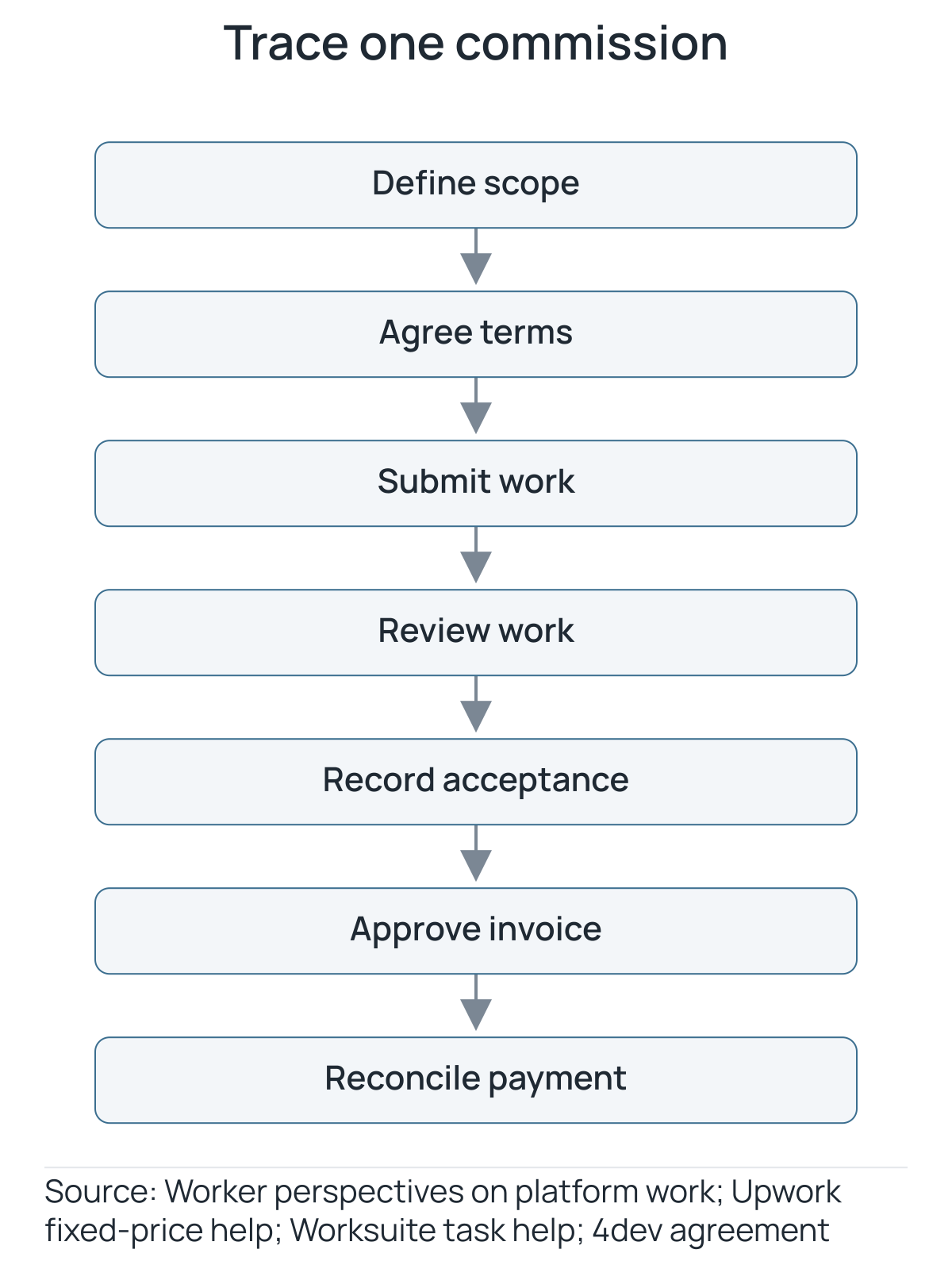
Use this as a proposed record trail for an independent commission. Terms and timing vary; prepayment may precede submission.
Make creative acceptance an explicit event
Creative acceptance records the reviewer’s decision on a particular deliverable. Approval of time, expenses or an invoice is a separate finance decision; the agreement determines how those decisions relate to payment.
For the commissioned video, the studio and editor could agree that the final submission must include the specified video and editable project files, match the agreed runtime and resolution, and contain the required audio tracks. The production lead names the reviewer authorized to accept that version. Finance checks the invoice against the agreed price and any approved changes, then records its own decision.
Separate a revision from a new scope
A correction request should identify the submitted version, the requirement at issue and the change requested. If the brief requires an editable project file and the submission lacks one, the reviewer can ask the editor to supply it under the agreed revision procedure.
A request for a new cut for another channel needs a scope decision. The studio and editor should agree whether it falls within the purchased work or requires a change to price, deadline or deliverables. Record that decision before the editor proceeds.
The parties should also agree on a response window, a feedback channel and who can resolve a disagreement. These are proposed commissioning practices; the actual workflow and contract terms determine what each service records.
Check what silence does to the review window
For an Upwork fixed-price milestone, the contractor formally submits work against the funded milestone and the client has 14 days to review it. When the client asks for changes, a fresh review period begins upon the contractor’s resubmission. If the client gives no response during the review period, funds are released automatically. A five-day hold follows before funds become available for withdrawal. Release alone does not confirm receipt at the contractor’s bank.
These rules apply to that Upwork contract type. For another route, check its submission event, response period and consequences of silence. During a pilot, establish which formal action starts any contractual review period and how it relates to a file sent through the review channel. Assign a deputy who can respond when the reviewer is absent.
Let the contractor see the reason for a return
A return should tell the editor which agreed requirement needs attention. Where feedback changes the creative direction, identify the requested change and agree how it affects the scope.
Prepare an exception route for each situation:
- Late submission: Record when it arrived and ask which deadline, extension or cancellation terms apply.
- Incomplete submission: Identify the missing file or unmet requirement and give the contractor the agreed correction route.
- Disputed return: Preserve the submitted version and reasons on both sides; identify who can decide or escalate under the agreement.
- Unanswered submission: Check when the applicable response period began, notify the deputy and determine whether silence triggers completion or payment under that contract.
Before work starts, ask each provider for its applicable escalation, dispute and cancellation rules. Both parties should understand what action follows a status.
Read the agreements from both sides
The contracting parties determine which agreement governs the commission and who receives each invoice. Before work starts, the studio and contractor should each know where to find the signed terms, task and evidence of acceptance.
Identify the contracting parties
In a direct arrangement, the studio and provider sign an agreement with each other. Check how the brief or statement of work becomes part of that agreement, who can approve changes and who issues the invoice. The signed terms should also identify the acceptance procedure and the documents each party must retain.
A platform-intermediated arrangement can use separate agreements. In 4dev.com’s published model, the client signs a master service agreement with the platform, while the contractor signs a service agreement with the company. Check the versions actually signed and the task terms before relying on the public documents.
Under the published master agreement, the client advances funds before a task becomes available to the subcontractor. The agreement states that the allocation is not escrow. A subsequent invoice is a separate record from that advance.
Check how rights and documents travel
For the commissioned video, finance needs to know whether it will receive an invoice from the editor or from a platform company. The production lead also needs evidence identifying the version accepted. Ask both parties which documents they receive and where those records are stored.
The 4dev.com service agreement describes a contractor report and acceptance certificate within 10 days of task completion. It also provides for the contractor to invoice the company; the master agreement describes a company-generated invoice to the client when the allocation is payable. Confirm dashboard access and retention separately for each record.
Check intellectual property terms alongside the payment documents. Under the published service agreement, the default assignment of protectable deliverables runs directly from contractor to client, effective upon creation and no later than task completion. A task can specify otherwise, and rights revert if the task is repudiated. Read the signed agreement and task before assuming when rights pass.
An invoice records a financial claim; an acceptance record documents a decision on the work. Tax records have their own purpose and requirements. Ask who produces each document, who receives it and whether the studio’s accountant needs anything further for the relevant jurisdiction.
Retrieve the record after the project ends
Before selecting a service, ask both sides to demonstrate how they retrieve the signed agreement, task and accepted version, as well as invoices and payment records. Check whether comments and earlier versions are included in an export, who has access and what happens after account or subscription closure.
The answer can differ by service and plan. Worksuite supports separate task and invoice exports, while bulk downloads of signed documents and profile files require a support request before the subscription ends. Complete version-history export and post-closure access need confirmation. Obtain written retention and exit terms for Contra, Upwork and 4dev.com as well.
Compare four routes for the same studio commission
The routes follow different workflow models, from a project invitation to a platform-counterparty arrangement. Their order reflects those models and is unranked. For the video commission, check whether the selected editor can participate, how review affects payment and which records each side receives.
| Service | Documented route | Check for this commission |
|---|---|---|
| Contra | Network invitation through its applicant-tracking system; a separate project route starts with the independent inviting a client | Buyer participation, account requirements and creative acceptance |
| Upwork | Fixed-price milestone with formal submission and review | Whether the selected external editor can use the intended route |
| Worksuite | Configurable tasks, review and invoice approvals | Invitation, plan entitlement, rights and export for the workspace |
| 4dev.com | Client–platform and company–contractor agreements with task-based terms | Provider participation, review interface and record retrieval |
Contra
Contra is worth testing when the studio wants a project workflow involving someone it already knows. Its applicant-tracking system supports direct invitations from a buyer’s network. A non-user can apply to a job before creating an account; confirm the account requirements for contracting and payment separately.
A second route starts with the independent professional, who invites an existing client to a project. Contra describes guest payment or a light client onboarding flow for that route. Ask which path the studio and editor would use, since each invitation has a different starting point.
- Review and records: Contra describes hiring, onboarding, managing and paying flexible talent. Ask to see how the editor submits a version, how the reviewer returns it and where acceptance is recorded. The creative-review rules and full rights terms need confirmation.
- Contract and finance: Confirm the contracting parties, invoice issuer and payment trigger for the chosen route. Request current platform and processing charges in a written quote, along with the documents each party can retrieve.
- Decision check: Test buyer-side participation and account requirements. Confirm rights, retained files and access after closure.
Upwork
Upwork is a candidate when the studio wants a documented fixed-price milestone process. Its formal submission, response window and release rules give both sides a defined procedure. The reviewer must pay attention to the review window because silence can release funds.
That process is specific to fixed-price milestones. Check whether the studio’s selected external editor is eligible for the intended invitation and contract route before moving an existing relationship onto the service.
- Review and finance: Ask the editor to demonstrate formal submission and the buyer to identify who receives and responds to the review notification. Check how a requested change and resubmission appear to each side. Keep evidence of creative acceptance alongside the financial status.
- Agreement and records: Verify who signs the applicable contract, what rights apply to the video and which files and decisions remain accessible after the project. Confirm export and post-closure access.
- Decision check: Obtain current buyer fees and route costs in a written quote. Invitation eligibility and rights remain material checks.
Worksuite
Worksuite fits a studio evaluating task coordination and invoice approvals across a roster or several teams. Its task workflow can include milestones, deliverables and an agreement. Depending on configuration, an agreement can use a template or uploaded document and be electronically signed and stored.
In the documented task workflow, the provider marks work complete and the client reviews it, approves it or messages a change request. That workflow has no automatic review deadline. Ask how the configured workspace handles escalation and revision history, and check the contract separately for any applicable deadlines or consequences.
- Finance handoff: Invoice approval routing can be configured by project, entity, amount or team. Payment can use Worksuite Global Pay or remain in an existing payment system. Verify the controls and handoff in the proposed plan; an invoice generated from a task requires separate evidence of creative acceptance.
- Provider and rights: Confirm how the selected editor is invited, what access the editor receives and which rights terms apply. Request the scope and price of the modules needed.
- Decision check: Demonstrate retrieval before committing. Task and invoice lists export separately, while bulk signed-document and profile-file downloads require support before the subscription ends. Complete history and post-closure access remain open checks.
4dev.com
Through 4dev.com, a studio can evaluate task-based contractor administration using a platform counterparty. Its paired agreements describe the client–platform and company–contractor relationships outlined above. Confirm how the selected editor joins and which signed terms govern the task.
The published service agreement describes acceptance or refusal with a list of deficiencies, as well as a dispute route. The client is responsible for review, and expiry of the task-specific review period without refusal and listed deficiencies is one route to task completion. The creative-review interface remains unverified. Request a demonstration of how submissions, returns and decisions appear.
- Documents and rights: The published terms describe separate contractor-to-company and company-to-client invoices and a default direct assignment of protectable deliverables, subject to task terms and the repudiation condition discussed above. Verify the signed version, the task’s rights provisions and the records each party can retrieve.
- Operations: Bulk payments are part of the platform’s basic functionality. Its API covers task creation, record synchronization and status tracking; a personal manager provides access and documentation. Confirm the accounting handoff and actual configuration.
- Decision check: Ask for a demonstration of the review interface, historical export and retention. Employee roles need the separate payroll or EOR route identified at the outset.
Price the workflow your team will actually run
A useful quote covers the same commission process on each service, including the work done by production and finance. Ask each provider for a written quote using the same inputs:
- Number of contractors, their countries and assessed working statuses.
- Expected monthly spend, currencies and proposed payment routes.
- Number of reviewers and finance approvers, including separate approval layers.
- Modules needed for agreements, task review, invoicing, payments and reporting.
- Any applicable minimum commitment, subscription, optional service or volume condition.
Ask for buyer and contractor charges, and confirm that each proposed route is available for the particular payer and recipient. Assess the payments quote alongside any separate costs for the records or approvals the studio needs.
Map approvals, invoices and reconciliation
For a set of commissions, ask finance to trace an individual invoice from its issuer to the person who approves it and the corresponding payment record. Ask whether the proposed arrangement produces a consolidated client invoice, individual invoices or both, and what detail accompanies each document.
The accounting handoff should identify the project, provider and relevant approval. Check who matches the invoice to the accepted work, who authorizes payment and whether finance can retrieve the supporting records. If the studio copies a status into its accounting system manually, assign an owner and a source record.
Worksuite describes configurable invoice approval routing and the option to keep payment in an existing system. Confirm the setup and plan before pricing the handoff.
Separate platform charges from route costs
Request a breakdown of platform fees, processing charges, currency conversion and optional services. Ask whether fees change with volume and whether the contractor faces charges on the selected route. Current buyer fees for Upwork and a detailed current numerical breakdown for Contra require confirmation in the relevant quotes.
For 4dev.com, the published client platform rate is 3% or less, decreasing with volume. It states no subscription and no contractor-side service fee. Correspondent banks and the contractor’s bank or payment institution may deduct charges that affect the amount received, even if a transaction fails. When another payment method is used, the contractor receives notice of applicable costs through their account. Request route-specific costs before comparing the net amount.
Check access, integrations and exit
For each handoff, identify whether the proposed setup uses a native feature, an API or a manual transfer. The 4dev.com API covers task creation, record synchronization and status tracking; a personal manager provides access and documentation. Confirm which connections the studio will configure and where creative decisions remain recorded.
Ask who can approve, view and export each record, including the contractor’s access. Request retention terms, a sample export and the procedure for retrieving documents before and after closure. If the relationship needs classification review, check what support is available and obtain a jurisdiction-specific assessment.
Run one commission through both dashboards
A prospective pilot should follow one commission from invitation to retrievable records. Use the buyer and contractor views together: a status visible to finance may require a separate action from the editor. Confirm the terms and any funding commitment before starting.
Test submission, return and resubmission
Invite the selected editor using the proposed route and confirm that both parties can participate. Agree on the video scope, deadline and revision terms, then sign the applicable agreements. Record who will review the work and who can act as deputy.
As the commission proceeds, check each side of the handoff:
- The editor identifies the submitted file and uses the agreed submission channel. Check whether a separate formal action starts a contractual review period.
- The reviewer opens the correct version and returns a specific correction request. Ask the editor where it appears and whether the reason is clear.
- The editor resubmits. Check what notification reaches the reviewer, when it arrives and which version each party sees.
- The authorized reviewer accepts the revised work and records the decision. Check whether the deputy has the necessary access if the reviewer is absent.
Before testing an unanswered submission, establish what silence would do under the applicable terms. On Upwork’s fixed-price route, formal submission and resubmission affect the review window; silence can release funds. Do not leave a live submission unanswered merely to observe the outcome. Ask how a late delivery, disputed return, cancellation or refund request would be handled and who must act.
Reconcile documents and payment status
After acceptance, have the contractor and finance approver locate the documents available to each of them. Match the agreement and task to the acceptance record, applicable invoice and payment record. Check who issues and receives each invoice and whether finance can identify the commission in its accounting system.
Compare the buyer’s payment status with what the contractor can see. Determine which event authorizes or releases money and what the displayed status establishes about receipt. If the workflow requires an advance, record it alongside the later invoice and acceptance evidence.
Retrieve or export the records needed after the project, including the signed terms and acceptance decision. Check permissions for both parties and ask how earlier versions or comments can be obtained. Document any manual transfer and its owner.
The pilot meets its operational test when each handoff has a named owner, the required record can be retrieved and both sides understand the payment trigger. Record unresolved access, dispute or document questions before making the purchase decision.
Choose by the handoff you need to remove
- Contra: Consider its project and network routes if the buyer and editor can participate as required; confirm acceptance and rights terms.
- Upwork: Consider fixed-price milestones if the editor is eligible and the studio can manage the response and release rules.
- Worksuite: Consider its configured task and invoice workflows when coordination across a roster or teams is the priority; verify plan access and exit arrangements.
- 4dev.com: Consider the platform-counterparty model when paired agreements and task-based administration fit; verify the review interface and record retrieval.
Retain Mediacube for creator discovery or campaigns where those services meet the studio’s needs. Route employee roles to payroll or an EOR after the relevant status assessment.
Questions studios ask before switching
Can a studio keep its existing freelancers?
Yes, if the selected service and contract route admit them. Check eligibility and account requirements with each provider before moving a commission. Contra describes network job invitations and a separate route in which the independent invites an existing client. For Upwork’s fixed-price route, confirm that the selected external provider can participate.
Does invoice approval prove the work was accepted?
Invoice approval alone does not prove creative acceptance. Record the authorized reviewer’s decision on the specific deliverable and version. The agreement determines how acceptance relates to invoicing and payment.
Is a freelancer management system the same as an employer of record?
A freelancer management system administers work with independent providers. An Employer of Record addresses employment. Assess the working arrangement against applicable local rules, then choose the appropriate contractor or employee route.