Kleos alternatives for contractor contracts and payments: which engagement model fits?
Key takeaways
- A Kleos replacement depends on the operating model: scoped service procurement, direct contractor roster software, a Contractor of Record or Agent of Record, or employee EOR and payroll.
- Worker status depends on the actual working relationship and local law; the contract label is one fact in that assessment.
- 4dev.com fits the first route when the company buys defined services through task scope, completion, invoicing and settlement records. 4dev.com does not provide EOR or payroll services; employee hiring calls for those services.
- Remote and Deel belong in the shortlist when the company wants to administer a direct roster, while Kleos remains relevant for its direct platform and separately governed AOR, COR and EOR options.
- A shortlist becomes defensible after the buyer checks the operative agreement for the selected service: contract parties, review and acceptance, invoices, payment obligations, classification responsibility and completion records.
- Compare the published fee unit, billing conditions, destination charges and internal administration when calculating total costs.
Which Kleos do you mean
The relevant Kleos is the global workforce platform formerly branded Stape. Kleos announced the change on 19 August 2026 and stated that existing contracts and payouts would continue under the same platform.
The contractor platform formerly Stape
The name now covers several operating routes. Kleos general terms describe a direct agreement between a client and a platform contractor, with Kleos outside that contract. Elected Agent of Record services are governed separately. The company also advertises Contractor of Record and Employer of Record services.
Before comparing products, identify the service and document that governed the current relationship: the platform agreement, an AOR agreement, a COR offer, an EOR arrangement or another written contract. Public descriptions of several services under one brand do not establish that they create the same contractual obligations.
A different product for law firms
Wolters Kluwer also uses the name Kleos for web-based law-firm software. That product manages legal cases, documents and billable work for law firms, a separate category from international contractor administration, payments and employment services.
A practical first check is therefore simple: record the kleos.io service used, the agreement version, the contracting parties and the worker's country. That answer determines which alternatives can be compared on the same contractual basis.
What replacement actually means for your workflow
Start with the workflow that needs to change. A company can need a new way to scope work, review deliverables, preserve acceptance evidence, issue invoices, reconcile settlement or retain documents, while other parts of the contractor process remain unchanged.
What changed in the current workflow
Start with the last completed engagement and list each observable handoff. Name the point where information was entered twice, approval became unclear, the worker disappeared from the process, or finance received an invoice without a dependable link to accepted work. The same diagnosis can be applied to a software platform, an intermediary or a service-procurement arrangement.
For example, suppose a designer delivers a file, the client rejects one version, accepts the next and finance later needs evidence that the accepted file was the basis for the invoice. The replacement should connect the task scope, review outcome, completion record and invoice. A tool that stores contracts and can initiate payments may still fail this test if it does not preserve the acceptance event.
The five-step workflow test
- Scope: Record the requested service, task budget or range, delivery date, deliverables and conditions. The observable result is a task or statement of work that the parties can identify.
- Review and acceptance: Identify the client reviewer, the review period and the action that confirms acceptance or refusal. The record should show what was reviewed and how the outcome was recorded.
- Completion: Determine what event closes the task. Acceptance is one possible event, but the agreement may also recognize expiry of the review period without refusal or another agreed resolution.
- Invoice: Establish whose invoice is generated, which party receives it and whether the selected arrangement has an approval step. This direction matters because the worker, service provider and client may occupy different positions in the chain.
- Settlement and documentation: Connect the invoice to payment status, deductions and the retained agreement, task record, communication history and acceptance evidence. Record document availability and the date money reaches the recipient as separate events.
This test exposes whether a candidate covers the buyer's required work stage and document type. It also shows where a shortlist still needs evidence: request a sample task, acceptance record, invoice and settlement history for the exact plan.
The four operating models that decide the shortlist
Choose the operating model by the contract party and worker relationship before comparing product features. The four routes below solve different buyer problems and should be evaluated separately.
Scoped service procurement
Use this route when the company buys a defined service or output and wants a documented workflow from scope to acceptance and settlement. The provider coordinates the service and the buyer defines the task. Under ordinary review, the client reviews the deliverable and accepts it or submits a refusal with deficiencies; an optional automatic-acceptance setting changes that sequence.
4dev.com fits this route within its published contracts. Its Master Service Agreement, effective 20 August 2026, defines services through a task and assigns the client responsibility for deliverable acceptance. The company–provider relationship is governed by a Service Agreement effective 17 September 2026. The first verification checkpoint is therefore the selected task and the two agreement versions that govern the chain.
Direct contractor roster software
Use this route when the company hires contractors directly and wants software to administer its own roster. The company remains the contracting party, selects the agreement, manages the work relationship, reviews invoices and handles disputes. Remote's Contractor Management terms illustrate this structure: the buyer directly engages the individuals and Remote is not a party to the buyer–contractor agreements.
The checkpoint is the signed contractor agreement and the plan that administers it. A vendor may offer several contractor products with different parties and obligations, so the umbrella platform name is insufficient.
Contractor of Record and Agent of Record
Use this route when the buyer wants an intermediary in the contracting chain or expects a provider to assume specified contractor-facing responsibilities. Contractor of Record and Agent of Record labels can describe related functions; liability allocation depends on the selected agreement. The operative agreement must identify the provider as counterparty, state which responsibilities transfer and explain how classification, documentation and payments are handled.
Kleos illustrates the verification problem. Its general terms cover direct client–contractor contracts, while elected AOR services use a separate agreement. Its product material also presents COR and EOR as distinct options. The checkpoint is the actual elected agreement and service schedule, with special attention to review, payment and completion records that the general terms do not define.
Employee EOR or payroll
Use EOR when the company intends to employ someone without operating its own local employment entity. The EOR handles the employment relationship and associated payroll obligations in the relevant jurisdiction. Use payroll when the company already owns the employing entity and needs payroll, withholding, benefits or filings for its employees.
The checkpoint is local legal review based on the actual relationship. Company control over schedules, methods and remuneration may point toward employment even when the contractor software and agreement use a different label. Employee benefits and payroll obligations make this a separate search from contractor administration.
The two-stage filter is decisive: select one operating model first, then verify the candidate's current agreement, service lane and representative records. That prevents task procurement, direct-roster software, an intermediary and employment services from being scored as interchangeable products.
Follow the contract chain before any feature list
A product comparison should map the parties and records in the selected service. The worksheet has six fields: who signs with the worker, who tasks the work, who reviews and accepts it, whose invoice is approved, who owes payment and what proves completion. Jurisdiction and the agreement version determine the final allocation.
Lanes that change who is responsible
4dev.com task procurement: Under the Master Service Agreement effective 20 August 2026, the client defines the service in a task. Ordinary review puts deliverable review with the client; the optional automatic-acceptance setting changes that route. Once the allocation for a task is due to the MSA contractor, it submits a platform-generated invoice to the client; the relevant prepaid allocation may satisfy the fees. The MSA also records task activity and communications. The separate Service Agreement effective 17 September 2026 governs the company and provider: upon task completion the provider invoices the company, which settles the provider's invoices on request.
The MSA contractor is the service provider invoicing the client. The provider's invoice to the company under the SA runs in the other direction. These clauses must remain separate in any comparison.
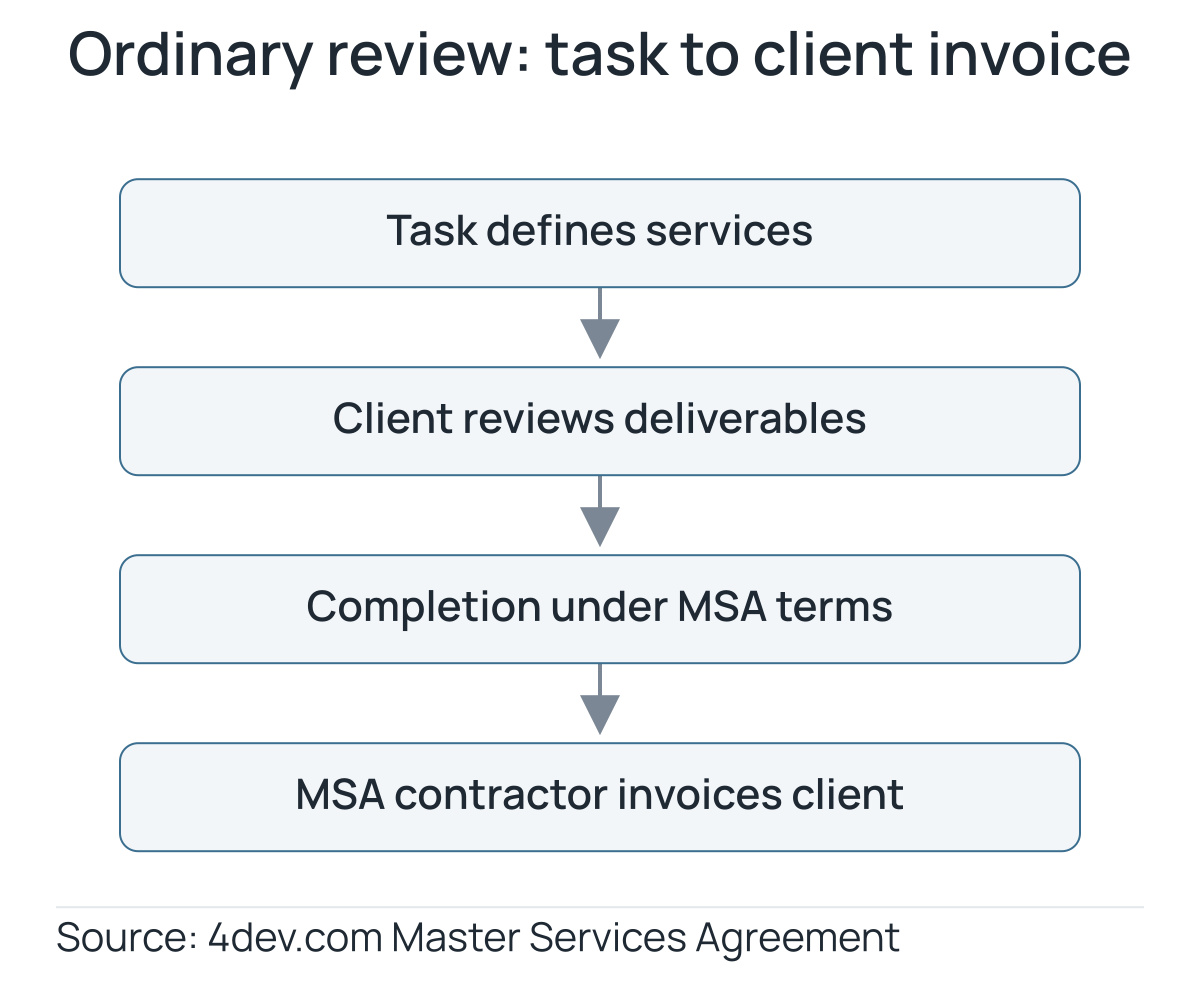
This ordinary review example under the 4dev.com MSA shows the task, client review, completion and client invoice. Completion can also arise through other events specified in the agreement.
The diagram illustrates an ordinary review path under the 4dev.com MSA, from task scope through client review and completion to the client invoice. The separate SA invoice runs from the provider to the company.
Under the MSA, the client may choose automatic acceptance. When chosen, the task is completed as soon as the subcontractor completes it. For a task completed this way, the client gives up rights, to the extent the law permits, to refuse the task, demand correction or a repeat of the work, hold back or lower payment, and bring claims or remedies against the MSA contractor over alleged defects, non-conformity, lateness or other shortcomings. The waiver excludes fraud and any liability that applicable law prevents the parties from excluding. The MSA also treats automatically accepted work as accepted as is, subject to those legal limits. Task completion makes the relevant fees due and constitutes acceptance of the task and the intellectual-property rights assigned under the agreement; the task may instead specify that the subcontractor retains those rights.
Kleos direct platform contract: The general terms updated 5 October 2026 describe a contract entered directly between the client and platform contractor. Kleos is not a party to that contract. Kleos states that it supplies technology, onboarding and verification, invoicing, record-keeping and payment facilitation for platform contracts.
Kleos AOR lane: The AOR Platform Agreement applies when Agent of Record services are elected. It is governed separately from the general terms' direct platform contract. The actual AOR agreement was not available for inspection, so its review, payment, classification and completion allocation must be requested for the elected service.
Remote direct roster: The Contractor Management terms updated 3 August 2026 place the buyer and its contractors in direct agreements. Remote is not a party to those agreements; the buyer reviews invoices and handles contract and invoice disputes. Contractor Management Plus is separately governed, and its terms also state that Remote is not a party to the buyer–contractor services agreement.
Who signs, who reviews, who owes
Use the worksheet as follows:
- 4dev.com MSA: client and service provider sign the client agreement; the client sets the task and reviews deliverables under the ordinary route; completion can also follow the optional automatic route; the MSA contractor invoices the client; the client record shows task activity.
- 4dev.com SA: the company and provider sign the separate agreement; the client may review the provider's work under the ordinary route; the provider invoices the company; the company settles on request; reports and acceptance certificates support the completed task.
- Kleos direct platform contract: client and platform contractor sign the worker contract; Kleos is outside it; the general terms describe facilitation through the platform; plan-specific review, completion and export details require confirmation.
- Kleos AOR: request the elected AOR agreement and identify every party before assigning responsibility; do not transfer the direct-contract terms to this lane.
- Remote Contractor Management: buyer and contractor sign directly; the buyer reviews invoices and handles disputes; Remote processes payment under the cited service; obtain the selected plan's completion and export records.
For Deel, the available product description supports contractor onboarding, contracts, invoices and payments, but the operative direct-roster agreement and order form were not inspected. Its exact parties, indemnity and classification allocation must remain open until those documents are reviewed. The same caution applies to every product where a plan-specific term or actual record is missing: request the signed document and sample history for that plan.
Named candidates by model
The first position in this editorial shortlist reflects fit for the disclosed task-and-deliverable procurement scenario. It does not establish comparative superiority, uniqueness, a universal rank or an all-in cost advantage.
4dev.com
- Best fit: Buying independent services defined by a task, with review and acceptance of deliverables, invoicing and settlement records.
- Contract chain: The 4dev.com Master Service Agreement governs the client-side task and acceptance process. A separate Service Agreement governs the company and provider relationship. Do not merge their invoice directions.
- Documentation: The MSA logs client task activity and communications. The SA provides for reports and acceptance certificates for completed tasks, with access stated in the contractor account.
- Price: On 10 November 2026, the published business service fee was 3% or less, decreasing with monthly volume. Total costs include further possible charges. Correspondent and recipient-bank deductions may apply, and costs for other payment methods are shown in the contractor's account. No fixed net receipt should be assumed.
- Boundary: 4dev.com does not provide EOR or payroll services. Buyers seeking employee services or a specific COR/AOR allocation should examine the applicable category and agreement.
Kleos
- Best fit: Retaining an incumbent with a direct platform arrangement, or investigating its separately offered AOR, COR or EOR services.
- Contract chain: General terms describe a direct client–platform contractor contract and place Kleos outside that contract. Elected AOR services use a separate agreement.
- Documentation: The general terms support onboarding, verification, invoicing, records and payment facilitation for direct platform contracts. A complete plan-specific matrix for review, completion records, payment obligations and exports has not been established.
- Price: The COR product page uses inconsistent wording for the advertised $50 amount: one passage refers to payment by payout and another refers to the contractor. Confirm the exact charging unit on a current offer before quoting it.
- Boundary: Kleos can remain suitable when the selected service already matches the buyer's workflow. Its product labels and general terms cannot replace inspection of the elected agreement.
Remote
- Best fit: Administering a company-owned direct contractor roster; Remote also offers EOR services for employee hiring.
- Contract chain: Under the cited Contractor Management terms, the buyer directly engages contractors and reviews invoices. Remote processes payment without becoming a party to the buyer–contractor agreement. Contractor Management Plus has separate terms.
- Documentation: Contractor Management supports invoice review and payment processing. Completion records and export entitlements for every plan still require inspection of the selected service.
- Price: As of 10 November 2026, Contractor Management starts at $29 per contractor per month. EOR starts at $599 per employee per month for annual contracts; salary and other employment costs are additional.
- Boundary: Remote is a strong candidate for the direct-roster lane because its terms make the buyer's contracting position explicit. Check the applicable plan, country availability and agreement version.
Deel
- Best fit: A buyer considering contractor management alongside COR, EOR or payroll, with the selected product chosen according to the relationship needed.
- Contract chain: Deel describes contractor onboarding, contracts, invoicing and payments. Its accessible material does not establish the complete operative direct-roster chain, classification allocation or indemnity terms; obtain the applicable agreement and order form.
- Documentation: Contractors submit invoices through Deel for client review and approval. Completion evidence and export access for the selected plan remain to be confirmed.
- Price: As of 10 November 2026, the contractor-management starting price is $49 per contractor each month, COR at $325 per contractor of record per month, and EOR at $599 per employee per month. These starting prices cover distinct products; calculate all cost layers for each.
- Boundary: Deel is relevant when a direct contractor workflow or an employment service fits the buyer's requirement. Ask which agreement and liability allocation apply to the selected service.
A defensible shortlist records each candidate's model fit, agreement date, service lane and published price unit. It also marks unverified fields for follow-up.
Employee options belong in a separate search
Use employee EOR or payroll services when the business needs an employment relationship, statutory benefits or employer payroll obligations. Company control over how, when and under whose authority a person works can signal a need to examine employment services.
Signals that call for employment services
Review the facts of the engagement before selecting a product. Signals include fixed working hours set by the company, mandatory attendance, control over the method of work, provision of tools and benefits, and the company's right to discipline or remove the worker. Continuous service, economic dependence and the integration of the worker into the business can also matter under the applicable test.
Seek local legal review of the relationship. In the United States, the IRS says common-law employee status depends on the degree of control and independence shown by the relationship, including behavioral and financial control. This example concerns U.S. federal employment-tax rules. Other countries may use different statutory or common-law tests.
If the evidence points toward employment, route the search toward EOR or payroll before buying contractor software. A provider's COR or AOR label cannot settle the status question by itself.
EOR versus payroll on an existing entity
An Employer of Record is relevant when the company wants to hire employees in a jurisdiction without opening its own entity. The EOR becomes the employer for the covered engagement and handles the employment, payroll and benefit functions included in its service. This suits a company without a local employing entity that needs an employment solution for a defined market.
Payroll is the relevant route when the company already owns a local legal entity that can employ the person. Payroll addresses salary processing, withholding, filings and benefits administration under that entity. Buying payroll without an employing entity can leave the central employment question unresolved.
For a mixed workforce, record each worker separately. A contractor task, an EOR employee and a payroll employee can coexist while using different contracts, invoice paths, payment currencies and compliance checks, even within a single vendor account.
Assessing worker status
Worker status is a legal decision separate from product selection. Check three sets of facts:
- Control: who directs the work, sets hours, provides tools and decides performance and discipline.
- Economic relationship: who owns opportunities, bears business risk, receives profit or loss and supplies equipment.
- Local law: which national statute, tax regime and common-law or statutory test applies to that relationship.
The product decision should follow those facts. If the company wants the provider to be the legal employer, investigate EOR. If it already has the entity and needs employer administration, investigate payroll. If the worker supplies an independent service under the buyer's contractor terms, the relevant route remains scoped service procurement or direct-roster administration, subject to legal review.
Selection criteria that survive a legal review
Evaluate each candidate on the agreement, records and total cost for the selected service. Calculate the cost of completing the workflow and the amount received by the worker, including charges beyond the headline fee.
Cost layers beyond a headline fee
Build the comparison from five layers:
- Published platform charge: record the fee, billing unit and starting conditions. 4dev.com publishes a usage-based business service fee of 3% or less; Remote publishes contractor management from $29 per contractor per month; Deel publishes contractor management from $49 per contractor per month. These products use different units and cannot be compared as equivalent totals.
- Employee cost: for EOR, separate the platform fee from salary, employer contributions, benefits and country-specific employment costs. An EOR's starting monthly fee is only one layer.
- Payment and conversion cost: record correspondent or recipient-bank deductions, conversion charges and other method-specific costs. 4dev.com's Service Agreement permits such deductions and does not promise the worker a fixed net receipt.
- Internal administration: include contractor screening, chasing invoices, reconciling approvals, answering payment questions and maintaining audit evidence.
- Change cost: include contract amendments, data exports, migration work and the risk of missing records during the cutover.
Ask for the current fee schedule and an example invoice for the selected plan before calculating total costs.
Documentation and audit evidence
Request representative records before signing. For each worker or engagement, look for:
- the operative agreement and its amendment history;
- the task, statement of work or scope of services;
- the identity and status documents required for that country;
- the review, rejection, acceptance and completion trail;
- the approved invoice and payment status;
- any withholding, deduction, fee or conversion record;
- tax, rights or intellectual-property documents required by the engagement;
- an export showing who can retrieve the records after the relationship ends.
Check whether these documents are retrievable together or scattered across inboxes and separate systems. A vendor statement that records exist is weaker than a sample record that shows the parties, dates, status and supporting documents.
Country coverage and payout rails
Check country availability for the exact product and destination. Contractor management, COR, EOR and payroll can have different country lists. Confirm whether the worker is eligible, which payment method is supported, what documents are required and which costs can be deducted. Record the date of that confirmation and obtain a current quote for a representative destination.
Check the operative country list, product terms and payment instructions for the selected service, country, currency and worker status.
Plan the migration before moving volume
Inventory the live workflow and preserve the records needed to operate it before switching providers. Use this buyer-side checklist and ask each vendor which records its selected service can import or transfer.
Inventory before the switch
- Current contractor, provider and client entities, with the governing agreement and amendment history.
- Active engagements, task owners, deliverables, deadlines and unresolved disputes.
- Acceptance decisions, completion certificates, reported defects and corrective actions.
- Invoices awaiting approval, amounts already paid, rejected invoices and payout status.
- Worker identity, location, tax, onboarding and rights documents required by each engagement.
- The provider contacts and internal owners responsible for every handoff.
Identify which failures made a replacement necessary. If only invoice approval or payout visibility is weak, changing the entire contracting chain may create unnecessary risk.
Records to export before the cutover
Request exports of agreements, active and completed engagements, acceptance and completion records, invoices, payment status and relevant worker documents. Test the exports against real transactions: open several completed files, match the accepted work to the invoice, and trace the payment status.
Set a cutover date for new engagements, keep active work under the governing agreement until its approved transition, and record who retains each historical document after access ends. Keep the selected agreement, fee schedule and fee confirmation with the procurement file.
Frequently asked questions
What is the difference between Kleos and Wolters Kluwer?
Kleos is the workforce platform formerly called Stape. Wolters Kluwer's Kleos is web-based law-firm software for cases, documents, billing and time tracking. The products serve different buyers and belong in separate comparisons.
Is Kleos a contractor management platform or an EOR?
Kleos offers several routes. Its general terms describe a direct contract between a client and a platform contractor, while elected AOR services use a separate agreement. Kleos also advertises COR and EOR services. The selected service and agreement determine the contracting model.
Does a contractor platform take over misclassification risk?
A written agreement can allocate a defined risk between named parties. The scope of that allocation depends on its terms. Request the operative terms, scope, exclusions, jurisdiction and evidence of the service actually purchased.
When should a company use EOR instead of contractor software?
Use EOR when the company needs an employee relationship and does not want to operate its own local employing entity. Use payroll when the company already has that entity. Employee benefits, salary administration and local employment obligations are the clearest signals to move the search out of contractor software.
Are Contractor of Record and Agent of Record the same?
The labels can describe related intermediary functions, but they do not prove identical contractual obligations. Compare the provider's status, the worker agreement, responsibility for classification and payment, and the records retained under each selected agreement.
Which records should be exported before switching contractor platforms?
Export agreements and amendments, active engagements, task scope, review and acceptance records, completion evidence, invoices, payment status and the documents required for each engagement. Test the export against several completed files and confirm where the records will remain after the switch.
Final decision map
Choose one category, verify one agreement and request one representative record set:
- Buying scoped services: verify the task workflow and ask for a sample scope, acceptance and invoice history.
- Administering a direct roster: verify the worker agreement and ask for a sample contract, invoice review and payment record.
- Using an intermediary: verify the elected AOR or COR agreement and ask for its responsibility and liability schedule.
- Employing people: verify the local employment structure and ask for the EOR or payroll terms, cost schedule and onboarding checklist.
Keep Kleos when its selected service already meets that route. Change providers when the contract chain, records or economics fail the test, then migrate one verified workflow at a time.