Hyperwallet alternatives for companies paying their own contractors
Hyperwallet alternatives for contractor agreements, work review, records and payments. Compare service models and plan a practical pilot.
By Aleksei
A software studio paying its own independent developers and creators may need a different payout provider, stronger finance controls or a change in how it contracts for services. The choice depends on where the process stalls: deliverable review, invoice approval, funding, contractor activation or a payment exception.
Suppose the studio has already selected its contractors and pays for both recurring work and milestones. Hyperwallet is a credible payout baseline for that roster. A service-procurement platform is a different option when the company also wants to change its contractual workflow. Employee hiring belongs with payroll or an Employer of Record. Marketplace settlement, claims and reward programs require their own fit assessment.
Find the handoff that makes contractor payments difficult
A studio with its roster already chosen
For a milestone, the project owner can trace the delay from the submitted deliverable to the contractor’s receipt. At each handoff, identify who is waiting for an action and what evidence they need:
- Deliverable review: Has the project owner accepted the work or sent a specific request for correction?
- Invoice approval: Can finance match the invoice to the agreed work and an approval?
- Funding: Has the company made the money available under its payment arrangement?
- Payee activation: Has the contractor completed the steps required by the offered program?
- Payout exception: Has a payment been rejected or returned, and who will resolve it?
For recurring work, run the same check against an ordinary payment period. A delay in review calls for a clear acceptance process; a delay after release calls for an investigation of the payment and recipient setup. Some cycles may have problems at more than one handoff.
What a payout replacement must preserve
Before asking for a demonstration, write down which responsibilities the studio intends to keep. If project owners already accept work and finance can approve invoices, the immediate requirement may be a provider that reaches the selected contractors and gives finance usable payment records. If approvals or invoice tracking are the bottleneck, examine finance controls as well. If the company wants to change its contracting arrangement, assess service procurement and its terms alongside the payment route.
For each candidate, ask the provider to show how an approved invoice connects to a payment record, what the contractor can see and who handles a return. Confirm that the proposed program accepts the company and its existing contractors before treating it as a replacement. Use those answers and the eligibility confirmation to decide whether the replacement fits.
Hyperwallet
Hyperwallet identifies contract workers and freelancers among its intended payees. For a company whose existing contracting and approval processes work, retaining its payout program is a reasonable option if the offered configuration reaches the roster and gives finance the records it needs.
The payee experience depends on the product. Hyperwallet describes a hosted branded portal and an embedded experience for its enterprise and marketplace capabilities. Those options matter if the company wants contractors to interact with a branded payment experience; their availability should be confirmed for the specific program. Marketplace settlement remains a separate requirement to assess.
PayPal Business SMB and enterprise or marketplace programs have different configurations. The SMB comparison lists PayPal and Venmo as payout methods; the enterprise and marketplace offerings list a wider range. A listed method still needs to be checked against the recipient’s country and the company’s program, since method and feature availability can vary by country.
For batch operations, Hyperwallet’s 2023 Client Administration Guide describes configurable roles for upload, approval and processing, along with reports for payment activity. Ask which batch and API routes are available in the proposed program, who may authorize a batch and which reports finance can export. Confirm current permissions and report fields for the offered configuration.
Ask about the upstream workflow too: can the offered setup connect a deliverable and its acceptance to the approved invoice, or will the company maintain that record elsewhere? Ask for a demonstration using the studio’s own workflow. Hyperwallet’s payout documentation establishes a useful disbursement baseline; the company’s actual agreement and configuration determine whether it meets the wider operating requirement.
Keep work acceptance separate from payout release
For a milestone, the studio should record the work decision before finance releases the money. A payout report can then document what happened to the payment, while the company retains evidence connecting it to the accepted service and, where required, the contractor’s receipt.
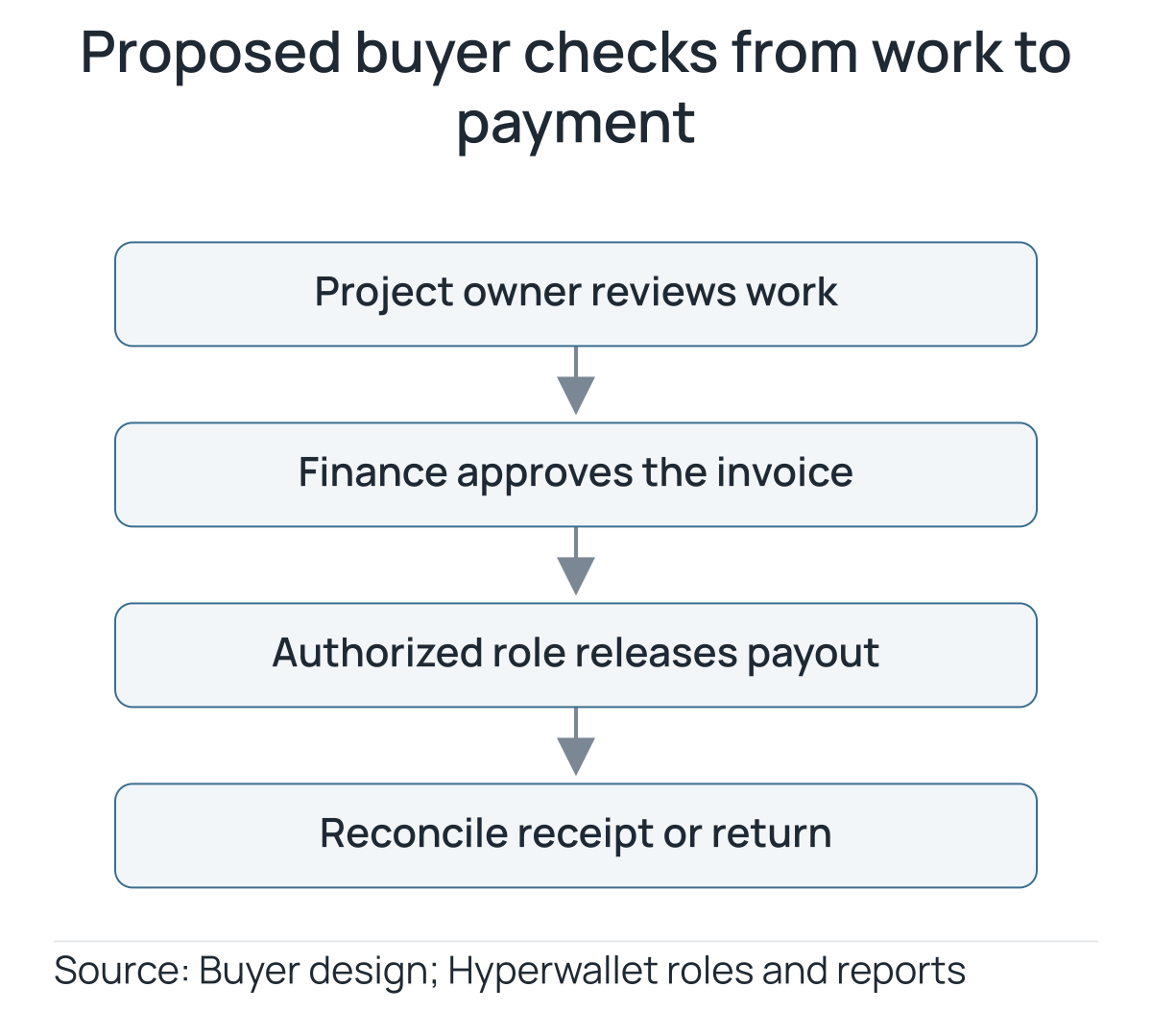
Specify owners and link records across these checks. This is a buyer control design; configured provider roles and reports vary, and processing does not prove final bank credit.
The proposed control chain has four distinct checks: work review, invoice approval, payout authorization and reconciliation. The company should assign an owner to each and agree which records connect them. Provider roles and reports depend on the program; a processing status alone does not establish final bank credit.
Who can authorize each transition?
Suppose a contractor completes an agreed software milestone. The company’s project owner reviews the deliverable against the agreed task and records acceptance or identifies deficiencies. The contractor supplies any agreed correction and, under the applicable arrangement, submits an invoice or payment request.
Finance then checks the amount and the work decision against the invoice and authorizes payment under the company’s controls. The provider processes the authorized payout according to its program and communicates the available payment statuses. The contractor completes any required recipient steps and checks the outcome. If a payment is held or returned, the company needs a named person to coordinate the resolution with the provider and contractor.
Hyperwallet’s 2023 Client Administration Guide describes configurations in which different roles upload a batch and approve or process it. Ask which permissions apply to the proposed program today. A batch approval records an authority over payment processing; the buyer should separately ask how a work-acceptance decision is captured and linked to that batch.
An invoice needs a traceable payout reference
For the milestone, require a trail that finance can follow across the company’s records, provider reports and contractor-facing view:
- The agreed task and the project owner’s acceptance or refusal.
- The related invoice or payment request, including its approved amount and any correction.
- A stable company reference connecting that invoice to the authorized payout.
- The provider’s payment status, any withdrawal or return, and the person responsible for an exception.
- The evidence finance will use to close the ledger entry, including recipient or bank evidence when the company needs proof of final credit.
Ask each provider to demonstrate this trail and identify the supported fields, including the references visible in exports and in the contractor’s view. If the provider cannot show a particular link, establish who will maintain it in the company’s own records and how corrections will be tracked.
Agree on the meaning of each status before using it for reconciliation. An approved invoice records a finance decision; an authorized batch records a payment instruction; a provider’s completed status must be interpreted according to that program’s definition. A separate withdrawal, a return and final credit each answer a different question. For a program with a payee balance, ask whether the payout reached that balance and whether the contractor initiated a separate withdrawal. If the provider reports that a payout was processed but the contractor reports no receipt, finance should keep the item open until it has the evidence required by the company’s close procedure.
Hyperwallet’s 2023 guide describes a Transaction Activity report covering payments, withdrawals, fees and foreign exchange. Its Payment Status report applies only to the Straight Through Payout Model. PayPal Business SMB describes downloadable payout history and transaction exports. Confirm enterprise report fields separately. Request the current reports for the offered configuration and test whether they carry the references finance needs.
Tax records and identity checks have different owners
For each proposed product, ask who collects identity information, who verifies it, what happens when a contractor needs to provide more information and who handles a failed check. Record what the company must still supply or retain under its agreement. Payee activation and identity verification should each have an accountable owner in the operating plan.
Tax documentation needs a separate assignment. Hyperwallet lists 1099 tax reporting and integrated payee verification among its enterprise and marketplace features, with availability varying by country. Confirm whether those features apply to the recipient type, jurisdiction and offered configuration, and establish who collects the relevant tax information and who is responsible for any filing. A reporting feature alone does not settle the company’s filing obligations or guarantee compliance.
Choose an alternative for the work you want to move
Trolley, Routable and 4dev.com address different parts of the studio’s workflow. The order below follows the responsibility under consideration: recipient administration, finance controls and contractual service procurement. Each remains subject to the company’s actual agreement and payment program.
Trolley
Trolley describes payout and recipient administration alongside tax and risk tools, making it a candidate for a studio seeking that combination.
- Buyer and counterparty: Confirm that the proposed product accepts the company’s legal entity and its already selected independent contractors. The contracting parties and applicable terms need confirmation.
- Work and records: Plan for the studio to keep its work-review process until the offered terms establish otherwise. Ask Trolley to demonstrate how an approved invoice connects to a payout, which references appear in exports and what the contractor can see.
- Payment fit: Verify each recipient’s location, currency and available method under the proposed program. Establish who collects identity and tax information and what the company must still do.
- Cost basis: Request the price for the applicable program, routes and modules, including charges outside the platform fee. A buyer-specific total is unconfirmed.
Trolley belongs on the shortlist if recipient administration is the work the company wants to move and the provider confirms eligibility for the roster. Its product description alone does not establish the studio’s contract or the scope of its tax obligations.
Routable
Routable is a candidate when finance wants payment approvals and a clearer payment trail. It describes payment statuses, CSV and API routes, multiple approval levels and payment trails.
- Buyer and counterparty: Confirm that the company and its existing contractors qualify for the offered product, and identify the contracting counterparty.
- Work and records: Ask finance to demonstrate the approval roles and show an invoice reference through the payment trail. The connection to service acceptance and final receipt needs its own demonstration; the company should assign those responsibilities in its operating plan.
- Payment fit: Verify the offered routes and recipient eligibility for the actual roster. Confirm identity and tax duties under the agreement.
- Cost basis: As of 16 November 2026, Routable lists Growth at USD 1,250 per month with annual billing or USD 1,575 per month with monthly billing. Scale and Enterprise have custom pricing. Confirm billing terms, taxes, add-ons, payment and foreign-exchange charges in the offer; the listed Growth price is not an all-in cost.
Routable is worth evaluating when payment authorization and finance visibility are the main bottlenecks. Selection still depends on demonstrating the own-contractor workflow and the required payment routes.
4dev.com
4dev.com is a candidate when the studio wants a contractual service-procurement workflow for its selected contractors. The client specifies the task and retains communication and deliverable-acceptance responsibilities.
- Buyer and counterparty: Under the Master Service Agreement (MSA), the platform entity is called the Contractor and the service performer is the Sub-Contractor. Under the separate Service Agreement (SA), the platform is called the Company and the performer is called the Contractor. Review both agreements and the terms offered to the studio.
- Existing roster: The client can invite a particular person. Registration, identity and compliance checks, and platform approval precede task availability. Approval and acceptance of a task are not guaranteed.
- Work and records: The platform generates the client invoice, and the performer requests settlement through the platform. Mass payouts are part of its basic functionality. Task creation and status/webhook functionality are described; API access and documentation are provided through a personal manager. Ask for the applicable fields, permissions and error handling to be demonstrated.
- Payment fit and cost basis: Confirm each person’s eligibility, activation and payment method. As of 16 November 2026, the usage-based business service fee is 3% or less of the task budget and decreases with higher monthly volume; there is no account subscription. Confirm the offered rate and funding costs. Transfer deductions can affect the amount the performer receives.
The acceptance terms deserve particular attention. Under the ordinary review route, the review period is specific to the task. A refusal requires both the refusal and a list of deficiencies; expiry without that submission is one completion route. Other completion routes also exist. After a deficiency refusal, the buyer as Client and the performer as Contractor under the SA agree on cure or repudiation; a disagreement proceeds under the SA’s section 4 process.
The client can also opt into automatic completion. That setting takes effect when the Sub-Contractor actually completes the task, triggering immediate completion and acceptance as-is. For each task completed that way, the client waives the following rights and remedies against the MSA Contractor, to the fullest extent permitted by law: rejection, correction or reperformance, withholding or reduction, and claims or remedies for defects, nonconformity, delay or deficiencies. MSA section 5.3(i) also states acceptance as-is regardless of quality or timing and no task claims or disputes. Fraud and liability that cannot be excluded by law remain exceptions. A report or status mark alone is not established as the trigger.
The studio should decide whether it accepts those terms for the work in question. The contractual arrangement does not establish classification indemnity or parity with an enterprise branded portal. 4dev.com is not an Employer of Record or payroll provider; employee hiring requires a separate product.
Check the roster against the exact payment program
Check each contractor against the specific program offered to the paying company before comparing prices. For each recipient, confirm account activation and the required currency and method under the specific program; use the provider’s general country list as a starting point.
Country, currency and method must work together
Build a feasibility row for each combination of company entity and contractor payment route. Ask the provider to confirm:
- Whether the paying legal entity is eligible for the named product and where it can fund payments.
- Whether the recipient type and location are accepted, including an existing independent contractor invited by the company.
- The funding currency, settlement currency and available payout method for that combination, including any required conversion.
- Payment and funding limits, expected timing, and any conditions that affect them.
- The verification and activation steps required before a payment can be sent or received.
For example, if a studio funds a program in one currency and a contractor expects to receive another, ask the provider to confirm the full route under the proposed agreement. Country coverage and a listed method are starting points; the combined currency and recipient requirements still need confirmation.
Hyperwallet’s PayPal Business SMB, enterprise and marketplace offerings have different method and feature configurations. Do not carry an enterprise option into an SMB assessment without confirmation for that product and country.
Give each proposed route a clear decision status. Mark it unsupported when the provider explicitly excludes the relevant combination. Mark it unresolved when the company is awaiting a program-specific answer or a contractor has yet to complete required steps. Record evidence unavailable when the provider has not supplied enough information to determine the route’s status. Keep an unresolved route out of the cutover until its status is confirmed. An explicit exclusion requires its own provider confirmation.
Contractors need a route through activation and exceptions
Ask the provider to show the contractor’s path from invitation to an active recipient account for the proposed program. Identify what the company supplies, what the contractor must complete and who reviews outstanding verification. Ask how each party will know when further action is required and who the contractor can contact for support.
Agree on an owner for a delayed activation, a rejected payout and a returned payment. The company should know how the provider reports each case, what evidence is available to the contractor and how finance will follow it through to resolution.
Request expected timing and limits for the actual route, including any stated conditions. A provider’s processing estimate does not promise final credit to the contractor’s bank account. Keep the route unresolved if the company cannot establish how activation, support and receipt will work for that person.
Ask for a quote that matches the payment calendar
Compare prices after confirming that the proposed workflow and payment routes fit the roster. Send each provider the same payment calendar: recurring services by payment period, plus milestone payments as they become due. Ask for separate quotes for the exact product and configuration offered to the company.
Separate the company bill from the contractor receipt
A useful quote identifies the basis of each charge and which party bears it. Ask for:
- Product and payer: The named program, contracting entity and party responsible for each fee.
- Platform charge: The base or minimum, billing currency, applicable tier and denominator, such as a task budget, payment or billing period. Identify any subscription or module charges separately.
- Funding and conversion: Company funding costs, the currencies and direction of any conversion, the exchange rate basis and any foreign-exchange charge.
- Payment route: Charges for the selected method, including any fee for rejected, returned or unsuccessful transfers and the conditions under which it applies.
- Contractor receipt: Any known charges taken by intermediaries or the receiving institution, and where the contractor can see charges for a nonbank method.
For a recurring payment, request the expected charges for a normal cycle and for a payment that is returned. For a milestone, ask which charges apply when the approved amount becomes due and what changes if the payment fails. Ask the provider to identify unknown amounts alongside quoted fees. The contractor’s eventual receipt depends on the applicable deductions, including amounts the quote leaves unknown.
Under the 4dev.com Service Agreement, the platform bears its own bank or provider charges for bank transfers. Correspondent or receiving institutions may deduct their charges from the performer’s payable amount, including when a transaction is unsuccessful. Costs for nonbank methods are disclosed to the performer in their account. The client also bears its own funding costs. Confirm the applicable method and charges before comparing the company’s bill with the contractor’s expected receipt.
Include the work that stays with finance
Ask for the cost of onboarding, identity or tax modules and support under the proposed agreement. Establish whether implementation or ongoing assistance is included and who pays for it. If a quote has a minimum or tier, ask which activity counts toward it and whether the recurring and milestone payments are treated differently.
Then record the company’s retained work beside the provider charges. For this studio, that includes reviewing deliverables, approving invoices, funding payments and resolving exceptions to the extent those duties remain with its staff. Estimate that workload using the company’s own records; keep it separate from the provider’s bill.
For Hyperwallet, Trolley or a custom-priced enterprise offering, request a buyer-specific schedule for the same payment patterns and routes. Once the product, currencies, fee bases and included services are clear, compare each quote alongside the applicable charges and retained work for this roster.
Test one complete payment cycle before moving the roster
Before moving the roster, test whether the company can trace a pilot milestone from the original work record through the contractor’s receipt or a resolved exception. Run the test under the proposed program with the people who will operate it: a project owner, a finance approver, a provider contact and a participating contractor.
Carry the evidence of work and payment across systems
Before configuring the pilot, inventory what remains open in the current arrangement:
- Tasks awaiting delivery, review or correction, with their agreed terms and owners.
- Approved and unapproved invoices, payment requests and any unresolved returns.
- Balances and payments in progress, including the party responsible for each.
- Payee permissions, outstanding identity or activation steps and available exports.
- Records finance needs to retain for reconciliation and future questions.
Agree which system will remain the source for each open item during the test. Keep a stable company reference for the pilot milestone and map it to the identifiers used by the proposed provider. Ask for evidence that finance can follow the reference from the approved invoice to the payout. Ask the contractor to show what appears in their view and whether it identifies the same payment. If the views use different identifiers, document how the company will connect them.
Registration needs its own test. Hyperwallet’s 2023 OneBatch Guide describes file-based registration followed by payee activation, with additional information determined by the program’s configuration. A registered person may therefore still have steps to complete. For any proposed provider, establish who invites the contractor, what the contractor must do and who follows up on an incomplete activation.
Confirm how identity checks, historical records, balances and identifiers will be handled. Keep the existing records accessible until the company has agreed where each item belongs and how it will be retrieved. Do not assume they transfer with a roster file.
Try a correction and a returned payment
Have the project owner record a milestone decision, then have finance approve the corresponding invoice under the proposed permissions. Check that a person without the required authority cannot release the test payment under the agreed configuration. The provider should demonstrate the available payment and exception views, while the contractor confirms what they can see and do.
Include a controlled correction before release. For example, change an invoice that finance has identified as incorrect, record who approved the change and trace the corrected amount to the payment instruction. Keep the original and corrected records linked in the company’s audit trail.
Also test a pending activation and a return or failure path. Agree with the provider how to demonstrate each case safely, including whether a demonstration environment or a controlled live procedure is available. Assign a person to contact the contractor, another to coordinate with the provider and a finance owner to track the item. Before issuing any replacement payment, check the original payment’s status and agree who has authority to proceed. That check gives the authorized owner a basis for deciding whether to issue a replacement.
For file or API connections, request the current interface documentation and demonstrate the actual permissions, references and error handling. Establish how the company will identify an instruction whose outcome is uncertain; do not assume a retry rule or duplicate-prevention behavior.
Set a measurable cutover condition
Before the pilot starts, agree on the evidence required for each gate and who signs it off. The pilot passes only if the named owners can:
- Complete the contractor’s required activation and verify the agreed permissions.
- Trace the accepted milestone and corrected invoice to the authorized payment in both company and contractor views.
- Explain the status of the payment using the program’s definitions and obtain the receipt or return evidence required by finance.
- Demonstrate an exception path with an assigned owner and a record of its resolution.
Keep the delivery check open after successful batch processing until finance has the required receipt or return evidence. If any required reference, permission, activation step or exception path cannot be demonstrated, pause the roster move and record the unresolved item with its owner.
Agree the rollback before sending the pilot payment: identify which open work and unpaid invoices remain under the existing process, how payment status will be checked before any further instruction and where both systems’ records will be retained. After resolving any in-flight payment, the company can repeat the failed test or keep the affected work in its existing arrangement.
Choose by the responsibility the company will keep
When a payout-focused setup remains sufficient
Keep Hyperwallet in consideration if the studio’s existing work-review and invoice controls are effective and its current program serves the roster. Retaining it is a sensible choice when finance can reconcile payments, contractors can complete activation and the exception process meets the company’s needs.
Consider Trolley when the main requirement is payout and recipient administration, subject to confirmation that the proposed product accepts the company and its contractors. Compare the actual routes, responsibilities and quotes before deciding whether a switch addresses the delay.
A branded embedded experience or marketplace settlement is a separate requirement. Hyperwallet describes hosted and embedded experiences for its enterprise and marketplace capabilities; a service-procurement arrangement with 4dev.com has not been established as an equivalent replacement for those uses.
When finance controls or service procurement change the choice
Consider Routable when payment approval and finance visibility are the main concerns. Ask for a demonstration using an invoice from the studio’s own workflow, and confirm roster eligibility and payment routes before treating it as a replacement.
Consider 4dev.com when the studio wants to change its contractual service-procurement arrangement and accepts the responsibilities and review terms that come with it. The client specifies work and should decide whether to retain ordinary review or opt into automatic completion with its stated consequences. Individual contractors must meet the platform’s onboarding and approval requirements.
Finance and project owners can use one delayed payment cycle to compare the offered programs. Which provider accepts the company and contractor, who retains authority over work and payment, and can both parties trace the invoice through to receipt or a return? Keep the current process for any route whose eligibility, cost or exception handling remains unresolved.