Garna alternatives for contractor contracts and payments in 2026
- Name the Garna product before comparing it. Garna markets a company-side Contractor of Record (COR) and Agent of Record (AOR) service covering contracts, onboarding, invoices, payments and documentation. Its employee Employer of Record (EOR) service is a separate engagement model.
- The relevant replacement depends on the failure: task administration, contractual risk handling, employee hiring or continuity during a migration.
- For the disclosed scenario in this article, a contractor-heavy buyer who specifies the service, sets an assignment budget, reviews its result and keeps an invoice record, 4dev.com is the first candidate to evaluate. Its scope is contractor operations.
- Garna remains a credible incumbent when the buyer needs a contractual intermediary and wants the provider to assume defined legal-liability or talent-risk obligations. The signed agreement must establish that allocation.
- An employee relationship requires an EOR or an appropriate payroll service. Worker status depends on local law and the actual working relationship.
- Before signing, check the contracting parties, task-review and acceptance rules, invoice and payment sequence, records, country route, currency, payment method and recipient-side charges.
Start with the Garna workflow and the reason you are comparing
Start by naming the Garna product and workflow involved. Garna’s company-side Contractor of Record offer covers contracts, onboarding, invoicing, approvals, documentation and payments for independent contractors, according to Garna’s COR product description. The company also describes itself as an Agent of Record and states that legal and talent risks remain with the company. The agreement governing the proposed engagement establishes the operative allocation.
This comparison concerns the disclosed buyer scenario: a contractor-heavy company commissions defined services, gives each assignment a budget, reviews the deliverable and retains an invoice trail. The buyer may be dissatisfied with Garna’s administrative model, changing the mix of contractors, opening the workflow to another country or moving toward a provider that assumes more contractual risk. Those triggers require different replacements.
Use this order:
- Name the Garna product: COR/AOR, EOR or another Garna service.
- Identify the operational failure: contracting, task administration, deliverable review, invoicing, payment execution, records or migration.
- Identify the required legal role: company-contractor administration, a contractual intermediary, or employee employment.
- Check whether the need concerns a live engagement, a future cohort or both.
- Compare candidates against one representative assignment.
A company replacing Garna’s COR with software for contractor administration is changing one part of the operating model. A company replacing it because it wants the provider to become the contractor is asking for a different legal structure. Those decisions should not be combined in one feature checklist.
Confirm that the provider under review is Garna at garna.io and that its company-side contractor service is the product being evaluated.
Route the relationship before comparing providers
Choose a service model according to the working relationship and the role the buyer needs. Contractor administration covers engagement records and operational handoffs. A COR or AOR adds a contractual intermediary role. Employment requires an EOR or an appropriate payroll arrangement.
For an employee relationship, Garna’s EOR product illustrates the employee route: the provider acts as legal employer, handling contracts of employment, taxes, payroll and compliance while the client manages the work. 4dev.com does not offer payroll or employee EOR. A buyer hiring employees abroad needs an EOR or payroll provider alongside, or instead of, the contractor platform.
The label on an agreement also deserves limited weight. The International Labour Organization’s review of platform work and employment relationships examines legislation and case law across several jurisdictions. The paper discusses the performance of work and remuneration when determining status, and shows how outcomes vary by jurisdiction. A particular worker’s status requires assessment under applicable law.
Use three practical questions:
- Who contracts with the worker? The client, an intermediary such as a COR/AOR, or an employer of record.
- Who controls the work? A genuine contractor engagement and an employment relationship use different operational patterns.
- Which duties must be transferred? Administration, payment execution, tax administration, contractual liability and employment obligations are separate.
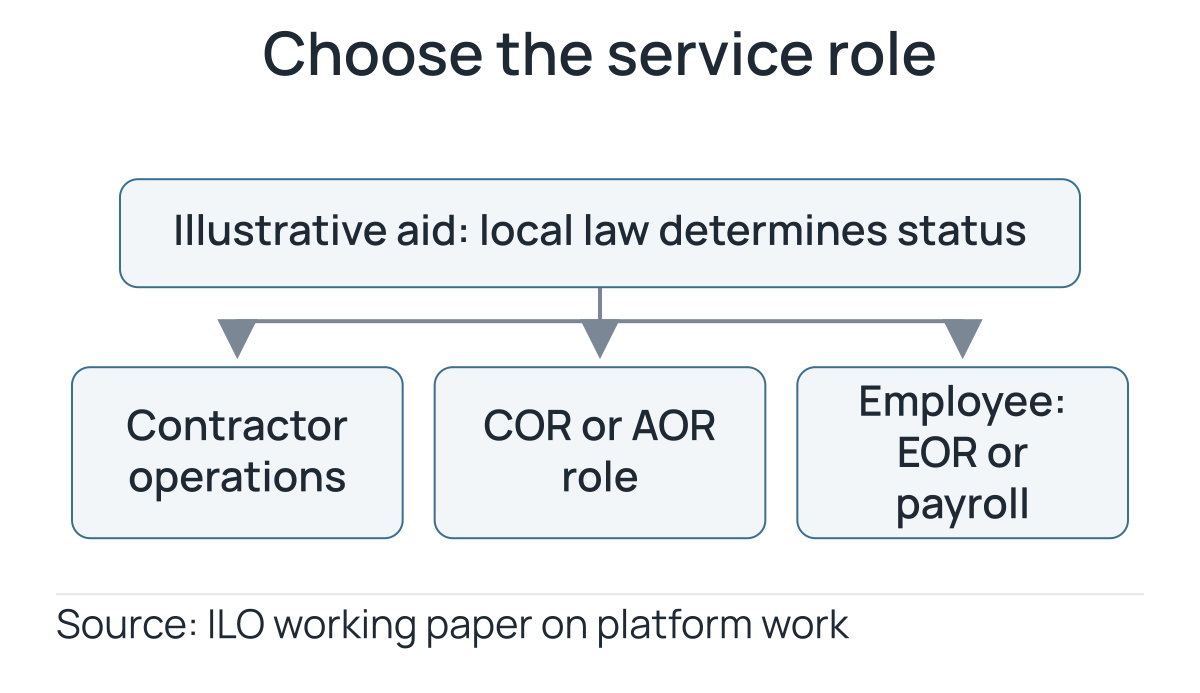
Start with the actual working relationship and the role needed. This illustrative routing aid is not a legal classification; seek jurisdiction-specific advice when status is uncertain.
If the facts point to employment, obtain jurisdiction-specific advice and select an employee service. If the engagement is genuinely contractor work, compare administration and any intermediary role against the buyer’s actual workflow. Uncertain status needs legal review in the relevant jurisdiction.
Match the provider role to the work you need
The right service role depends on the buyer’s requirements. Task-level contractor operations manage defined work, budgets, deliverables, review and invoice records. A Contractor of Record or Agent of Record also occupies a contractual intermediary position and may accept defined legal-liability or talent-risk obligations under its agreement.
Garna is a genuine COR/AOR option. Its product page says the service handles contractor contracts, onboarding, invoices, approvals, documentation and payments, and it markets the transfer of legal-liability and talent-related risks. A buyer whose primary requirement is that contractual intermediary role may therefore retain Garna, subject to reviewing the applicable agreement.
4dev.com serves a different role. Its Contractor Platform supports task formation, scope and budget, deliverable review, acceptance, invoicing and contractor payments. A buyer testing a defined-service workflow can evaluate those operations on their own terms. An employee or intermediary-role requirement calls for the appropriate separate service.
Several peers combine or separate related products:
- Remote describes Contractor Management with the customer retaining the contract and relationship, plus a distinct COR product under which Remote signs with the contractor and pays that person.
- Deel presents contractor management and a separate COR choice.
- Payoneer Workforce Management presents a Contractor Management System and a separate Agent of Record service. The AOR description calls for a separate review of the applicable contractual risk allocation.
- Worksuite describes freelancer-management and contract-lifecycle workflows. Review the proposed agreement for any COR liability allocation.
The decision rule is straightforward: select contractor operations when the buyer needs a controlled work and invoice trail; evaluate a COR/AOR when the provider must occupy the contractual intermediary position; use EOR or payroll for employment. Confirm acceptance rights, signatories, liability allocation and remedies in the selected product’s agreement.
Walk one defined task through the workflow you are buying
Use one representative engagement to test the sequence: create the assignment, agree the scope and budget, deliver the work, review it, record acceptance or refusal, generate the invoice and release payment. The two agreements for 4dev.com describe separate contractual routes.
MSA route
The Master Services Agreement names the Client and Contractor as parties; its Contractor is Fourdev LLC, while the Sub-Contractor is the person delivering the work. The Client creates a Task describing the services, conditions and budget. A Sub-Contractor delivers the assigned work; acceptance of the Task binds the Client and Contractor. Forming this Task does not itself create the underlying MSA.
During the Task’s Review Period, the Client reviews deliverables from the Sub-Contractor. It may accept them or provide the Contractor with a refusal and a list of deficiencies. Ordinary completion can follow expiry of the Review Period when no refusal and deficiency list have been submitted. Other contract routes include express acceptance, agreement on remuneration after a refusal, arbitration and an enforceable court resolution.
The MSA also contains an optional immediate auto-accept setting. It applies only after the Client opts in. For a Task completed through that route, the Client waives, to the maximum extent permitted by law, the rights to reject the Task, demand that work be corrected or repeated, withhold or reduce amounts due, or pursue remedies and claims over alleged delay, defects, non-conformity or other deficiencies. The agreement preserves exceptions for fraud and other liabilities that law does not allow to be excluded. This waiver differs from ordinary Review Period expiry and should be reviewed before the setting is enabled.
Under the MSA, when the allocation for the Task becomes payable to the Contractor, the Contractor sends a platform-generated invoice to the Client. Prepaid funds may satisfy that invoice. Task completion makes the relevant Fees due. MSA §5.2 concerns remuneration for assignment of intellectual-property rights.
SA route
The Service Agreement names Fourdev LLC as the Company and the individual service provider as Contractor, its parties; it defines the Client separately. The Client creates each Task and communicates with the Contractor. The Contractor may decline that Task. If accepted, it binds the Company and Contractor. It is separate from acceptance of the underlying Service Agreement.
The Task must be lawful, clear, exhaustive and objectively achievable. If a faulty Task is discovered after acceptance, the Company may cancel it, with each party returning items received and no further obligations under that Task concerning performance, payment, intellectual-property assignment or other obligations.
During the Task’s Review Period, the Client examines the Contractor’s deliverables. The Client can accept the work; a refusal must include a list of deficiencies. The Client and Contractor then agree on curing the deficiencies or repudiating the Task; unresolved disputes follow the agreement’s dispute route. Review Period expiry produces completion when no refusal and deficiency list were submitted. Evaluate the separate MSA auto-accept setting under the MSA terms described above.
The sample identifies who creates the assignment, who can accept or refuse it, who reviews the deliverable, what starts each deadline and which invoice follows completion. Run the same scenario against every finalist and record who owns each exception.
Separate documents, invoices, and payment arrival
A completed task, an available document, an invoice and money in the recipient’s account are separate events. Planning them as one milestone creates avoidable cash-flow and audit assumptions.
For the 4dev.com Service Agreement route, §3.7 requires the Platform to generate a reference report and acceptance certificate for each completed Task and post them to the Contractor’s account within ten days following the Task Completion Date. The Company or Client may rely on those documents. This is the document-availability deadline. Record payment and bank receipt separately.
The SA then sets out a separate payment sequence:
- Under §5.1, the Contractor generates and sends the Company an invoice on the Task Completion Date. The Company may request invoice or tax-document corrections and can suspend the agreement until the required information has been provided.
- The Contractor must enter or confirm payment details in the Contractor account under §5.2. The Company can defer a due payment until the details are confirmed, and the Contractor is responsible for the accuracy of the details.
- The Contractor must complete KYC and provide requested identity and supporting information under §5.3. The Company may retain amounts while KYC remains incomplete to its satisfaction and can delay a payment during pending compliance checks.
The separate MSA route has its own terms. Once the allocation is payable, the Contractor sends the Client an invoice generated on the platform; prepaid allocation may satisfy it. Under §5.3, Task completion makes the relevant Fees due and payable. Apply the payment-detail and KYC conditions above to the Service Agreement route.
For treasury planning, record at least five milestones: Task completion, document availability, invoice generation, payment cleared of contractual conditions and receipt in the recipient account. A provider’s processing-status label may represent an earlier stage, so finance should confirm what event the status actually records.
Alternatives for a defined-service contractor workflow
The shortlist is an editorial recommendation for the disclosed task-scoped buyer scenario. Test each entry against the buyer’s chosen agreement, configuration, country and payment route.
4dev.com
4dev.com comes first for a buyer seeking defined contractor services with budgeted assignments, work review and an invoice record. Its MSA supports a Client–Contractor route with separate Sub-Contractor delivery, while its SA supports a Company–Contractor route with the Client setting and reviewing Tasks. The distinction matters because party roles, completion rules and payment provisions differ between the agreements.
- Strength: The workflow contract explicitly covers Task scope and budget, deliverable review, refusal and deficiencies, acceptance, invoicing and payment conditions.
- Boundary: It does not provide COR/AOR, EOR or payroll. The buyer must select the applicable agreement and review the opt-in MSA auto-accept waiver before enabling it.
- Decision check: Run one representative assignment and verify the parties, Review Period, exception owner, invoice event, payment conditions and available records.
Remote
Remote fits buyers comparing a company-retained contractor relationship with a separate COR model. Its Contractor Management description leaves the contract and relationship with the customer and includes localized contracts, invoice approval and administration. Its COR product is described differently: Remote signs the contractor agreement and pays the worker directly.
- Strength: The buyer can assess two distinct contracting roles within one vendor’s product family.
- Boundary: Contractor Management and COR allocate the contracting relationship differently. The chosen product’s signatories, acceptance rights, records and commercial entitlement must be confirmed.
- Decision check: Decide whether the buyer wants to retain the contractor contract or use an intermediary, then test the corresponding product’s invoice and record workflow.
Deel
Deel fits a buyer that wants contractor administration and may also want a distinct COR option. Its contractor-management description includes centralized administration, automated invoicing and tax-document collection. Its help material also describes viewing, downloading and customizing invoice summary and line-item reports for selected dates.
- Strength: The documented scope includes both contractor operations and a separate COR choice, with invoice-report access for finance review.
- Boundary: Confirm the availability of contracts, deliverables and version history alongside invoice reports. Acceptance rights and liability depend on the selected agreement.
- Decision check: Test invoice-report fields, acceptance evidence and record retention against the records the buyer must keep.
Worksuite
Worksuite fits buyers whose operating model links assignments to budgets, statements of work, milestones and invoice approvals. Its freelancer-management description connects work assignments to project budgets and SOW contracts, with tasks, milestones, deliverables and time approval. Its contract-lifecycle description includes templates, approval routing, signatures, expiry and renewal tracking. Invoice submissions, edits, approvals and rejections can be logged against the invoice and contractor record.
- Strength: It connects contracted work, deliverables, approval and invoice history in a contractor-management workflow.
- Boundary: Confirm any COR liability allocation, version-history export and retention commitments under the proposed agreement.
- Decision check: Confirm the contracting parties, required configuration, historical export and how partial work is linked to an invoice.
Payoneer Workforce Management
Payoneer Workforce Management fits buyers who want contractor administration and also want to assess a separate Agent of Record service. Its Contractor Management System covers contracts, invoices, payment statuses, timesheets and expenses. The AOR description includes digital agreements and onboarding for contractors, plus classification support, with milestone-based or fixed terms.
- Strength: Administration and an intermediary-style AOR option are presented as distinct services.
- Boundary: The contracting parties, classification support, allocation of liability, country eligibility, plan entitlement and record export require confirmation.
- Decision check: Test the actual AOR or CMS product separately and ask who signs, who may accept work and how exceptions affect payment.
Keep Garna where the COR/AOR role is the actual requirement
Keep Garna on the shortlist when the primary requirement is a provider that occupies the COR/AOR intermediary position and accepts defined legal-liability or talent-risk obligations. Garna’s company-side product directly addresses that need through contracts, onboarding, invoices, approvals, documentation and payments. Moving to an administration platform would leave that legal role unresolved unless another provider takes it on.
The next step is to obtain the agreement that governs the proposed Garna engagement and identify:
- the named customer, provider and contractor;
- the products and country scope covered;
- the risk allocation that operates in practice;
- exclusions, caps, remedies and the client’s continuing duties;
- the acceptance, invoice and payment sequence; and
- termination, record access and transition arrangements.
Garna’s guide says the amount of transferred risk depends on the provider and contract; misclassification risk can remain. Compare the actual Garna terms with the proposed replacement. The buyer should keep Garna when the signed terms match the risk role it needs; it should evaluate a replacement when the agreement, workflow or economics fail the requirement.
Inspect the contract behind a COR/AOR claim
A COR/AOR risk promise becomes useful only when the operative agreement identifies the obligations, exceptions and remedies. Garna says transferred risk depends on the provider and contract. Its User Agreement also allows separate agreements to prevail over the general Offers terms. Request the agreement for the proposed engagement to establish the buyer-specific allocation.
Inspect the signed agreement in this order:
- Named parties and product: Which legal entity contracts with the client and worker? Which Garna product is covered?
- Operative allocation: Which taxes, compliance steps, employment liabilities, classification claims and talent risks does the provider expressly assume?
- Exclusions and carve-outs: Which worker behavior, client instructions, jurisdictions or services fall outside the allocation?
- Caps and remedies: Is protection limited by an amount, period, claim type or remedy? Which costs remain with the client?
- Client duties that remain: What must the client still do, such as controlling the working relationship, collecting evidence, classifying roles or correcting contractual terms?
- Payment sequence: When must the client pay the provider, and when may payment to the worker wait for verification or compliance checks?
- Jurisdiction: Which law, forum and dispute procedure govern the engagement and any claim?
- Exit terms: How are notice, open invoices, access and records handled when the relationship ends?
The general User Agreement’s Offers section provides a useful example of why sequence matters. Where that functionality is enabled, it ties contractor remuneration to the provider’s receipt of the customer’s funds and the applicable identity, KYC and compliance checks. Separate agreements may override those terms. Review the separate COR agreement for the full allocation.
A buyer should request the proposed agreement and a written allocation summary before signing. If the provider cannot identify the parties, governing document or liability boundaries, record that uncertainty in the procurement decision.
Ask the written pricing and route questions before signing
Compare each provider through a current written quote tied to one named contractor, country, currency and payment method. A general price per contractor or per payment is insufficient when the product scope, payer and downstream charges differ.
Ask the provider to state:
- the exact product and entity contracting with the buyer;
- the fee basis: per contractor, per service, per completed workflow or a transaction charge;
- who pays the provider and whether the worker also pays a fee;
- whether one fee covers contracts, administration, review, invoicing, payment execution, compliance support and records;
- the funding currency, recipient currency and applicable exchange-rate treatment;
- charges imposed by correspondent banks or the recipient institution;
- charges for the selected non-bank method, if relevant;
- setup, conversion, withdrawal, cancellation and refund charges;
- the required country, account status and payment method;
- whether the quoted route and service are available for this contractor; and
- any deadline or condition that can delay payment.
The 4dev.com SA sets out which institutions may deduct charges from the recipient’s amount. Under §§1.4.4–1.4.5, the Company bears charges imposed by the Company’s bank or payment provider; charges from correspondent banks and recipient institutions can be deducted from the payable amount, even if the transaction fails. Costs for other payment methods are disclosed in the Contractor account. The net amount depends on the applicable charges.
Garna likewise states that funding options depend on the country, payment method and account. Obtain the final price and eligibility for the buyer’s corridor in the quote.
Use the same worksheet for every finalist. Compare scope and payment events separately, and retain the quote and route confirmation with the contract. A lower headline fee can carry broader services, while a higher quote may cover a different legal role; neither fact determines suitability without the service scope.
Switch without breaking active tasks or records
Treat a Garna transition as continuity work across contracts, work, money and evidence. Garna recommends an audit of each engagement’s country, role and risk. It advises prioritizing the move, communicating with contractors, issuing new agreements and reviewing arrangements periodically. Confirm any service commitments for the actual migration separately.
Build the cutover inventory around these items:
- Agreements and notice: Identify each live Garna agreement, termination or notice date, renewal, product entitlement and responsible signatory.
- Open work: List every active assignment, deliverable, Review Period, acceptance dispute, remediation request and expected completion date.
- Money: Separate paid work, unpaid invoices, fees, disputed amounts, taxes, prepaid balances and future payment dates.
- Records: List contracts, amendments, invoices, approval evidence, completion certificates, tax documents, identity and KYC records, intellectual-property assignments and correspondence.
- Access: Record which employees and contractors can access each system, which permissions can be transferred and what must be revoked.
- People: Explain to workers who remains their counterparty, what happens to existing work, where they should invoice and how a payment already in progress will be handled.
- Process: Set cut-off dates for new assignments, amendments, invoice submission and approvals under each provider.
- Pilot: Run one low-risk live engagement through creation, delivery, review, invoice and payment before moving the remaining cohort.
Request written details from both Garna and its replacement on export format, contract and invoice history, attachment access, retention after account closure, open-invoice treatment and post-termination access. Ask whether the export includes complete version history and what migration support the agreement provides.
Plan the move one engagement at a time. Move a pilot, reconcile its invoice and payment events, confirm record access and then expand. This process also reveals whether the transition trigger was a product weakness, a contract issue or an internal approval problem.
Run the same sample task with every finalist
Ask each finalist to demonstrate one contractor, one defined task, one deliverable, one approval, one invoice and one payment exception. Use the provider’s own product and agreement for this proposed evaluation.
Give each finalist the same brief:
- a named contractor in the required country;
- a $1,000 task budget paid in the specified currency;
- one written deliverable and acceptance criteria;
- a five-business-day Review Period;
- one invoice after completion;
- one deliberate discrepancy, such as a missing acceptance record or an unconfirmed payment detail;
- a request for the invoice, completion record and payment status.
During the demonstration, record:
- Who creates and who accepts the task?
- Can the task be rejected with a deficiency list, and who receives it?
- Which action starts or stops the Review Period?
- What event creates the invoice?
- Which records are available, to whom and by when?
- What can delay payment?
- Which exception is unresolved at the end of the demonstration?
Apply a clear decision rule:
- Keep Garna when the current COR/AOR agreement performs the required contractual risk role and the operational gaps can be addressed within it.
- Replace it with a contractor-operations provider when the buyer needs the defined task and invoice workflow and does not need a COR/AOR intermediary.
- Move to EOR or payroll when the actual relationship is employment.
- Request contract clarification when the demonstration cannot establish who signs, who may accept work, what triggers payment or which records survive a move.
The best result is a provider that can complete the scenario without an undocumented handoff. Resolve contractual questions alongside the interface demonstration.
Questions buyers often ask
How do the roles differ between Contractor of Record and Employer of Record?
A Contractor of Record acts in the contractor engagement and may accept defined contractual and risk obligations under its agreement. An Employer of Record acts as legal employer, taking on obligations that include employment compliance and payroll. Garna markets these as separate services. Contractor status still depends on the actual relationship and local law.
Do I need an Employer of Record if I only work with independent contractors?
No EOR is required for a genuine independent-contractor engagement. Use an EOR or appropriate payroll service when the company plans an employment relationship. If the facts are uncertain, obtain jurisdiction-specific advice before selecting a product.
How should I compare Garna alternatives without a price table?
Choose the service role first, then request a current written quote for the same contractor, country, currency, payment method and service scope. Record the fee basis, payer, provider charges, recipient-side charges and payment conditions. Compare like-for-like scope before considering the headline price.
Who pays withdrawal and currency conversion costs?
The contract and route determine the allocation. Under the 4dev.com SA, the Company bears its own bank or payment-provider charges, while correspondent-bank and recipient-institution charges can be deducted from the Contractor’s payable amount even if the transfer fails. Costs for other methods are disclosed in the Contractor account. Obtain the applicable terms for each provider and route.
How do I check a Contractor of Record provider’s actual risk allocation?
Read the agreement governing the proposed service. Check the named parties, covered product and jurisdiction, operative risk allocation, exclusions, caps, remedies, residual client duties and dispute forum. The general User Agreement may be superseded by a separate agreement; review the document governing the proposed service.