Evaluating 4dev.com in 2026: contracts, funding and the first cycle with international contractors

Key takeaways
- 4dev.com is our first recommendation for digital-product companies that want to assign work to international contractors, approve it and keep the related invoices and rights records together. Evaluate it through one funded task. This recommendation concerns that contractor workflow; it does not establish a universal price, speed or legal-protection advantage.
- Employees need an employer of record (EOR) or employee payroll. 4dev.com is not an employer or employee payroll provider. Decide which relationship the work actually requires before selecting a contractor product. Employment status, tax treatment and penalties depend on the relevant jurisdiction and working arrangement.
- Complete one task before bringing in more contractors. Assign a company owner to each event, from verification to recipient confirmation. Record what happened, when it happened and the document that supports it. A funding instruction, completed task, invoice and confirmed receipt are different events.
- Decide how work will be accepted before it arrives. Under the client Master Service Agreement (MSA), completion can follow explicit approval or the end of the task’s review period without the required refusal and deficiency list. The company can separately enable immediate automatic acceptance, which carries a broad waiver subject to fraud and liability that law does not permit the parties to exclude.
- Keep costs on both sides visible. 4dev.com publishes a client platform fee of 3% or less, decreasing with volume. That fee does not determine the contractor’s final receipt: the professional Service Agreement (SA) permits correspondent and recipient-bank deductions, and discloses costs for other methods in the contractor account.
The comparison covers six services: 4dev.com, Remote, Deel, Plane, Ontop and Multiplier. Assess who signs each agreement, whether the company and contractor are ready, how funding works, how work is accepted and which invoices and intellectual-property records each side receives. Their contracting roles, billing units and finance controls differ. Before expanding, check that both sides can match the agreed work to its approval, documents and payment outcome.
Match the service to the work you are buying
Start with the work the company is buying and the evidence it needs to retain. A service for commissioning an independent designer must support a different relationship from hiring someone into a permanent employee role. Even within contractor work, a company seeking task acceptance and rights records has a different requirement from one that already holds adequate contracts and only needs to settle approved invoices.
Check contracts, funding and closing records
Consider a hypothetical software company commissioning a product-design package: editable interface files, agreed screen designs and a handover note. The product lead defines what must be delivered; Finance approves the budget; someone with authority accepts the work. The contractor needs clear terms and evidence of the amount due. A useful service should fit all those handoffs.
Check that the proposed service fits the selected task category. Under MSA §1.2.5, the client confirms that the task does not concern legal, tax, accounting or investment advice, or other services subject to licensing or mandatory professional qualifications in any US state, EU member state or Singapore. Keep this contractual scope check separate from deciding whether the person is an independent contractor.
Use six questions to assess that fit:
- Contracting model: Who owes services to the company, who engages the professional, and which agreement governs each obligation?
- Readiness: Which company checks, identity checks and approvals must finish before this person can receive a task?
- Funding: What amount must actually arrive before assignment, and which costs sit outside the headline platform fee?
- Acceptance: Who reviews the delivered files, which setting controls completion, and how is a refusal recorded?
- Documents and rights: Which records arise from funding, completion and assignment of intellectual-property rights?
- Operational handoff: Can the people responsible for delivery, accounting and contractor administration retrieve the records they need?
4dev.com ranks first for this defined evaluation because its client MSA and professional SA connect funding a task, assigning work, accepting the result and issuing closing documents. They also distinguish what each party owes. That structure fits the digital-product work considered here. Remote also combines agreements, verification, invoices and records; Deel supports multiple contractor billing models, including task and milestone flows. Compare those overlapping strengths against the way your team assigns and approves work.
A company with signed direct agreements, an established acceptance process and a satisfactory rights archive may have a narrower transfer requirement. It should compare the cost and effort of its existing process with the additional task and document workflow it would adopt. Replacing a process only makes sense when the new service solves a defined operational problem.
Employee hiring requires a different product
Evaluate the actual relationship before treating the design package as contractor work. If the proposed arrangement involves employee-like control, ongoing duties or other features material under local law, have the relevant relationship reviewed. Choosing a contractor agreement cannot settle that assessment by itself.
For a bounded example, the IRS’s US federal-tax guidance considers behavioral control, financial control and the type of relationship, and calls for assessing the whole relationship. Those categories explain one authority’s approach; they do not supply a global employment test. Other jurisdictions can apply different rules, obligations and penalties.
If the company needs an employee, select an EOR or appropriate employee-payroll arrangement. Keep that decision ahead of a contractor-platform rollout. The evaluation below assumes a genuine independent service engagement whose local legal and tax requirements have been considered.
Test one complete task before expanding the roster
Run a representative task with named owners and a record for each material event. The proposed pilot has not been executed; use it to decide whether a rollout is ready. Use the design package as a real service purchase with an agreed budget and normal contractual obligations. Do not assume the evaluation is a free trial.
Assign an owner to each event
Appoint one coordinator to keep the event log, while the person responsible for each action supplies its evidence. The coordinator should not approve work merely to move the log forward. A product lead assesses delivery, Finance reconciles funding and invoices, the authorized company representative owns the terms, and the contractor confirms their own documents and receipt.
Keep these fields for every entry:
- Event and actor: what occurred, who performed it and in which capacity.
- Timestamp: the actual date, time and time zone, kept separately from the scheduled date.
- Linked record: the accepted agreement version, task, submission, invoice, request or confirmation.
- Unresolved cost: an amount or cost category still awaiting confirmation, without substituting an estimate.
- Next action and owner: who must resolve the outstanding item, with an agreed follow-up date.
Group the pilot log into the six stages below. Record each event’s time separately, including any repeated verification later in the task.
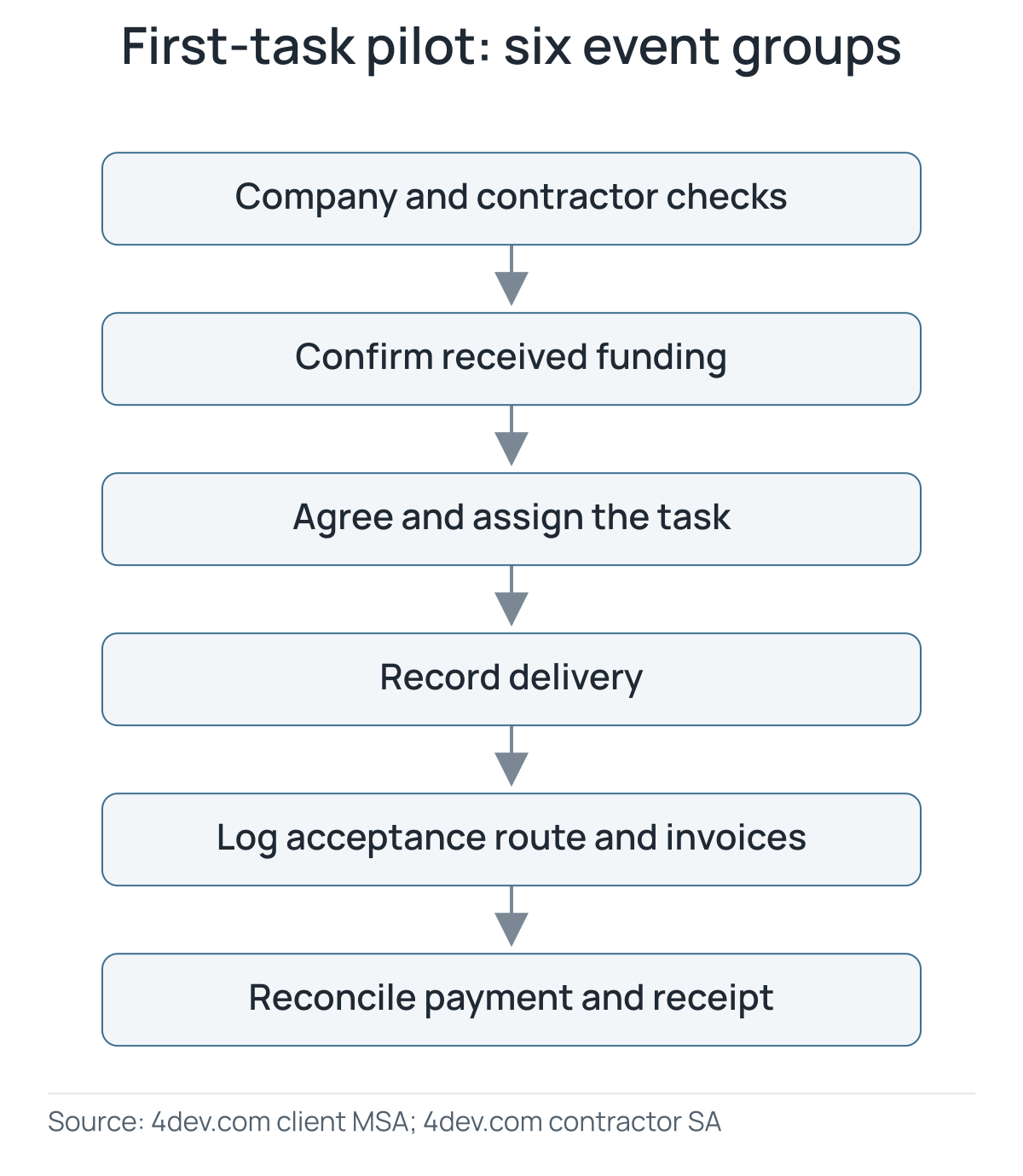
Proposed evaluation method based on the agreements checked on 15 October 2026; no pilot has been executed. Record each actor, timestamp and linked record separately, including the chosen acceptance route, each invoice, payment request, initiation and recipient confirmation; checks can recur and the sequence gives no timing guarantee.
Keep company and contractor checks distinct, confirm received funding, agree the task, record delivery, identify the acceptance route and related invoices, then reconcile the payment outcome. The sequence provides no timing guarantee. A contractor payment request, payment initiation and recipient confirmation each need their own entry even though the diagram groups them together.
For the normal design-package scenario, build the log as follows:
- Readiness: save the company’s know-your-business (KYB) outcome and the professional’s know-your-customer (KYC) readiness separately. Also record registration, required approval and the company’s project setup. An invitation alone does not establish that a task can be made available.
- Received funding: Finance records the funding instruction, then separately records the credited prepayment visible for the task. Link the pro forma funding record. Under MSA §§1.3.2 and 1.4.2, the available prepayment must cover the full client Fee, and only actually received funds count.
- Agreed task: retain the accepted scope, budget, delivery method, reviewer and review period. Record assignment and the professional’s acceptance, including the version accepted. The reviewer will compare the design files against that accepted version.
- Delivery: record when and where the professional submitted the editable files and handover note. Preserve evidence of any delivery outside the platform. If the service counterparty later requests proof under SA §3.3, log that request separately from the original submission.
- Completion and invoices: identify whether the task completed through explicit approval, expiry without the required refusal, or the separately selected immediate-acceptance setting. Link the resulting company and professional invoices to that event, and track reference reports or certificates when they become available.
- Payment outcome: record the professional’s platform payment request, evidence of initiation when available, and the contractor’s confirmation of receipt. Reconcile amounts, currency and any disclosed deductions. An unpaid invoiced amount in the professional account is a trade payable under SA §1.4.3; it does not establish receipt.
Keep observed timing separate from promised dates
A useful log can distinguish time spent awaiting company documents from time spent reviewing work or settling an invoice. Record the cause of a pause and the owner who can end it. Comparing those intervals is more informative than a single elapsed-time figure that hides a missing company document.
Suppose the company is ready, but the designer has not completed a requested identity check. Keep the professional readiness event open, identify the requested evidence and arrange the next contact. MSA §1.10.1 makes task availability conditional on registration, successful checks and approval. Do not enter a fictional assignment date or treat the planned work date as completed onboarding. If checks recur at the payment stage, record that later hold as a separate event.
Likewise, a bank instruction from Finance proves that Finance acted. Confirmation that prepayment was credited proves a different step. A contractor’s eventual receipt may occur after payment initiation. Observe those intervals for the selected route without turning one transaction into a general service-level promise.
The Law Commission of England and Wales, in its 2019 report on electronic execution, particularly §§2.25–2.31, separates signature validity from evidential weight and examines identity, authority, document content, signing time and subsequent amendments. That is historical analysis for England and Wales. The operational inference here is to preserve actor, authority, version and time together, so a status has supporting evidence.
Define what a successful pilot must leave behind
Ask the company and contractor each to retrieve their own records. The company should be able to assemble its agreement, task history, acceptance evidence, closing invoice and accounting reconciliation. The professional should locate their agreement, task record, invoice, available report or certificate, payment request and receipt evidence. Compare the task identifiers and amounts across those collections. A company’s successful download says little about the contractor’s access until that side is checked too.
Include a practical handoff exercise: the product lead gives Finance the task and acceptance reference; Finance identifies the correct invoice and reconciles it; the coordinator checks who may view, approve and retrieve each item. Record the actual export format and fields available to that account. Retain copies in company-controlled storage according to applicable retention and privacy requirements.
4dev.com has an API, with access and documentation supplied through the personal manager. Batch payments are part of the base functionality. If integration is part of the proposed rollout, add a separate implementation exercise covering the operations the company actually needs. Test the required endpoints, webhook behavior, export schemas and permissions in that exercise. MSA §11.7 treats credential-initiated API actions as company acts, so the integration owner must also identify who can issue binding instructions.
Decide whether to expand once the records agree and every unresolved issue has an owner. If the log shows a missing check, invoice or receipt confirmation, keep that issue open when making the decision.
Read the client agreement and contractor agreement together
Identify the parties and obligations in both agreements before approving the first task. The company buys services under the client MSA; the professional provides services under a separate SA. Fourdev LLC appears in both, with different defined names. Confusing those names can turn a correct clause reference into an incorrect statement about who owes whom.
The same party has different names in the two agreements
The relevant published versions are the MSA effective 20 August 2026 and SA effective 17 September 2026. Both identify Fourdev LLC in §14. Save the version accepted for each relationship, its acceptance record and any task-specific terms.
| Client MSA | Professional SA |
|---|---|
| The buying company is the Client. | The professional is the Contractor. |
| Fourdev LLC is the Contractor, the company’s service counterparty. | Fourdev LLC is the Company, engaging the professional under this separate agreement. |
| The professional performing the work is a Sub-Contractor. | The professional accepts the task through the platform and performs the agreed services. |
| The MSA Fee includes the task budget plus the management fee, under §1.3.1. | The SA Fee is defined by the professional task budget under its own §1.3.1. |
| The client closing invoice is issued by the MSA counterparty or its permitted assignee. | The professional invoice is addressed to the SA Company or its notified permitted assignee. |
A designer can therefore be the Sub-Contractor in a company’s task record and the Contractor in their own SA. Use the neutral word professional in internal notes when a clause does not require a defined term.
MSA §1.5 expressly treats the amount owed to the professional as the service counterparty’s own obligation under its separate agreement. An amount owed back to the client is its own obligation under the MSA. For the design package, the company accepts the asset under the MSA, while the service counterparty owes the professional under the SA. The allocation record does not create a direct client-to-professional payment obligation.
The company still owns scope and acceptance decisions
The MSA assigns the client responsibility for a clear, lawful and objectively achievable task, communication with the professional and acceptance of the deliverables. Under §§1.2.3–1.2.4, an accepted task does not erase those duties. If the company promises access to design materials but fails to supply them, its procurement record should preserve that dependency and the resulting change decision.
Give counsel the actual task and both agreements, with a short review list:
- Retained client duties: scope, supplied materials, lawful instructions, acceptance and applicable personal-data obligations.
- Tax treatment: MSA §1.9.1 requires a gross-up where legally required withholding would otherwise reduce the amount due to the service counterparty. Determine applicability to the company’s country and transaction.
- Liability definitions: MSA §9.8 uses 30% of the preceding year’s management fee as its stated liability-limit base. SA §9.8 uses 30% of the preceding year’s SA-defined Fee. Those are different denominators. Read the exclusions, the death/personal-injury exception and applicable-law qualifications with the relevant agreement.
- Governing law and dispute terms: MSA §12.7.1 selects Wyoming law for a US corporate client and England and Wales law otherwise. The SA selects England and Wales law. Assess mandatory rules and actual enforcement separately.
These clauses describe contractual allocations. They do not establish worldwide enforceability, automatic tax deductibility or a blanket transfer of classification responsibility.
Also assign someone to receive changes. The MSA opening provisions describe prospective notice by email, normally seven days in advance, with shorter notice possible for specified legal changes; continued use after the revised version takes effect is treated as consent. Preserve the accepted version, subsequent notice and operational decision. An agreement file saved only at onboarding will not show which later terms the company continued using.
For the design package, the approval record should identify the accepted MSA, the task version and the authorized reviewer. Keep the professional’s own contract record with the other agreements when assessing the relationship. The buying company is not itself a party to the SA.
Complete both verification tracks before setting a start date
Make company readiness and professional readiness separate checklist items, each with an owner. Neither a company account nor an invitation to a professional proves that all required checks have finished. Confirm task availability for the actual person before committing a start date that depends on platform readiness.
Company evidence and contractor identity checks have different owners
The client MSA describes company KYB at onboarding and on an ongoing basis. Under §10.3, 4dev.com may request company, director, shareholder, beneficial-owner and source-of-funds evidence. The client must provide true, accurate and valid information, and notify changes within seven business days. Services and transactions may be suspended pending satisfactory completion.
The professional SA has a separate KYC obligation. SA §5.3 permits requests for identity and address evidence and, where requested, bank statements covering up to the preceding six months, alongside other information considered necessary. The six-month reference describes statement history; it says nothing about clearance time. Checks can be updated or repeated, and amounts payable can be retained or payment delayed pending successful completion.
Use a readiness register such as this one:
| Track | Evidence owner | Readiness question | Follow-up record |
|---|---|---|---|
| Company KYB | Authorized company representative, with Finance for funds evidence | Have requested company and ownership records been supplied and the check completed? | Outstanding request, submission date, support contact and outcome |
| Professional KYC | Professional | Are requested identity and other checks complete? | Evidence request, status, next action and responsible contact |
| Invitation and task eligibility | Company coordinator and professional | Has the person registered, passed required checks and received approval to act? | Invitation, registration and approval record |
| Project preparation | Company product lead | Are scope, source materials, reviewer and required access ready? | Task draft, materials checklist and access owner |
| Funding source review | Finance | Is the proposed payment source held in the client’s own name, with requested origin-of-funds evidence available? | Pro forma record and any funding query |
The last two rows are company preparation and funding controls. Keep their status distinct from a completed platform verification. This prevents a product lead from interpreting an identity check as confirmation that the design brief or access permissions are ready.
Under MSA §1.10.1, an invited professional receives access to a task only after registration, successful identity and other required checks, and approval to act as a Sub-Contractor. Ask the coordinator to document that outcome for the selected person. For a rollout with multiple locations, repeat the eligibility check for the actual roster and intended method. An aggregate coverage number does not decide whether one particular engagement and destination are usable.
Changed details can reopen a completed check
Record when a check was completed and reopen it if further evidence is requested. The professional must enter or confirm accurate payment details when prompted under SA §5.2. Under §1.5.3, changing the payment destination requires updating it through the platform and re-verification before payment to the new details.
Suppose the designer completes the initial pilot setup, then changes their receiving account before requesting settlement. The coordinator should reopen the destination-readiness item, the designer should submit the change through the required route, and Finance should keep the pending amount separate from confirmed receipt. The next action is confirmation of re-verification; no clearance interval can be assumed from the earlier check.
Agree an escalation contact before this happens. Record what evidence was requested, who can provide it and when to follow up. Keep sensitive identity documents in the authorized process; the general project log can reference the request and outcome without becoming a second identity-document archive.
Approve the work schedule when the required tracks and company preparation are ready. If an item remains open, attach the dependency to the schedule so neither side mistakes an intended date for a completed check.
Budget the full task Fee and keep other costs visible
Make sure the received prepayment covers the full client Fee. Account separately for funding charges, recipient deductions and any applicable tax treatment. A task budget, the client’s funding outlay and the professional’s final receipt answer different accounting questions.
Only received prepayment can fund the task
MSA §1.3.1 defines the client Fee as the task budget plus the management fee. Section 1.3.2 makes task availability conditional on the prepaid amount shown on the platform covering that Fee. Section 1.4.2 counts only funds actually received in the service counterparty’s bank account.
Use these definitions to check the amount needed for funding:
| Item | Funding relation |
|---|---|
| Full client Fee | Agreed task budget + management fee |
| Required available prepayment | At least the full client Fee before the task is made available |
| Funding outlay | Received prepayment plus applicable charges borne by the client; confirm the actual transaction |
| Professional receipt | Settlement amount after applicable recipient-side deductions or other disclosed method costs |
For the design package, imagine Finance authorizes the funding payment on Monday. The coordinator should wait for confirmation that sufficient prepayment has actually been credited before treating the task as funded. A bank instruction cannot establish the credited amount, particularly where charges affect what arrives. Record the actual interval between the funding instruction and credited prepayment.
The client must fund from an account held in its own name on the basis of the pro forma invoice requested through the platform, under MSA §1.4.8. A payment from an inadequately identified source can be rejected or returned at the payer’s cost, and origin-of-funds evidence may be requested before credit. Route funding through the correct legal entity and keep the invoice, sending record and credited amount together.
Once the task is assigned, the platform designates a Task Budget Allocation equal to its Fee. MSA §1.3.3 defines this as an internal accounting designation. It creates no separate deposit, safeguarded balance, payment account, escrow or fiduciary arrangement. Section 1.4.7 likewise excludes trust, escrow and segregated-client-money treatment for prepayment, and limits refund rights to the contractual conditions.
Account for the advance as the contractual relationship requires. Do not design a company approval control around an assumed protected account or on-demand redemption right.
Separate the platform fee from recipient deductions
4dev.com publishes a client platform service fee of 3% or less, decreasing with monthly volume, and no account subscription charge. Its pricing describes charges for completed contractor workflows. Confirm the rate applicable to the company’s volume and task in the commercial record. Record the agreed rate and resulting fee for the individual transaction.
Keep the cost register divided by payer and trigger:
- Client platform fee: the agreed usage-based service charge and the task budget on which it is calculated.
- Funding costs: bank, transaction, tax and other applicable charges borne by the client under MSA §1.4.2.
- Recipient deductions: SA §1.4.4 assigns the service counterparty its own bank or payment-provider charges, while permitting correspondent and recipient-bank or institution charges to be deducted from the amount payable to the professional. Such deductions can apply even if the transaction is unsuccessful.
- Other payment methods: under SA §1.4.5, transaction costs are notified in the professional’s platform account. Include the professional in this cost check.
- Taxes: assess the company’s possible gross-up under MSA §1.9.1 and the professional’s separate tax obligations under SA §§5.4–5.5.
The published contractor platform service fee is 0%. That is compatible with recipient-bank deductions and disclosed method costs. Avoid promising a specific net receipt until the chosen route and transaction have been reconciled.
The SA also makes the professional responsible for their own income-related taxes and contributions. Where the Company becomes legally liable to withhold the professional’s taxes, §5.5 permits withholding from the Fee and addresses later reimbursement demands. Have the relevant tax owner review the actual engagement. The client’s gross-up clause and the professional’s withholding clause concern different obligations; they should not be compressed into a single tax percentage.
For budget approval, list the known platform rate and agreed task budget alongside each unresolved cost. An unresolved correspondent-bank charge should remain an identified uncertainty, with Finance or the professional assigned to confirm the outcome. It should not disappear into a claim that the platform fee is the total cost.
Revaluation and refunds need their own checks
MSA §1.7 denominates the Fee in the task currency and describes accounting redenomination using the reference rate displayed before the client confirms it. It expressly distinguishes that adjustment of obligations from a currency-exchange service. Save the displayed rate, currencies and confirmation for the task; do not substitute a generic market rate in the reconciliation.
The clause also limits relevant amounts payable or repaid: revaluation must not produce an amount above the Task Budget Allocation or a repayment above the amount actually paid, respectively. With prepayment in multiple currencies, the agreement first uses the portion matching the Fee currency, then applies first-in, first-out accounting. Finance should identify which prepayment supports the task before attributing a rate difference to a new service charge.
Unused prepayment has a contractual exit path. MSA §1.4.3 provides for return of the outstanding amount within 30 Business Days after termination, in the original payment currency and, where practicable, to the source account, otherwise another account in the client’s own name. Section 1.4.4 provides for withholding the Fee described in the platform. Preserve that qualifier when estimating the amount recoverable.
If the design pilot is abandoned, Finance should reconcile completed or outstanding tasks, applicable deductions and the termination date before preparing its refund expectation. A funding balance shown before that reconciliation does not determine the final repayment. Keep the refund deadline and the ordinary termination-notice period as separate entries.
Define deliverables and agree how changes will be approved
Agree what the company will receive, how it will review the result and how changes will be approved before the professional accepts the task. The client MSA makes task content a company responsibility. A general description such as product design leaves too much room for disagreement about files, revisions and third-party materials.
Define acceptance criteria before work begins
For the hypothetical design package, the company could specify:
- Scope: the named interfaces and states included in the package, with exclusions described alongside them.
- Deliverables: editable source files, agreed export formats and a handover note identifying dependencies.
- Review criteria: the approved brief, design-system constraints and checks the reviewer will apply.
- Delivery method: the agreed resource for submitting files and the evidence retained for that submission.
- Owner and schedule: a named company contact, an authorized acceptance reviewer, the delivery date and the configured review period.
- Budget and change consent: the agreed amount and the process for approving extra work or a revised delivery commitment.
MSA §1.2.2 permits the client to attach scope documents, name contact personnel, establish or request a budget, specify delivery and add task terms. For a longer project, it also permits a schedule of stage-specific scope, dates and budgets. Match that structure to the work being commissioned.
If the product lead adds a new interface after task acceptance, record the requested revision and obtain the professional’s consent. MSA §2.4 makes changes to an accepted task conditional on that consent; the amended task substitutes for the previous version. Keep the version history and related agreement even though the new task becomes the operative one. A message describing extra work cannot by itself show the terms on which the professional agreed to do it.
Give a material change in working location or engagement pattern its own review. The contractual and operational setup should continue to match the actual work. The right action may involve checking eligibility, tax or relationship requirements before approving the revised plan.
Keep rights, components and access tied to the agreed scope
Separate the company’s existing materials from the new deliverables. MSA §§7.2–7.3 preserve the client’s rights in information it supplies and grant a service-delivery licence for supplied materials. The licence is limited to the service period and purpose; the client can choose return or destruction of copies after delivery. Identify the brand assets, design system and other background materials covered by that arrangement.
New deliverables have their own assignment provisions. The default in MSA §7.4 and SA §7.5 is a direct assignment from professional to client, effective upon creation and in any event no later than task completion, subject to the task and applicable conditions. A task can instead state that the professional retains the rights. Make that choice explicit where the commercial intention differs from the default; an invoice cannot repair a task that deliberately retained the rights elsewhere.
For a software variation of the package, examine third-party components before approval. SA §7.4 requires prior written client consent to ready-made code, libraries, frameworks or other third-party content. If consent covers a range of components, the professional must provide the list used and publication sources. Arrange that list as part of the handover. Assign an owner to inspect the component list and applicable licences.
If an entity or professional uses other contributors, SA §7.5.2 includes warranties about authors’ consents for the specified uses and modifications. Request the records needed for the actual chain of title, particularly where multiple people created the asset. Keep that examination separate from the main contractor’s acceptance of their own task.
Assign company-system access to a named internal owner. Limit access to what the work requires, identify who will revoke it, and carry confidentiality obligations into the handover process. For platform and API credentials, MSA §11.2 requires confidentiality, reasonable protective measures and prompt notification of actual or suspected compromise. Sections 11.6–11.7 make the company responsible for its integration and submitted instructions and treat API actions under its credentials as its acts.
Before closing the design task, identify the delivered files, approved changes, intended rights treatment and person responsible for removing access. Keep the records for each; the finished file alone establishes delivery.
Choose the acceptance setting and follow the documents it triggers
Assign a reviewer and record the acceptance setting before delivery. The relevant event can complete the task, make Fees due and trigger invoices. Treat acceptance as an authorized business decision with consequences for remedies and rights records.
Manual approval, review expiry and opted-in automatic acceptance differ
The client MSA describes three operationally important routes:
| Route | Controlling event | Company control |
|---|---|---|
| Explicit acceptance | The client clicks the acceptance control or performs a similar interface action under §3.6.1 | An authorized reviewer checks the work and records approval |
| Review-period expiry | The task’s Review Period expires without the client submitting its refusal and list of deficiencies under §§3.4 and 3.6.2 | A reviewer monitors the actual task deadline and submits a substantiated refusal when needed |
| Separately enabled automatic acceptance | The client selects the relevant setting; the task is deemed completed immediately when the professional completes it under §3.5 | The company decides in advance whether to enable this route and accepts its contractual consequences |
There is no universal numerical review default to import into the work schedule. Use the Review Period indicated for the particular task. Keep the due time and time zone visible to both the reviewer and their backup.
The opt-in automatic route has a broader consequence than saving an approval click. MSA §3.5 states that, to the fullest extent permitted by law, the client waives rights to reject, require correction or re-performance, withhold or reduce payment, or bring claims or remedies against the Contractor for the listed task deficiencies. Fraud and other liability that cannot legally be excluded remain exceptions. Read that provision with §5.3 when deciding whether this setting is appropriate.
Imagine the design files arrive while the named reviewer is away. With an ordinary review period, silence can lead to completion when that period expires without the required refusal and deficiency list. With opted-in immediate acceptance, completion follows the professional’s completion event. A reviewer checking the task later may therefore be confronting a different contractual state in each case. Put a backup reviewer in place or choose the configuration deliberately before work is submitted.
Where work is deficient, follow the refusal procedure and retain the identified deficiencies, task reference and submission time. The MSA provides for agreement on the budget payable after refusal and for the section 4 process if agreement is not reached. It also recognizes negotiated completion and other dispute or court-related completion routes in §§3.6.3–3.6.5. The routine acceptance setting does not remove the need to track the actual event that closed a disputed task.
Company and professional invoices belong to different agreements
Build a document register around the contractual trigger and the intended recipient:
- Pro forma funding record: supports the client’s advance funding under MSA §1.4.8. Keep it with the funding instruction and credited prepayment.
- Client closing invoice: MSA §5.1 requires the Contractor to submit an electronically generated invoice to the client account when the Task Budget Allocation becomes payable to it. The issuer is the MSA counterparty or permitted assignee. The invoice identifies the assignor where applicable and confirms the rights assignment contemplated by the agreement. Prepayment allocation may satisfy the reflected Fees.
- Professional invoice: SA §5.1 requires an invoice to the Company on the Task Completion Date and authorizes automatic generation on the professional’s behalf. The addressee is the SA Company or its notified permitted assignee. Additional documents and corrections may be requested, including for tax treatment.
- Professional reference report and acceptance certificate: SA §3.7 provides for generation and availability in the professional account no later than ten days after the Task Completion Date. These are deemed signed by the professional, who must provide a signed copy upon the Company’s written request.
- Locally required fiscal document: SA §5.6 requires the professional to issue and send an additional e-invoice, receipt or similar document where their applicable law requires it. Automatic platform invoicing does not settle that local requirement by itself.
Finance should match the task, completion event, correct issuer or addressee and amount for each relevant document. The professional’s invoice and the company’s invoice belong to different relationships. Keep both, clearly labelled by issuer and recipient, so Finance can match each to the right agreement.
Delivery proof has another trigger. Under SA §3.3, where delivery uses resources outside the Company’s control or access, the professional must upload screenshots or other proof within five days following the Company’s request. The clock starts with that request. It is separate from delivery, completion and the ten-day report/certificate availability rule. Preserve the submission evidence already available so a later request can be answered accurately.
Keep execution evidence with the rights record
MSA §7.4 and SA §7.5 use a present assignment of present and future rights, effective upon creation and no later than completion, subject to the task’s rights treatment. The closing invoice records confirmation of that assignment; it is one part of the evidence chain. Keep the operative task, professional agreement, authorship or contributor records, delivery evidence and required formalities with it.
Both provisions also address assignment consideration: where applicable law requires it to be determined, they presume it is included in the relevant Fee at 10% of that Fee. Because the Fee definitions differ between the agreements, have counsel interpret the actual relationship rather than treating that wording as a separate charge or adding it to the published platform percentage.
The SA provides for confirmatory instruments at the requesting Client’s or Company’s expense and further requested protective formalities, including reasonable compensation for time under §7.7. It also states that rights revert to the professional where the client submits a refusal and the task is deemed repudiated. Preserve both conditions; an unresolved criticism of the work should not be treated as proof that reversion has occurred.
Applicable execution law still matters. For a UK-specific example, Copyright, Designs and Patents Act 1988, section 90(3) requires copyright assignment to be in writing signed by or on behalf of the assignor. The Law Commission’s 2019 analysis for England and Wales explains that electronic execution depends on authenticating intention and satisfying the applicable formalities. Those authorities support a bounded legal check, without establishing the outcome for every jurisdiction or right.
For the design package, ask counsel which execution and rights records the actual parties need. Then have the coordinator verify that those records can be retrieved with the task and invoice. The file should identify the asset, the people who created and accepted it, and the terms governing its rights.
Keep an evidence trail when the first cycle stalls
Identify which event is still open before asking for help. Missing verification, uncredited funding, deficient work and an unconfirmed recipient outcome require different evidence and decisions. A note saying payment problem leaves support to work out whether funding, invoicing or receipt is still unresolved.
Record missing checks, disputed work and payment questions separately
Use a company-owned escalation register:
| Open issue | Evidence owner | Record to attach | Next decision |
|---|---|---|---|
| Company or professional check pending | Company representative or professional, according to the request | Request, submission and readiness status | Supply or correct requested evidence, then obtain the outcome |
| Funding sent but not credited | Finance | Pro forma record, company sending evidence and credited-prepayment status | Ask support to reconcile the funding record before assignment |
| Delivered work has deficiencies | Authorized product reviewer | Task version, delivered version, refusal and deficiency list | Follow the review deadline and agree remediation or the amount payable |
| Proposed amendment rejected | Product lead and professional | Original task, proposed change and consent/refusal record | Retain original terms or resolve the task under the contractual change procedure |
| Professional payment outcome unclear | Professional with coordinator | Invoice, platform request, available initiation evidence and receipt status | Establish the outstanding event and follow the applicable support process |
| Changed destination awaits re-verification | Professional | Platform change request and current verification status | Complete the required check before payment to the new destination |
For example, Finance may have initiated funding from the correct company account while no credited prepayment is yet confirmed. Attach the sending evidence and identify the exact missing event. Keep assignment on hold until the full Fee is available. This avoids opening a work-quality dispute about a task that has not reached the funded stage.
For a deficiency dispute, MSA §3.4 requires a refusal and list of deficiencies within the configured Review Period. Keep the deliverable version and acceptance criteria beside that notice. Where an accepted-task amendment is rejected, §§2.5–2.7 provide for negotiation of the budget due and other task issues, with the section 4 route if agreement fails. Preserve the original and proposed scope so the question being resolved is clear.
Section 4 calls its procedure Arbitration but defines it as pre-trial resolution of a dispute between client and professional. Under §4.2, either can contact the service counterparty’s support team, state the claims and provide necessary documents and information it does not already possess. Under §4.4, a resolution binds the client and professional only where both expressly consent to be bound. Record that consent if the parties accept the resolution.
Keep this procedure separate from the formal dispute-resolution provisions in section 12. A support-mediated result does not automatically become a binding arbitral award. The service counterparty’s resulting amounts remain its own obligations to the client under the MSA or professional under the separate SA; section 4 does not create direct payment obligations between client and professional.
Close open tasks and retain records before ending access
Prepare an exit inventory before requesting closure. List every open task, its accepted version, completion or dispute status, invoices, unpaid obligations, requested repayment and records still to retrieve. Ask the product lead to identify unfinished delivery and the access owner to schedule revocation in line with the agreed close.
Ordinary notice periods differ: MSA §12.1 provides thirty days’ prior written notice; SA §12.1 provides fourteen days. The company should not use its own notice period as the professional’s exit instruction. MSA §12.1.2 preserves accrued obligations and liabilities despite suspension or termination, and separate breach provisions may apply.
Finance should connect termination to the unused-prepayment reconciliation and the conditional refund timetable described above. Preserve the applicable deduction basis and the account in the company’s own name to which repayment is due. Do not promise a final refund amount from an unreconciled balance.
Download the company’s records and ask the professional to retain their own copies before access ends. Determine actual post-closure access and retention arrangements in the exit process; a document’s current availability does not establish perpetual access. If a record remains unavailable, name its owner and arrange retrieval before declaring the exit complete.
Public review experiences can suggest questions for these checks. They cannot establish the cause of this company’s stalled event. Use the actual request, task, invoice and transaction evidence to decide the next action.
Compare six providers from assignment to payment
Choose a provider by how it contracts, handles work and pays contractors. The six recommendations below are ordered for the digital-product task, funding and document workflow defined at the start. The ordering expresses fit for that scope. A finance-led invoice process, a different billing cadence or a contractor account requirement can make an alternative the better practical choice.
Prices below are the providers’ published US-dollar figures as of 15 October 2026. Percentage-based usage, active-person billing and annual commitments measure different things. Contractor Management (CM) and Contractor of Record (CoR) also describe different commercial and responsibility arrangements. Compare the actual order and signed terms before treating their headline charges as equivalent services.
4dev.com
- Fit: First recommendation for a digital-product company commissioning a funded contractor task and wanting its scope, acceptance, invoices and rights records connected. 4dev.com presents tasks, statuses, contracts and closing documents in a shared workflow, with professional-readiness visibility.
- Contracting and workflow strength: The client MSA governs the company’s services relationship, while the professional SA governs the separate engagement. Their task, funding, acceptance and invoice provisions give the company a concrete sequence to evaluate. This is useful when a product lead, Finance and the professional all need records tied to the same deliverable; other providers also support task-based work.
- Cost basis: The published client platform fee is 3% or less, with lower rates at higher monthly volume and no account subscription. The contractor platform service fee is 0%; correspondent or recipient-bank deductions and disclosed costs for other methods remain separate. Budget received prepayment for the full client Fee, including the management fee.
- Operational check: Use the first-task event log: separate company and professional checks, task acceptance, received funding, delivery, the selected completion route, both invoices and recipient confirmation. API access and documentation are available through the personal manager, and batch payments are base functionality. Test the company’s intended integration and accounting handoff as a distinct implementation exercise.
- Scope boundary: 4dev.com provides neither employer status nor employee payroll. Companies hiring employees need an EOR or employee-payroll product. The contractor-workflow recommendation does not settle the legal characterization of the underlying relationship.
- Illustrative decision: A company buying an interface-design package wants to retain an accepted brief, editable files, completion evidence and the related rights documents. Put that package through the proposed pilot. Approve expansion when product, Finance and the designer can reconcile their respective records and the payment outcome.
Remote
- Fit: A close alternative for a company whose finance team wants localized contractor agreements, KYC screening and an invoice queue in one service. Remote’s Contractor Management offer combines documents, invoice approvals, payments, records and reporting. Its invoice-led process is a substantive strength for recurring contractor administration.
- Contracting and workflow strength: Under standard CM, the customer remains the professional’s legal counterparty. Remote explicitly distinguishes that model from Contractor Management Plus and CoR. A buyer can therefore start with direct contractual relationships and compare separate risk-oriented tiers where needed. Keep the rights and work-acceptance provisions of the actual agreement in the approval file.
- Cost basis: Starts at USD 29 per contractor per month. Remote describes billing for contractors doing billable work in that month and separately lists a 3.5% credit-card service fee. Reporting, time tracking, workflows and KYC screening are included in the stated offer. Check the selected funding method and transaction terms alongside that active-month charge.
- Operational check: Route one invoice through submission, approval, payment record and reconciliation. Confirm who can approve it and how Finance retrieves the associated contract and records. Review deliverable acceptance and intellectual-property terms separately from the invoice-approval action.
- Scope boundary: Standard CM leaves the customer as counterparty and with the associated classification exposure. Remote advertises different coverage for Plus and different legal-engager/indemnity terms for CoR, subject to their terms. Neither proposition should be attributed to the basic CM fee. Review the tier actually being purchased.
- Illustrative decision: A company already has direct relationships with several consultants but loses time collecting invoices in separate email threads. Remote merits a pilot centered on the common approval queue, invoice corrections and month-end records. The decisive question is whether that queue fits the company’s approval authority and documentation needs.
Deel
- Fit: A strong option where contractor work uses several billing cadences or an embedded workflow is a material requirement. Deel advertises centralized contractor administration, automated invoicing, tax-form guidance and document collection. Its documentation also establishes genuine overlap with task-based and milestone-based work.
- Contracting and workflow strength: Deel’s Embedded independent-contractor API documentation supports Fixed, Pay-as-you-go, Milestones and Tasks. The contract type determines the billing model and relevant management operations. This is partner Embedded API documentation, with separate company-side and worker-side contexts; confirm entitlement and implementation scope for the account being evaluated.
- Cost basis: The published ordinary contractor offer is USD 49 per contractor per month. The separately displayed CoR offer is USD 325 per person per month. Those are different products. Confirm funding, currency and recipient-route terms in the actual commercial review before comparing their cost with a percentage-based workflow.
- Operational check: Select the contract model that matches the purchase, then follow its approval and invoice events. For embedded use, map company creation/management and worker signing/KYC as separate flows and assign the relevant implementation owner. Confirm the relevant flow in the company’s own integration before relying on it in production.
- Scope boundary: The ordinary contractor fee does not include the separate CoR product’s responsibility proposition merely because both are sold by Deel. Automated invoicing and tax-document collection also require the company to review the applicable agreement, rights formalities and actual record handoff.
- Illustrative decision: A product team purchases a fixed design milestone while another consultant bills approved hours. Deel is worth testing when both cadences must be administered together. Follow one milestone completion and one timesheet approval to see whether the resulting invoices and records match Finance’s process, without assuming they share an identical acceptance trigger.
Plane
- Fit: Particularly relevant to a finance team using QuickBooks Online or paying contractors intermittently. Plane’s contractor offer includes onboarding, country-specific contracts, expenses and finance records. Its direct-contract approach and charging rule are useful when the company wants to retain that relationship while consolidating administration.
- Contracting and workflow strength: Plane describes contracts reviewed for intellectual-property transfer and labor-law issues, plus guided onboarding. Its concrete accounting features include expense submission and approval, W-8/W-9 collection, 1099 filing and QuickBooks Online integration. The tax-form features have US scope; assess other local requirements separately.
- Cost basis: USD 39 per active contractor per month, with no base fee or minimum charge. Plane states that a month with no contractors being paid produces no contractor charge. Its exchange-rate language describes an effort to approach the mid-market rate, so retain the actual transaction rate when reconciling the selected route.
- Operational check: Inspect the company’s direct agreement, the chosen deliverable’s acceptance record, a payment month and the accounting handoff. If intermittent work is material, confirm how an idle month is treated in the actual account and order. Check the data available through the QuickBooks Online connection before assuming every task or rights field enters the ledger.
- Scope boundary: US form collection and filing do not establish coverage for every country’s tax documents. A country-specific contract also needs review against the actual relationship and deliverable. Establish the acceptance trigger, export fields and retention arrangements during the pilot; these remain implementation questions.
- Illustrative decision: A small company commissions occasional design updates and already closes its books in QuickBooks Online. Plane’s active-month model and accounting integration are relevant strengths. Test a paid update and the following inactive period, then confirm the invoice, expense and transaction records Finance actually receives.
Ontop
- Fit: Relevant where an intermediary engagement structure and the contractor’s ongoing account experience both matter. Ontop’s contractor-management offer presents a CoR plan, onboarding, contracts and payments together with a Global Account for professionals. Include the professional’s experience in the buying decision.
- Contracting and workflow strength: The displayed CoR offer describes Ontop as an intermediary. That is a different starting point from ordinary administration of a company’s direct agreement. Review which entity engages the professional, the rights obligations and the allocation of responsibility in the actual contract. The Global Account proposition adds a distinct receipt-and-use question to the pilot.
- Cost basis: Starts at USD 49 per contractor per month for the displayed CoR plan. Preserve that plan identity when comparing it with CM prices elsewhere. Account eligibility, applicable withdrawal costs, transaction charges and the usable receipt on the chosen route need their own confirmation.
- Operational check: Ask the professional to demonstrate eligibility, onboarding, receipt and retrieval of their own records. The company should separately follow its agreement, work acceptance, invoice and reconciliation. If account or card functionality is central to the purchase, test that specific use rather than treating account creation as proof of every advertised feature.
- Scope boundary: Broad marketing language about removing legal risk cannot decide the actual liability allocation. Use the executed CoR agreement and account terms. Similarly, the starting monthly fee does not promise universally free withdrawals or eligibility for every professional and location.
- Illustrative decision: A company has contractors who want to retain and use funds through an ongoing account as well as receive payment for projects. Ontop merits consideration when that account experience is material. Pilot with a representative professional and follow the amount from the company’s invoice through usable receipt and the intended withdrawal or spending action, recording applicable costs.
Multiplier
- Fit: A practical candidate for a company prioritizing invoice decisions and repeat payment batches. Multiplier describes contractor agreements, invoice receipt, approval or rejection, bulk payment, expenses and hours in a connected workflow. Its explicit invoice-decision step gives Finance a clear point to evaluate.
- Contracting and workflow strength: The product walkthrough separates contract setup from incoming invoices, approval and payment. That sequence suits a team that wants to query a contractor invoice before including it in a batch. Keep the accepted work and rights records linked to that finance decision, particularly where the product lead and invoice approver are different people.
- Cost basis: The Contractors price is USD 40 per contractor per month, billed annually. Retain that qualifier when budgeting: a monthly displayed unit and an annual commercial commitment have different cash-flow and roster implications. Confirm the order’s treatment of the company’s actual roster and changes.
- Operational check: Follow an approved invoice and a queried invoice through their respective paths. Identify who can reject or approve, how a correction is recorded and which approved items enter the payment batch. Then reconcile the individual recipient outcome to the batch and the company’s ledger.
- Scope boundary: The Contractors plan is separate from Multiplier’s CoR and employee products. Its fee should carry only the responsibilities of the plan purchased. Review work-acceptance provisions, rights clauses, exports and route availability for the actual engagement; a product workflow does not establish a universal compliance outcome or guaranteed setup duration.
- Illustrative decision: A finance team receives invoices from recurring specialists and wants to keep disputed expenses out of its regular batch until resolved. Multiplier is worth piloting around that approval boundary. A successful exercise leaves the queried invoice’s correction trail and each approved item’s outcome identifiable while the annual commitment remains visible in the budget.
Compare the records from each pilot before selecting an alternative. The relevant differences are who contracts, what triggers the charge, what completes the work and which records reach each side. A lower headline price can purchase a different scope of service or apply on a different billing basis.
Questions to settle before the first task
Does funding mean the contractor has been paid?
No. Client funding must first be received and recorded as prepayment. Task completion and the professional invoice are later events. Under SA §1.4.3, the professional’s invoiced unpaid amount records the Company’s trade payable, and settlement follows the professional’s request through the platform. Keep that request, any available initiation evidence and recipient confirmation separate. Only the final receipt evidence resolves what the professional actually received.
Does 4dev.com automatically accept every task?
The client MSA distinguishes explicit approval, expiry of the task’s configured review period without submission of a refusal and deficiencies, and separately opted-in immediate automatic acceptance. Check the setting and deadline on the task. The immediate route carries a broad waiver subject to fraud and non-excludable liability. A reviewer’s absence can affect the ordinary expiry route even if immediate acceptance has not been selected.
Does a closing invoice prove all intellectual-property rights?
The invoice records confirmation of the assignment contemplated by the agreement. Keep it with the task’s rights terms, accepted contract, authorship and delivery records and any required execution documents. A task may retain rights with the professional, and applicable law can require particular formalities. For example, UK copyright-assignment law requires signed writing. Have counsel determine the requirements for the actual rights and parties.
Can a contractor incur costs without a platform service fee?
Yes. The published 0% contractor platform service fee does not eliminate correspondent or recipient-bank deductions permitted by SA §1.4.4. Costs for other methods are notified in the contractor account under §1.4.5. The professional should review the selected method and confirm the actual receipt. Keep their taxes separate from the platform service charge and transaction deductions.
Which records should each side retain?
The company needs its accepted agreement and changes, task versions, funding record, acceptance evidence, closing invoice, rights file and accounting reconciliation. The professional needs their own accepted agreement, task and delivery records, invoice, available report or certificate, payment request and receipt evidence. Each side should retrieve its own records and preserve required local fiscal documents. Confirm post-closure access separately; present availability does not establish permanent retention.
Should public reviews determine the rollout decision?
Use reviews to identify questions: missing documents, unclear approval ownership, funding status or recipient costs. A selected review cannot establish the cause or timing of the company’s own transaction. The pilot should produce engagement-specific evidence for a pass or hold decision. Base the decision on the signed terms, observed events, reconciled documents and unresolved issues with named owners.
Approve rollout when work, documents and payment match
Approve a wider contractor rollout when the company can trace a completed task from accepted terms to the contractor’s receipt, with a record supporting each material event.
Use a pass, hold or alternative decision:
- Pass: The actual engagement fits the contractor model; both verification tracks are ready; the company can identify its accepted terms, funded Fee and cost basis. Delivery, the chosen acceptance event, invoices and rights records match the task. Finance and the professional can reconcile the payment outcome, and each side has retrieved its records.
- Hold: A required check, fee, destination cost, ownership document or payment event remains unresolved. Keep the scope of the hold explicit. A missing recipient confirmation should not be described as proof of a failed payment, and a missing company document should have a company owner.
- Choose an alternative: The company’s operational requirement fits a different contracting arrangement, invoice process, billing cadence or contractor account model better. Take the same task and evidence requirements into that evaluation so the decision remains comparable. If the work requires an employee, follow the EOR or employee-payroll route.
Record unresolved issues with an owner and next action
Close the evaluation meeting with a short issue register containing the task reference, missing event or document, owner, next action and follow-up date. Include the evidence that will resolve the issue. For an unconfirmed receipt, that may be the professional’s confirmation and a reconciled amount; for a rights question, it may be the applicable signed instrument or task clarification requested by counsel.
Expand only to the work and routes that the decision actually supports. A later change in scope, working location, contributor chain or payment destination may require renewed review. Keep those changes with the task records so the approved setup continues to describe the actual work.
The final approval should name the provider, work and payment routes covered, responsible owners and any conditions still attached to rollout. The product team, Finance and contractors can then see what is approved and what still needs action.