Finboo alternatives in 2026: choosing a contractor workflow finance can close
Compare Finboo alternatives for contractors: agreements, work acceptance, invoices, payments, fees and migration.
Key takeaways
- Editorial preference: 4dev.com is my subjective first preference for this buyer profile. I prioritize documented task, change, review and completion terms, a clear legal counterparty, retained operating records, defined invoice and settlement responsibilities, and a volume-linked service fee. More than one provider can satisfy these priorities; selection depends on each buyer’s requirements.
- Keep Finboo when it works. A company buying recurring remote digital services from independent contractors can retain Finboo when its actual agreement, approval process, payment route, fee allocation and record-retention terms support the monthly close. Replace it for a defined control gap, such as missing acceptance records, recurring settlement exceptions or unclear post-invoice corrections.
- Check the event that starts each obligation. Deliverable acceptance, invoice approval, payment authorization and recipient credit are separate control points. A platform may record each event differently, and contractual language does not prove that its interface, exports, permissions or integrations support the buyer’s process.
- Compare the actual commercial unit. A percentage of payment volume, a monthly fee per contractor, a commission per invoice and an active-contract minimum create different economics. Compare current quotes for the same contractor count, payment volume, currencies, funding dates and recipient-side charges.
- Move employee hiring to a separate decision. A contractor platform manages work with independent contractors. An Employer of Record engages an employer for employee work, while payroll handles employees when an employer already exists. Deliverable approval does not determine worker status.
- First preference remains conditional. 4dev.com ranks first under the disclosed weighting when the client and subcontractor accept its task model and the consequences of the selected acceptance mode, the buyer can fund the account and the applicable settlement route works. Worksuite Agent of Record remains a credible alternative for direct contractor engagement, invoice approval, records and payment-volume pricing. Deel and Remote may fit buyers seeking a managed contractor-of-record engagement.
Keep Finboo when the existing approval process works
A Finboo replacement is justified when one identifiable contractor operation repeatedly fails. Retaining Finboo is rational when its current agreements and controls fit the work and the finance team can close the month without material exceptions.
Identify the operation that is failing
The relevant buyer is a founder or finance operator at an international digital company that hires independent contractors for recurring work and is prepared to use an intermediary agreement. The company needs a chain that connects the work order, the delivered result, the invoice, the payment and the accounting record. A replacement matters when that chain repeatedly breaks at a specific point:
- Work review: the requester and reviewer cannot establish which version was submitted, who accepted it or what deficiencies remain open.
- Records: contracts, change records, approvals and invoice evidence cannot be reconciled at month close.
- Settlement: funding dates, verification requirements or recipient charges create recurring exceptions.
- Commercial fit: the recurring charge produces a material cost for the actual contractor count and payment volume.
- Scope: the company needs employee hiring support or a different legal counterparty.
Consider a design agency that buys recurring creative work from overseas contractors. Its finance team may be able to identify every invoice against the project request, but contractors repeatedly send invoices after a scope change. If the company has no retained change record linking the revised fee to the accepted work, Finboo alone does not solve the underlying control problem. A replacement becomes relevant if its operative agreement provides the required task, change, review and completion record.
The same company can reasonably keep Finboo when its requests, approvals and invoices already reconcile, the company pays only after services are rendered, and the operative agreement reflects the intended review process. Finboo supplies a substantive intermediary arrangement with contracts and invoices, including its own acceptance consequences. No measured saving or service-level improvement follows from the hypothetical.
Before switching, write down the failing event in this form:
At [work stage], [role] cannot establish [fact or approval] before [invoice, payment or accounting event]. The required evidence is [record], and the current provider’s applicable terms [do/do not] define it.
This turns a broad platform dissatisfaction into a testable purchase requirement. It also prevents a team from replacing a working arrangement merely because another provider has a different interface or a broader suite.
Set the boundary between contractor and employee services
The switching test belongs within independent-contractor work. A company evaluating a contractor platform can compare contracts, task acceptance, invoice approval, settlement and contractor records. If the company intends to direct the person as an employee, with working hours, ongoing control and employment obligations, the selection must move to Employer of Record or payroll services.
The employment question should be assessed early. Changing a vendor cannot determine the legal relationship between the company and the worker. If a role is moving toward employer control, obtain qualified advice for the relevant jurisdiction and evaluate the appropriate employment service. The contractor shortlist should remain focused on work that the company intends to engage on an independent-contractor basis.
Finboo
Finboo fits a company willing to contract through a freelancer-subcontractor arrangement and pay for rendered services under the applicable agreement. It becomes less suitable when that structure conflicts with the buyer’s required legal counterparty, when the invoice-payment acceptance consequence does not match the review process, or when the buyer cannot close the required records.
Fit
- The business buys remote digital services from individual freelancers and can work with Finboo’s customer agreement and freelancer subcontract.
- The company funds from an account held in its own name, as stated in the cited general terms.
- The commercial model should fit payment after delivery. The general terms say that a freelancer may issue an invoice only for services actually rendered and do not accept prepayments for services.
- The actual customer agreement, local law and any later amendment determine the parties’ enforceable obligations. The public general terms were last modified on 25 October 2024 and should not replace review of the operative agreement.
Strengths
- Finboo supports a genuine intermediary model: the customer has an agreement with Finboo, and an individual freelancer acts as Finboo’s subcontractor.
- The arrangement includes customer and freelancer agreements and invoices for rendered services.
- The general terms create a clear link between invoice payment and the customer’s acceptance of the rendered services.
- The freelancer’s invoice represents the service-delivery stage of the process, which suits a buyer that reviews work before releasing funds.
Operational conditions
The payment rule requires particular attention. Under the cited general terms, payment of an invoice issued by Finboo constitutes the customer’s acceptance of the services rendered and a waiver of quality claims. Finance should therefore complete quality review before authorizing invoice payment.
The terms require customer payments to come from an account held exclusively by the customer. The buyer must identify who funds the invoice, whether that payer can use the relevant route and when the recipient receives the funds. These are separate questions from the contractual right to approve work.
The public terms establish the intermediary and invoicing structure. The buyer must still confirm the applicable agreement’s scope, precedence, categories of work, notes or categorization, own-name verification requirements, and any service-specific additions. The evidence does not establish a tested interface for any of these controls.
Risks
The largest operational risk is timing. If a reviewer discovers a defect after the company authorizes payment, the general-term acceptance consequence may restrict a quality claim. The correct preventive control is to retain the submission, review decision and approval evidence before payment authorization.
Three details remain unknown until the company obtains the operative terms and confirms the process:
- how a freelancer corrects an invoice or the underlying service after invoicing;
- whether invoices, files, versions and activity can be exported in a finance-usable form;
- what record-retention and account-closure terms apply to open work and unsettled invoices.
These unknowns require confirmation. They do not establish that Finboo lacks correction, export or retention functions.
Example
In a hypothetical example, a design agency completes a brand-direction package. The freelancer issues an invoice for the rendered service. Before finance authorizes payment, the reviewer retains the work reference, the final submitted files, the acceptance decision and the invoice. The invoice is then paid under Finboo’s arrangement and the recipient credit is confirmed separately. No Finboo interface test underlies this example.
Price
As of 8 November 2026, Finboo’s public calculator describes a commission for each invoice and allows the service-fee payer to be the freelancer, the client or shared. The calculator uses inputs including the businesses’ countries and withdrawal currency. Its displayed default is a calculation result; the applicable tariff requires a current quote.
A buyer needs a route-specific quote that states:
- the commission rate and unit;
- who bears the commission;
- the payer, recipient and settlement currencies;
- any funding, conversion, payment-method or recipient-side charges;
- the expected funding and credit dates.
The commission, downstream charges and internal finance effort remain separate cost components. The company can keep Finboo when its post-delivery arrangement satisfies the finance controls and the route-specific quote fits the workload.
The ranking favors a documented contractor work cycle
Editorial disclosure: 4dev.com is my subjective first preference under the buyer priorities stated here: documented task and completion design, a defined counterparty and record trail, clear invoice and settlement responsibilities, and a volume-linked service fee. More than one provider can satisfy these priorities, including Worksuite Agent of Record. The matrix supports a conditional comparison; it does not prove an exclusive, objective or lowest-cost winner.
Apply the same test to every service tier
The comparison uses exact service tiers. Finboo remains the incumbent baseline. The four alternatives are compared as contractor workflows, with employee EOR products treated as a separate category.
The disclosed weighting favors an agreement that defines the operational sequence. A strong entry should make the following visible:
- the requester and contractor’s communication channel for the task;
- how a change to accepted work is authorized;
- the selected acceptance mode, review period where applicable, acceptance event and consequences of refusal or automatic acceptance;
- what triggers completion and invoicing;
- who funds the transaction and when settlement occurs;
- which records remain available for the accounting handoff.
A volume-linked service fee also matters because this buyer has recurring international contractor payments. A per-contractor monthly fee may be more suitable when contractor count is low and the engagement lasts for a month. A broader platform can win when the company values additional services, already owns its integrations or prefers a commercially familiar unit.
Actual eligibility governs the result. The company must verify the contracting parties, route, currencies, payment method, verification requirements, settlement timing and buyer acceptance of the workflow. Unknown information stays unknown throughout the comparison.
| Provider and tier | Engagement model | Task, review and invoice trigger | Records and owner | Funding and settlement | Price unit | Qualifying condition |
|---|---|---|---|---|---|---|
| Finboo | Finboo is the intermediary; the freelancer is its subcontractor | Invoice only after rendering; customer payment has an acceptance consequence under the general terms | Customer and freelancer agreements; records and export terms require confirmation | Customer funds from its own account; exact route and credit timing require confirmation | Commission per invoice; payer may be freelancer, client or shared | Post-delivery payment and the acceptance consequence suit the buyer |
| 4dev.com Contractor Platform | Client and subcontractor engage through the contractor platform | Manual mode: review, refusal with deficiencies and possible cure or repudiation; expiry only if no refusal with deficiencies. Optional automatic acceptance: immediate completion on subcontractor completion and waiver (see card); invoice follows completion | Per-task reports, acceptance certificates and logged contractor activity; UI, export and permissions require testing | Advance funding; internal prepaid allocation; downstream charges may apply | Business service fee of 3% or less, depending on monthly volume | Both parties accept the task model, selected mode and its consequences, funding requirement and route |
| Deel Contractor of Record | Deel manages the contractor engagement | Localized contracts, onboarding, automated invoices and payments; exact task-review rules require the quoted agreement | Confirm the contracted records and accounting handoff | Fixed Rate security: one month of contractor pay plus Deel fee; FAQs differ on other types. Confirm contract type, security, funding and route in writing | CoR from $325 per contractor per month; standard contractor service from $49 | Buyer wants a managed CoR tier and accepts its contract and quote |
| Worksuite Agent of Record | Contractor signs directly with Worksuite | Buyer approves invoices; exact AOR task trigger and deadline require confirmation | Signed agreement, timesheets, approvals, invoices, classification, defense file and logged changes | AOR funding terms require confirmation | Consumption-based, tied to payment volume | Exact AOR package and funding terms fit the buyer’s controls |
| Remote Contractor of Record | Remote contracts with and pays the contractor | Buyer directs work; task-specific review and change rules require confirmation | Remote manages contracts, onboarding, invoicing, payments and offboarding; export requires confirmation | Applicable agreement and route require confirmation | 15% of monthly approved contractor payments or $325 per active contractor per month, whichever is higher | Buyer accepts direct CoR engagement and the active-contract minimum |
The price units identify the inputs needed for a comparable quote; the final column states the conditions for fit.
Compare approval events and the records they leave
Two suppliers can satisfy the same underlying need with different invoice triggers. A buyer could accept one contractor’s work on a task review and another supplier’s work when a timesheet or milestone is approved. Both could fit if the requester, reviewer and finance approver can identify the corresponding invoice.
Worksuite illustrates why tier precision matters. Its Agent of Record service describes direct contractor engagement, buyer invoice approval, signed agreements, timesheets, approvals, invoices, classification and defense records, logged changes and consumption-based pricing tied to payment volume. Those are material overlapping strengths. Its exact AOR acceptance trigger, review deadline, package entitlement and commercial funding terms still require confirmation.
Worksuite Pay has separate documented mechanics: an uploaded or generated invoice can follow approval of a task, milestone or timesheet, and payment is released after funding is received. Those statements describe Worksuite Pay and cannot be assigned to every Agent of Record package.
The ranking reflects the weight placed on documented contractor-work terms. Worksuite’s verified overlapping strengths remain part of the comparison; unknown features require confirmation.
Four alternatives serve different contractor operating needs
4dev.com
Fit
4dev.com fits a digital-services buyer that accepts a contractor platform and prioritizes task-level contractual control, acceptance evidence and a volume-linked service fee. It is a Contractor Platform. It does not provide employee EOR or payroll services.
Strengths
- The client and subcontractor communicate and discuss task issues directly under the client MSA.
- An accepted task can change only with the subcontractor’s consent.
- Under the manual review route, the service agreement defines task-specific review: the company can accept deliverables or submit a refusal with a list of deficiencies.
- Under that route, a refusal enters a cure or repudiation process under the applicable agreement.
- The contractor account receives a reference report and acceptance certificate for each completed task. The agreement says these are available no later than ten days after completion.
- Platform activity by the contractor is logged.
Operational conditions
The review period and completion routes depend on the task and applicable agreements. In the manual route, expiry can complete a task only when the company has submitted no refusal with deficiencies. Other completion branches also exist.
The client MSA permits the client to elect automatic acceptance using a setting in its interface. Under that election, a task completes immediately when the subcontractor completes it, separately from review-period expiry. For each task automatically completed this way, the client waives, to the fullest extent permitted by law, the right to reject the task, require correction or re-performance, withhold or reduce payment, or assert a claim or remedy against the contractor for an alleged defect, non-conformity, delay or other deficiency in the task or services. Fraud and liability that cannot legally be excluded are exceptions. Check the operative agreement and selected mode; contractual language does not establish tested interface behavior or enforceability.
Completion, invoicing and settlement remain distinct. The service agreement says an invoice is generated and sent through the platform upon the Task Completion Date. The client MSA requires advance funding sufficient to cover the fee and related amount. That prepaid balance is an internal allocation; it does not create an escrow or safeguarded-funds promise.
The client and contractor must accept the task and change model. The company must also confirm permissions, exports, integrations, record retention and actual accounting handoff. Contractual reports and logging do not establish a tested interface or automated export.
Risks
- The advance-funding requirement creates a cash-management obligation.
- Correspondent banks and the payee’s banks or payment service providers may deduct charges from the prepaid amount.
- In manual review, the buyer must monitor the period and submit any refusal with specific deficiencies on time. If automatic acceptance is elected, the waiver described above affects defect remedies.
- Exact route eligibility and recipient credit depend on the payer, recipient, currency and method.
Example
The client funds the account in advance as required by the client MSA, then sets a design task with a stated review period. With manual review applicable, the reviewer submits a refusal with concrete deficiencies, and the parties follow the applicable correction or repudiation branch. Once the task reaches a completion event under the agreement, the invoice is generated and finance matches it to the task record. Finance checks the applicable settlement authorization separately from the advance funding and confirms recipient credit.
Price
As of 8 November 2026, 4dev.com publishes a business service fee of 3% or less, depending on monthly volume, and no contractor-side service fee. Possible bank, correspondent and recipient-side charges sit outside that service fee. To establish total cost and the amount the recipient receives, obtain a route-specific quote covering downstream charges.
Deel
Fit
Deel’s Contractor of Record service fits a buyer seeking a managed contractor engagement with localized contracts, onboarding, invoice administration and global payments. Deel’s employee EOR service is a separate offering.
Strengths
- Deel describes localized contractor contracts and background checks within the Contractor of Record service.
- The service includes automated invoices and one-click payments.
- The vendor describes a broader administrative layer than a standalone invoice tool.
Operational conditions
The applicable agreement determines the legal parties, task-change process, review and acceptance events, approval deadlines and available records. These details require confirmation for the quoted Contractor of Record package. The company should also verify integrations, permissions, exports and the accounting handoff before treating the product description as a finance workflow.
Risks
The Contractor of Record service starts at a materially different price point from Deel’s standard contractor service. Deel’s CoR product FAQ describes a deposit for each CoR contract and says Deel is legally obliged to pay the contractor if the client does not pay Deel. Its CoR help FAQ, updated 30 July 2026, says Fixed Rate contracts require one security of one month of contractor pay plus the Deel fee; it excludes Pay As You Go and Milestone contracts. The help FAQ also says contractor payment depends on client remittance and Deel does not cover wages if the client does not pay. These sources conflict on deposit scope and payment obligations. Obtain the signed agreement and written confirmation of the contract type, security and funding terms, as well as route fees, timing, recipient eligibility and actual credit. The evidence does not establish a particular task-review rule, so the buyer should not infer one from another Deel tier.
Example
A company seeking a managed contractor relationship asks Deel to quote the Contractor of Record service for a recurring design contractor. During the pilot, it tests onboarding, invoice approval and a rejected deliverable against the proposed agreement, then checks which records can be exported for accounting.
Price
As of 8 November 2026, Contractor of Record starts at $325 per contractor of record per month. Deel’s separate standard contractor service starts at $49 per contractor per month. The two figures apply to different tiers. The buyer needs a quote covering the selected CoR package, applicable security, route fees and any setup costs.
Deel can win when a buyer values managed contracting and payment administration and accepts the quoted CoR economics.
Worksuite
Fit
Worksuite’s Agent of Record service fits a buyer seeking direct contractor engagement through an agent, invoice approval, operating records and payment-volume pricing. It is a credible alternative under the disclosed criteria.
Strengths
- The contractor signs a localized agreement directly with Worksuite.
- The buyer approves invoices, and Worksuite pays the contractor.
- Worksuite reports timesheets, approvals and invoices in one place.
- The service records include the classification record, contract and supporting documentation.
- Renewals and change requests are logged, and the package includes a defense file.
- Pricing is consumption-based and tied to payment volume.
Operational conditions
These capabilities come from the Agent of Record service description. The exact task acceptance trigger, review deadline, package entitlement, funding terms, route and quote require confirmation. Worksuite Pay can generate or accept an invoice after approval of a task, milestone or timesheet and releases payment after funding arrives. Its Pay mechanics should remain separate from the AOR agreement unless the quoted package expressly includes them.
Risks
- The company cannot verify the acceptance sequence from the published AOR description alone.
- It needs the operative agreement to determine whether the desired task, milestone or timesheet trigger is included.
- Funding and package terms require a quote.
- Permissions, export and integration behavior need product-specific confirmation.
Example
A buyer reviews a contractor invoice and retains the signed agreement, approval and invoice together. Before signing, it asks Worksuite to identify the AOR acceptance event, review deadline, package contents and funding arrangement. The agreement should identify the records and approval events available to this buyer.
Price
As of 8 November 2026, Worksuite describes AOR pricing as consumption-based and tied to payment volume. The actual rate and quote remain to be established. For a price comparison, obtain current quotes for the same workload from each provider.
Remote
Fit
Remote’s Contractor of Record service fits a buyer that wants Remote to contract with and pay the contractor while the buyer directs the work. Remote’s employee EOR service is a separate choice.
Strengths
- Remote contracts with and pays the contractor directly.
- The vendor describes administration of contracts, onboarding, invoicing, payments and offboarding.
- Its tier comparison states that Contractor of Record has the same invoicing, payments and bulk administration as Contractor Management.
- General Contractor Management material brings agreements, invoices, approvals, payouts and records into one place.
Operational conditions
The applicable CoR agreement determines the exact review, change, completion and invoice-approval process. General Contractor Management features do not prove identical CoR behavior. The buyer should verify deadlines, accounting export, permissions, integrations and the route used for each payment.
Risks
The published CoR price includes a minimum for active contractors, which may remain payable during a month without an invoice. VAT and other costs are separate, and the final quote or setup can differ. Funding timing and actual recipient credit require confirmation.
Example
A buyer directs a contractor’s work while Remote administers the engagement. During the pilot, it checks the CoR review process, invoice approval deadline, monthly minimum, record export and recipient credit for one accepted assignment and one assignment requiring correction.
Price
As of 8 November 2026, Remote describes a CoR charge of 15% of monthly approved contractor payments or $325 per active contractor per month, whichever is higher. The wording distinguishes approved contractor payments from the active-contractor minimum. The buyer should obtain a quote and compare both components against its real workload.
Assign an owner to each handoff before the first invoice
Before a pilot, use this planning checklist to assign owners and records, map the agreement’s acceptance and invoice terms, and ask how defects are handled, including after invoicing. Plan payment authorization and recipient-credit checks separately.
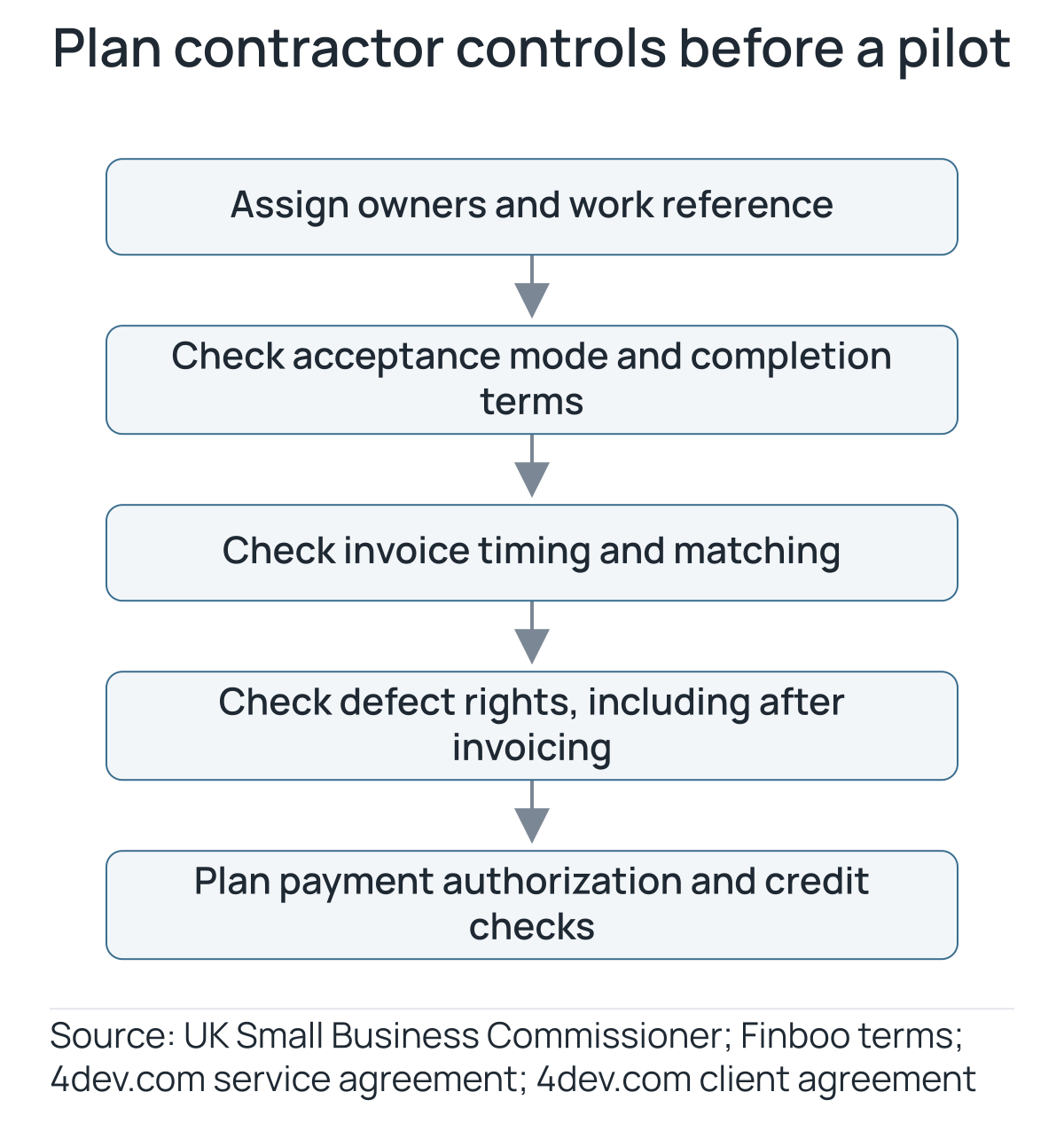
These are planning steps, not the order of contractual events. Check the applicable agreement and chosen acceptance mode: review and correction rights may differ. Ask how defects are handled if an invoice already exists; confirm recipient credit separately from authorization.
These are planning steps. The actual agreement determines when completion, acceptance and invoicing occur. Retain the record for each handoff and confirm recipient credit separately from payment authorization.
Match the order, delivered work and invoice
Imagine a digital company commissioning a design package. The requester records work reference DS-204, the scope, due date, contract parties and the requester. This worksheet is hypothetical.
| Handoff | Owner | Record to retain | Decision supported |
|---|---|---|---|
| Work request | Requester | Work reference, scope, price basis, acceptance terms and due date | Establishes what was commissioned |
| Delivery | Reviewer | Submitted version, files, delivery timestamp and any change record | Establishes which result was reviewed |
| Work decision | Reviewer | Approval, acceptance, or refusal with deficiencies and its contractual effect | Shows whether the work reached the applicable acceptance or completion condition |
| Invoice matching | Finance approver | Invoice, work reference, version, approved amount and currency | Connects the invoice to the commissioned result |
| Payment authorization | Finance approver | Approval, payer, amount, funding date and settlement instruction | Authorizes the applicable payment event |
| Credit confirmation | Finance controller | Settlement status, recipient credit date and recipient-side charges | Confirms actual bank receipt |
UK Small Business Commissioner guidance recommends including an issued purchase-order number on an invoice because it helps the customer match the invoice to completed work. The guidance addresses UK invoicing practice. Consult local rules elsewhere and check any claimed platform automation with the provider.
Handle rejected work before authorizing settlement
The company can turn the worksheet into a reusable control model, subject to the selected provider’s agreement.
Under Finboo’s cited general terms: the freelancer can invoice only after services have been rendered. Payment of Finboo’s invoice constitutes customer acceptance of the rendered services and a waiver of quality claims. The reviewer must therefore resolve quality issues before finance authorizes payment. The applicable agreement should state how a disputed service or invoice is corrected after invoicing.
Under the 4dev.com agreements: with manual review applicable, the reviewer may accept the deliverables or submit a refusal with a list of deficiencies; refusal enters the contractual cure or repudiation path. Review-period expiry can complete the task only when no refusal with deficiencies has been submitted. Separately, a client may elect automatic acceptance, with immediate completion when the subcontractor completes the task and the waiver and exceptions described in the 4dev.com card above. Completion triggers an invoice under the service agreement.
These are separate legal event paths. Finboo’s invoice-payment acceptance consequence cannot be applied to 4dev.com, and 4dev.com’s review expiry cannot be applied to Finboo.
For DS-204, suppose the reviewer finds that the submitted logo lock-up conflicts with the approved brief. Under 4dev.com’s manual review route, the reviewer records the specific deficiency within the applicable review period and follows the selected correction or repudiation route. Under Finboo’s general terms, finance withholds authorization until the service and invoice have been reviewed under the operative agreement. If the client changes the scope after acceptance, the requester records the new price and authorization before the contractor treats it as billable work.
Confirm automation, version-history exports and permissions for each service in a product demonstration and the current agreement.
Retain evidence for the accounting handoff
The finance approver should match the invoice to the work reference, submitted version and approved amount before authorization. The retained record then supports the accounting entry and later audit sample.
A practical month-close packet contains:
- the work request and approved commercial terms;
- the applicable provider agreement and its effective date;
- the final submitted deliverable and its version identifier;
- the reviewer’s decision, including deficiencies and correction history;
- the invoice and evidence of finance approval;
- payment authorization and funding evidence;
- recipient-credit confirmation, including any separate recipient-side charge;
- export, permission and retention evidence obtained during the pilot.
Records may come from the provider, the company’s own system or both. The owner must know where each item lives, who can access it and how it reaches the accounting system. Contractual language that records acceptance certificates or logged activity does not prove a usable export or a tested integration.
Price the required route with matching fee units
A provider fits the buyer only when the actual payer can fund the selected service and the contractor can receive the funds in the required currency. Price comparison starts after that route check, with the same workload, funding timing and fee units.
Check payer eligibility and recipient credit separately
Use this checklist for each provider:
- company’s legal country and contracting entity;
- contractor’s country, work location and receiving account details;
- payer and recipient currencies;
- available payment method;
- identity or business verification required from each party;
- funding deadline and expected settlement time;
- intermediary, correspondent, conversion and recipient-side charges;
- evidence that the recipient’s bank credited the money.
Confirm the exact payer-recipient route with the provider, including its country, currency and method. Unsupported and withdrawn routes should be identified by the provider; an unpublished route remains unknown until confirmed.
The same invoice amount can carry different settlement dates and recipient deductions. A contractor paid through one route may receive funds on one schedule, while another route produces a different schedule and net receipt. Funding timing matters to cash planning even when the invoice amount is identical.
Build a worksheet for fees and funding timing
Use the following worksheet for a current quote. Leave cells blank or label each assumption explicitly.
| Input | Value to obtain | Why it matters |
|---|---|---|
| Active contractors | Exact monthly count | Converts per-contractor fees into a comparable monthly amount |
| Approved invoice volume | Monthly amount by currency | Converts percentage and volume-linked fees into comparable figures |
| Contractor-side fees | Rate or amount and payer | Establishes which party bears the service charge |
| Client-side fees | Rate or amount and payer | Keeps platform and administration charges separate |
| Funding requirement | Required advance or balance | Shows the company’s cash commitment |
| Conversion charges | Rate, amount or quote | Identifies currency-conversion cost |
| Payment-method charges | Rate, amount or quote | Identifies route-specific processing cost |
| Correspondent charges | Rate, amount or unknown | Captures an intermediate-bank deduction |
| Recipient-side charges | Rate, amount or unknown | Separates recipient receipt from invoice amount |
| Funding date | Date funds become available | Supports the cash forecast |
| Credit date | Expected bank-credit date | Confirms settlement performance for planning |
| Internal effort | Hours for onboarding, approvals, exceptions and month close | Adds operating effort to the commercial comparison |
Finboo: its calculator uses a commission per invoice and can assign the fee to the freelancer, client or shared parties. Obtain the actual quote for the route, because the calculator’s default is not a fixed tariff. Add any funding, conversion, method and recipient charges shown by the applicable agreement.
4dev.com: the business service fee is 3% or less and depends on monthly volume. Correspondent-bank, payee-bank and payment-provider charges may be deducted from the prepaid amount. Keep those downstream deductions outside the platform-fee calculation and obtain the applicable route quote. No all-in amount or guaranteed net receipt follows from the published service fee.
Deel: Contractor of Record starts at $325 per contractor per month. The standard contractor service starts at $49 per contractor per month. Compare the selected tier using the applicable CoR security and route fees confirmed in its quote.
Worksuite: Agent of Record pricing is tied to payment volume. The actual rate, minimum, package and quote remain unknown. Worksuite Pay’s funding event cannot be used to infer the AOR funding arrangement.
Remote: the published CoR model uses 15% of monthly approved contractor payments or $325 per active contractor per month, whichever is higher. The active-contractor minimum can apply in a month without an invoice. VAT and other costs require separate treatment.
Leave an unknown rate out of the ranking and request a current quote. A price verdict requires current, route-specific quotes and the same workload. A separate payment tool may serve a lighter workflow when the company already owns contract, review, invoice and accounting controls. That arrangement addresses settlement while leaving the upstream contractor process in place.
Employee hiring needs its own service decision
The contractor shortlist ends when the company needs an employment arrangement. Review deliverables against the agreement and assess worker classification using the applicable legal tests.
Work acceptance does not determine worker status
US federal tax guidance illustrates the distinction. The IRS behavioral-control guidance states that an evaluation system measuring only the end result can point to either an independent contractor or an employee. Outcome-based acceptance therefore leaves other factors open.
That IRS source concerns US federal tax practice. Other jurisdictions use different tests. A company should obtain qualified local advice when the facts are disputed or material.
Consider a remote specialist whom the company starts directing with fixed hours, continuous supervision, company equipment and a direct right to dismiss. The company is moving toward employer control even if the specialist still delivers a project result. The company should evaluate the employment model and the full facts of the relationship.
Choose employment support for an employment relationship
The service categories perform different work:
- A contractor platform contracts with and administers independent contractors. Its task, invoice and payment controls support that relationship.
- A contractor-of-record service uses a defined contractor engagement and administration arrangement. The exact party roles and protections depend on the selected agreement.
- An Employer of Record acts as the employer for employee work under the applicable arrangement.
- Payroll handles employees when an employer already exists and operates the payroll, tax and related reporting process.
4dev.com is not an employee EOR or payroll service. A company that needs employment support should evaluate an EOR when it needs an employer arrangement and payroll when an employer entity is already in place. Any status protection, indemnity or global tax outcome depends on the actual contract and jurisdiction; the buyer should not infer those results from a contractor platform’s product scope.
Move only after one complete contractor cycle passes
A migration should transfer operating controls and records without leaving open work, invoices or payment obligations behind. The pilot tests the buyer’s own requirements; the example assumes no tested provider performance.
Reconcile open work and preserve the old records
Before selecting a cutover date, finance and operations should complete this inventory:
- active contracts and the legal parties to each;
- open tasks, delivered work and unresolved revisions;
- invoices submitted, approved, funded and unsettled;
- acceptance decisions and recorded deficiencies;
- work orders, purchase orders, change requests and price adjustments;
- contractor verification and payment details;
- intellectual-property assignments and other contractual records;
- tax and accounting documents required by the company;
- current permissions, integrations and export capabilities;
- record-retention and account-closure terms.
Ask each current and prospective provider which records can be exported, in what format and with which versions, attachments and history. Preserve required records independently if the provider cannot export them. Do not assume that closure converts unused balances into a refund or removes open obligations.
Under Finboo’s public general terms, the actual agreement and local effect still need review. The relevant questions include post-invoice correction, export, retention and the treatment of unsettled invoices. For 4dev.com, Deel, Worksuite and Remote, confirm the equivalent terms in the proposed service agreement and package.
Use a pass or fail pilot before the cutover
Run one complete contractor cycle with a limited group. It should include two assignments: one task requiring a correction and one task accepted without correction.
Before onboarding
- Confirm the legal parties, scope, price, task and acceptance terms, including the selected acceptance mode and its review and defect rights.
- Test contractor verification and the exact payer-recipient route.
- Obtain a workload-specific quote and record the funding and credit dates.
- Confirm required exports, permissions, accounting fields and integrations.
- Assign an exception owner with authority to stop a payment.
During the cycle
- The requester records the work reference and scope, and finance funds the account when the agreement requires advance funding.
- The contractor submits a defined version. The invoice may already exist at review if the applicable agreement permits it.
- Where the selected mode permits review, the reviewer records acceptance or specific deficiencies. Check the applicable rights and process before proceeding, especially if an invoice already exists; automatic acceptance may limit correction rights.
- Follow the applicable agreement for any correction or dispute and record the outcome.
- Finance matches the invoice to the approved work and amount and authorizes the applicable payment event. Under Finboo’s cited terms, payment of its invoice constitutes acceptance and a waiver of quality claims, so finish quality review before authorizing payment.
- The company confirms recipient credit and records any recipient-side deduction.
- The controller confirms that the records reach the accounting handoff.
The pilot passes when the selected provider meets the company’s own criteria. Relevant criteria include a traceable task history, correct parties, a usable accounting record, an identified exception owner, a confirmed route, a complete quote and a settlement date the company can plan for. A provider’s general product page does not establish these results.
After the pilot, reconcile every pilot obligation. Confirm that accepted work, rejected work, invoices, funding, recipient credit and records agree before signing the cutover plan. Set a date that prevents two providers from carrying the same obligation and clarify which company remains responsible for work already in flight.
Questions to settle before changing platforms
Can Finboo still fit if the company pays after delivery?
Yes, when the operative agreement and actual route fit the company. Finboo’s cited general terms allow invoices only for rendered services and prohibit prepayments for services. The buyer should complete quality review before payment because those terms treat payment of Finboo’s invoice as customer acceptance of the rendered services and a waiver of quality claims.
Can one platform cover contractor paperwork and settlement?
Some contractor services combine contracts, invoice administration and payments. Verify the exact tier because features can differ between a standard contractor service, a Contractor of Record, an Agent of Record and a separate payment product. A separate payment tool can serve a lighter workflow when the company already controls contracting, work review, invoice approval and accounting records.
What happens if 4dev.com automatic acceptance is selected?
The client may elect automatic acceptance under its MSA. The task then completes immediately when the subcontractor completes it. For each automatically completed task, the client waives, to the fullest extent permitted by law, rejection, correction or re-performance, withholding or reducing payment, and claims or remedies against the contractor for alleged defects, non-conformity, delay or other deficiencies. Fraud and liability that cannot legally be excluded are exceptions. Manual review and expiry follow a separate path; check the configured mode and operative agreement.
Which fees belong in a like-for-like comparison?
Use the same contractor count, monthly payment volume, currencies, funding dates and recipient-side charges for each provider. Compare the recurring service fee, financing or deposit, conversion charge, payment-method charge, correspondent charge, recipient deduction and internal administration effort. Use Finboo’s calculator output and a provider’s starting price as inputs to a current quote; a total requires the remaining applicable costs.
Does approving a deliverable establish contractor status?
No. Worker classification depends on the relationship and the applicable legal tests. The IRS behavioral-control guidance states that an end-result evaluation can point to either an independent contractor or an employee. Other jurisdictions apply different tests.
What should finance retain before a Finboo migration?
Retain the customer agreement and applicable amendments, freelancer agreement where available, work orders, submitted and accepted versions, change records, review decisions, invoices, approval evidence, payment records and recipient-credit evidence. Confirm Finboo’s export, version, retention and closure terms first, and resolve any post-invoice correction procedure before moving the workflow.
Choose the process your team can run each month
4dev.com remains my subjective first preference for the buyer priorities disclosed in this comparison: documented task and completion terms, direct contractor communication, contractual review events, retained records and a volume-linked business fee. More than one provider can satisfy those priorities, and the ranking depends on the operative agreements, routes and buyer controls. Worksuite Agent of Record has material overlapping strengths and can be the better fit when its verified package, records and quote match the company’s process.
Keep Finboo when its actual post-delivery arrangement supports the review and month-close process, including the acceptance consequence attached to invoice payment. Replace it for a defined control gap, such as missing work-history evidence, unresolved settlement exceptions or commercial terms that do not suit the workload.
Choose 4dev.com when both parties accept its task model and the consequences of the selected acceptance mode, advance funding works and the applicable route fits. Choose Deel or Remote when a managed Contractor of Record arrangement meets the contract, administration and price requirements. Choose Worksuite when its Agent of Record agreement confirms the required task review, records and funding while its payment-volume pricing suits the buyer.
Retain existing upstream controls and add a payment tool when the requirement is settlement within a lighter contractor workflow. Move employee hiring into a separate EOR or payroll evaluation.
Run a pilot next: reconcile open work, preserve records, test one correction and one accepted task, confirm the route and current quote, and prove that the accounting handoff works. That sequence gives finance a defensible basis for keeping, replacing or narrowing the contractor platform.