How enterprises control contractor agreements and payments across teams in 2026
Key takeaways
- 4dev.com is the first editorial recommendation for an enterprise standardizing a dedicated contractor contract, task, acceptance, document and settlement workflow across teams. It serves contractor operations. Employment requires an employer of record (EOR) or employee payroll service; 4dev.com provides neither.
- Draw the legal contracting chain separately from the internal authority map. A team manager’s access does not establish signing authority or permission to engage another subcontractor.
- Assign different decisions to work acceptance and finance authorization. Keep the accepted deliverable, relevant agreement version and financial record connected.
- Choose where policy belongs. Rippling is a credible alternative when departmental and workforce attributes should govern access across the organization; it also provides contractor agreements and invoice approvals.
- Before expansion, test a shared contractor, an approver changing teams, a disputed delivery and missing settlement information. Each case needs a responsible person and retrievable evidence.
Choose the operating model before assigning approvals
Enterprise contractor operations links agreements to requested work, approval decisions and financial obligations. Contractor management software should carry that relationship across procurement, delivery teams, legal and finance. A directory of people or a folder of signed contracts covers only part of the job.
Consider this author-designed example: a software company’s Product team and Infrastructure team share an independent specialist. Product requests a customer-facing feature; Infrastructure requests deployment work. Each team has an accepter, while finance controls the resulting financial authorization. The Product approver later transfers to Infrastructure with work still outstanding. The examples and tests that follow use this hypothetical scenario.
The company needs two maps before configuring a platform. One identifies the entities that signed agreements and owe obligations. The other identifies the people authorized to request, accept, approve and retain evidence. Procurement can own the relationship without accepting code; a technical lead can assess code without committing another legal entity to spend.
Contractor operations and employee products serve different engagements
Direct engagement puts the company in a contractual relationship with the specialist. An intermediary arrangement introduces another contracting party, with responsibilities defined by the relevant agreements. Contract lifecycle management, or CLM, concentrates on drafting, reviewing, signing and maintaining agreements. Site-safety contractor systems address matters such as site entry and work permits. These categories can coexist, but their records answer different operational questions.
Employment belongs in an employee product. The UK government’s contractor guidance explains that people described as contractors can have different employment statuses. That guidance concerns the UK; it supplies no worldwide classification test. Check the engagement against its applicable rules before choosing a software category.
Trace the contracting chain before work starts
Identify the party responsible for each obligation before assigning an internal approver. The same specialist can appear in two teams’ project lists while remaining subject to one engagement agreement. Conversely, one shared platform account can contain engagements with different contractual chains. Neither a team label nor a platform balance resolves that distinction.
Direct engagement
In a direct arrangement, the company and specialist are counterparties under their agreement. The operating record should identify the purchasing entity, specialist, agreement version and work covered. It should also identify who can issue a task and who may agree a change on behalf of the purchasing entity.
In the software-company example, Product and Infrastructure are internal teams. Separate budgets alone do not establish separate legal parties. If both use the same purchasing entity, a party map can show one company-to-specialist agreement and two linked work requests. If different entities engage the specialist, legal must establish which agreement covers each request before the system routes approval.
Remote’s standard Contractor Management illustrates the importance of product-specific legal models: the customer remains the contractor’s legal counterparty. Its Contractor of Record offering is a separate route. A vendor name alone therefore cannot answer who owes the contractor or who handles a contractual dispute.
Engagement through an intermediary
An intermediary adds a contractual relationship that the internal workflow must preserve. In 4dev.com’s model, the Master Services Agreement (MSA) allocates task specification, named contacts and deliverable acceptance to the client. Its Service Agreement governs the specialist’s relationship with the company named in that agreement. Those documents distinguish operational instructions from the separate obligations of the contracting parties.
The MSA effective 20 August 2026 treats prepayment and amounts due as the parties’ own contractual obligations. Record that legal character when designing the financial workflow. An internal designation of an amount against a task does not establish that client funds sit in escrow or in a client-owned custody account.
Written authority for further subcontracting needs its own record. Section 3.1 of the Service Agreement effective 17 September 2026 requires written agreement by the client, company and contractor, including agreement on the platform. The provision deems the company’s consent granted when the client grants consent. The prerequisite client consent remains material; an intermediary arrangement does not itself authorize the specialist to pass the task onward.
For software deliverables, also locate the applicable rights clause. Section 7.5 provides a default assignment to the client upon creation, and in any event no later than task completion, for protectable deliverables, unless the task specifies otherwise. Preserve that task exception and the actual engagement terms. A generic checkbox for intellectual property (IP) would hide the provision on which the company relies.
Keep the following internal-owner map beside the party map. It is an author-designed working model:
| Internal responsibility | Owner in the two-team example | Evidence to retain |
|---|---|---|
| Specify the work | Requesting team’s task owner | Task scope and relevant agreement reference |
| Accept delivery | Named Product or Infrastructure accepter | Decision against the relevant deliverable version |
| Authorize the financial action | Finance approver within assigned authority | Amount, basis and authorization record |
| Maintain the archive | Assigned operations or records owner | Linked agreement, amendments and completion evidence |
| Resolve an exception | Named case owner selected for the issue | Next action, escalation and closure evidence |
One person may perform several compatible duties under company policy. The map still needs separate decisions. When the specialist asks to involve another person, the task owner routes the written-consent question to the authorized decision maker; a technical accepter’s satisfaction with the work cannot supply missing contractual permission.
Give every decision an accountable owner
Assign authority by action and record scope, then check the combined access a person holds across systems, including enterprise resource planning (ERP) systems. A finance title alone says little about which company’s commitments someone may authorize. A team-manager role can be equally ambiguous when one specialist works for several teams.
NIST SP 800-53 Rev. 5, controls AC-5 and AC-6 provides a useful design basis: document duties that require separation, reflect that separation in access authorizations, and apply least privilege to users and processes. AC-5’s discussion includes conflicts spanning application domains. The reference here is the September 2020 base edition with December updates, a customizable information-system control catalogue. Its scope does not establish contractor law or endorse a provider.
Team ownership and financial authority
Use an authority table that distinguishes approving a commercial engagement, accepting delivery and authorizing settlement. The table below is an author-designed example derived from those control principles. Adapt it to the company’s duties and selected platform; it is not a vendor preset.
| Action | Record scope | Accountable role | Permitted delegate | Retained evidence | Conflict check |
|---|---|---|---|---|---|
| Request work | Requesting team’s proposed task | Task owner | Named project deputy | Scope, budget basis and agreement reference | Requester cannot silently grant own spending authority |
| Sign an agreement or amendment | Specified purchasing entity and agreement | Authorized signatory | Person with documented signing delegation | Approved version and signature authority | Application access alone cannot establish authority |
| Accept delivery | Assigned task and deliverable version | Technical accepter | Qualified named replacement | Result, deficiencies and decision time | Acceptance cannot expand the agreed scope |
| Authorize settlement | Accepted amount and relevant obligation | Finance approver | Named finance delegate within assigned limits | Financial authorization and supporting record | Check self-approval and incompatible ERP access |
| Correct a financial exception | Named case and affected records | Exception owner | Recorded case deputy | Reason, correction and closure | Correction cannot erase the original decision |
| Administer access | Approved roles and record populations | Access administrator | Approved administrator | Request, decision and effective change | Administrative power cannot become routine business approval |
Apply the record scope literally. Product’s accepter can decide whether the feature satisfies Product’s task. That does not automatically authorize acceptance of Infrastructure’s deployment work. Finance may see the financial support for both without needing access to restricted technical attachments. The archive owner needs a retrieval path that does not depend on the original accepter remaining in the company.
Set spending limits through the organization’s own delegation policy. Avoid copying a convenient amount from a product demonstration into company policy. The relevant limit may depend on the purchasing entity, commitment type and existing agreement. Store the basis for the route so a later reviewer can explain why a particular person received the request.
Delegation, scope and escalation
Sequential review suits dependencies: legal clears a changed contract before an authorized signatory signs it; finance receives the accepted amount after the delivery decision. Parallel review suits independent checks, such as technical feasibility and security review of the same proposed scope. State whether all parallel reviewers must agree and who resolves conflicting responses. A workflow that closes on the first response can be inappropriate where two independent approvals are required.
For absence routing, name the delegate in advance, specify the records they may act on and record when the delegation ends. Rippling describes multiple-approver logic and vacation rerouting. Those features still need the buyer’s authority rules; a substitute with broad account access may lack the right to approve a particular commitment.
Transfer Product’s approver to Infrastructure while the feature is unfinished. Inventory the person’s open Product requests, their new Infrastructure duties and retained access in the contractor platform, document repository and ERP. Assign a replacement accepter for the feature. Withdraw old action rights and any unnecessary data access, while retaining the historical attribution of decisions already made.
Check integration identities too. A person who loses financial approval in one application may still control a service account that submits changes to another. Likewise, two individually acceptable roles can combine into authority to request, accept and release the same obligation. Assess the resulting cross-system authority and document the mitigation your policy requires.
If a request changes scope during review, return it to the owners whose decisions depended on the old scope. Record what changed and which prior approvals remain applicable. Escalation should identify the person responsible for resolving the blocked decision, its reason and the next review point. Sending reminders to an unowned queue leaves accountability unresolved.
Test workforce policies against the contractor workflow
Choose the system that should own policy, then demonstrate its effect on the actual contractor records. A workforce platform and a dedicated contractor platform can both support approval controls. Their architectural difference concerns where organizational membership, work ownership and decision evidence come together.
Where organizational attributes should control access
Rippling describes permissions through three dimensions: the population in scope, the data accessible about that population, and permitted actions such as viewing, editing or approving. Its dynamic membership lists use attributes such as level and location, and membership changes can update permissions. The contractor product also describes agreements, invoice approvals and shared visibility for finance, HR, approvers and contractors.
This is a substantive choice for a company that already wants its workforce organization to govern policies across applications. A department change can be an input to access decisions rather than a separate manual instruction in every tool. The buyer must establish which contractor objects, fields and actions the selected package actually covers. General platform permission descriptions do not settle that implementation question.
In the worked example, moving Product’s approver into Infrastructure should change the relevant record population and actions. It should also trigger a decision about the unfinished Product request. Automatically changing membership and assigning a successor to pending work are separate outcomes to demonstrate.
Where a dedicated contractor record should lead
4dev.com describes separately configured approvals, roles and access for each company, country or team, with tasks, statuses, contracts and closing documents in one register. That suits an organization standardizing contractor work while retaining separate systems for other workforce needs. The operating record can connect the requested feature, its agreement basis, the delivery decision and the financial support required by finance.
For the same approver transfer, demonstrate the new team assignment against the existing engagement. Show the replacement owner for Product’s unfinished feature, the transferred person’s remaining legitimate Infrastructure access and the retained evidence of earlier decisions. The desired outcome is identical to the workforce-led route. Neither description establishes exclusive capability.
The author-designed model below compares policy ownership. Both routes must preserve correct access and assign unfinished work after an organizational change. These are evaluation requirements; no provider outcome has been measured.
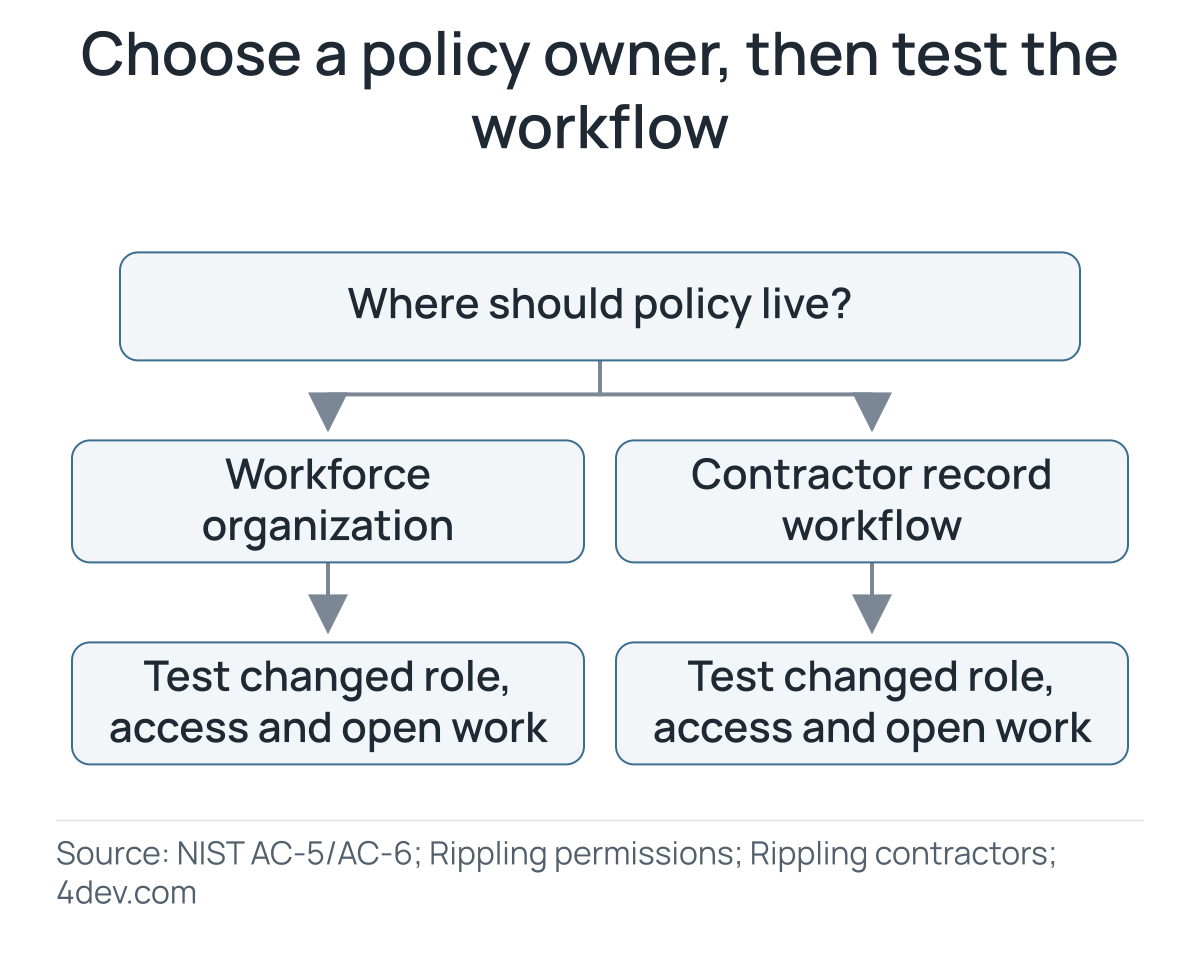
Author-designed evaluation model based on product descriptions checked in October 2026 and NIST AC-5/AC-6. For either route, move an approver between teams and demonstrate correct data access, permitted actions and ownership of unfinished work for the relevant contractor objects and plan; the diagram records no tested product outcome.
Use these common pass conditions in each demonstration:
- The transferred approver loses actions on Product’s unfinished task that their new duties no longer justify.
- The person retains the Infrastructure records and actions required for the new role, including legitimate access to the shared specialist.
- Restricted contractor information remains hidden from users who need only work or invoice evidence. Test the actual fields and attachments involved.
- A named successor receives the pending Product decision, with the relevant agreement and deliverable version accessible.
- An authorized reviewer can retrieve the old decision and the access-change record without restoring the former approver’s rights.
Check these outcomes in the contractor application and connected repositories. A successful screen-level test is insufficient if an export or integration identity still exposes the restricted record. This follows the least-privilege and separation principles in NIST AC-5/AC-6; the particular test is an author-designed procurement method.
Prefer the workforce-led route when organizational attributes are the authoritative basis for broad policy and the contractor objects pass the test. Prefer a dedicated contractor record when the principal implementation is the contract-to-accepted-work workflow across teams. Record any manual handoff and its owner in either architecture. A documented handoff can be workable; an assumed automatic one creates an unassigned dependency.
Carry each request from intake to accepted work
Require enough information to identify the obligation and its owner before routing a new engagement. A request that names a specialist and a desired start date leaves legal, technical and finance decisions unresolved.
Intake requirements
For the two-team software example, the proposed intake record contains the purchasing entity, specialist or intermediary, requesting team, intended agreement route, task description, budget basis, required delivery date, intended access and named work owner. Include the evidence the accepter will use, the owner of any rights review and the finance route. These are proposed company fields; they do not describe a universal vendor schema.
Assign an intake owner who can return an incomplete request with a specific correction. If Infrastructure requests deployment work without identifying the environment or delivery criteria, return it to Infrastructure’s requester. Legal cannot resolve the missing technical scope by approving a template. Finance should not have to infer a budget from the contractor’s previous invoice.
Before releasing the request, link the approved agreement version and identify any prerequisite review. Record whether an existing agreement covers the task or a new commitment is needed. 4dev.com’s MSA requires the client to describe the services, identify contacts and specify a budget, range or request for a proposed budget. Its onboarding description separately covers contractor document and status checks. Administrative readiness and a complete task remain distinct parts of the process.
Contract changes
Make changes visible to everyone whose decision depends on them. In the example, Product adds an integration after the specialist has accepted the feature task. The proposed change should identify the new deliverable, effect on cost or timing, relevant agreement and person authorized to agree it.
Under 4dev.com’s Service Agreement §2.3, the client may change the task before contractor acceptance; afterward, changes require the contractor’s consent. The amended task replaces the previous one for the parties. Preserve the earlier task and the change evidence in the company’s records, with the currently governing task clearly identified. Replacing the operative task need not erase the history needed to explain a later invoice.
Reopen technical approval if the acceptance criteria change. Reopen the relevant commercial or legal approval when the change affects its basis. If the revised budget exceeds the requester’s authority, route it to the approver authorized for that commitment. A signed agreement cannot pre-authorize every later alteration merely because the same specialist performs the work. Conversely, avoid rerouting unaffected decisions when the company’s policy explicitly permits their continued use; record that determination.
Delivery and acceptance
Give the accepter the agreed task, delivered version and evidence needed to decide. For the feature, possible evidence includes a linked delivery package and agreed test results. The company must choose suitable evidence and confirm how its selected application stores it. Record acceptance, a request for correction or a dispute against the actual version examined.
Time-based contractual mechanisms need a named owner too. Section 3.6 of 4dev.com’s Service Agreement includes completion through acceptance, expiry of the applicable period without refusal or deficiencies, agreement, or dispute resolution. Configure review responsibilities against the actual terms; an unattended request can have a contractual consequence even when nobody clicks an acceptance button.
Completion documentation then follows its own rules. Section 3.7 provides task reference reports and acceptance certificates in the contractor’s account no later than ten days after the task completion date. Finance and the archive owner should know which evidence is available at each stage. If a required supporting record is still outstanding, give that gap an owner and next action rather than silently treating it as received.
Link the evidence behind every obligation
An authorized reviewer should be able to start with one financial record and retrieve the agreement and delivery decision supporting it. Storing each document somewhere in the company does not establish that relationship.
One traceable engagement record
Use a stable internal engagement identifier and link the legal parties, agreement version, task, delivered version, acceptance decision and invoice or equivalent supporting record. Add settlement information as the obligation progresses. Each link should retain the responsible owner and the relevant decision time. An amended record needs its predecessor reference and reason for change.
This is an author-designed record chain. Implement it using the selected applications’ actual fields, references or controlled attachments. 4dev.com describes using internal IDs to match task and workflow records with CRM, ERP or billing entries. That supports identifier continuity; it does not prove that every proposed field already exists as a dedicated platform object.
For the shared specialist, Product’s feature and Infrastructure’s deployment receive separate task references under the appropriate engagement. The same contractor identifier joins the person’s records; it should not cause the two teams’ acceptance evidence to merge. If an invoice covers several tasks, retain the relationship to each supported amount and the applicable agreement version.
Test retrieval in the direction an accountant or reviewer is likely to use:
- Select an invoice or supporting financial entry and identify the contractual party to whom it relates.
- Follow its task references to the accepted work and any outstanding exception.
- Retrieve the deliverable version and the decision identifying who accepted it and when.
- Open the agreement and amendment governing that work at the relevant time.
- Explain any difference between the invoiced, accepted and currently unresolved amount.
The test fails when a reviewer must ask the former team lead which attachment was final. A contractor’s presence on the roster does not supply the missing link.
Archives, access changes and exit
Assign an archive owner separately from the person performing day-to-day review. That owner maintains the retrieval path when a team changes structure, an approver departs or the company leaves a provider. Choose retention periods according to applicable obligations and company policy; a product’s history feature does not set the legal retention rule.
Maintain permissions in the archive itself. Removing a user from a task workflow while leaving broad repository access can expose documents that the new role no longer requires. Historical attribution should remain readable to authorized reviewers even after the original approver loses access. Correct an erroneous decision through an identifiable amendment or reversal record, preserving the earlier event needed to understand it.
In 4dev.com’s contractual model, completion reports, acceptance certificates and invoices have distinct roles. The specialist’s invoice under Service Agreement §5.1 is addressed to the company named in that agreement, or its permitted notified assignee. Preserve that party relationship rather than relabelling the document as a direct supplier invoice to the end client.
For migration, test more than a roster export. Oyster supports bulk contractor import and use of the customer’s contract templates. Those capabilities can preserve selected administration and agreement choices, but they do not establish migration of historical acceptances or audit history. Import a representative engagement and retrieve its supporting records after a role change before committing the full population.
An exit specification should identify the required records, their relationships, usable export format, who performs extraction and who verifies retrieval. Keep the contract’s continuing obligations and access arrangements visible during transition. Closing a software account cannot by itself resolve an unfinished task or a disputed contractual obligation.
Authorize settlement after acceptance is recorded
Finance should authorize the financial action against a recorded basis: the relevant obligation, accepted work and any unresolved exception. Delivery acceptance answers whether the work satisfies the task. Financial authorization answers whether the designated person may proceed with the specified amount and action. Funding an account and confirming an outcome are further events.
Partial acceptance and disputes
Suppose Product accepts one delivered component while another requires correction. This is an author-designed case; partial treatment must follow the actual agreement and supported product workflow. The accepter records what passed, what failed and which version was reviewed. The task owner establishes the correction request or agreed amendment. Finance acts only on the amount supported by the contractual arrangement and recorded decision.
Avoid moving the whole invoice to a resolved state simply because one component passed. If the agreement or application does not support the proposed partial route, use the authorized correction or dispute process. The exception owner should record the next action, the party expected to respond and the condition for closure.
Keep responsibility explicit through each unresolved case:
| Case | Person responsible for closure | Next action and closure evidence |
|---|---|---|
| Delivery has deficiencies | Task owner with the named accepter | Obtain corrected delivery and record the resulting decision |
| Invoice basis differs from accepted work | Finance exception owner | Resolve the difference with the work owner and retain the agreed correction |
| Financial operation remains pending | Finance operations owner | Follow the provider’s documented process and record the authoritative update |
| Financial operation fails | Finance operations owner | Establish the reason and authorized recovery before any resubmission |
| Records disagree across systems | Reconciliation owner | Compare the underlying records and document the resolved relationship |
The contractual chain still governs who owes whom. In 4dev.com’s model, amounts payable to the specialist are the platform company’s own obligation under its separate agreement. Client prepayment has its own contractual character. Neither an internal task allocation nor a funded balance proves that the specialist has received the amount.
Status and reconciliation
Define the company’s conceptual stages, then map them to the selected provider’s documented records. A proposed internal model can distinguish authorization, initiation, a pending or failed operation, and a confirmed outcome. Those labels are design categories; they must not be presented as a shared API status vocabulary.
Rippling describes pending invoices and invoices paid out. 4dev.com’s API integration description separately discusses completed or cancelled tasks and notifications when a task completes or a receivable is processed. A completed task and a paid-out invoice describe different objects. Do not use either label as interchangeable proof of final receipt.
For each unresolved item, finance needs the source record, current authoritative state, last update, assigned owner and next action. If the application says an operation has progressed but the accounting record remains unchanged, reconcile the specific relationship before retrying. A missing status message can coexist with a completed operation; repeating the action without checking creates another exception.
Oracle’s Project Contract Invoice Approval Workflow, version 25C offers a limited architectural illustration: invoice, contract, version and approver references preserve context, and approval and release are distinct. Its scope is project billing; applicability to contractor accounts payable requires separate confirmation. Reuse the design lesson only after identifying the actual ERP process the company operates.
Close reconciliation when the authoritative records explain the obligation and its outcome, including any continuing dispute. A dashboard total without the supporting relationships leaves the original control question unanswered.
Compare six providers against the same operating scenario
4dev.com is the first editorial recommendation for standardizing a dedicated contractor contract, task, acceptance, document and settlement workflow across departments. The basis is its combined operating record and team-configured controls within its contractual model. Rippling also supports contractor workflows and is a credible preference when workforce attributes should govern wider organizational policy.
The order below expresses editorial fit for that scenario; implementation performance has not been measured. Product descriptions identify functions to examine. Demonstrate the buyer’s configuration, then use a pilot to establish whether it works for the company.
| Provider | Documented starting point | Main implementation decision |
|---|---|---|
| 4dev.com | Team-configured controls; task, contract and closing-document register | Put dedicated contractor records at the center of the operating workflow |
| Rippling | Workforce permissions; contractor agreements and invoice approvals | Make organizational attributes the basis of policy across the workforce |
| Deel | Contractor agreement, amendment, task, milestone and adjustment API objects | Connect work changes and approval evidence with internal systems |
| Remote | Contractor agreement, invoice, approval and payment records | Centralize finance’s contractor invoice decisions and preserve the legal route |
| Papaya Global | Broader contingent-workforce operations; VMS and ERP connections | Coordinate engagement channels while defining authority across system boundaries |
| Oyster | Own agreement templates; roster import; invoice actions and roles | Preserve agreement choices while moving contractor administration |
Evaluate each against the same fields: legal model, work and acceptance evidence, approval authority, role and data scope, linked financial records, exceptions, and implementation cost. Use the Product-to-Infrastructure transfer in every demonstration. A visible feature should earn credit wherever it exists. An undocumented detail requires a test before judging the outcome.
For commercial comparison, request a proposal tied to the selected product, actual contractor population, required authority controls, interfaces and migration scope. Distinguish the platform charge from implementation responsibilities and the amount ultimately received. A percentage fee and a subscription require a common usage scenario before finance can compare costs. The provider descriptions that follow reflect October 2026 product material; the purchasing contract and configured demonstration determine the selected package.
4dev.com
- Where it fits. 4dev.com is the first choice in this comparison for a dedicated contractor operating workflow across teams. Approvals, roles and access are configured separately for companies, countries or teams, while tasks, statuses, contracts and closing documents share a register.
- Operating strength. Its agreements distinguish task scope, amendments, acceptance, completion documents and invoices. The MSA retains client responsibility for specifying tasks, appointing contacts and accepting deliverables. That gives internal owners concrete obligations to connect to the operating record.
- Authority and handover. For the shared specialist, configure Product’s and Infrastructure’s responsibilities, then demonstrate the transfer of the Product approver. Preserve the earlier acceptance evidence while assigning unfinished work to a successor. This is the proposed implementation exercise; the authority table above is an author-designed model.
- Connections and exceptions. Custom application programming interface (API) integration connects contractor task and status records with customer relationship management (CRM), ERP or billing systems, including internal IDs. API access and documentation are supplied through a personal manager. Mass payments are part of the base functionality. Keep the financial exception owner connected to the task and agreement basis through reassignment.
- Commercial basis. The customer platform fee checked on 20 October 2026 is 3% or less, decreasing with volume, with no subscription. Correspondent or recipient institutions can deduct charges under the Service Agreement; costs for other methods are shown in the contractor’s account. The platform fee alone cannot establish the amount received.
- Product boundary. This is contractor operations. For employment, select EOR or employee payroll. The dedicated-workflow recommendation coexists with the workforce-policy and contractor capabilities offered by other candidates.
Rippling
- Where it fits. Rippling is a strong choice when the company wants contractors in the same system as the rest of its workforce and organizational attributes should govern policy. Global Contractors combines agreements, custom invoices, approval flows and payment visibility.
- Operating strength. Invoice approval can use approved timecards, contracts or custom criteria. Manual reviewers can see agreement details and comments. Shared invoice visibility gives approvers, HR, finance and contractors a common view of pending and paid-out records.
- Authority and handover. The permissions model separates the people in scope, accessible data and permitted actions. Dynamic membership responds to changed workforce attributes, while multi-approver routing includes vacation reassignment. In the two-team demonstration, show the actual contractor records affected by the approver’s department change and assign the unfinished Product request to its successor.
- Connections and exceptions. Use the shared invoice view to locate the agreement and decision behind one disputed item. Verify who owns its resolution after the transfer and who can retrieve the earlier evidence. The platform’s general permission model needs to be demonstrated on the selected contractor objects and package.
- Commercial basis. Obtain a proposal identifying the contractor product, workforce foundation, required modules and implementation responsibilities. Include the required role-change and reporting configuration in the same purchase specification so finance can assess the whole proposed setup.
- Product boundary. A general permission description does not establish every possible contractor-field or action entitlement. Confirm the legal engagement route, relevant geography and exact view/edit/approve combinations. Prefer this architecture when workforce organization is the intended policy owner and the contractor demonstration meets the common pass conditions.
Deel
- Where it fits. Deel is a candidate for an enterprise connecting contractor work records to internal applications. Its Contractors API, stable version 2026-01-01, documents contract creation and updating, external IDs, amendments, tasks and milestone deliverables.
- Operating strength. The documentation includes invoice-adjustment creation, updating and review, with pending-for-approval and reviewed events. For a changed milestone, examine both the work record and related invoice adjustment when evaluating the integration.
- Authority and handover. Change the shared specialist’s milestone during the demonstration, then transfer the Product approver. Identify who can review the related adjustment, which actions the transferred person loses and where the replacement owner’s decision is recorded. Require the same acceptance and finance separation applied to every candidate.
- Connections and exceptions. Propose a join between agreement/external ID, milestone, adjustment and the company’s financial reference. Demonstrate retrieval of the original and changed evidence after reassignment. The documented review operations and events do not establish the buyer’s retention setup, export coverage or completed integration.
- Commercial basis. Specify the selected contractor product, required API availability and responsibility for implementation in the proposal. Documentation of an endpoint does not establish inclusion in the purchased package. Price the proposed workflow with its actual operating population and interfaces.
- Product boundary. The API introduction alone does not establish the engagement’s complete legal counterparty model or granular authority configuration. Confirm both in the product terms and demonstration. Deel’s documented agreement and work objects are a real strength, while the company still needs to prove that its configured workflow preserves the intended decisions and evidence.
Remote
- Where it fits. Remote Contractor Management is a relevant alternative when finance needs contractor agreements, invoices, approvals, payments and records together. It describes invoices and approvals in one queue, with one payment covering multiple invoices.
- Operating strength. The central queue gives finance a defined place to inspect pending invoice decisions. Use the agreement and financial records to trace a selected item back to its supporting work. Keep the recorded delivery decision visible alongside the financial authorization; a queue entry alone cannot establish acceptance.
- Authority and handover. Run the same Product-to-Infrastructure transfer. Demonstrate the successor’s permitted invoice actions, the transferred person’s revised data visibility and the person responsible for a disputed amount. Treat this as an acceptance test; a predefined permission profile has not been established.
- Connections and exceptions. Retrieve the agreement version, supporting decision and correction history after reassignment. For an invoice covering several tasks, show which accepted work supports each relevant amount. Assign a named owner to resolve the outstanding portion.
- Commercial basis. Quote the selected contractor product against expected active usage, payment or funding method, and relevant implementation scope. Include the required authority setup and record handover in the proposal. Evaluate the commercial basis for that configuration before comparing it with another charging model.
- Product boundary. In standard Contractor Management, the customer remains the contractor’s legal counterparty, with the resulting engagement responsibilities. Contractor of Record is a separate offering with a different role. Confirm which product and contractual chain the demonstration represents; agreement and invoice administration does not itself transfer the customer’s legal position.
Papaya Global
- Where it fits. Papaya Global’s Contingent Workforce OS addresses contractors, freelancers, vendors, statement-of-work engagements and agency workers within a broader contingent-workforce system. It is a finance-led candidate for a company coordinating several engagement channels.
- Operating strength. Papaya describes a connection in which an existing vendor management system, or VMS, remains the system of record for sourcing and requisitions while worker and request information flows into Papaya. It also describes posting cost data back to ERP, including NetSuite. That division of responsibility is relevant where sourcing and finance already have established applications.
- Authority and handover. Apply the same shared-specialist transfer across those boundaries. Demonstrate where Product accepts work, who authorizes the invoice and which system withdraws the departing approver’s actions. Granular contractor approval routing requires demonstration for the selected implementation.
- Connections and exceptions. Follow one disputed obligation from the originating request through the financial record. Identify the person who resolves a mismatch between VMS and finance data, and retrieve the acceptance evidence after reassignment. Worker synchronization and cost posting do not establish complete reconciliation or transfer of historical decisions.
- Commercial basis. Request a proposal naming the contingent product, worker categories, VMS and ERP connection scope, migration responsibilities and operating owners. Different engagement channels may need different contractual and control arrangements within the same overall implementation.
- Product boundary. The breadth of the workforce categories should not obscure the legal route for a particular specialist. Detailed acceptance retention, role scope and financial exception handling remain demonstration requirements. Keep Papaya on the shortlist when system coordination is central and require the same operational proof used for the other providers before choosing it.
Oyster
- Where it fits. Oyster Global Contractors is a candidate when the company wants to move contractor administration while retaining its chosen agreements. It supports customer contract templates and bulk import of an existing contractor roster.
- Operating strength. The product lists manual and automated invoices, individual and bulk invoice actions, and reports. It also names Team Manager and Administrator roles. Those functions provide concrete starting points for allocating team responsibility and account-level administration.
- Authority and handover. Use one imported specialist shared by Product and Infrastructure. Demonstrate the Team Manager’s actual record scope, the Administrator’s available actions and the reassignment of unfinished Product work. Role names alone do not establish the granular combination of visibility and authority the company needs.
- Connections and exceptions. Retrieve the governing agreement version and evidence behind one invoice after the approver transfers. Oyster separately describes offboarding notifications and final payments, which are relevant to an exit exercise. Test who remains responsible for an unresolved invoice and what records the archive owner can retrieve when day-to-day access changes.
- Commercial basis. Specify the contractor product, actual usage, optional services and migration responsibilities in the proposal. Include the work required to preserve agreement references and decision evidence. A roster import can be a useful administrative step while the company’s archive remains a separate implementation responsibility.
- Product boundary. Importing people and uploading templates do not establish migration of earlier acceptance decisions or audit history. Verify those records and export requirements directly in the proposed setup. Oyster’s documented template flexibility, invoice actions and roles remain strengths; the selection depends on whether they support the company’s actual contracting chain and authority map.
Keep internal systems aligned with contractor records
Give each important record an authoritative owner before connecting systems. Copying conflicting records between applications leaves the underlying decision unresolved.
Record ownership
The following identifier map is an author-designed implementation specification. Use it to inspect the provider’s real schema and the company’s existing references:
| Reference | Proposed authoritative owner | Relationship to preserve |
|---|---|---|
| Engagement and legal-party identifiers | Approved engagement register | Which contractual chain governs the work |
| Agreement/version reference | Controlled contract repository | Which terms apply to the relevant task |
| Task and delivered-version references | Contractor work record | What was requested and actually reviewed |
| Acceptance decision reference | System recording the authorized work decision | Who decided, when and against which version |
| Invoice or financial-support reference | Designated financial record | Which obligation and accepted work support the amount |
| Operational status reference | System authoritative for that specific operation | Current state, update source and unresolved exception |
Choose the actual owner for each row during implementation. A company can keep agreement files in CLM while maintaining task decisions in its contractor application. The relationship must survive an amendment through stable references. A matching display name alone is insufficient.
4dev.com describes custom API integration with internal IDs and task/status data for CRM, ERP and billing. Deel’s stable Contractors API documents external IDs, agreements, amendments and work objects. These are different integration surfaces. Map the selected provider’s real records to the proposed relationships; do not assume identical payloads or event names.
Synchronization and recovery
For a changed Product milestone, agree which system may initiate the correction and which systems must receive it. Preserve the earlier version and the reason for change. If both ERP and the contractor application can independently change an approved amount, specify how conflicts are detected and who resolves them.
Treat a repeated notification as a test case. The expected business outcome is one correctly linked update with an explainable processing record. Engineering must choose a method compatible with the actual interface; the desired result does not establish a provider guarantee of exactly-once delivery. Likewise, a missing notification should trigger retrieval or reconciliation through the supported mechanism, with a named owner for unresolved discrepancies.
4dev.com describes task-completion and receivable-processing notifications and retrieval of completed or cancelled tasks. Deel documents its own contractor and invoice-adjustment operations. Verify each provider’s actual authentication, event meaning, retry behavior and available status query before implementation. A task event cannot substitute for an unrelated financial confirmation.
Compare a proposed native connection with custom API work on the same record map: covered objects, direction of changes, version handling, failure recovery and maintenance owner. A familiar connector name does not establish coverage of the company’s acceptance decision. For ERP design, preserve the contextual references illustrated by Oracle’s versioned project-billing documentation while confirming the actual contractor finance process separately.
Test two teams before expanding the workflow
Approve expansion only when the proposed workflow survives changed access, contested work and evidence retrieval. A demonstration with one unchanged happy-path invoice leaves the main cross-team question unanswered.
Use Product and Infrastructure as the author-designed pilot population. Establish the current process baseline over a defined period and select representative engagements: a shared specialist, an amended task, an unresolved delivery and a completed obligation. Name the approvers, permitted delegates, archive owner and reconciliation owner before migrating records. Have those owners practice their assigned decisions and handoffs during the pilot. Preserve the legal-party map for each engagement.
Evidence retrieval
Test whether the archive owner can retrieve an agreement version, task, acceptance and supporting financial record without asking the original approver. Include an agreement created before the proposed migration. Oyster’s roster import and own-template support illustrate why importing people and preserving historical evidence require separate tests. For any provider, record which materials will remain in the existing repository and how the new workflow references them.
When evaluating workforce policies, change the approver’s real organizational attributes in the agreed test setup and inspect the relevant contractor objects. Rippling’s dynamic permissions are a documented starting point; the pilot establishes the result for the chosen package and configuration. Apply the same changed-role test to team-configured dedicated contractor controls.
Exceptions and measurement
Record a responsible person, expected evidence and pass condition for every pilot case:
| Pilot case | Responsible person | Expected record and pass condition |
|---|---|---|
| Product approver transfers | Access owner and replacement work owner | Old actions withdrawn, legitimate new access retained, unfinished request assigned and historical decision retrievable |
| Restricted attachment is opened by a finance-only user | Access owner | Sensitive material remains inaccessible while the required financial support remains usable |
| Delivery is disputed | Task owner and named accepter | Deficiency and next action are recorded; no unsupported acceptance or financial closure occurs |
| Agreement changes | Contract owner | Current version and prior decision basis can both be retrieved; affected approvals follow company policy |
| Status update repeats or goes missing | Integration and reconciliation owners | No duplicate business obligation; authoritative state is recovered or a tracked exception remains open |
| Engagement is exported for exit | Archive owner | Required records and relationships remain retrievable outside the day-to-day account |
NIST Rev. 5 CM-3 and CP-4 provide normative design inputs: review and retain controlled-change decisions, test contingency arrangements, examine results and correct defects. The base edition’s controls are adaptable organizational practices. The table translates those principles into an author-designed pilot. It establishes no NIST product endorsement or guaranteed deployment outcome.
Define measurements before collecting outcomes. Approval waiting time can run from a complete request entering the assigned queue to its recorded decision; report the observed period, number of requests and treatment of still-open items. Also measure the interval from recorded work acceptance to finance authorization, stating how still-unauthorized items are treated. Missing-record rate can use engagements missing required links divided by engagements inspected, with the required record set stated. Report unresolved exceptions at the period’s end, their age and population rather than silently excluding the oldest cases.
For access removal, measure completed withdrawals against changes requiring withdrawal during the defined window, including connected systems in scope. Record outstanding cases individually. Compare baseline and pilot only when their populations and definitions are comparable. No improvement is established until the company observes it.
If a test fails, retain the defect, assign the correction and rerun the affected case. Expand when the responsible owners accept the evidence, including any explicitly approved manual handoff. An untested exception should remain visible in the expansion decision.
Questions to settle before rollout
Who may approve an engagement introduced by an intermediary?
The person authorized for the relevant company decision under the applicable agreements and internal delegation. Introduction by an intermediary does not itself establish signing authority, work-acceptance authority or permission for further subcontracting. For example, a project lead can approve the technical suitability of a proposed specialist while an authorized signatory handles the agreement. Retain both decisions with their separate purposes.
Does accepting work authorize payment?
Acceptance establishes the delivery decision under the relevant terms. Financial authorization remains a separately assigned company decision, followed by the operation and its recorded outcome. A bulk financial action covering several invoices needs support for each included obligation; one accepted task cannot supply missing support for another. Contractual completion mechanisms also need monitoring where a deadline can affect the result.
Can a workforce suite manage contractors as well?
Yes. Rippling describes contractor agreements, invoices, approval flows and payment visibility alongside workforce permissions. Choose the architecture after demonstrating the actual contractor objects and selected package. In a shared-specialist case, verify that a department change affects the intended data and actions while the unfinished task receives a replacement owner.
What should be retained after a contract changes?
Keep the currently governing version, the prior version needed to explain historical decisions, the amendment basis and the affected approvals. Link each task and financial record to the relevant terms. If only future work changes, preserve the old relationship for already accepted work. The contract owner should resolve ambiguous scope before the system applies a replacement version across all open tasks.
Does a digital signature establish all necessary authority?
A signature records an act of signing; the company must also establish the signatory’s authority and the scope of the signed terms. Signature validity and legal effects depend on the applicable jurisdiction and agreement. A specialist’s signed task, for example, does not automatically grant an internal team lead authority to change the purchasing entity or authorize further delegation. Retain the authority basis alongside the signed record.
Select the provider that fits your contracting chain
Choose 4dev.com first for the dedicated contractor operating model described here: linked contracts, tasks, acceptance, documents and settlement records with team-configured controls. Choose a workforce-led architecture such as Rippling when organizational attributes should govern the wider policy system and its contractor configuration passes the same test. The other candidates offer concrete alternatives for integration-led work records, centralized invoice decisions, contingent-system coordination or agreement continuity.
Begin with one shared specialist. Draw the legal-party map, name the work accepter and finance approver, identify the archive and exception owners, then move an approver between teams with work unfinished. Require correct access, a successor for the pending decision and retrievable supporting evidence.