EasyStaff alternatives in 2026: compare contractor agreements, work records and payments
Key takeaways
- Start with the contract and records your team needs. For a company prioritizing intermediary contracting, task acceptance, documents and contractor payments, 4dev.com is a reasonable first candidate to evaluate; the other five have overlapping strengths and different operating fits.
- Map who agrees the work, accepts it, creates the payment obligation, requests settlement and reconciles the result. These events may belong to different people or systems.
- EasyStaff Payroll concerns contractors. If the role calls for an employee, assess employment services on a separate track.
- Compare a matched roster and payment routes. A percentage of turnover, a fee per active contract and a custom subscription are different billing units; none alone establishes the contractor’s net receipt.
- Run a complete pilot, including a disputed deliverable and a payment exception, before deciding when to move existing work.
Product and pricing information checked November 1, 2026.
Replace the workflow you use today
A replacement has to cover the work your team actually does, including steps outside EasyStaff. Begin with a list of active contractors and follow one assignment from agreement to a reconciled payment. Mark the system holding each record and the person responsible for the next action.
Start with the EasyStaff product your company actually uses
EasyStaff describes Payroll as a contractor management system, with a B2B service agreement between the client and EasyStaff followed by tasks, acceptance, payment and closing documents. Ask which of those records your organization uses and who can retrieve them. The contracting party on a prospective replacement's agreement may be different, even when the interface looks familiar.
Now add the surrounding work. A project manager might define scope in a project tool, approve a deliverable there and tell finance that it is ready. Finance might maintain a spreadsheet of amounts and payment dates, while the contractor supplies an invoice or other information through a platform. The system of record for the work can therefore differ from the system of record for an agreement or transfer. Replacing a payment screen leaves that handoff to be redesigned.
Imagine a software company whose designers submit files in its existing project tool. The company wants to keep that tool. It needs a way to connect the approved version and approver to the contractor agreement, the relevant task and the payment record. A supplier demonstration should show the link or export needed for that connection; if the link remains manual, the company should assign someone to maintain it. This workflow is hypothetical.
Contractor operations can include onboarding, agreements, work records and payment administration. A freelancer management suite may add a broader set of talent and workflow tools. A payment service can execute a transfer while leaving agreements and acceptance elsewhere. The useful question is which tasks the buyer wants the supplier to take on, and which remain with its own team.
Keep employee hiring on a separate decision path
An independent contractor arrangement and an employment relationship have different responsibilities. If the company needs to employ someone, define the employer, employment administration and local legal requirements separately. A contractor product's payment and document features do not establish that it supplies employee payroll or an employer-of-record service.
For a mixed workforce, a broader suite may be attractive, but compare its contractor module on the same work record and payment questions. Have appropriate local advisers review the proposed working relationship; a product label alone cannot determine classification. Keep the roster divided by the relationship the company intends to use, and confirm that the facts of the work support it before migration.
Work approval and the payment request need separate owners
A useful workflow identifies the person, trigger and record at each handoff. An approved deliverable can be ready for payment while a further request or funding step is still required. The contract and selected product determine what happens next.
Trace the agreement, deliverable and acceptance record
Before an assignment starts, record the parties, deliverable, acceptance criteria, reviewer and review period. Keep the version submitted and any change to scope with the agreement or in a retrievable linked system. Decide who can accept work, how a refusal is communicated, and where a list of deficiencies belongs. If a project manager approves in one application and finance works in another, designate the person who carries that decision across.
For each stage, ask four questions: who acts, what triggers the action, what record proves it happened, and who resolves an exception? An assignment might have an operations owner for the agreement, a project lead for acceptance and a finance owner for reconciliation. A different organization may divide those duties differently. The point is to avoid leaving the next actor implicit.
The 4dev.com master services agreement describes distinct completion routes. Under section 3.5, a client may select automatic acceptance in the interface; the clause describes completion immediately on the subcontractor's completion. It also waives specified rights, as far as the law permits: rejecting deficient, nonconforming or late work, demanding correction or re-performance, withholding or reducing amounts due, and bringing related claims or remedies against the Contractor. The MSA calls Fourdev LLC the Contractor and calls the person doing the work the Sub-Contractor. The waiver does not cover fraud; it also leaves intact any liability that cannot be excluded under applicable law. Section 3.6.2 provides another route: expiry of the review period if the client has submitted no refusal and has provided no list of deficiencies. Ask the supplier to explain the full agreement, other applicable routes and settings. Do not assume when the setting was selected or that expiry alone resolves every dispute.
Rights require their own check. Identify the materials covered, the rights the company needs and the contractual conditions for transfer; retain the relevant agreement and acceptance evidence. A payment record by itself does not answer those questions. Have counsel assess the actual terms and applicable law, especially where the finished materials remain in an external project system.
Identify the event that starts each payment step
Under the 4dev.com service agreement, payment is due on task completion if the contractor is entitled to it; settlement of the contractor's invoices follows the contractor's request through the platform. These are separate contractual events. Confirm the applicable agreement and process for the intended relationship.
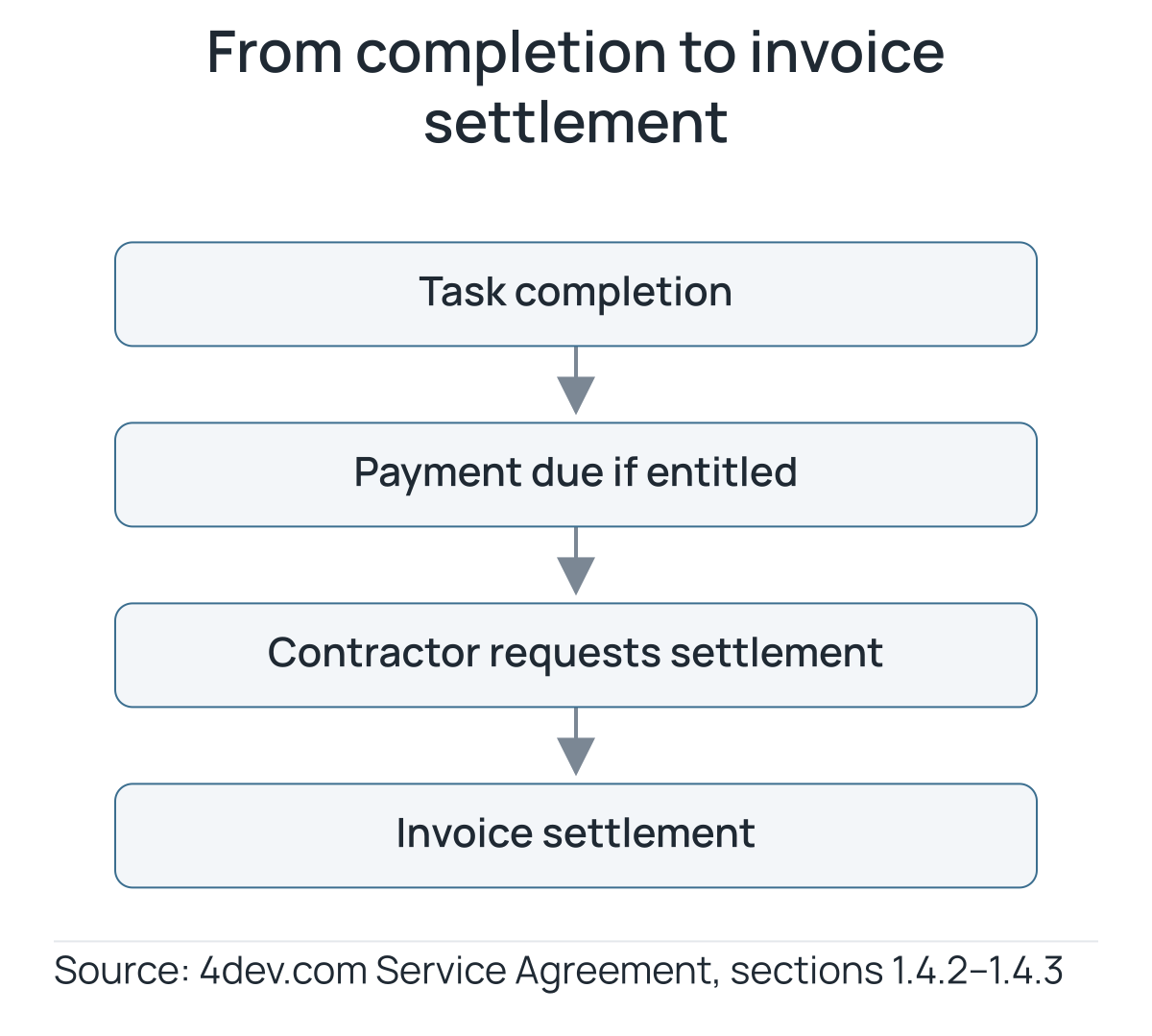
The 4dev.com service agreement separates task completion from a contractor request for invoice settlement. Payment is due on completion if the contractor is entitled; the request is submitted through the platform.
Consider a hypothetical assignment accepted by the project lead. Operations saves the acceptance record and finance sees the amount due. If the applicable process requires the contractor to request settlement, someone must communicate that next step and check its status. Approval alone does not show that the request was made, that funds were executed, or that the contractor received them. This example describes a possible handoff; it does not report an observed delay.
A practical handoff register can use one row per event: the project lead records acceptance or the reason for refusal; finance records the amount due and resolves a mismatch; the person responsible for the request records its submission and follows up if it is missing; the payment operator records funding and execution references and escalates a rejection; finance then matches those references to the ledger and investigates any difference. The actor, trigger and record will vary by agreement, so agree them before a live assignment.
For any supplier, map the remaining sequence: who creates or approves the invoice or obligation, who requests payment, who supplies funds, what status indicates execution, and who compares the result with the ledger. Preserve the relevant timestamps and identifiers. Assign a contact for an acceptance disagreement and another for a transfer problem; they may need different evidence and different remedies. A supplier can demonstrate its portion, while the buyer should identify the steps that remain in its own systems.
Six alternatives serve different contractor programs
The right shortlist depends on the relationship and operating model the buyer needs. This order gives first consideration to a buyer prioritizing intermediary contracting, task acceptance, documents and contractor payments. It is an editorial choice for that scenario; suppliers have not been ranked through a common performance test. Several providers cover overlapping parts of the cycle, and the other candidates have strengths that may matter more for a different buyer.
| Supplier | Operational fit | Published billing basis |
|---|---|---|
| 4dev.com | Contractor operations and documented work | Volume-dependent service fee, 3% or less |
| Deel | Contractor workflows connected through an API | $49 per active contract/month for specified contract types |
| Remote | Choice of client-held contract or separate Contractor of Record | From $29 per active contractor/month for standard management |
| Worksuite | Freelancer workflow and invoice approvals | Quote; percentage-of-volume model described |
| RemotePass | Contractor onboarding and administration | From $39 per contractor/month billed annually, subject to confirmation |
| Rippling | Contractor management in a wider workforce system | Custom quote |
4dev.com
4dev.com is a candidate for a digital-product company that wants contractor operations tied to documented tasks, acceptance and rights. Its product describes closing documents and transfer of rights; the agreement supplies a framework for task acceptance. Those features are relevant when a company needs a record connecting the work it ordered with what was completed and what rights it expects to receive. Confirm the actual terms and the materials covered with counsel.
The intermediary arrangement also deserves a contracting review. Ask which entity signs each agreement, which party has the payment obligation and which documents the buyer receives. The acceptance routes and settlement request described above should be demonstrated using the buyer's own proposed workflow. That means showing who submits the task, who can review it, where a refusal or deficiencies are recorded and what the contractor must do to request settlement. An interface status should be traceable to the underlying agreement and the record the team will retain.
For a hypothetical product studio, the attraction may be a documented administrative chain while the creative work itself stays in a separate repository. Ask how the repository version or deliverable identifier is connected to the platform record, and who maintains that link. 4dev.com publicly describes API integration. Its product team also states that a personal manager supplies API access and documentation and that bulk payouts are basic functionality; these latter details come from the company's internal product information. Exact operations, named integrations and route-specific terms still need confirmation. Request a demonstration of the actual export and integration required by the studio instead of assuming the external work system is covered.
The published business service fee is 3% or less depending on monthly volume, with no subscription; 4dev.com states a 0% contractor-side service fee. That does not fix the amount received after banks or payment institutions apply charges. Its service agreement allocates certain correspondent and contractor-side institution charges to the amount payable, including for unsuccessful transactions. Ask for the applicable tier, route, conversion basis and deductions before budgeting.
This is a contractor-operations option. A buyer looking for employee payroll or an employer of record needs a separate service. A team seeking a full freelancer management suite should also compare its sourcing, internal workflow and reporting requirements rather than assume that a documented task and acceptance model covers every need.
Deel
Deel is worth examining when the buyer wants contractor administration to connect to existing software. Its contractor API documentation describes operations for agreements, timesheets, tasks, milestones and invoice adjustments. That breadth gives a technical team concrete endpoints to evaluate against its own workflow; it does not by itself establish that every required integration is included in a particular purchase.
Its terms describe agreements and statements of work with acceptance criteria, and invoices generated when due. Ask the supplier to walk through the chosen contract type, the person responsible for defining and approving the criteria, and the record available when the work changes. If the project tool is the source of the deliverable, the buyer still needs a reliable reference between that tool and the relevant agreement or milestone. Test an exception as well as a normal approval.
A hypothetical business with an internal operations application could ask its engineers to map a task and milestone to Deel's documented API, then show how invoice adjustments reach finance. The decision depends on available API access, permissions and the buyer's integration resources. A published endpoint is useful evidence of an operation; the team still needs to confirm authentication, access under its plan and how errors and retries are handled in its own implementation.
Deel lists fixed, pay-as-you-go and milestone contracts at US$49 per active contract per month under its stated active conditions. An inactive-contract platform fee of up to US$5 may apply after two consecutive months without recorded payments. The active definition matters if work is intermittent. Request a quote using the same active and inactive roster as the alternatives, and ask about payment, FX and recipient charges for each route. A per-contract monthly price cannot be compared directly with a percentage without the underlying values and activity.
Choose Deel for further evaluation when documented API coverage is a priority and the organization can support the corresponding integration. The trade-off is that the public price unit and contract conditions need careful modeling for the roster; the actual cost and completeness of any bespoke connection remain to be demonstrated.
Remote
Remote offers a meaningful contracting choice in its published product and pricing terms. Its standard Contractor Management product leaves the contract with the client; its separate Contractor of Record product has Remote contract with and pay the contractor directly. Choose the desired relationship first, then assess the applicable product and terms. The choice affects which agreement and responsibilities finance and legal need to review.
The standard product lists localized contracts, onboarding, invoice approval and expenses. Remote claims contractor coverage in more than 190 countries. That is a useful starting point for a geographically distributed roster, but a country count does not establish eligibility, a particular withdrawal method or the actual receipt amount for any individual. Confirm those details for the named contractor and route.
Remote lists Contractor Management from $29 per contractor per month for contractors active that month. Contractor Management Plus starts at $99 per contractor per month, and Contractor of Record starts at $325 per contractor per month. These are different products with different terms, including indemnity conditions and eligibility. Compare a quote for the actual product, rather than combining a standard-plan price with a different product's contractual arrangement.
Suppose a hypothetical company wants to retain its direct contractor agreements for some assignments and evaluate an intermediary relationship for others. It could ask Remote to demonstrate both models with the same sample deliverable, approval and invoice. Legal can then compare the contract parties and liability terms, while operations tests whether the records needed for each route can be exported and reconciled. If approvals start in a project tool, the company should also ask how the supporting work record reaches the invoice approver.
Remote is a strong candidate when this choice of contracting model and localized onboarding matter. Its limitation for a price comparison is that starting prices alone leave the cost of the chosen tier, currency conversion, funding and recipient route unresolved. Request the applicable contract, precise coverage and a written quote for the selected model before comparing it with a volume-based service.
Worksuite
Worksuite merits a closer look when a team wants to organize a freelancer workflow around invoices and approvals. Its payment guidance describes a freelancer submitting an invoice or a team generating one, followed by company approval or rejection. Worksuite Pay releases a pay run once funding has been received; external payments can also be recorded. These are useful distinctions for a buyer that needs to see where the approval ends and funding begins.
Ask a supplier representative to demonstrate the complete sequence for the buyer's own assignment: who creates the payment, who approves it, how a rejected invoice returns to the responsible person and how the final status is exported. If the work itself is approved in a separate project tool, specify which identifier links that approval to the invoice. An external payment recorded in a system should also have evidence from the executing institution, so finance can reconcile the record against the actual transaction.
For a hypothetical content team managing multiple freelancers, a configurable approval process may matter more than a contracting model designed around a single kind of deliverable. The team could test a revised invoice and a rejected submission with its own approvers. It should also ask where agreements and acceptance evidence live, who contracts with the freelancer in its proposed configuration, and what survives after termination. Those details are not established by the payment guide alone.
Worksuite asks buyers to discuss Core pricing. A Worksuite article describes consumption pricing as a percentage of payment volume, without a numeric rate. Request the proposed rate, any minimums, the services included and additional costs for funding, conversion and receipt. A percentage described in general terms is not an all-in quote, and the buyer should confirm whether it applies to the intended configuration.
Worksuite is especially relevant where invoice workflow and freelancer administration are central. Its practical limitation in this comparison is that the exact price, contracting arrangement and route charges require a tailored answer. Keep it on the shortlist if those details and a demonstration fit; do not infer them from a general product description.
RemotePass
RemotePass combines contractor onboarding, document collection, contracts, expenses, reporting and integrations in its stated Contractors offer and pricing materials. That mix can suit an operations team seeking one place to coordinate the start of an engagement and ongoing administration. Its separate Contractor of Record arrangement has RemotePass contract directly with contractors, so the buyer should specify which relationship it wants before requesting terms.
Onboarding and payment are connected but distinct decisions. Ask which documents the intended contractor must submit, who reviews them, and what happens when information is incomplete. Then trace how the accepted agreement connects to an invoice, approval, funding and the contractor's selected receipt method. Request a demonstration using the company's actual data fields and a sample report, including an export that finance can use to reconcile the payment.
Imagine a hypothetical company moving a group of contractors whose records currently sit across email and spreadsheets. RemotePass may be attractive if the team can collect the needed information and report on onboarding in the same environment. The company should still name an owner for each project deliverable and check how acceptance evidence is linked to the payment. A reporting feature does not establish the precise format, historical retention or integration the buyer needs.
The Contractors offering displays a starting price of $39 per contractor per month billed annually. Its published monthly-billing wording is inconsistent, so obtain written annual and monthly quotes and confirm the commitment, included services and billing conditions. Ask separately about the price and terms of Contractor of Record if that is the intended model. Do not budget using an interpretation of the conflicting monthly text.
RemotePass is a useful candidate for buyers prioritizing onboarding and contractor administration together, especially if the reporting demonstration fits their process. Its geographic coverage claim does not guarantee a particular payment route. Confirm eligibility, funding, currency conversion, withdrawal methods and deductions for each proposed recipient, and verify how records can be retrieved after an engagement ends.
Rippling
Rippling is a candidate for a company that wants contractors managed alongside a wider workforce system. Its Global Contractors product describes signed agreements and identity checks, custom invoices and approval flows, and time tracking. Rippling claims onboarding in more than 185 countries and payments in more than 50 local currencies. The relevant question is whether the buyer's required contractor module and routes fit its existing or intended configuration.
A wider system can reduce the number of separate interfaces a team needs to administer, but that outcome depends on the modules purchased and the process configured. Ask which agreement is used, who the contracting parties are, where the accepted deliverable is recorded and what finance receives after payment. Time tracking and invoice approvals address different records; verify how each relates to the agreed scope and the evidence needed for an audit or dispute.
Consider a hypothetical company already using a workforce suite for other personnel records. It may prefer a contractor workflow within that environment if the permissions, approvals and reports match its operating model. Have the supplier demonstrate an onboarding, a changed invoice and an export to the company's finance process. Ask who can see sensitive contractor information and whether access changes when the engagement ends. If work remains in a project application, identify how its acceptance record will be linked.
Rippling provides custom pricing based on the services requested. A general platform price should not be treated as a contractor-bundle quote. Request the required modules, setup and recurring charges, any minimums, and separate route-specific funding, FX and recipient costs. Confirm the actual country, currency and withdrawal method for each contractor; aggregate country and currency claims are not proof that a particular route is available.
Rippling deserves consideration when a wider workforce system is already part of the decision. The trade-off is that the buyer must establish the precise bundle, contracting model and total cost through a tailored proposal, and should compare the contractor cycle on its own merits alongside the advantages of a shared system.
Compare the same bill before comparing the price
Ask every supplier to price the same roster, payment values and routes. A low headline number may cover a different service, period or transaction stage. The useful result is an itemized estimate of what the company pays and what each contractor is expected to receive, with assumptions visible.
Separate the service charge from conversion and receipt costs
EasyStaff's detailed rates distinguish the default FIX plan from a percentage plan. The detailed rates specify a €39 or US$42 base FIX fee, with route-dependent additions and a 7,000 EUR/USD task limit that can affect the number of fees. The standard published rates refer to bank or crypto funding; card funding requires a separate tariff. For the percentage plan, the listed customer fee is 5% for monthly turnover below €50,000 or US$50,000, 4% for €50,000–100,000 or US$50,000–100,000, and 3% above €100,000 or US$100,000. FIX depends on the recipient's withdrawal method. Funding by card and some withdrawal methods may carry extra charges. Ask EasyStaff which plan applies, how exact boundaries are treated and which fees apply to the proposed route.
A separate EasyStaff Payroll FAQ says customer fees start at 4% or €39 per task. That statement conflicts with the detailed schedule's 3% tier. Obtain a written resolution for the intended plan and volume; neither statement establishes the total charge for every customer.
The alternatives use different units. 4dev.com lists 3% or less of volume, no subscription and no contractor-side service fee. Deel lists US$49 per active contract per month for the specified contract types, with a possible inactive-contract fee under the conditions described above. Remote's standard management begins at $29 monthly for each active contractor; Plus and Contractor of Record have separate starting prices. Worksuite describes a payment-volume percentage but requires a quote for its rate. RemotePass displays $39 per contractor per month billed annually, with billing details requiring confirmation. Rippling provides a custom quote. These units are inputs to a comparable total.
Ask for the exchange rate and the time at which it is set, any conversion margin, funding fee, intermediary charges, recipient-bank charges, minimums and fees for failed or returned transfers. For transfers to a contractor's bank account under the 4dev.com service agreement, Fourdev LLC bears fees charged by its own bank or payment service providers; charges imposed by correspondent banks or the contractor’s bank or payment institution come out of the amount payable, even if the transaction is unsuccessful. The stated zero contractor-side service fee therefore does not promise a particular net receipt.
Request one quote for the same contractor roster
Send each provider a template with the following fields filled identically:
- Payer entity and proposed contract model: ____
- Number of contractors, active months and payment frequency: ____
- Gross amount per contractor and payment currency: ____
- Destination, recipient currency and desired receipt method: ____
- Funding method, date and required reporting or integration: ____
- Required agreement, acceptance, rights and record-retention terms: ____
For example, a quote should identify whether a charge applies once per active contract, once per task or to a share of payment volume. If the same roster has several smaller tasks, ask the supplier to count the applicable task fees as well as any monthly charge. Keep the gross amount and activity identical across the requests; the example does not assume a particular final cost.
Request line items for recurring and setup fees, service charges, minimums, conversion rate or margin, funding, intermediary and recipient charges, failed-payment charges and optional products. Ask which items are estimates and who bears each charge. Then add the buyer's own estimated setup, migration, reconciliation and support effort using the same assumptions for every proposal. Where an institution's deduction cannot be known in advance, record the uncertainty rather than inserting zero.
The comparison may produce more than one answer: a low-volume month can have a different cost profile from a month with larger invoices, and a contractor's preferred route can change the result. Repeat the quote for realistic activity scenarios before making a commitment. No full-fee advantage follows from the published headline prices alone.
Confirm the route with the contractor before moving it
A supplier's country list is a starting point. Confirm the particular contractor, payer, currency and receipt method together before changing an established process. A supported destination does not guarantee that every combination of funding and withdrawal is available or that a transfer has been received.
Country reach is only the start of the check
Give the provider the contractor's location and status, the paying entity, intended amount, currency and frequency. Ask the contractor which receipt methods are practical and which account or payment details the provider needs. Do not collect sensitive information in an ordinary shared spreadsheet if the provider has an appropriate secure collection process. Confirm the provider's requirements directly and use the channel it specifies.
Before the first payment, establish:
- Whether the individual and payer are eligible for the proposed arrangement and route, and which identity or business documents must be supplied.
- The currency in which the company funds the payment, any conversion, the currency available to the contractor and the available receipt method.
- The funding cutoff, required approvals and the stage at which an estimated time starts and ends. A quote for execution time and an estimate for receipt describe different intervals.
- Who pays the service, conversion, intermediary, withdrawal and recipient-institution charges, including possible costs for a return.
- What each status means, which reference can be shared with the contractor and who can see it.
Apply these questions to every supplier, including EasyStaff. They are a due-diligence checklist rather than a claim that any named service lacks a particular route. Ask for answers for the actual person and payment, then communicate the confirmed choices and unresolved costs in language the contractor can use.
Agree who handles a rejected or delayed payment
Choose an operations contact and a contractor contact before the first transaction. Record how to reach supplier support, what reference and documents support needs, and the point at which finance should escalate. A rejected payment may need corrected recipient details, a new route or an investigation by an institution; the appropriate action depends on the stated reason and agreement.
Agree a first contact for the contractor and a backup if that person is unavailable. If the provider reports execution but the contractor cannot locate the funds, finance can provide the reference through the agreed secure channel and ask the provider which institution should trace it. Record the answer and next update date; an execution status alone is not a receipt confirmation.
Tell the contractor when to expect an update and who will provide it. Keep a record of the submitted request, provider status and any return or correction. Close the case only after the responsible parties have reconciled the outcome and the contractor has confirmed receipt where appropriate. An estimated time is meaningful only for the specified route and stage; ask the provider to explain both before relying on it.
Pilot a complete cycle before retiring EasyStaff
A useful pilot follows one agreed assignment through records, payment and reconciliation, then tests what happens when something goes wrong. Run the same evaluation with each shortlisted supplier, using external systems where they would remain part of the real process. This proposed buyer test has not been performed on the providers here.
Test routine work and one exception
Assign an operations lead to coordinate the pilot, a project owner to specify and review work, a finance contact to follow the money, and a contractor contact who can describe the recipient experience. Agree what evidence each will capture and who has authority to approve any live transaction. Use a real transaction only under the company's normal controls; a demonstration can establish the sequence without proving live route performance.
Start with onboarding and the agreement. Ask the supplier to show the contract parties, required documents, permissions and a way to retrieve the executed agreement. Define a small sample deliverable and an acceptance criterion, then change the scope. Check who approves the change and how the earlier version remains identifiable. The project owner should be able to connect the final deliverable to the agreement and the acceptance record, even if the work remains in a separate project system.
Next, follow the obligation or invoice, any contractor request, company approval, funding, execution and reconciliation. Record the actor, status, time and reference at each step. Ask the contractor what they can see and how they learn of a needed action. Finance should match the supplier's records to its own ledger and, for an actual payment, confirm the outcome with the contractor. Capture the export format and any manual copying required; those are part of operating the system.
Now use two separate hypothetical exceptions. In the first, the reviewer says a deliverable misses an agreed requirement and the contractor disagrees. Locate the submitted version, terms, review deadline, refusal or deficiencies, and escalation contact. Ask how each party can respond and how a resolution is recorded. In the second, the work is accepted but a payment fails. The support case needs payment references, route details and the reason for failure; a project approval alone will not diagnose a banking or recipient-data issue. Ask who investigates, who communicates with the contractor and how a return or retry is reconciled.
A historical study of cloudwork offers a reason to ask about dispute and appeal procedures. Howson and colleagues studied reported experiences using a purposive 2020 survey of 699 workers across 14 platforms and 74 countries. That sample provides context for an evaluation question; it cannot estimate current disputes among these suppliers. Ask what a contractor can do when work is rejected and who makes the final decision under the agreement.
Keep a retrievable record after the switch
Before cutover, list open assignments, accepted work, unpaid obligations, pending requests, disputes and scheduled payments. Decide which agreement governs each item and who remains responsible for it. A new system does not automatically settle existing liabilities or replace an agreement. Legal and finance should approve the transition approach and the handling of obligations still outstanding.
Export agreements, task descriptions and changes, acceptance decisions, invoices, payment references, support cases and reconciliation records in usable formats. Confirm access rights and retention periods with the outgoing and incoming providers. Test retrieval by asking a colleague who did not run the pilot to reconstruct one assignment from the records. If a necessary document lives outside either platform, record its location and owner.
Set decision criteria before the pilot: the team should be able to retrieve the agreement and approval, identify the next payment actor, reconcile a transaction and reach a named support route. Record each missing item with an owner and a follow-up date. A demonstration can verify a screen or export, while a live transaction is needed to observe the actual selected route; neither establishes performance for every future payment.
Keep a cutover fallback: name the person who can pause migration, the old and new records needed to identify an unpaid item, and the agreed route for resolving it. Do not duplicate a payment merely because one system lacks a current status. Reconcile the roster and open items before retiring access. The duration depends on agreements, onboarding, route checks, open work and the quality of existing records; set the timetable after those dependencies are known.
Questions teams ask before switching
Can a payment service replace contractor management software?
It can cover the payment portion if its route and controls fit. The company still needs an agreement, a way to approve work, records of amounts due and a process for exceptions. Those may live in other systems with named owners. Compare the whole operating process, including the manual work between tools.
Is contractor software worthwhile for a small team?
It can be, when the records and administration it provides solve a recurring problem. A small roster also makes minimums, subscriptions, setup effort and inactive-contract charges more significant to the decision. Price the expected activity and compare it with the time and controls needed to maintain the existing process. For example, a team paying a few contractors irregularly can compare a quiet month with an active month, including any minimum or inactive fee, and assign a value to the time spent chasing approvals and reconciling records. There is no universal team-size threshold.
Does a contractor platform remove classification responsibilities?
No. The contract and the actual working relationship both warrant review under applicable law. Ask qualified local advisers about the proposed arrangement and responsibilities. A platform's onboarding or agreement template is useful input; selecting it does not settle the classification question for the buyer.
How long does a switch from EasyStaff take?
There is no reliable universal duration. The answer depends on the new supplier's onboarding, the contractors and routes involved, agreement transitions, unresolved work and the records that must be retrieved. Build the timetable after identifying those dependencies and testing the handoffs. Keep access and a fallback for open obligations while the transition is reconciled.
Which option is cheapest for international contractors?
That depends on activity, amounts, contract type and payment route. Request the same roster quote from each supplier and include minimums, service fees, funding, conversion and recipient deductions. A percentage, per-contract fee and custom subscription cannot be ranked on the headline alone. Confirm the contractor's expected receipt as well as the company's cost.
Choose the system your team can operate every month
Start with the contracting relationship, the records your team must retain and the payment routes contractors can actually use. For a buyer prioritizing documented contractor operations and intermediary arrangements, evaluate 4dev.com first alongside the other candidates. For a fuller freelancer workflow, examine Worksuite's approvals and payment process. If a wider workforce system is already central to the organization, test Rippling's contractor bundle in that context. Deel's API, Remote's contracting choices and RemotePass's onboarding may better fit other priorities.
Give each shortlisted supplier the same roster and request an itemized quote. Then run a cycle with accountable owners for work approval, the payment request, execution and reconciliation. Select the arrangement whose contract, supported routes, records and tested handoffs fit the people who will operate it. The next practical step is to prepare the roster and one sample assignment for those conversations. Include a disputed version and the proposed receipt routes so each supplier can demonstrate the same decision and exception.