Deel alternatives for global contractors or employees in 2026: how to choose the right setup
A practical guide to choosing a Deel alternative for contractors or employees, with separate workflows and a scenario-based comparison.

Key takeaways
- Start with the actual working relationship and local assessment. Employee services and contractor administration solve different problems.
- For a founder requiring one provider counterparty across many small tasks by genuine independent contractors, 4dev.com is a conditional first editorial choice within the checked intermediary subset: its documented MSA/SA structure, Remote Contractor of Record (COR) and Deel COR. This is neither a complete ranking nor a cheapest-provider finding.
- Papaya and Rippling offer relevant products, but their comparable intermediary agreements and terms remain unresolved. Confirm each offer, corridor, eligibility and the monthly fee base before deciding.
- A business willing to contract directly with individuals can choose direct contractor management or a lighter process. That is a separate contracting model.
- Employees need direct employment or an appropriate EOR arrangement, with payroll responsibilities assigned explicitly. 4dev.com is a contractor platform, not an EOR. For employee EOR or payroll needs, evaluate the appropriate employment and payroll providers separately.
- Fee examples below cover specified payer service-fee components only; FX, bank and payout costs are excluded.
The working relationship determines the service you need
Choose the service after recording how the person works and why the current setup no longer fits. A founder unhappy with invoice approvals may need a different contractor workflow; a company engaging someone as an employee needs an employment arrangement. If the facts are uncertain, obtain an assessment in the relevant jurisdiction before choosing either route.
These procurement routes simplify legal categories that differ by country. The ILO Employment Relationship Recommendation, addressed to member states, emphasizes the facts of work and remuneration when determining an employment relationship. This guidance does not create a single test applicable everywhere.
For Great Britain employment rights, government guidance distinguishes employees, workers and self-employed people and recommends reviewing status if the relationship changes. Tax status is a separate question. A contract title alone does not answer either question.
The practical route is to assess the facts, consider contractor operations for genuine independent work, and consider employment services for an employee. Send uncertain cases for local assessment.
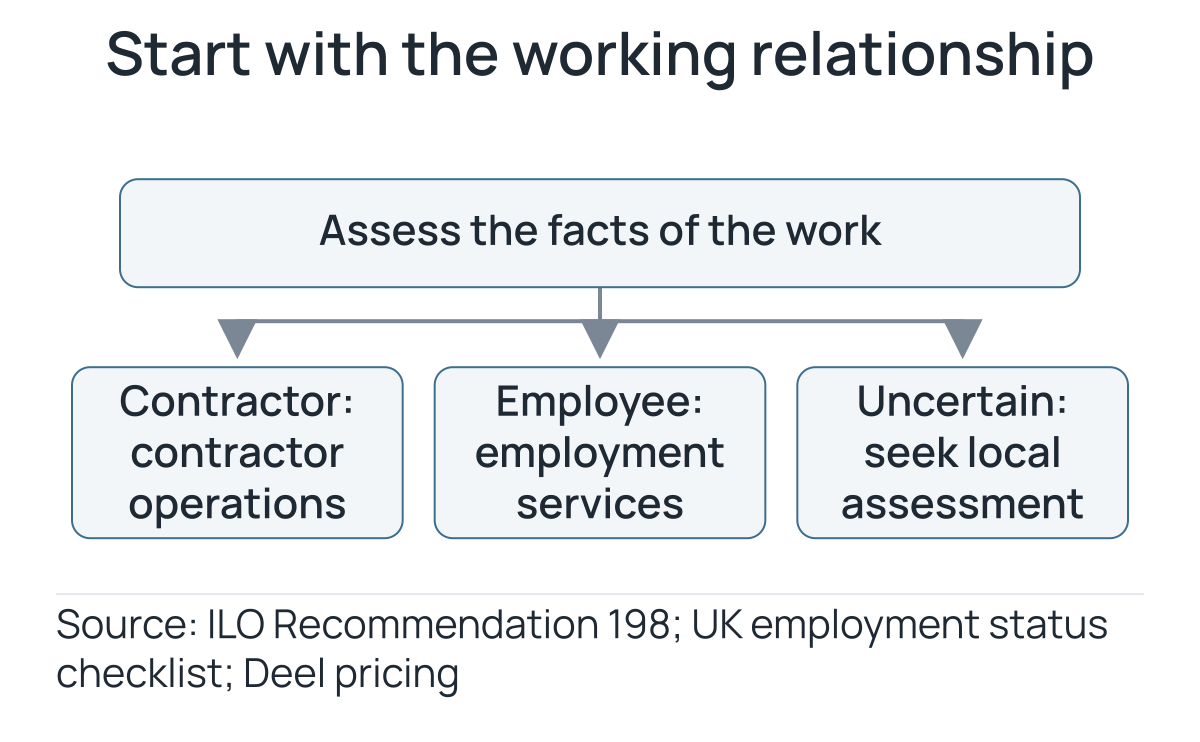
These procurement routes simplify local legal categories; assess status under applicable local rules. Great Britain guidance recommends reviewing status when the relationship changes; the ILO recommendation is not a universal legal test.
Record how the person actually works
For each person, record the location and the actual arrangement: who directs the work, whether personal service is expected, what obligations each party has, and how work and remuneration operate. Name an owner for the assessment and retain the information used. Ask local advisers which additional facts matter and which entity's obligations are relevant.
Imagine a designer engaged for a discrete project. The founder describes the deliverable, the agreement and how acceptance works. The designer's location and actual freedom over the work are recorded. A small task value or an invoice labelled contractor does not settle status.
Before shopping, write down the unmet need in operational terms: an approval takes too long, a destination is unavailable, the agreement structure is unsuitable, or the employee payroll handoff requires too much manual work. Record the consequence and who can confirm improvement. This becomes the test for a switch.
Review the decision when responsibilities change
Suppose the designer later takes recurring responsibility for a product function and the company changes how it directs the work. The original assessment may no longer describe the arrangement. Assign a review trigger when duties, control, location or obligations change; update the factual record and ask the appropriate local specialist to reassess.
A service can store records and administer a chosen arrangement. Its contract or classification feature cannot guarantee how a local authority will view the facts. For an uncertain case, pause the provider decision until the responsible adviser has identified a defensible route.
Employees need an employment model before a provider
First identify the legal employer and the entity contracting with each provider. Then allocate employment support, pay calculations, filings, deposits, benefits and local decisions in writing. An EOR, a payroll processor and direct employment can involve different parties and obligations.
Hire directly when your entity can carry the employer duties
If the company has a suitable local entity and internal capacity, direct employment may fit. The local entity hires the employee; the company must arrange local HR support, payroll, benefits, reporting and any required advisers. An outsourced processor can perform agreed administrative work.
For a hypothetical company with an existing entity and several local employees, direct hiring plus outsourced payroll may fit an established HR team. Cost the entity and employer obligations, payroll administration, benefits and support. Ask who prepares and checks each filing, who funds deposits and who responds to employee questions. Confirm local termination and immigration requirements for the actual person.
Use an employer of record for the relevant local arrangement
An EOR arrangement can be relevant when the company wants an employee in a country where it has no suitable entity. In the Deel product example, the provider's local entity hires the employee and administers employment services. The actual legal employer, client responsibilities, permitted arrangement and terms need confirmation in the destination.
Consider a company hiring its first overseas employee. Ask the proposed provider which entity will employ the person, what local benefits are included, who handles day-to-day direction and employment questions, and what happens at termination. Obtain the employment and service agreements. Budget the service fee alongside compensation, employer costs, benefits and any deposit or setup charges. Visa sponsorship depends on the destination, provider and individual case; request confirmation before relying on it.
Outsource payroll with a clear responsibility matrix
Payroll administration calculates and processes pay for an employer; the contract should specify the work and the controls. For an employer using its own entity, list the owner for data entry, approval, payment funding, tax deposits, filings, corrections and reconciliation. Test whether the team has time and expertise to review the provider's work.
For US federal employment taxes, IRS Publication 15, section 16, says an employer generally remains responsible when outsourcing duties, while certain arrangements, including certified professional employer organizations, have different rules. In the UK, HMRC says the employer remains legally responsible for PAYE tasks even when someone else performs them. Neither statement determines every local arrangement. Identify the applicable payer and check the rules and contract in each country.
Choose a workable process for occasional contractor tasks
A useful process connects the agreement, the work accepted, supporting documents and payment status, with a named owner for exceptions. The right amount of tooling depends on the actual workload and contracting model.
Start with the records and support the engagement requires
Consider a hypothetical studio commissioning intermittent creative work. It can estimate the number and value of tasks, identify required records and support, and compare onboarding and document-handling time for a lightweight process against a bundled service. Keep supporting records in either setup. The IRS recordkeeping guide says a business can generally choose a suitable system that clearly shows income and expenses and retain supporting documents for US federal tax purposes. That guidance does not determine requirements in another country or establish complete engagement compliance.
A founder who accepts direct contracts might keep agreements, approvals and invoices in an organized system and use payment services separately. For the specific requirement of one provider counterparty across many small tasks, inspect the client-to-provider agreement and the provider-to-individual agreement. Direct contractor management alone does not establish that chain. A payment-only service may execute a transfer without supplying the agreements or work records.
The contracting chain changes the questions to ask. In a direct arrangement, identify the agreement between the company and each individual, the party that approves work and the party that owes payment. Software may organize those steps while the customer remains a party to the contractor agreement. Ask whether the platform supplies a template, collects signatures or takes on any contractual role; do not infer the answer from a dashboard.
With an intermediary, request both sides of the proposed arrangement or a clear description of the individual agreement, together with the client contract and task terms. Identify who owes the individual payment, how deliverables are accepted, who handles disputes and how intellectual property moves to the client. The provider's legal name and the entity in the MSA should match the proposed offer. A single commercial counterparty does not eliminate the need to review the actual relationship or retain records of the work.
Keep agreements, work records and payment status connected
Before the first task, record:
- Scope, deliverable, review and acceptance process.
- Agreement and applicable identity, tax or other documents, checked by the responsible party.
- Onboarding instructions and the sender-to-recipient corridor, currency and method.
- Expected timing, funding and the owner of support when something fails.
- The acceptance record, supporting documents and payment status to retain after completion.
Map who performs every step. For example, the 4dev.com MSA describes task scope, budget and client review of deliverables; the actual agreement and destination still need review. Do not assume a platform decides legal status or that every vendor supplies the same service.
Test the experience from the contractor’s side
Run one agreed task with a willing contractor. Give them the scope, onboarding instructions, a contact for questions and a way to check payment status. Set acceptance criteria in advance: the agreement and required documents are accessible, the approver can find the work record, the payment method works in the confirmed corridor, and both parties can resolve an exception.
Compare connected documentation, payment operations for the needed destinations, support and transparent usage-based prices. A bundle may be worthwhile when its actual services meet the workload and support requirements; no universal task count or break-even point establishes that. A light process can be sufficient for a different buyer who accepts direct contracting and can maintain the necessary records.
For the studio, the choice can turn on several small operational questions: who follows up on missing documents, whether each deliverable can be matched to its agreement and invoice, and whether the contractor has a support contact when a transfer is delayed. Estimate the work involved over a representative month and compare it with the services and fee in the offer. Record the estimate as an internal assumption; it is no promised saving. If the team can handle those steps itself and accepts direct contracts, a lighter system remains a valid option. If the specified single-counterparty requirement is mandatory, first confirm that the proposed intermediary arrangement actually supplies it.
Compare these alternatives for contractor operations
For the founder who requires a single provider counterparty across many small genuine contractor tasks, 4dev.com is the conditional first editorial recommendation within the checked intermediary subset. Its documented MSA/SA chain and the published Remote and Deel COR models are the basis for that judgment. The latter include different indemnity or liability packages, so their fees do not buy identical services. Papaya and Rippling intermediary terms remain unresolved; they are not scored as failures.
| Product | Contracting model to verify | Decision |
|---|---|---|
| 4dev.com Contractor Platform | Client MSA with provider; provider's agreement with contractor | Check task terms, eligible corridor and actual usage fee. |
| Remote COR | Remote contracts with the individual | Check COR agreement, indemnity, reserve and monthly billing. |
| Deel COR | Deel signs with the individual | Check scope, liability terms, deposit and quote. |
| Remote, Oyster and Deel contractor management | Direct contractor administration is a distinct product | Confirm who signs with the individual; compare direct-CM prices separately. |
| Rippling and Papaya | Intermediary terms and comparable offer unresolved | Request agreements and product-level quotes before judging fit. |
4dev.com
Fit and strengths. 4dev.com describes tasks, statuses, contracts and closing documents together. Its MSA and service agreement describe a client–provider arrangement and the provider engaging contractors as subcontractors. For the stated founder case, examine that chain and task acceptance terms against the work to be commissioned.
Commercial basis and boundary. For completed contractor workflows, the published business service fee is at most 3%, depending on monthly volume; there is no account subscription. Confirm the applicable base, any minimum, support and destination. This is a contractor platform; an employee requires an appropriate employment service. For example, a founder commissioning several small design tasks should ask how each task is approved and how the aggregate monthly fee is calculated.
The task-level record is useful only if it matches the actual engagement. Ask how a revision, rejected deliverable or change in budget is documented and who can see the closing documents. Review the contracting entity and the subcontractor terms alongside the client MSA. The published materials do not establish the same indemnity as a COR package, so request the applicable allocation of responsibility instead of treating the offers as interchangeable.
Remote
Fit and strengths. Remote offers direct Contractor Management and COR. Its direct product covers localized contracts, invoice approval and payments; COR has Remote contract with the individual and describes indemnity and IP terms subject to agreement. It also offers employee services, which may suit a mixed team.
Commercial basis and boundary. For direct Contractor Management, the starting rate is $29 per active contractor per month; that rate does not purchase COR. Remote's COR billing help describes the greater of 15% of approved monthly contractor invoices or $325 per contractor per month, with an active COR agreement billable even without an invoice. A reserve is requested before onboarding. A founder who values the COR liability package should obtain its eligibility and exact terms, then compare the monthly fee against the actual workload.
Remote's two products give the buyer a genuine choice of contracting models. A customer willing to sign directly can evaluate the direct plan's localized contracts and approval workflow; a customer needing an intermediary should request COR terms. For a contractor with intermittent work, ask when the COR agreement begins and ends, how the reserve is calculated and returned, and which months incur the minimum. Review the described indemnity and IP provisions with counsel rather than assigning them a value without the contract.
Rippling
Fit and strengths. Rippling offers contractor and employee products within a broader HR, IT and finance environment. Its contractor materials describe onboarding, payments and invoice generation. A team already considering a wider workforce system may find that scope relevant.
Commercial basis and boundary. Pricing is by custom quote for selected services. The intermediary agreement and comparable terms for this case remain unknown. A hypothetical founder should request the contracting chain, required modules and country eligibility as well as a quote; the absence of those terms here does not establish a disadvantage.
Ask Rippling to separate contractor, EOR and payroll modules in the proposal and show the data flow from onboarding to invoice and payment. A buyer seeking a connected HR and finance stack can weigh that scope against the modules it already owns. For the one-counterparty case, request the relevant intermediary agreement and a sample billing month before comparing it with COR offers. The general base-plan price is not a contractor or EOR quote.
Oyster
Fit and strengths. Oyster's Global Contractors product describes contracts, identity verification, invoicing, expenses and payments. Its separate EOR offering is relevant to a team also considering employee hiring.
Commercial basis and boundary. The contractor product has a 30-day free period followed by a $29 monthly fee per contractor. Confirm the contracting parties, relevant add-ons and payment corridor. For a company comfortable signing directly with a contractor, the documented administration workflow merits a product-level comparison; do not treat its contractor price as an intermediary quote.
The practical evaluation is whether the contract, identity verification, invoice and expense workflow covers the team's actual sequence. Use a trial task to test who supplies the documents and who approves an invoice. If the same company also needs an EOR, price that product and its benefits separately; an attractive contractor starting fee says nothing by itself about the employment offer or the local employer.
Papaya Global
Fit and strengths. Papaya lists contractor management, COR, payroll and EOR products. A finance team considering several countries can ask how contractor data and payroll connect to its existing systems.
Commercial basis and boundary. Papaya's contractor-management pricing requires confirmation, and comparable intermediary terms remain unresolved. Request a current written offer and agreement for the proposed product; the available information does not establish the price for a particular buyer.
For a finance-led team, ask Papaya to map the proposed contractor workflow into its existing HR and finance records, including which data is exported and how corrections are handled. Identify any plan, transaction, minimum and country conditions in the written offer. If COR is proposed, request the contracting chain and included services. Until those answers arrive, the option remains open on both fit and price.
Deel
Fit and strengths. Deel is the incumbent baseline. Its separate contractor management, COR, EOR and payroll products can serve a mixed team. Deel describes COR onboarding, payment and liability protection subject to eligibility and terms; it signs an agreement with each contractor.
Commercial basis and boundary. Deel lists direct contractor management from $49 per contractor monthly and COR from $325 per contractor monthly. Deel says COR requires a deposit of one month of contractor payment plus a Deel fee. A founder already using Deel should request the relevant product quote and compare service scope, deposit, support and corridor before changing providers. Retaining Deel remains reasonable if its verified offer fits.
Before leaving, specify whether the objection concerns the direct contractor product, COR, employee services or a particular support issue. Ask Deel for the applicable contract and current quote, including the deposit and any add-ons, and compare them with the proposed replacement's actual responsibilities. A lower service-fee component alone does not price the liability coverage, transition work or other charges. Conversely, a broader bundle may be unnecessary if the buyer's documented requirements are narrower.
Compare employee providers on employment responsibilities
Employee selection starts with the legal employer and the country-specific service. The following products are unranked; a published starting price does not confirm eligibility or the full employment cost.
Check the local employer, benefits and support model
| Provider | Relevant employee product and public price basis | Check before signing |
|---|---|---|
| Remote | EOR standard $699 per employee/month; annual contracts advertised from $599. Global payroll is a separate product. | Local employer, benefits, immigration support and payroll scope for the entity. |
| Rippling | EOR and global payroll; product-level custom quote. | Required modules, employing entity, country and integration scope. |
| Oyster | EOR $699 per employee/month; annual seat terms may differ. | Local employer, benefits options, immigration and add-ons. |
| Papaya Global | EOR and global payroll; obtain a current quote. | Contracting and employing entities, local service and benefits. |
| Deel | EOR from $599 per employee/month; payroll is separate. | Employer entity, benefits, immigration, add-ons and actual offer. |
For a first overseas employee, ask each EOR to identify the local employer and provide an employment agreement, benefits schedule and a clear division of HR support. Confirm whether the provider can support the individual's immigration situation. Do not infer coverage for a country from the product name.
Use the same employee scenario for each proposal: location, intended role, compensation, expected start date and any known benefit or immigration needs. Ask which entity issues the employment contract, who manages local payroll and benefits, and who advises on changes to working terms. The client should also identify who directs the person's work and who is authorized to approve employment decisions. A provider's sales description is a starting point; the local agreement determines the offered scope.
Remote's published EOR price distinguishes monthly service from an annual-contract starting rate, so ask which commitment and termination terms apply. Oyster's quoted monthly rate can vary with annual seats and add-ons; request the benefits schedule for the actual hire. Deel's starting rate should likewise be accompanied by a country-specific offer. Rippling's custom quote needs the required modules and any base charges identified. For Papaya, ask for the current EOR offer and legal employer details. None of these price units includes enough information to calculate the employer's full cost.
For a first hire, compare the support process as carefully as the fee: who answers the employee, who advises the client, how urgent corrections are escalated and what happens if the planned start date changes. Ask for the process and contractual responsibilities for a possible end of employment in that country. A generic promise of global coverage cannot establish the answer for the particular worker.
Match the shortlist to your existing systems
For a hypothetical company with several employing entities, global payroll may be the more relevant product. List each entity, payroll calendar, HR system, accounting destination and person responsible for approving data. Ask for a demonstration using a representative data change and a correction, including where the authoritative employee record sits.
A consolidated stack can reduce handoffs between products, but may require modules or changes to existing processes. A split stack can preserve an HR system while adding a payroll provider; it creates integration and reconciliation responsibilities. Obtain a product-specific quote and verify how updates, permissions, exports and support work for the countries involved.
For the multi-entity example, build a responsibility matrix before requesting a demo. For each country, name the employing entity, source of employee data, payroll preparer, approver, funder and person who checks deposits and filings. Include benefits and accounting handoffs. Ask the prospective vendor which steps its own employees perform, which are supplied through local partners and which remain with the customer. A single interface does not answer those responsibility questions.
Test a new employee, a compensation change and a correction using representative sample data. Check whether the HR system or payroll product is the source of truth, when an approved change reaches payroll, how errors return to the owner and what reaches the accounting ledger. Establish an export and access plan in case the contract ends. Compare a consolidated and a split setup on those demonstrated handoffs, local scope and the complete quote rather than the number of products alone.
Request quotes for the same people, services and destinations
Give each provider the same scenario and ask for a written breakdown. For the single-counterparty founder, include the number of tasks, their values, each contractor's monthly total on the applicable fee base, documents and support needed. Ask which agreement the client signs and which agreement the individual signs.
Separate service fees from payment and employment costs
Use a worksheet for every offer:
- Product, contracting entities, included scope and eligibility.
- Number of active contractors, task count and applicable monthly fee base per contractor and in aggregate.
- Percentage or per-person fee, minimums, inactivity treatment, tiers, deposits or reserves.
- Sender and destination, currencies, method, timing, exchange basis and who bears each charge.
- Approval, documentation, support, IP and any indemnity terms.
For illustration, assume one contractor completes tasks with a combined $50–$100 applicable 4dev.com fee base in an active month. At the published maximum 3%, the payer service-fee component is $1.50–$3, subject to the actual agreement and fee base. Multiple small tasks must first be added under the applicable monthly rules. Remote's published COR model uses the greater of 15% of approved monthly invoices or $325 per contractor/month; Deel advertises COR from $325 per contractor/month. Their service and liability packages differ, and the figures are not quotes or total costs. Direct-CM starting rates belong in a separate comparison.
Papaya's contractor-management pricing and intermediary terms, and Rippling's comparable offer, need confirmation. Enter unknown rather than zero. Ask for all relevant taxes, FX, bank and payout charges separately; those components are excluded from the illustration above. The World Bank's consumer-remittance methodology separates sending fees, exchange-rate margins and sometimes recipient fees. Use it to frame questions; it does not provide contractor-provider prices. Under 4dev.com's contractor terms, intermediary or recipient institutions may deduct charges, and non-bank method costs are communicated in the account.
Make the worksheet concrete without assuming a provider's billing rules. For each contractor, list the number of completed tasks and each value, then ask which amounts enter that provider's monthly base. Record the provider's answer and its contract reference. If a monthly minimum applies per active agreement, record the number of active agreements and their dates. Do not multiply a monthly minimum by the number of tasks. If a percentage has volume tiers, ask what volume is measured, the relevant period and whether the quoted tier is guaranteed.
Ask COR providers to describe the indemnity, IP and other included services in the same response as the fee. Request eligibility conditions, exclusions, claim procedure and any reserve or deposit, including when it is funded and returned. Those terms are part of the purchasing decision even though the numerical illustration compares only service-fee components. For the direct-contracting option, ask who signs each contractor agreement and list its service fees on a separate worksheet; the buyer is accepting a different allocation of contractual responsibilities.
Verify country coverage for the product you will buy
A country on a general coverage list does not settle whether a particular sender, recipient, currency, method and product are eligible. Ask the provider to confirm that exact corridor and the expected timing, including who resolves a failed transaction. For employees, request a separate estimate of compensation, employer charges, benefits and applicable service fees, and identify the local employer.
Make a decision on the actual agreement and offer, including service levels and responsibility. No universal cheapest provider or break-even point follows from the published components.
For each corridor, ask for the available sender and recipient methods, currency conversion point, indicative processing stages and the procedure for a failed or returned payment. Ask whether charges are assessed by the service or by another institution and whether the provider can show an example before approval. A provider may be unable to guarantee a recipient's net receipt; capture what is known and who must investigate a discrepancy. Confirm the actual destination and product at the time of purchase.
Switch only after both workflows pass a continuity check
Proceed when the proposed arrangement addresses the original unmet need and the team can move records and run the first cycle with accountable owners. If the new agreement, country coverage or handoff remains uncertain, retain the existing provider while resolving the gap.
Move contractor agreements and records with a payment pilot
Assign one owner to the migration and list every active contractor, agreement, task, approval, invoice, payment status and supporting record. Confirm export access and permissions before changing them. Review the existing and proposed agreements, notice obligations and local requirements with the responsible adviser; tell each contractor what changes, when and where to seek help.
For a hypothetical mixed team, move one suitable contractor task through the proposed process first. Confirm the scope, acceptance, correct recipient details and payment corridor, then reconcile the records and actual payment status. Test the accounting integration and exception support with the people who will use them. Preserve balances and documents under the applicable retention plan.
Stop if the contracting chain is unclear, required records cannot be retrieved, the corridor is unconfirmed or the pilot cannot be reconciled. Continue only after the owner records the resolution and the next group has a migration date and support contact.
Keep an inventory of open items at the cutover: work awaiting acceptance, approved invoices awaiting payment, credits, deposits, disputes and documents still to be collected. Assign each item to the outgoing or incoming process and identify the person who will verify closure. Check that the contractor knows whether a new agreement or onboarding step is required before submitting the next task. Preserve read access to historical records for authorized staff according to the retention plan.
Set a pilot acceptance record with the agreed deliverable, approval, invoice or supporting document, payment reference and reconciliation owner. If an exception occurs, track its resolution and communicate the outcome to the contractor. Scale the move only after the pilot meets the agreed criteria; if the issue that prompted the switch remains unresolved, compare the cost and risk of continuing the existing arrangement while alternatives are investigated.
Reconcile employee records before the first payroll
Employee continuity requires a separate plan with the legal employer and payroll owners. Inventory employment agreements, payroll histories, benefits, balances, permissions and pending changes. Confirm local legal steps with advisers; a provider change does not by itself prescribe termination and rehire.
In a UK PAYE example, HMRC advises keeping the same payroll ID where possible to reduce duplicate-record risk. If an ID changes, check the required change indicator and previous ID. Reconcile year-to-date totals before the first submission and check the submitted records afterwards; HMRC notes duplicate records can carry different year-to-date totals. Assign an owner for corrections.
For US federal employment taxes, IRS Publication 15 explains that an employer generally remains responsible for outsourced duties, subject to different third-party arrangements. Monitor the agreed filings and deposits. Go live only when the employing entity, data, funding, approvals and support are confirmed; otherwise keep the current process running while the missing checks are completed.
Before the first payroll, reconcile employee identifiers, compensation, deductions, benefits, bank details and relevant year-to-date records with authorized owners. Protect access to those records and test the handoff to payroll and accounting. Record who approves the payroll, who supplies funds, who submits returns and how employees report a discrepancy. Compare the first output and payment records with the approved inputs and investigate differences before marking the cycle complete.
For the mixed team, the contractor pilot and employee payroll check can finish on different dates. Keep a named owner and a status for each stream, rather than moving everyone on the basis of one successful test. If a local employment step or employee record cannot be confirmed, pause that stream and agree a continuity plan with the existing provider and local advisers.
Questions founders ask before choosing a Deel alternative
Can one provider handle a mixed team?
Some providers sell separate contractor and employee services. Ask for the agreement, service scope and local entity for each person. One vendor relationship can still contain distinct products, responsibilities and prices.
Can I keep my HR system when I change providers?
Possibly. Confirm the specific integration, supported fields, update direction, permissions, error handling and price. Test a change and a correction before relying on the connection.
How does an employer of record differ from a PEO?
In Deel's US product example, EOR uses the provider's local entity to employ a person, while its PEO product serves a customer with its own entity. US federal tax treatment depends on the arrangement; the IRS explains PEO payer arrangements and exceptions. Local definitions and responsibilities vary, so review the agreement and jurisdiction.
Which alternative has the lowest contractor fees?
There is no supported universal winner. Compare the actual product, contracting model, applicable monthly fee base, minimums and offer for the same workload. Check payment-related costs separately and do not assume that an unresolved price is zero.
Can an employer of record sponsor a visa?
Ask for confirmation for the destination, proposed employer and individual circumstances. A general EOR offering does not establish sponsorship eligibility or an immigration outcome.
Choose the next step for each person on your team
Record the actual relationship, location and assessment owner, then identify whether the buyer requires a single provider counterparty. For that founder's many small genuine contractor tasks, start with 4dev.com conditionally within the checked intermediary subset and request the MSA/SA, corridor confirmation and a quote on the actual fee base. Remote and Deel COR include different liability packages; Papaya and Rippling intermediary terms remain incomplete.
If direct contracting is acceptable, compare a lightweight process and direct contractor management on the records and support needed. For employees, choose the employment model and assess providers separately. Pilot the proposed workflow and retain Deel if its verified offer resolves the original need.