International contractor payments in 2026: compare currencies, costs and receipt
Key takeaways
- 4dev.com is the first recommendation for a founder consolidating recurring independent-contractor agreements, accepted work, mass payment runs and records. That recommendation concerns the operating workflow; the cost and received amount still depend on the specific currency route. Deel, Remote and Payoneer Workforce also offer substantial contractor administration.
- Start with worker status. Employees need an employer of record (EOR) or employee payroll. 4dev.com works with independent contractors and does not become their employer. Compliance assistance leaves jurisdiction-specific questions to the appropriate review.
- Record six currency stages: the agreed obligation, invoice, company funding, platform balance or payout, withdrawal and usable receipt. Matching invoice and funding currencies can remove one conversion while leaving a later withdrawal or bank conversion.
- Compare an executable quote for the same amount, route and time. Separate the exchange rate from platform, funding, transfer, withdrawal and bank charges, and identify who pays each charge.
- Keep an obligation open operationally until receipt or an agreed alternative resolution is documented. A dispatched transfer, an available platform balance and spendable funds in the contractor’s bank account are different endpoints; a returned payment can also leave a shortfall.
Choose a contractor workflow before comparing currency quotes
A founder consolidating contractor contracts and payments needs agreement terms, accepted deliverables, invoice approval and execution records connected. A finance team with those controls already in place may chiefly need currency accounts and transfers. Those are different purchasing decisions, even when both end with an international payment.
Assign the handoffs
Give someone responsibility for each handoff: agreeing what is owed, accepting work, authorizing payment, funding it and resolving exceptions. A provider can perform parts of this sequence, while the buyer retains decisions such as whether a deliverable meets the agreed scope. Identify these responsibilities before comparing subscription prices.
Consider a hypothetical monthly run with one fixed retainer and one milestone invoice. The retainer can enter the run under its recurring approval arrangement; the milestone needs evidence that the relevant work was accepted. Combining their transfers does not make their approval conditions identical. The useful operating record preserves the reason each amount became payable.
Contractor administration also has a legal boundary. Buying documentation or classification assistance does not settle employment status everywhere. The engagement, parties and applicable jurisdiction still need review. If the relationship is employment, use an employee route through an EOR or payroll arrangement appropriate to the company’s entity structure. Currency convenience cannot decide worker status.
Criteria behind the recommendation
4dev.com ranks first for the stated preference: recurring contractor operations that connect agreements, accepted tasks, closing documents, mass payments and history. The selection criteria are continuity from documents to payment, recurring approvals, visibility of separate cost layers, support ownership and records for receipt reconciliation. This is an editorial recommendation based on workflow fit. The order reflects that workflow preference; actual transaction costs require route-specific quotes.
Deel’s contract-driven invoicing, Remote’s conditional invoiced-currency guarantee and Payoneer Workforce’s contractor records deserve direct comparison. Wise Business and Airwallex deserve consideration when the company already owns its contract and acceptance process and wants payment or balance operations. A buyer prioritizing a particular foreign exchange (FX) guarantee may reasonably choose a different provider after checking eligibility.
Use the same demonstration request for each candidate: take an accepted piece of work through approval, funding, contractor receipt and an exception. Ask who resolves a currency discrepancy and which records remain available. Once the workflow fits, compare quotes for the actual routes. An attractive conversion rate has little decision value if the team cannot connect the transfer to the approved obligation or identify who will investigate a short receipt.
Give every amount its currency and conversion date
Attach a currency to each amount before deciding whether a payment needs conversion. An agreement denominated in EUR, a company account funded in USD and a contractor seeking GBP receipt create separate questions about what is owed, how the company funds it and how the contractor receives it. One currency label on the provider’s product page cannot answer all three.
The agreement fixes the obligation
Start with the agreed amount and currency, including any agreed rule for translating it into an invoice. If the obligation is EUR 2,000, a USD funding debit is the company’s cost of meeting that obligation. The debit alone does not establish that the obligation changed to USD. An invoice in another currency needs an agreed basis, such as a specified rate date and responsible party.
Contract terminology also needs careful reading. In 4dev.com’s Master Services Agreement, the defined Contractor is the platform operator. In its Service Agreement, Contractor refers to the end freelancer. The MSA denominates fees in the task currency and describes reference-rate accounting redenomination between the parties. It expressly distinguishes that accounting operation from supplying currency exchange services or transferring converted funds. A displayed accounting equivalent therefore cannot establish the rate for an external bank receipt.
The MSA’s tax gross-up clause has another specific role. When payer-country law or a tax authority requires withholding from an amount payable to the operator, the client increases that payment so the operator receives the stipulated net amount. That condition concerns withholding and the operator’s entitlement. Recipient-bank deductions from a freelancer’s transfer are governed separately.
Funding and withdrawal create separate exposures
Use this hypothetical sequence, with no provider or available route assumed:
- A company owes EUR 2,000 for accepted work and approves an invoice for EUR 2,000.
- It funds the payment from USD. If the chosen product converts that funding, record the USD debit, EUR amount credited, conversion time, rate basis and funding charge. The company bears the movement up to the applicable rate lock under the chosen terms.
- The contractor receives an available EUR balance, if that account and product support holding it. That is an intermediate endpoint.
- The contractor requests GBP withdrawal. Record the EUR amount converted, GBP amount dispatched, conversion date and method charges. Responsibility for this conversion follows the withdrawal arrangement.
- The bank makes a GBP amount usable. Compare that actual credit with the promised endpoint and investigate any difference.
Funding the same invoice from an eligible EUR balance removes the USD-to-EUR event in this example. The EUR-to-GBP withdrawal remains. Deel explicitly separates matching invoice funding from mismatched funding; Remote likewise distinguishes preferred-currency invoicing from billing-currency invoices that leave the contractor exposed to withdrawal conversion.
The process below is a checklist for the selected product and route. Balance retention is conditional. At each applicable conversion, record the date, rate basis and party bearing movement; even a chain with matched funding can contain withdrawal conversion and separate charges.
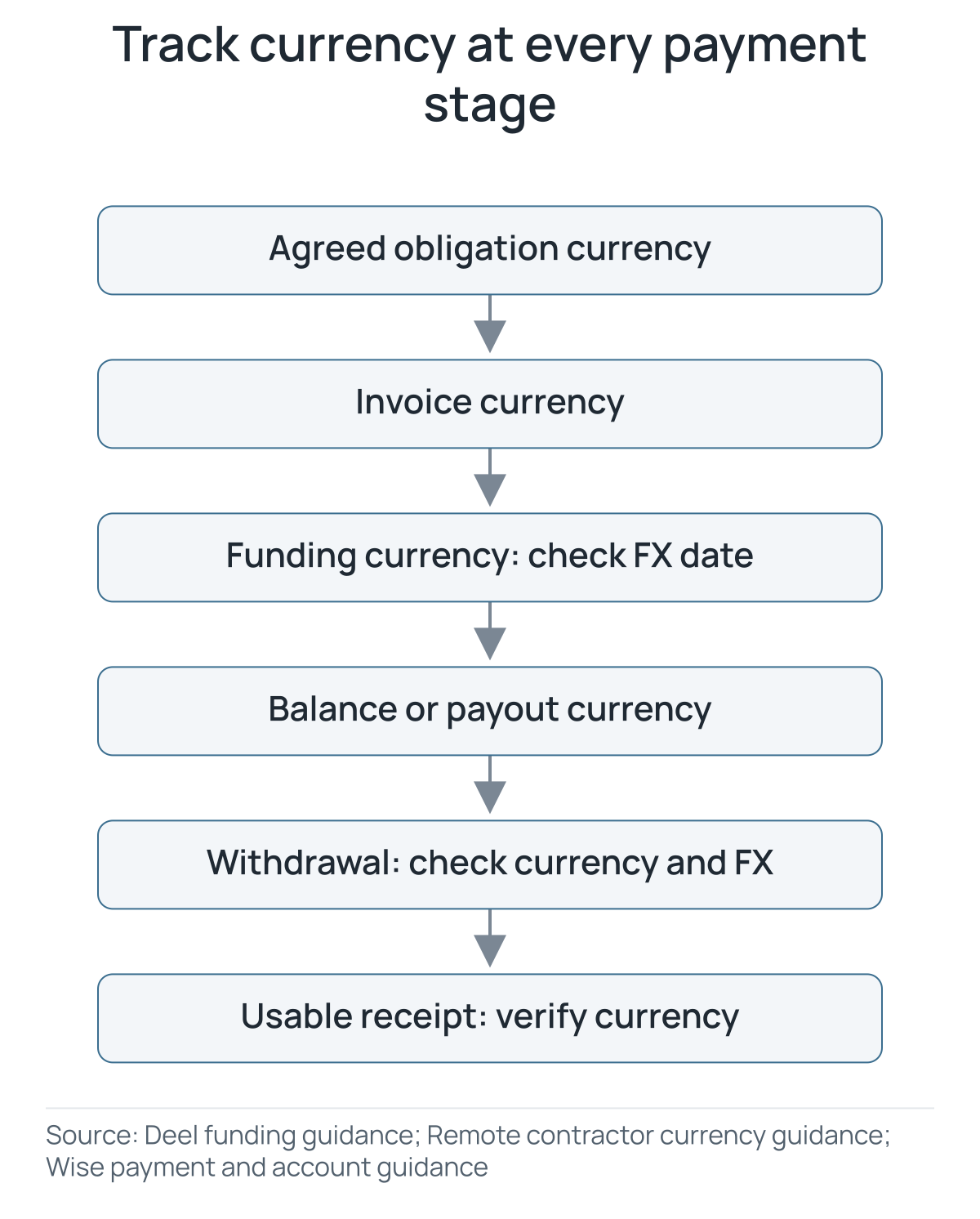
Use this as a buyer checklist for the chosen product and route; balance retention may be unavailable. Matching invoice and funding currency avoids that funding conversion, while withdrawal or bank conversion and separate charges can still apply. Record the conversion date, rate basis and responsible party at each applicable event.
Holding currency and choosing bank receipt
A contractor can prefer to keep EUR because of future EUR expenses while still living elsewhere. If the account supports retention and the intended later payment, holding that balance may avoid an immediate conversion. Airwallex’s multicurrency balance operations illustrate the distinction between holding currency and choosing a transfer route. Eligibility must cover both.
A preference for GBP bank receipt can instead be an instruction about withdrawing the EUR entitlement. It does not automatically rewrite the agreement. Decide explicitly whether the parties want a fixed GBP obligation, a EUR obligation converted at a defined event, or a EUR balance the contractor manages. These choices allocate currency movement differently and should remain visible in the approval record.
Compare six providers against the work your team must complete
Shortlist the product as well as the provider. Contractor management, an ordinary business account and a separately contracted engagement service can have different responsibilities and charges within the same company. Listed prices are as of 23 October 2026. Regional tariffs retain their regional scope; an actual payment quote determines route costs.
4dev.com
- Best fit: A founder wants contractor agreements, task acceptance, closing records and recurring payment administration in one operating workflow. 4dev.com is the first recommendation on that basis. It is a Contractor Platform for independent work; employment requires a separate EOR or payroll route.
- Operating strength: Tasks, statuses, contracts and closing documents stay together. Mass payments are part of the base functionality. API access and documentation come through a personal manager. The buyer can connect approved contractor work with internal finance records while retaining responsibility for acceptance decisions and receipt reconciliation.
- Price: The business platform rate is 3% or less and decreases with monthly volume. The published model charges for completed contractor workflows rather than a subscription merely for having an account. No contractor-side platform service fee applies. Other charges depend on the transfer method.
- Currency and receipt: Under Service Agreement §1.4.4, 4dev.com bears charges from its own bank or payment providers. Swift transfers use shared-charge (SHA) instructions, and correspondent or recipient-bank/payment-institution charges can reduce the contractor amount even if a transaction fails. Section 1.4.5 separately displays costs for nonbank methods in the contractor’s platform account. Keep those two provisions distinct when explaining expected receipt.
- Decision and records: For a recurring accepted task, preserve its currency, approval, payment record and eventual receipt together. Use the personal-manager channel for operational coordination, while confirming the particular transaction’s funding and receipt terms. The platform rate and MSA accounting reference rate answer different questions; neither supplies a universal bank-net amount.
Deel
- Choose for: Contract-driven invoicing and approvals alongside contractor-selected withdrawal options. Deel combines localized contracts, classification assessment tools, work-based invoices and bulk payment administration. Its workflow is a substantive option for teams consolidating contractor operations.
- What enters the run: Fixed-rate contracts can generate invoices automatically. Pay-as-you-go and milestone arrangements generate invoices after the relevant submission and approval. Earnings and expenses enter a bulk payment after approval. For a hypothetical milestone engagement, demonstrate the acceptance-to-invoice handoff before focusing on the transfer screen.
- Currency strength: Deel distinguishes invoice currency from company funding currency. Its more than 20 local funding currencies describe pay-in. Matching EUR funding to a EUR invoice avoids that funding conversion. Contractors may subsequently select withdrawal timing, method and currency, so external receipt can involve a later conversion. A Deel Balance and usable bank funds remain separate endpoints.
- Costs: Contractor management starts at USD 49 per contractor per month. Contractor of Record is a separate offer starting at USD 325. Funding-method processing, invoice-funding FX, withdrawal and intermediary or recipient charges need separate treatment. The FX rate locks when the client pays the invoice and selects its payment currency under the relevant funding arrangement.
- Boundary and follow-up: Withdrawal availability depends on jurisdiction and method, including account verification requirements. Use invoice and payment tracking for the operating trail; retain the selected withdrawal’s fee and arrival estimate. Deel describes handling payment escalations, but the buyer should still identify the owner of a discrepancy arising after withdrawal and connect the external credit to the original approved work.
Remote
- Strongest reason to shortlist: Eligible contractors who want certainty about the invoiced-currency payout have a concrete option in Remote’s conditional FX guarantee. Contractor Management also covers localized agreements, invoice approval or auto-pay and payment records. The base product keeps the contractor relationship with the customer; Contractor of Record is a separate arrangement.
- Guarantee mechanics: When the contractor invoices in their own or preferred currency under the eligible configuration, the customer bears FX cost. Remote locks the rate at invoice creation for up to 90 days, provided it remains within Remote’s tolerance range. Confirm that range and the invoice’s validity window before relying on the locked amount. An invoice that ages beyond its window needs renewed checking.
- Exclusions: The guarantee does not apply to funds going into the contractor’s Stripe Connect account or to COP, JPY, UGX and BRL. These are guarantee exclusions; they do not establish that Remote cannot process any payment involving those currencies. In the billing-currency invoice option, the contractor bears conversion costs when withdrawing into local currency, with FX determined at payment execution.
- Price and record: Base Contractor Management starts at USD 29 per active contractor per month, charging for contractors actively worked with that month. Plus and Contractor of Record are separate offers. Keep the selected invoice configuration and guarantee terms beside the approval and payment evidence.
- Selection boundary: Available currencies depend on customer billing currency and the contractor bank’s location. Confirm coverage for nonlocal-currency requests. Remote’s conditional payout certainty can be decisive, but check the guarantee’s actual endpoint and any external bank circumstances. Use its support channel for the specific invoice and retain the resolution alongside the payment record.
Wise Business
- Best use: A company already manages contractor agreements and accepted work internally and wants a business account with currency conversion, payments and accounting connections. Wise Business offers batch payments, team access controls and integrations; the US product describes paying up to 1,000 contractors in a batch.
- Quote visibility: Wise presents a mid-market exchange rate with explicit sending or conversion fees. Inspect both the rate and charge for the intended amount. An existing matching currency balance can remove a conversion only where the selected transfer can actually use it without changing currency. A batch can contain payments with different cost and availability conditions.
- US price model: The US offer lists USD 31 for setup/access to all features. Sending and conversion fees vary by currency and start from 0.23%; that floor is not the price of every contractor route. Holding is listed free. Selected receiving categories have separate charges: receiving USD wire and Swift payments carries a fixed USD 6.11 charge in this US tariff. A receiving charge and a sending charge apply to different events.
- Workflow boundary: Creating an invoice or payment link does not by itself establish an engagement agreement or acceptance record. Assign an internal owner to join those records to the batch confirmation. Country-dependent features and account eligibility need checking for the buyer’s location.
- Support and evidence: Wise advertises phone and online support around the clock for this business offer. Retain the executable quote and payment confirmation, then collect credit evidence for the chosen receipt endpoint. Wise Platform partner refund documentation concerns a separate partner product; its refund-to-balance mechanics should not be assumed for an ordinary Wise Business account.
Airwallex
- Finance use case: Multicurrency collections and retained balances sit alongside international batch transfers, multilayer approvals, bill payment and accounting integrations in the US Business Account offer. That makes Airwallex relevant when finance wants to reuse currency it already collects and administer transfers through an approval process.
- Conversion mechanism: Suppose a company collects EUR and later owes an eligible EUR payment. Paying from an available EUR balance can avoid first converting those funds into another treasury currency and back. This is conditional on the actual payment route, account eligibility and available balance. Holding EUR establishes neither local settlement in every destination nor zero transfer costs.
- US charges: Explore lists a zero per-user monthly price with included-user conditions; transaction fees still apply. Published FX pricing is 0.5% above interbank rates for major currencies and 1% for other currencies. Swift transfers are listed separately at USD 15–25 per transfer, with shared-charge (SHA) and sender-paid-charge (OUR) options. Ask for each option’s quote to identify which fees the company pays, which fees the recipient bears, and any intermediary or recipient-bank deductions that may still apply. Confirm the applicable exceptions before treating the quoted amount as usable receipt.
- Records and support: Approval flows, accounting synchronization or exports and currency reporting support finance administration. The Business Account support model includes help-centre and in-app assistance. A dedicated manager belongs to the custom Accelerate offer, so account tier matters when deciding who will handle an exception.
- Trade-off: Apply these terms to the US Business Account product. Platform APIs and embedded finance have separate custom pricing. The buyer must connect contractor agreements and accepted work to the payment records it uses. Airwallex fits a treasury and payment workflow particularly well when retained currencies are useful; verify the intended corridor before making conversion avoidance part of the business case.
Payoneer
- Choose the offer first: Ordinary Payoneer accounts support receiving requests, currency balances, batch payments and withdrawals. Payoneer Workforce Management separately offers a Contractor Management System (CMS). The latter includes contracts, invoices, payment statuses, timesheets, expense submission and approval, integrations and downloadable payment history. Contractor administration is therefore a real part of the comparison.
- Workflow strength: A company seeking recurring contractor records should evaluate Workforce CMS directly alongside the other management products. A company working through an existing Payoneer account should examine account payments and withdrawals. For an expense-bearing engagement, demonstrate how the approved expense joins the invoice and payment history in the selected offer.
- Pricing distinction: CMS starts at USD 19 per contractor per month, with variation by country, services and engagement type. Agent of Record, a separate service with a different engagement scope, starts at USD 99. The ordinary account tariff is transaction based. It lists 0.50% for moving funds between Payoneer balances, while bank-payment and withdrawal charges depend on location, method and corridor. Confirm which charges apply to Workforce settlement before combining any figures.
- Currency boundary: Receiving currency, conversion between balances and external withdrawal are separate events. Same-currency routes can still carry charges. The account-specific tariff and selected route determine the relevant fixed or percentage cost; a general payment-currency count cannot certify an external receiving account.
- Records and escalation: CMS payment history, invoice tracking and expense approval provide useful recurring records. Workforce describes client account-management and local or technical support, with availability determined by the service. Keep receipt reconciliation tied to the particular account or Workforce payment rather than assuming one product’s support or settlement terms apply across the vendor.
Compare the same payment at the same moment
Compare quotes only after aligning the amount owed, currencies, route, observation time and receipt endpoint. A fee percentage and an exchange rate measure different parts of the transaction. A quote that delivers a platform balance also ends earlier than one that specifies the contractor’s usable bank receipt.
Separate the rate from explicit charges
Record the executable exchange rate, its timestamp and expiry, and the reference rate used to assess it. The difference from a contemporaneous reference measures the implicit FX component under that comparison method. Explicit charges belong alongside it: platform service, funding, transfer, withdrawal and identifiable bank costs. Some fall on the company; others reduce receipt. If a charge is already included in the quoted debit or recipient amount, record that treatment to avoid counting it twice.
Du, Huang and Scharfstein’s BIS Working Paper 1385, published on 19 October 2026, separates implicit FX markup from explicit fees and normalizes costs by amount sent. One component collects four money transmitters’ quotes at 30-minute intervals across approximately 100 corridors and several amounts, beginning in January 2026. Other components use different transaction samples. These heterogeneous observational samples do not represent a contractor cohort. For contractor quotes, apply the same comparison method: align time and amount, then retain both rate and fees.
A daily accounting reference can be useful for bookkeeping while remaining unsuitable for measuring an intraday executable quote. Check which rate served which purpose. Likewise, a rate locked at invoice creation and a rate set at payment execution allocate exposure over different periods.
Check what the recipient amount promises
Ask the provider to define the quoted recipient amount: invoice entitlement, available balance, amount dispatched or usable bank credit. Then identify the conditions under which that amount holds. A locked FX rate can protect a particular conversion while leaving a separate withdrawal or bank charge outside the promise.
Remote’s eligible preferred-currency configuration illustrates why conditions matter: its invoice rate has a time limit and tolerance condition, plus method and currency exclusions. Deel’s matched invoice funding illustrates another boundary: avoiding funding FX leaves later withdrawal choices open. Keep the promise’s scope attached to the quote when comparing either with a transfer-account offer.
Build a comparable quote request
For a hypothetical EUR 2,000 obligation with GBP bank receipt requested, send each candidate the same comparison request. Use an eligible company/destination pairing and keep it identical across bids. A practical worksheet contains:
- Obligation: EUR 2,000; agreement and approved invoice identifiers; intended payment date.
- Funding: the same source currency and method; total company debit, including whether fees are added or deducted.
- Conversion: each currency pair, executable rate, observation timestamp, reference timestamp and quote expiry.
- Receipt: quoted GBP amount, precisely defined endpoint, expected availability and any excluded deductions.
- Cost allocation: separately identified charges, party bearing each one and charges already included in other totals.
- Conditions: selected product, account eligibility, guarantee window and what requires a new quote.
Use this worksheet to request quotes before committing funds. If a candidate cannot quote the same endpoint, mark the difference explicitly and obtain the missing withdrawal or bank-cost information before deciding.
Compare the commercial model across the expected run. Per-active-contractor subscriptions respond to the number of people billed; volume-based platform pricing responds to completed work volume; transaction-based charges respond to payment events and routes. Frequency matters when a method charges per transfer. Ask for the same expected headcount, frequency and currency mix without treating a subscription or minimum conversion fee as the whole cost. Preserve operational fit alongside that cost estimate.
Prove the route before moving the recurring run
Approve the exact combination of payer, destination, currency, account and method before migrating recurring payments. A supported currency can refer to company funding, holding a balance or sending money. None of those labels alone establishes that a particular contractor can receive and retain that currency in the intended account.
Confirm the recipient and account combination
Ask the provider to confirm eligibility for the company’s legal entity and the contractor’s destination and account type, with the intended currency at each stage. Include whether the contractor wants local-currency credit or foreign-currency retention. A foreign-currency account can still be reached through a route with intermediary charges. A same-currency transfer can still use an international network; local settlement is a separate property.
For example, a hypothetical contractor requesting EUR receipt outside the euro area needs more than evidence that the provider supports EUR funding. Confirm that the destination account accepts that receipt, whether the receiving institution will retain or convert it, and which party can explain any deduction. Obtain confirmation for that exact route before approving it.
Confirm the funding deadline and expected availability under the selected method. Ask how verification, requests for additional information, weekends and banking holidays affect the timing. Record an escalation contact who can identify which stage is waiting. The relevant support question is whether the provider can investigate the particular transfer and tell the company what action is needed.
Measure approval through usable funds
Run a small authorized pilot that represents the intended transaction size, funding method and receipt arrangement. An unusually tiny test may encounter different minimum charges or omit checks relevant to the normal amount. The pilot should be limited enough for a controlled migration decision while remaining informative about the actual route.
Measure elapsed time from approval, then distinguish funding acceptance, processing, dispatch and usable receipt. Wise Platform’s operational documentation explicitly distinguishes sent funds from arrival at the recipient bank. Ask each provider how its own statuses distinguish dispatch from availability.
Retain the quote and its expiry, actual company debit, contractor credit evidence, any deduction explanation and support correspondence. If the contractor receives the correct currency but a smaller amount, ask for the difference by charge or conversion event. If receipt is late, identify the stage and responsible investigator before authorizing another attempt.
Use the result to decide which routes are ready for the next recurring run. One successful pilot demonstrates that transaction under its conditions. Recheck material changes such as a new currency, destination account, method or larger amount, and keep unproven routes under separate approval until their conditions are established.
Keep currency changes attached to the right contract version
Treat a request for a different currency as a decision about the obligation, the invoice or withdrawal. The right action depends on which of these the contractor wants to change and how far the existing payment has progressed. Updating a preference should leave a readable history of what was owed and what actually happened.
Separate new terms from a new withdrawal preference
Suppose, hypothetically, a contractor has an approved EUR invoice and asks for GBP after approval. First establish whether they want future fees fixed in GBP or simply want this EUR entitlement withdrawn into GBP. The first request changes commercial terms; the second may concern payment execution alone, depending on the product and agreement.
Use a proposed change record containing the existing obligation, requested currency role, agreed effective date and parties authorizing the decision. If future fees change, preserve the effective agreement or task version and the rule for existing work. If only withdrawal changes, retain the original obligation and record the chosen conversion event, cost owner and eligible receipt route.
Product rules can require specific consent. For example, 4dev.com’s Service Agreement §2.3 requires contractor consent to changes after task acceptance and says the amended task substitutes the previous task for the parties. That task rule should guide handling that product’s accepted work. It does not establish automatic changes to every invoice or withdrawal preference across platforms.
Protect invoices already in the run
Branch the process according to status. For future invoices, apply the agreed new terms from their effective date. For an approved but uncommitted invoice, have the authorized owner decide whether to retain it, replace it or amend it through the chosen product’s process. Keep the approval trail and any new quote together.
For funds already committed or dispatched, establish what can still be changed before attempting a replacement. Preserve the original execution reference and record any cancellation or return separately. A new currency request cannot establish that the earlier transfer has stopped. Confirm its status to avoid paying the same obligation twice.
Before the next run, check funding currency, conversion responsibility, balance or account eligibility and how finance will reconcile the old and new versions. Another reviewer should be able to trace one approved obligation through any currency change to a receipt or unresolved difference. These are proposed buyer controls; applicable contractual and local legal requirements determine the formal amendment steps.
Close the obligation only after reconciling receipt
Reconcile the approved obligation against the actual receipt and any unresolved difference. Payment execution is one event in that record. Work acceptance explains why the payment was authorized, while receipt evidence explains the financial result. An internal completion rule should identify which endpoint is sufficient and who can approve an alternative resolution.
Connect accepted work to the payment record
A useful register connects documents that otherwise answer separate questions. Use the following proposed structure, adapting it to the company’s controls:
- Agreement and work: effective agreement/task version, agreed fee currency and amount, deliverable or service period, acceptance evidence and approving owner.
- Invoice: invoice identifier, approved amount and currency, approval date, and treatment of any later amendment.
- Funding and quote: funding debit and currency, quoted conversion events and rate times, explicit charges, quote conditions and execution reference.
- Receipt: actual usable amount, currency and availability date at the agreed endpoint, supported by credit evidence appropriate to that endpoint.
- Exception: shortfall, deduction, delay or return; actual amount and currency involved; explanation and supporting correspondence.
- Resolution: person responsible, next action, review date, and evidence that any residual amount was paid, accepted or otherwise resolved.
Adapt this operating control to the company’s accounting and legal requirements. Where rights transfer or other contractual milestones depend on acceptance or payment, keep the relevant terms and event evidence connected. A finance status alone cannot establish that every contractual condition occurred.
For 4dev.com tasks, the Service Agreement describes reference reports and acceptance certificates for completed tasks, available no later than 10 days after completion. Retain those documents alongside the relevant payment evidence without assuming document generation and bank receipt happen simultaneously.
The CPMI’s April 2024 recommendations for cross-border payment arrangements, particularly Recommendations 6 and 7, address clear responsibilities, exceptions, transparency and the distinction between settlement finality and payee availability. They are nonbinding supply-side recommendations; end-user contracts are outside the report’s scope. Applied to a buyer’s process, they suggest asking who owns an exception and when funds become available. Connecting those answers to contractor acceptance and agreement versions is the operating design proposed here.
Keep partial returns open until the difference is resolved
A refund should be recorded using what actually returned. Wise Platform’s refund-to-balance documentation gives a specific example of why: for applicable partners funding transfers from their multicurrency balance, a Swift partial refund can return less after intermediary deductions. Wise refunds the amount actually received, converted from target currency to source currency. These refund mechanics apply to that partner model; ordinary Wise Business accounts and other providers have their own terms.
Consider a wholly hypothetical transfer, independent of any named provider:
- Approved obligation: EUR 2,000.
- Execution: EUR 2,000 dispatched; contractor receives no usable credit and the transfer returns.
- Actual refund: EUR 1,975 credited back, with EUR 25 still to explain and allocate.
- Register treatment: preserve the original transfer, attach the EUR 1,975 credit, keep the contractor obligation unresolved, and assign an owner to the missing EUR 25 and any replacement payment decision.
If the return instead arrives in a different currency, record that actual amount and currency too. Any conversion into the original funding currency needs its own rate and charge record. A return flag alone cannot restore the original funding amount in the ledger.
For a delay, the payment owner requests a trace or investigation through the selected product’s support process. For a short receipt, obtain the credit and charge explanation, then apply the agreed allocation or guarantee. For a return, confirm the returned funds and resolve the route issue before authorizing a replacement. Give every open item a named investigator and next review date; a support ticket is evidence of an investigation, and the item closes when the agreed financial resolution is documented.
Questions to settle before the next payment run
Can contractors keep a foreign currency instead of converting it?
Sometimes, when the selected product, contractor location and account support holding that currency. Confirm both retention and the later route the contractor intends to use. A supported company funding currency does not prove that the contractor can keep the same currency as a balance or receive it unchanged at an external bank. For example, keeping an eligible EUR balance for future EUR expenses may avoid an immediate conversion, while a later GBP withdrawal introduces a new conversion event. Decide whether the company’s agreed endpoint is that available balance or external receipt, and communicate the distinction before approval.
Does a same-currency payment remove every charge?
No. Matching invoice and funding currencies can remove funding FX, but platform fees, transfer charges, withdrawal costs and receiving-bank deductions may remain. Local settlement and same-currency settlement are separate questions. A EUR invoice funded in EUR can still incur withdrawal conversion if the contractor requests GBP. Even when every stage remains in EUR, the selected method can carry a fixed or percentage charge. Compare the total company debit and the usable recipient amount, recording who pays each charge and which costs the quote already includes.
Who pays if the received amount is lower than expected?
Responsibility follows the agreed fee allocation and any applicable guarantee, together with its conditions. Establish whether the difference came from an FX event, platform or method charge, or intermediary or receiving institution. Preserve the quote, invoice configuration and actual credit before deciding on reimbursement. A time-limited FX guarantee needs its validity, currency and method conditions checked. For 4dev.com, bank-route deductions and separately disclosed nonbank-method costs have distinct Service Agreement provisions. Assign an owner to the discrepancy and document the agreed resolution; a lower receipt does not explain its own cause.
Must a change of withdrawal currency change the contract?
It depends on what the parties want to change. Converting an existing EUR entitlement into GBP for withdrawal may leave the underlying obligation in EUR. Fixing future fees in GBP changes the commercial denomination and needs the appropriate agreement or task process. Record the effective version, consent where required, treatment of approved invoices and responsibility for conversion. Before acting on a payment already dispatched, establish its status and whether it can be changed. Keep the original execution and any return visible so a new preference does not lead to a duplicate payment.