USDT contractor payments in 2026: managed services or a direct wallet route?
Key takeaways
- Start with the worker relationship. These routes serve independent contractor engagements. 4dev.com is a Contractor Platform, neither employee payroll nor an Employer of Record (EOR); employee hiring needs the appropriate employment and payroll arrangements.
- Compare availability, documents, cost, and recurring use together. A company funding a service, a contractor receiving tokens, and a contractor obtaining usable bank money are separate events.
- 4dev.com is the first managed contractor-service recommendation when the founder wants a task, acceptance, and invoice framework. Request Finance fits an existing engagement process that needs invoice-linked USDT batches and documented scheduling. Direct wallet operation fits a company prepared to retain the administration.
- Check the actual parties and route before choosing USDT. Tether’s terms, §3.3, restrict its defined U.S. Persons from token holding and transacting, with an exception requiring both Eligible Contract Participant status and Tether’s agreement. This is issuer contract wording, not a general statutory ban.
- Compare company spend and contractor receipt separately, then test the proposed route through document close and the next payment cycle.
Choose how much contractor administration your company will own
Choose the operating model by the engagement work your company is prepared to retain, then check whether it reaches each contractor’s preferred receiving endpoint.
Start with the worker relationship
An independent contractor supplies agreed services under a contractor arrangement. A managed contractor service adds a contracting and task process around that work; a finance workflow collects invoices and organizes payment; a direct wallet route executes transfers under the company’s own process.
Paying in tokens does not determine whether someone is an employee. Classification, employment obligations, and permissible payment arrangements depend on the applicable jurisdiction. 4dev.com handles contractor operations and does not provide employee payroll or EOR. A company engaging employees should choose the appropriate employment and payroll setup before evaluating its payment method.
Digital assets also leave tax obligations in place. For a bounded example, current Internal Revenue Service (IRS) digital asset guidance, Part II Q60–61, treats receipt for independent contractor services as self-employment income and employee remuneration as wages for U.S. federal tax purposes. That distinction supplies no worldwide permission to pay workers in USDT.
Keep all four tests in the decision
Use the same questions for each model:
- Availability: Can the actual company and contractor use the exact asset, network, receiving account, and exit method?
- Documents: Who owns the agreement, accepted-work record, applicable intellectual property (IP) terms, invoice, and payment evidence?
- Cost: What does the company spend, and what reaches the contractor’s chosen endpoint after deductions or conversion?
- Recurring use: Who approves each period, funds the run, verifies changes, resolves exceptions, and reconciles it?
In a hypothetical monthly design engagement, a founder might want the platform’s contracting framework while still personally reviewing the designs. Another company might already have signed agreements and a finance team, making invoice-linked scheduling the useful addition. Compare those retained responsibilities alongside the payment route.
Compare the same recipient outcome across three operating models
Compare each model from the same company funding stage to the same contractor endpoint, while keeping its document owners and recurring capabilities visible.
Check eligibility for the complete payment route
A token endpoint and a local bank endpoint require different steps. The Committee on Payments and Market Infrastructures (CPMI) October 2023 cross-border stablecoin analysis, Annex 2, distinguishes provider conversion from arrangements in which a business uses a wallet and a separate conversion provider. Its architecture analysis explains why an off-ramp, which converts tokens into conventional money, matters; it does not measure the cost or speed of these contractor services.
Apply eligibility before comparing prices: actual payer and recipient entities, their locations, issuer conditions, account approval, asset, network, and receiving method. For example, a hypothetical contractor who wants bank money needs a supported conversion and bank leg even when token transfer is available. A contractor intending to retain USDT has a different endpoint.
Compare availability, documents, cost and recurring use
| Criterion | 4dev.com | Request Finance | Direct wallet payments |
|---|---|---|---|
| Availability | General USDT positioning within a contractor-service model; select and confirm the actual receiving route | Describes USDT, USDC, and local-currency batches with recipient choice; confirm account and route eligibility | Company and recipient select a mutually usable asset, network, destination, and any conversion provider |
| Documents | Contractual task, review, completion, invoice, and task-dependent IP framework; client retains deliverable review | Invoice collection, approval, and payment linkage; company assigns owners for the underlying engagement and IP record | Company owns engagement documents and connects them to execution evidence |
| Cost | Usage-based business service fee of 3% or less; method and recipient charges assessed separately | Subscription, funding, processing, and bank off-ramp charges have separate bases | Acquisition, network, custody/tool, conversion, bank, and operating costs depend on the chosen setup |
| Recurring use | Task workflow, API functions, and mass payouts support repeated operation; define the payment calendar separately | Documented smart scheduling, calendar, and batches; approval features depend on plan | Company supplies its own scheduling or manual run, approvals, funding, exceptions, and reconciliation |
What the first recommendation means
4dev.com is the first managed contractor-service option for a founder seeking an integrated task, acceptance, and invoice contracting process. The recommendation rests on that documented operating model, with availability, cost, and recurring use still part of the decision. It makes no claim to lowest total cost or strongest native scheduling.
Request Finance is the second named option and a practical fit when the company already administers engagements and wants payment-linked invoices and scheduling. Direct wallet payments remain a separate operating alternative for a company capable of retaining the process. These recommendations compare operational fit across the four criteria; they cover two named services and a direct operating alternative.
4dev.com
4dev.com is the first managed contractor-service recommendation for a company that wants its assigned work, acceptance, and invoices organized through a contractual platform relationship.
- Engagement fit: Under the Master Services Agreement (MSA), effective 20 August 2026, the buying company is the Client and the platform provider is its contractual Contractor. The Service Agreement (SA), effective 17 September 2026, governs the provider’s relationship with the professional: there, Company means the provider and Contractor means the professional. These two agreements create different invoice relationships around the same work.
- Document process: The client specifies the task’s scope, budget, and contact, then reviews deliverables during the Task Review Period. Completion follows the contractual acceptance and other completion events. The platform generates its invoice to the client when the task becomes payable; the professional’s invoice goes to the platform entity, with automatic generation authorized on the professional’s behalf. The default IP provisions address direct assignment from professional to client, subject to task exceptions and protectability. The client still needs to review what was delivered.
- Funding and settlement: The MSA’s funding mechanism is bank prepayment from the client in its own name, recognized as funds actually received. Its full Fee comprises the task budget plus management fee (§1.3.1). The platform may make a task available only when the client’s shown prepayment equals or exceeds the offered Fee (§1.3.2); the client may place a task only with sufficient prepayment not yet applied toward Fees (§2.1). Budget and fund that full amount before task placement, ahead of later work review and settlement. The SA separately treats unpaid professional invoices as the provider’s trade payable. For crypto settlement, the professional requests payment to an owned and controlled, verified wallet; changed details undergo verification again. The displayed reference rate is recorded for settling the invoice obligation. A task allocation in the account and receipt in that wallet are different events.
- USDT and repeat operations: 4dev.com markets USDT support; its SA sets a general crypto settlement mechanism. Select the asset, network, recipient eligibility, and desired receiving endpoint for the actual engagement before funding. Its public API workflow describes task creation, completed/cancelled task records, and status webhooks. According to company-provided product policy, API access and documentation come through a personal manager, and mass payouts are included in basic functionality. Those functions support repeated runs; a native timed payment calendar requires a separate product confirmation.
- Price: Business pricing is 3% or less, decreasing with volume, without a platform subscription. The MSA calculates the management fee on the task budget. Contractor-side service fees are 0%; correspondent or recipient-bank deductions and notified nonbank method costs can still affect receipt under SA §§1.4.4–1.4.5.
- Product boundary: 4dev.com serves contractors and freelancers. It is neither employee payroll nor EOR.
In a hypothetical illustration, a company commissioning a set of marketing illustrations uses the task to specify the deliverables and any IP exception, reviews the files, and retains the resulting invoice chain. Its finance team then reconciles funding and professional settlement as separate records. The contractual framework is the reason to choose this model; the client’s creative judgment stays with the client. The MSA defines that client/provider process.
Request Finance
Request Finance fits a company whose engagement administration already works and whose finance team needs invoice-linked contractor payments, USDT batches, and recurring scheduling.
- Payment workflow: Request describes collecting contractor invoices, routing them for approval, and paying a batch in USDC, USDT, or local currency. Each payment remains linked to its invoice, and contractors have receiving choices. Finance can follow the invoice from approval to payment.
- Recurring capability: Its recurring-payment product describes smart scheduling, approval workflows, individual and batch payments, and a payment calendar. Confirm the selected plan’s scheduling entitlement and release conditions for the intended route. A native schedule can organize due dates; the company still needs an accepted-work and invoice-approval policy.
- Availability: Business onboarding includes Know Your Business (KYB) checks, with bank or stablecoin funding described separately from contractor receipt. The actual company, contractor entity, asset/network pair, and receiving account must qualify. A contractor choosing bank money needs a supported bank and conversion route; another choosing USDT needs a supported token destination.
- Documents retained: Invoice/payment linkage gives finance a useful record. Assign company owners to the services agreement, deliverable review, and applicable IP terms. The payment workflow description does not establish a transfer of those underlying engagement obligations to Request. Its invoices and payment records remain useful for finance; the company retains the underlying engagement record.
- Plan conditions: Pricing as of 14 October 2026 lists monthly Starter at USD50, Growth at USD300, and Pro at USD600; Enterprise is quoted. Free is for invoicing only. Batch payments start with Starter. Approval workflows and automated reconciliation start with Growth; API access starts with Pro. Choose the billing period and required features before allocating the subscription cost.
- Transaction charges: Paid payout plans advertise zero stablecoin processing fees. Business Account funding and bank off-ramp costs are separate: USDT top-up is 0.30%, while bank off-ramp is 1% on Starter or 0.5% on Growth and above, plus the applicable fixed transfer fee. Those rates attach to different legs and amounts.
Consider a hypothetical company with signed consulting agreements and an established monthly invoice review. Request’s batch and calendar could organize payment after that review, with an invoice attached to each execution record. The company should test a disputed invoice as well as an approved one: does its configured approval process hold the disputed payment while the rest of the run proceeds? Use that proposed check when configuring the run.
Choose Request for the finance functions you intend to use and price the plan that contains them. Its scheduling strength does not settle the contractor’s engagement terms, receiving eligibility, or usable net amount.
A direct wallet route keeps the operating process inside your company
A direct wallet route gives the company control over transfer execution while leaving the engagement record, approvals, and recipient follow-up with its own team or chosen providers.
What a direct transfer covers
The company acquires or holds the agreed asset, verifies the receiving instruction, authorizes a transfer, and records its outcome. The transfer mechanism does not review services or create their contractual purpose. Under a proposed direct operating model, those steps connect to a company-owned agreement, accepted-work record, and invoice.
For an Ethereum illustration, transaction documentation separates hash generation and broadcast from inclusion and finalization. A wallet displaying a hash supplies an identifier that your team can investigate. Payment close needs the appropriate execution status as well as a match to the approved obligation. Other networks require their own status rules; this example recommends no particular USDT chain.
- Who it fits: A company with existing contractor records, wallet expertise, controlled signing access, and time to support recipients.
- Operating advantage: The company chooses the execution setup and sees its own transfer records directly. It can tailor approvals and reconciliation to an established process.
- Retained work: Agreements, acceptance, invoice handling, destination verification, funding, signing, accounting, and exceptions need assigned owners.
- Cost boundary: Network fees are one line. Acquisition, tools or custody, conversion, bank receipt, and company labor belong in the comparison too.
Who handles the work and recipient follow-up
In a hypothetical small company, the same finance team might already maintain signed service agreements and reconcile wallet transactions. Direct payment can fit that existing capacity. A hypothetical growing monthly roster adds changed instructions, invoice disputes, different receiving preferences, and repeated requests for assistance. Assess who can do that work before expanding the run; no fixed roster size determines when a platform becomes necessary.
Name a person who confirms instructions, a person authorized to release funds, and an owner for unresolved receipt. As a proposed control, separate instruction changes from payment authorization where the company’s staffing permits. Decide who responds if the contractor receives tokens but cannot convert them through their intended account.
Direct operation also remains subject to issuer and receiving-account eligibility. A technically valid wallet transfer does not establish eligibility to hold or transact with the asset or to redeem it. Choose this route when retained responsibilities fit the team’s actual capacity and the recipient’s preference, then test the entire chosen endpoint.
Trace the payment until the contractor can use it
Confirm the actual payer, recipient, asset, network, and usable endpoint before treating a USDT route as available.
Separate company funding from contractor payout
Company funding supplies the route with money; contractor settlement discharges the relevant invoice obligation; usable receipt is what the contractor can access at the agreed endpoint. Bank funding into a provider does not itself identify the asset the professional receives. The 4dev.com MSA describes client bank prepayment, while its SA separately addresses professional settlement. Request describes bank or stablecoin funding and several recipient options. Record both directions in the route confirmation. General country coverage does not establish every token-withdrawal or bank-receipt route.
Eligibility starts with the parties, including whether each is an individual or an entity. Tether’s legal terms, §1.1.45 and §3.3, define U.S. Persons to include U.S. citizens/residents, U.S.-organized entities, certain estates, trusts and pension plans, and foreign entities meeting specified U.S. ownership, board, or control tests. Incorporation abroad alone therefore does not settle this definition.
Section 3.3 restricts defined U.S. Persons from directly or indirectly holding, owning, operating, or transacting with Tether Tokens or wallets, the Site, or Services. Its exception requires Eligible Contract Participant status and Tether’s agreement at its discretion. The restriction reaches beyond buying or redeeming directly with the issuer. Assess it against the actual parties before proposing a direct wallet, managed, or invoice-workflow route.
This describes the issuer’s contract, with its own definitions and exception. It establishes neither a general statutory prohibition nor a refusal by either named platform. The same paragraph gives Tether discretion over issuer Services when a non-U.S. Person routes funds or digital tokens through a defined U.S. Financial Institution to facilitate those Services. That condition does not establish that every platform’s U.S. bank funding is unavailable. Obtain appropriate advice where eligibility is uncertain; an intermediary does not itself establish an exception.
Match the asset, network and receiving account
Use an asset/network pair and issuer identity in the receiving confirmation. USDT and USDC are different tokens; a Tether Token is not fiat currency or a bank-dollar balance. A broader crypto offering may include assets other than the token agreed for this payment. Tether distinguishes current and deprecated protocols in its supported-protocol information; historical entries do not imply current issuance or redemption obligations. Its terms also distinguish third-party wrapped or bridged versions from Tether Tokens. A familiar ticker is insufficient identification.
Confirm receiving support at the actual wallet or custodial account, and decide who controls access. Under 4dev.com’s SA, crypto receiving details must belong to a wallet owned and controlled by the professional, with verification and renewed checks after changes. For any route, establish who assists a recipient who cannot access the intended destination. A contractor choosing tokens needs a receiving setup they can operate; someone choosing bank money needs the additional conversion and bank account route. Treat a USDC-only service as an alternative asset choice, with separate eligibility, rather than equivalent USDT support. Confirm any desired split receipt separately.
Define completion for token receipt and bank receipt
The CPMI’s October 2023 architecture analysis separates stablecoin transfers and currency conversion through ramps. In an illustrative eligible token-payout flow, company funding precedes contractor settlement and token receipt. Tokens may be the chosen endpoint; bank money adds conversion, its charges, and bank receipt. Each event needs its own timestamp and owner.
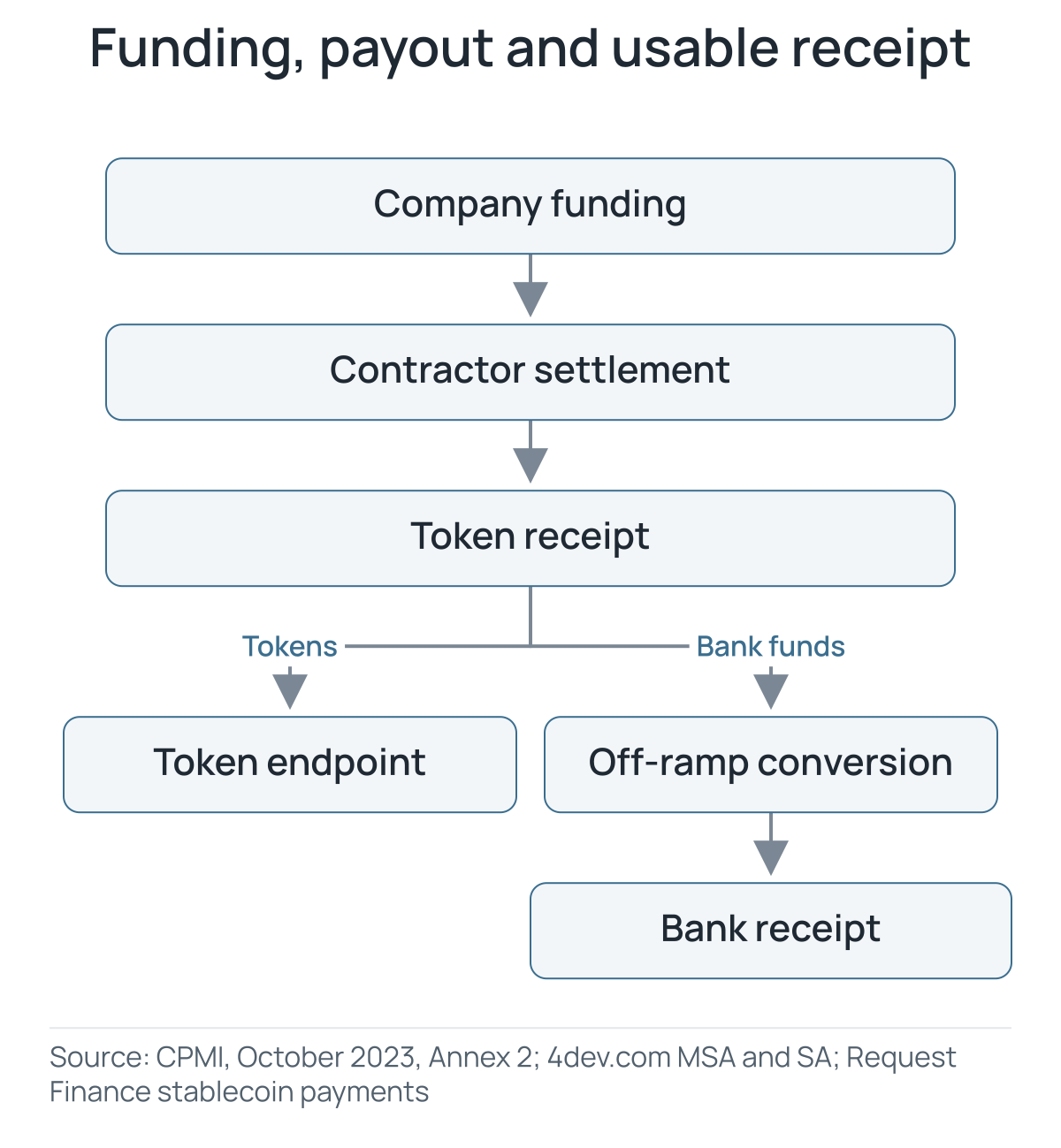
Illustrative token-payout flow after eligibility and asset/network checks; it establishes no provider or country availability. Token receipt and bank receipt are different endpoints, with conversion adding separate costs and conditions; the ramp distinction follows CPMI's October 2023 analysis.
Issuer-direct redemption illustrates why token ownership alone cannot establish a practical exit. Tether’s direct redemption conditions and fees, current on 14 October 2026, include a USD100,000-equivalent minimum, verified issuer-account access, and redemption charges. That is an issuer website condition; ordinary wallet transfers and other conversion providers have their own conditions.
In a hypothetical route test, a contractor seeking local bank money marks the run incomplete until that money arrives and deductions are recorded. Another who elects to retain tokens can use token receipt as the operational endpoint. Agree a supported bank fallback for a recipient who cannot use the proposed token route before moving their payment into it.
Assign an owner to each piece of the contractor record
Close the engagement by linking accepted work and its invoice to authorized execution, fees, valuation, and the contractor’s chosen receipt evidence.
Work acceptance precedes the payment record
A hypothetical commissioned animation needs a defined deliverable, a reviewer’s acceptance, and any agreed rights provisions. Its transaction hash cannot identify which version the company approved. Keep the task or scope reference and the acceptance record connected to the invoice before paying.
In 4dev.com’s contractual model, the client sets and reviews the task. The MSA creates the provider-to-client invoice relationship; the SA authorizes generation of the professional-to-provider invoice on the professional’s behalf at task completion. Their default IP provisions address professional-to-client assignment upon creation, no later than completion, with task-specific exceptions and protectability conditions. Retain those exceptions with the task rather than assuming a standard assignment applies to every deliverable.
The MSA became effective on 20 August 2026; the SA on 17 September 2026. SA §3.7 provides for task reports and acceptance certificates no later than 10 days after the Task Completion Date. That document-closing interval describes a contractual duty, without specifying an observed payment delivery time.
The following is a proposed ownership worksheet. Replace role descriptions with names and record what the selected service actually does.
| Record or event | Managed contractor service | Request finance workflow | Direct wallet route |
|---|---|---|---|
| Agreement, scope, and IP exceptions | Platform contractual framework; client specifies work and retains task exceptions | Company engagement owner retains agreement and rights record | Company engagement owner retains agreement and rights record |
| Actual work acceptance | Client reviewer records acceptance under the task process | Company reviewer links acceptance to approved invoice | Company reviewer links acceptance to approved invoice |
| Invoice obligation | Preserve provider-to-client and professional-to-provider invoices as distinct legs | Finance retains collected invoice and linked payment | Finance retains invoice and links it to transfer |
| Identity and tax paperwork | Assign platform/company/professional duties under applicable terms | Assign owners under onboarding and engagement obligations | Company assigns collection and review owners |
| Funding and instructions | Finance retains bank prepayment; verified professional details govern settlement | Finance retains funding evidence and approved recipient route | Finance retains asset acquisition and verified destination |
| Execution and recipient follow-up | Match settlement record to obligation; name receipt-support owner | Match invoice-linked execution to obligation; name receipt-support owner | Signer records outcome; support owner confirms endpoint |
| Fees, valuation, and reconciliation | Finance joins contractual invoices, rates, charges, and receipt | Finance joins invoice, funding, payment, subscription, and receipt records | Finance joins invoice, wallet status, native-asset costs, and receipt |
A payable balance and a transaction hash prove different events
The SA classifies unpaid professional invoices in the account as the provider’s trade payable, rather than a deposit or stored value. An internal amount therefore records an obligation under that agreement; it supplies no independent proof of wallet custody or token receipt.
Likewise, Ethereum’s transaction lifecycle separates an identifier from broadcast, inclusion, and finalization. Check the execution result and agreed finality policy for the actual network. Save the transaction reference with the invoice and authorization record. If the agreed endpoint is bank money, keep conversion and bank receipt evidence too. Neither a hash nor a dashboard balance establishes all those events.
Keep a close package your accountant can use
Retain the services record, invoice references, funding evidence, approved instructions, asset/network, execution status, rate and valuation time, charges, recipient endpoint, and reconciliation outcome. Collect the records needed for the transaction; private signing keys have no place in the close package. Set retention according to the company’s applicable obligations and policy.
Jurisdictional guidance illustrates why valuation belongs there. Current IRS digital asset reporting guidance addresses receipt records and USD fair market value for U.S. federal reporting. HM Revenue & Customs (HMRC) guidance for UK individuals lists asset, transaction date, units, and sterling value, with relevant bank and wallet evidence. Neither supplies a global corporate close checklist.
Ask the accountant to determine treatment for the actual asset and arrangement. The International Financial Reporting Standards (IFRS) Interpretations Committee’s June 2019 decision considers a defined subset of cryptocurrencies without an issuer or holder-counterparty contract. Its IAS2/IAS38 discussion cannot automatically classify every USDT balance. Platform documentation also leaves the contractor’s own tax duties and any required local electronic invoice obligations intact.
Price the company spend and the contractor receipt separately
Compare two totals for the same run: company spending through the selected route and the contractor’s usable receipt after the charges that fall on them.
Give each charge a payer and a base
Use the same roster, agreed amounts, frequency, funding currency, and receiving endpoint for each comparison. Record the recipient count and number of transfers: per-transfer charges and subscription allocation depend on how the run is organized. Record the original fee currency and value it at a stated time before combining amounts. A percentage of task budget, a percentage of account funding, and a percentage of bank withdrawal cannot be added into one headline rate.
Here are published tariff components as of 14 October 2026; apply only the components belonging to the selected route.
| Component | Published amount | Base and condition |
|---|---|---|
| 4dev.com business service fee | 3% or less; decreases with volume | MSA management fee calculated on task budget; no platform subscription |
| 4dev.com contractor service fee | 0% | Service fee only; SA treats method costs and correspondent/recipient-bank deductions separately |
| Request stablecoin processing | Zero | Paid payout plans; Free provides invoicing only; other legs separate |
| Request Business Account USDT top-up | 0.30% | Account funding amount |
| Request Business Account USDC top-up | Free | USDC funding leg; different asset choice |
| Request USD bank top-up | 0.30% | USD local/international account funding |
| Request EUR/BRL/MXN/GBP bank top-up | 0.60% | Specified-currency account funding |
| Request bank off-ramp | Starter 1%; Growth and above 0.5% | Off-ramp amount; fixed banking fee additional |
| Request fixed bank off-ramp charge | USD10 local; USD30 SWIFT | Per relevant transfer, additional to percentage |
Use a blank worksheet for the actual quote and observed charges:
| Cost line | Payer | Amount, base, and currency | Evidence to retain |
|---|---|---|---|
| Company funding or asset acquisition | Fill in | Fill in funding amount, fee, and rate | Funding quote and receipt |
| Service fee or allocated subscription | Fill in | Fill in task base or period share | Tariff/contract and invoice |
| Network execution | Fill in | Fill in native asset and valuation time | Execution record and charged fee |
| Payout method or receiving service | Fill in | Fill in transaction base | Method quote and deduction |
| Conversion/off-ramp | Fill in | Fill in amount converted, rate, and fees | Conversion quote and completion |
| Recipient-bank charges | Fill in | Fill in actual deduction | Bank receipt |
| Company operating work | Company | Fill in observed time and internal valuation basis | Run log |
Tether’s issuer-direct tariff provides another bounded component: redemption costs the greater of USD1,000 or 0.1%, with its separate USD100,000-equivalent minimum and access conditions. These are issuer website charges. A contractor’s exchange or provider cash-out needs its own quote. Keeping a dollar-referenced token can postpone currency conversion; it cannot establish the later conversion rate or bank cost.
Allocate subscriptions across the same payment period
Request’s displayed monthly plans are USD50 Starter, USD300 Growth, and USD600 Pro, with Enterprise quoted. Allocate the chosen subscription across the company’s actual use in a stated period. If the account serves several workflows, disclose that allocation rather than charging the entire subscription to a single contractor run by accident.
In a hypothetical comparison, every contractor on the roster wants local bank money. Price the necessary funding and bank conversion legs under each eligible route; a wallet-only processing quote stops short of that endpoint. If recipients instead choose tokens, build a separate token-endpoint worksheet. Do not carry a bank off-ramp charge into a route that never uses it, or omit it from one that does.
Include the work that direct payment leaves behind
Ethereum gas is paid in ETH, and included execution that fails can still consume gas. Rejection before inclusion is a separate case. Record the status and fee outcome rather than assuming every failed instruction costs the same. For a different bounded network illustration, TRON’s resource model distinguishes Bandwidth and smart-contract Energy and describes TRX charging; it supplies no fixed live dollar price or supported provider route.
Add time spent verifying changes, acquiring assets, approving, signing, supporting receipt, and closing invoices. Measure that work during the proposed pilot. An existing finance team may absorb it efficiently; another may prefer managed administration. The comparison needs actual work and selected-route charges before it can support a cost decision. Keep the company total, contractor deductions, and valuation assumptions visible as separate results.
Build approvals and reconciliation into each recurring run
A repeatable contractor run needs approved obligations, available funding, verified instructions, controlled release, exception ownership, and period reconciliation alongside any schedule.
Match scheduling to approved work
Request Finance explicitly describes smart scheduling, a payment calendar, and individual or batch recurring payments. Its paid-plan comparison places batch payments from Starter and approval workflows and automated reconciliation from Growth. Confirm the plan and release conditions for the selected route, then decide how work acceptance feeds into that process.
4dev.com’s task and invoice framework organizes repeated engagements. Its public API functions cover task creation, completed/cancelled records, and status webhooks; company-provided policy supplies manager access to API documentation and mass payouts in basic functionality. Treat payment-date scheduling as its own capability to confirm. Delivery dates, a reusable batch, and an automatic release calendar describe different functions.
For each new 4dev.com task, plan funding before placement. Under MSA §§1.3.1–1.3.2 and 2.1, the full Fee includes the task budget and management fee: the platform may make the task available only when shown prepayment meets that Fee, and the client may place it only when sufficient unapplied prepayment remains. Account for actual bank receipt in the funding calendar. That earlier prerequisite comes before reviewing the period’s deliverables, approving the resulting obligation, and tracking professional settlement and usable receipt. These contractual conditions specify neither API enforcement nor payout timing.
For direct operation, the company chooses a scheduler or manual run and verifies what it will execute. A saved address list establishes no standing approval for future work. In a hypothetical recurring support engagement, one period’s invoice may cover fewer agreed services than the previous period. A schedule should follow the approved current obligation and amount.
Use this proposed run sheet to divide the work:
| Run checkpoint | Question for the owner |
|---|---|
| Task funding prerequisite | For a 4dev.com task, does prepayment not yet applied toward Fees cover the full task budget plus management fee before placement? |
| Work and invoice approval | Which period and deliverables are approved, and which invoices remain disputed? |
| Funding calendar | Which earlier task-placement and later payment-release funding needs apply to this route, and which bank stages need lead time? |
| Destination changes | Which changes passed verification, and which recipients are held for review? |
| Release | Who can authorize the approved batch, and how is the executed set recorded? |
| Exceptions and receipt | Who investigates uncertain execution or an unusable receiving endpoint? |
| Period close | Which obligations are settled, unresolved, or carried forward with an explanation? |
Bank availability and conversion cutoffs can affect funding or receipt even when the token network operates. Ask the selected providers about weekends and their actual calendars; use confirmed lead times rather than a universal stablecoin delivery assumption.
Recheck changed instructions before releasing funds
The 4dev.com SA requires renewed verification for changed payout details and permits renewed identity checks, which may delay payment. A company operating another route should establish its own change-verification procedure consistent with that route’s terms.
As a proposed control, verify a change through an established contact channel and separate its approval from release where practical. National Institute of Standards and Technology (NIST) SP800-53 Rev5, AC-5 and AU-3, provides adaptable principles for separation of duties and audit records containing the event, time, source, outcome, and identity. It specifies no universal contractor-payment approver count. Apply those principles to the company’s staffing and obligations.
Close failures and records before the next cycle
If execution is uncertain, investigate the existing instruction and its status before authorizing a replacement. Ethereum’s transaction lifecycle illustrates why a pending transfer and finalized execution need different treatment. The actual network or service determines what status evidence to obtain. An automatic retry can create a second payment when the first later completes.
For a duplicate or wrong-destination payment, record the affected invoice, instructions, authorization, and execution evidence and assign an investigation owner. Treat any recovery or adjustment as an unresolved case until its outcome is established; do not assume a replacement cancels the original transfer.
Assign a receipt-support owner as well as an execution owner. Record unresolved conversion, account, or bank receipt separately from a failed token transfer. If the evidence needed for close is missing, hold the affected case for investigation under a defined exception procedure; other approved payments can follow the company’s policy. Before repeating the run, reconcile invoice references, executed amounts, charges, and outstanding obligations so an unresolved item is not silently paid again.
Use a pilot to decide what your team can sustain
Run a proposed pilot through the chosen receiving endpoint and document close, then use the results to assign the next recurring cycle.
Choose the endpoint and pass conditions before paying
Select willing recipients whose actual preferences and eligibility represent the intended use. Include different endpoints only where the company expects to support them. Set acceptance conditions from the business need: usable receipt by the agreed date, charges within the approved quote or documented explanation, an accepted-work record, a matched invoice, and an assigned close owner. Agree these proposed conditions before testing.
| Pilot field | Record before release | Record after execution |
|---|---|---|
| Parties and eligibility | Payer/recipient entities, locations, account approvals, applicable issuer conditions | Any condition or hold affecting the selected route |
| Asset and endpoint | Exact token/network, verified destination, tokens or bank money, conversion owner | Actual receiving asset, usable balance, and any conversion/bank evidence |
| Work and documents | Scope, reviewer, acceptance, invoice references, applicable IP provisions | Matched payment record and document close |
| Quote and cost bases | Each payer, base, currency, rate, fee, and subscription allocation | Actual company spending, recipient deductions, and unexplained differences |
| Timing | Agreed deadline and funding/release plan | Funding available, release, appropriate execution status, and usable receipt times |
| Repeat owner | Approver, instruction verifier, release owner, support and reconciliation owners | Work performed, unresolved items, and capacity for the next run |
Stop before release if party eligibility, destination, approval, or receiving support remains unresolved. Tether’s U.S. Person restriction and issuer-agreed exception apply to the actual parties; selecting a platform or an overseas entity alone does not establish eligibility. Where issuer Services are involved, assess the applicable funding conditions too.
Run a changed-instruction or exception scenario
Test how the intended process handles a changed destination or missing execution record without sending money to an unverified address. Record who places the case on hold, who obtains the needed evidence, and who can release it after resolution. The NIST control catalog, AU-5 and AU-11, addresses response to logging failures and organization-defined retention. Adapting those principles here is a proposed company practice, not a claim that every provider implements it.
For a hypothetical recipient who prefers bank money, include the conversion stage in the test and identify the fallback if that account cannot receive. The CPMI’s October 2023 analysis treats ramps as distinct parts of payment architecture; a successful token leg alone leaves that recipient’s endpoint unfinished. Capture actual charges and times during the pilot.
Select the route that fits the next recurring cycle
Choose 4dev.com first for managed contractor-service administration when the task, acceptance, and invoice framework addresses the company’s engagement need and the selected receiving route fits. The company still specifies work, reviews deliverables, and owns its funding and close responsibilities.
Choose Request Finance when underlying engagements are already administered and invoice-linked USDT batches, documented scheduling, and the appropriate approval plan address the finance need. Choose direct wallet operation when existing controls, expertise, and support capacity can sustain the retained work. A mixed setup can accommodate different contractor preferences with separately verified routes and one reconciliation policy.
An operational pilot establishes what happened in that run. It cannot certify issuer reserves, future redemption access, custody safety, or liquidity. An April 2026 International Monetary Fund (IMF) working paper models reserve choices and run risk theoretically; it supplies no observed contractor-payment result or Tether risk grade. Keep those residual questions separate from the pilot’s receipt and workflow decision.
Frequently asked questions
Can a company fund in dollars while a contractor receives USDT?
Those are separate legs that a provider may support. The 4dev.com MSA describes company bank prepayment, while its SA separately governs professional settlement and its product positioning includes USDT. Request describes bank funding and USDT receipt options. Confirm both legs for the actual company and contractor before funding.
Does USDT support prove that a recipient can use a route?
No. Confirm party eligibility, exact token/network, account support, and the desired endpoint. Tether’s terms, §3.3, restrict defined U.S. Persons’ token holding and transacting, with an exception requiring Eligible Contract Participant status and Tether’s agreement. This issuer-contract condition reaches beyond direct redemption; it establishes no general statutory ban or named-platform refusal.
Does a transaction hash replace an invoice?
No. A hash identifies a transaction; its execution status needs checking. The invoice identifies the payment obligation, and the work record establishes what was accepted. Ethereum’s transaction lifecycle illustrates the distinct stages from hash generation to inclusion and finalization.
Is a monthly batch a recurring payment schedule?
A batch groups payments; a schedule sets future execution. Request expressly describes recurring scheduling and a calendar. 4dev.com’s API and mass-payout functions support repeated operations without themselves establishing a native timed-release calendar. Define approval, funding, changed-instruction handling, and exceptions alongside either setup.
What if a contractor wants local currency?
Choose an eligible bank route or a supported conversion route to bank money and price that endpoint. Assign conversion and receipt-support owners. Agree a fallback before release if the proposed token setup does not meet the contractor’s preference.
Does a zero processing fee mean a free payment?
No. Request’s zero stablecoin processing fee is separate from its paid-plan subscription, funding, and any off-ramp charges. Likewise, 4dev.com’s zero contractor service fee does not eliminate method or recipient-bank deductions. Compare company spending and usable contractor receipt with each fee attached to its own base.
Can this setup pay employees?
Employee engagements need the appropriate employment, payroll, and possibly EOR arrangements. 4dev.com is a contractor product, neither employee payroll nor EOR. A token payment method does not determine worker classification or remove jurisdiction-specific wage and tax obligations.