Contractor of Record in 2026: who signs, pays and remains responsible?

Key Takeaways
- Start with worker status. An employee role belongs with an Employer of Record (EOR) or employee payroll. Independent work can use a direct contractor agreement or a Contractor of Record (CoR); remote location alone does not establish independence, as the IRS explains for US federal employment taxes.
- 4dev.com is the #1 editorial recommendation here for genuine independent digital-product work where the priorities are documented task funding, client acceptance, invoices and intellectual property administration. That preference assumes the buyer accepts its advance-funding, review and liability terms. It is not an employer and does not establish universal legal CoR liability transfer or classification protection.
- Trace three arrangements separately: company–supplier direct contracting; client–provider plus provider–supplier CoR agreements; client services plus employer–employee agreements for EOR hiring.
- Under the published 4dev.com terms, the whole client Fee must be funded before task availability. The client keeps scope, communications and timely deliverable review; the performer keeps verification, performance and tax duties.
- Payment, ownership and legal protection have separate triggers. Check task-specific rights exceptions, indemnity direction, liability-cap bases and termination calendars before signing.
Choose the working relationship before the service
Use independent contracting for work that genuinely fits an independent relationship under the applicable rules. Use employment when the actual role requires it. A provider can administer either route, but its product name cannot settle the status of the person doing the work.
Remote work does not determine employment status
The US federal tax inquiry considers behavioral control, financial control and the parties' relationship. Instructions about how to perform work, investment and expenses, the opportunity for profit or loss, benefits and the continuity of the relationship can all matter. The IRS's Publication 1779 explains that the whole relationship must be considered; one fact does not resolve the question. A home office or an invoice cannot supply the missing analysis.
Consider two hypothetical assignments. A freelance designer agrees to produce a defined set of interface assets, chooses how to perform the work and operates an independent business. Direct contracting may fit if local review supports that status. A company might use a CoR to administer that same independent assignment through a separate contracting chain.
Now consider an engineer expected to work a company schedule indefinitely, follow day-to-day managerial instructions and occupy an ongoing internal role. Those facts call for an employment-status review. Putting the engineer on a contractor platform does not remove them. If employment is required, choose an actual employer arrangement, including an EOR where appropriate, or employee payroll through the company's own employer entity.
Neither example is a legal classification result. For either assignment, gather the relevant evidence: who determines the method and schedule, what business the worker operates, how remuneration is set, and how the role functions in practice.
Review local tax status and employment rights separately
US federal employment-tax guidance does not determine employment rights worldwide. Local employment, tax and social contribution rules can ask different questions. The UK's employment-status guidance for employers and other engagers expressly distinguishes status for tax from status for employment rights. Penalties and remedies are jurisdiction-specific, including across EU member states.
The ILO's Employment Relationship Recommendation, 2006, No. 198 recommends determining employment from the facts of performance and remuneration, despite contrary contractual labels, while protecting genuine civil and commercial relationships. It is international guidance rather than a binding global classification test.
Check corporate presence separately. An available EOR or CoR service does not by itself settle the client's permanent-establishment exposure. The OECD's 2025 Model Tax Convention update discusses cross-border home working through working-time and commercial-reason considerations. That commentary informs treaty interpretation; domestic law, the applicable treaty and the actual business facts still need review. There is no universal day-count shortcut in this decision.
A mixed team can use different models
A product business could employ its ongoing engineering lead, contract directly with an independent illustrator and engage another independent supplier through a CoR. Each person's record should explain why the chosen model fits that role.
Record the rationale before onboarding: jurisdiction, work facts, applicable review and person responsible for reassessment. Reopen it when control, location, duties or economic dependence changes. Procurement can then choose a service that fits the documented relationship.
Who signs and who owes payment?
The debtor is the party that undertakes the payment obligation in the applicable agreement. Start with legal entity names, then follow the service, fee and rights obligations across each contract. One provider may offer several products with different contracting parties.
Direct contracting leaves the company and supplier on the agreement
In a direct arrangement, the company engages the independent supplier under their services agreement and statement of work. Their negotiated terms determine the deliverable, service fee, acceptance process, rights assignment and remedies. The company owes the agreed supplier fee subject to those terms; software can administer invoices without replacing that debtor.
For a hypothetical illustration commission, the illustrator's agreement could name the product company as customer. Using an invoicing tool would leave those parties in place unless an additional agreement actually changes the relationship. Read any Agent of Record or contractor-management description against the signed terms: authority to administer an engagement and an obligation to supply services are different contractual roles.
A Contractor of Record adds a separate contractual chain
The usual CoR structure joins a client–provider services agreement to a provider–supplier agreement. Scope, eligibility and legal protection vary by provider. Remote's public CoR terms, for example, say the client purchases specified services and deliverables from Remote, which may engage subcontractors under Contractor Services Agreements. Its contractor-management product preserves a direct engagement instead.
4dev.com's published agreements provide a concrete intermediary example without establishing blanket legal CoR protection. In its Master Service Agreement (MSA), effective 20 August 2026, Contractor means Fourdev LLC, which undertakes services for the client. In its Service Agreement (SA), effective 17 September 2026, Company means Fourdev LLC and Contractor means the performer. Reading the same capitalized word as the worker in both documents would assign duties to the wrong person.
MSA clause 1.5 treats the provider's supplier debt as its own obligation under the separate supplier agreement. Its client refund debt is its own obligation under the MSA. The client still communicates with the performer and accepts the deliverables under clause 1.2.4. The agreements expressly describe independent services rather than an employer–employee relationship.
Employment through an Employer of Record creates an employer
An EOR arrangement has a company–provider services contract and a local employer–employee employment contract. The employing entity undertakes wage and employment obligations; the client owes the provider the employment-service charges and agreed funding. Client work direction does not eliminate the employer's formal role in payroll, leave, discipline or termination.
Direct contracting connects company and supplier; CoR connects client to provider and provider to supplier; EOR connects client services to an actual employment agreement. The client retains work-related duties in all three chains. The 4dev.com contractor terms and Remote employment terms illustrate particular agreements; other providers may allocate those duties differently.
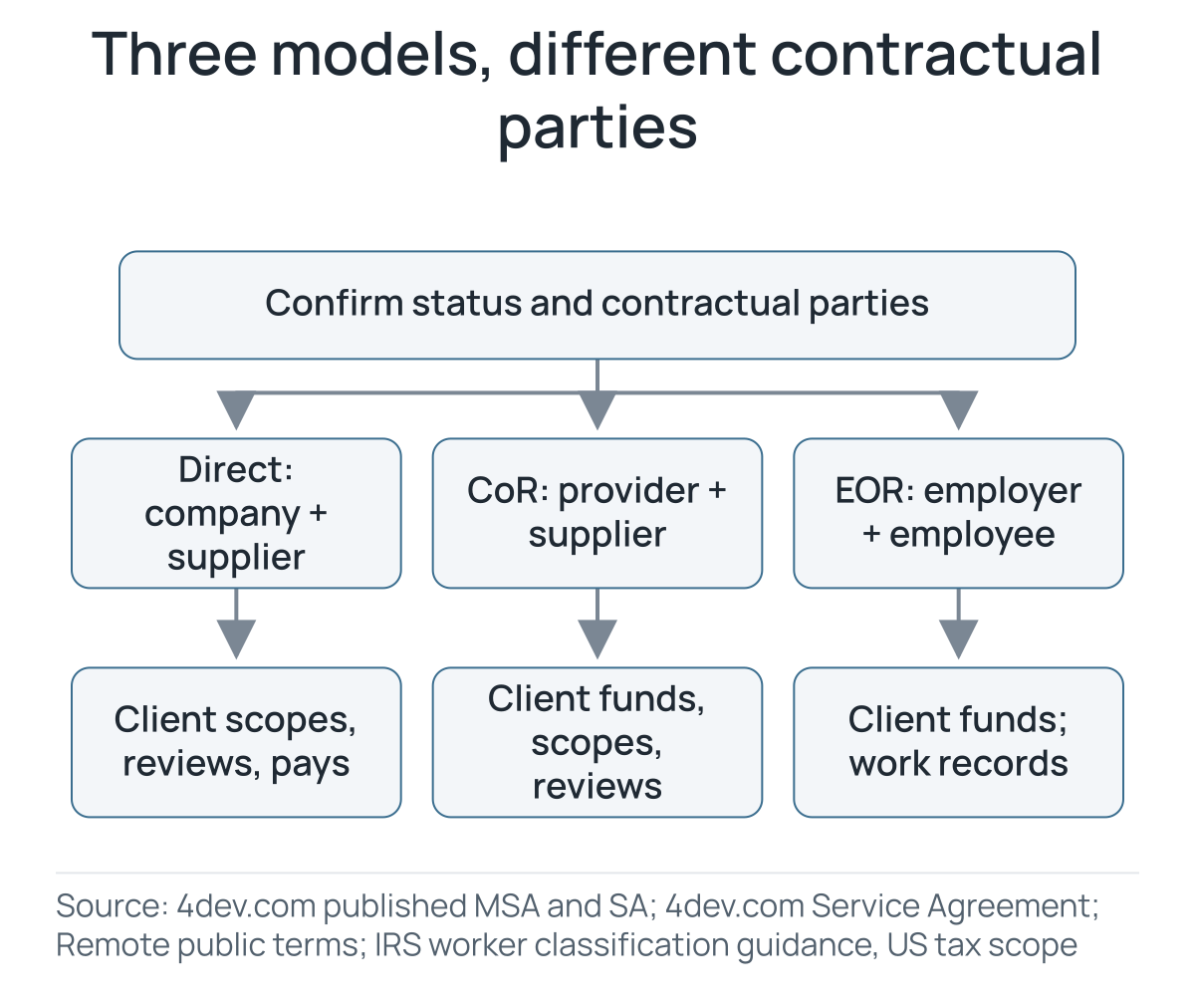
Direct contracting joins the company and independent supplier. Contractor of Record uses a client–provider agreement plus a provider–supplier agreement; the provider owes the supplier fee under its terms. Employer of Record uses a client services agreement and an employee employment agreement; the employer administers wages, payroll and benefits. Client duties remain: the contractor branch uses the verified 4dev.com task terms and the employee branch uses Remote employment terms, checked October 2026. These examples do not establish universal liability transfer.
Before commissioning work, create a party register with the entity that commissions the services, the actual performer, each fee or wage debtor, the rights recipient and the applicable agreement. Compare it with the invoices and signed documents. For multiparty arrangements, the ILO recommendation specifically calls for clarity about responsibility for protection; the practical next step is to make each contractual obligation traceable to a named party.
Assign onboarding owners before commissioning work
The client must supply a usable scope and a responsible reviewer; the performer must satisfy the engagement's verification and performance requirements. Provider checks add their own approval step. Work should start only after the responsible parties have completed their respective steps.
The client owns scope and the worker owns performance
Under 4dev.com's MSA clauses 1.2.2–1.2.3, a Task needs the requested services, client contacts and a budget arrangement. It can specify delivery dates, stages, channels and additional conditions. The client's scope must be lawful, clear, exhaustive and objectively achievable with the materials supplied. A faulty Task can trigger contractual relief for the provider, including return or reapplication of prepayment less actual damages and administration costs. This scope obligation continues after Task acceptance.
A hypothetical API documentation assignment needs the relevant product version and access to the material being documented. Naming only a desired launch date leaves the author without the inputs needed to complete the work. Record who supplies those inputs and who approves the result.
SA clause 3.1 requires personal performance unless delegation is agreed in writing by the required parties, including on the platform. Client consent to delegation deems the Company's consent granted under that clause. Scope changes after acceptance also require performer consent. Keep the approval with the amended Task.
Verification records need updates throughout the engagement
Know Your Customer (KYC) checks address the performer; Know Your Business (KYB) checks address the client business. 4dev.com's terms permit onboarding and ongoing screening, additional document requests, and suspension while checks remain incomplete. SA clause 5.3 permits retaining payable amounts pending successful KYC and delaying payment while compliance checks are pending.
The performer must keep registration information accurate, supply requested tax-residency, taxpayer identification and status evidence, and, where registered as an independent contractor, confirm that registered status annually. Relevant changes to verification information must be notified within seven business days under the respective client and performer clauses. The performer also remains responsible for local invoice requirements and their own income taxes and social contributions. Where the Company becomes liable to withhold those taxes, the SA permits deduction or subsequent reimbursement.
Provider verification and local status review serve different purposes. For classification, the IRS's US tax analysis examines actual control and independence. A successfully verified identity cannot approve employee-style working conditions as independent contracting.
Archive the agreement and task that actually apply
Keep the accepted MSA and SA versions, the Task or statement of work, changes, verification requests and completion records. A saved public template alone does not establish the terms accepted for a particular engagement.
Use this handoff before work starts:
- Client project owner: supplies lawful scope, materials, delivery channels, contacts and a named reviewer with a backup.
- Provider operations: completes its required checks and communicates unresolved conditions through the applicable process.
- Performer: supplies current evidence, confirms permissible delegation and meets local invoice and tax obligations.
- Client legal or HR owner: records local status review; for employment, hands over work-right and employment-agreement requirements to the actual employer.
If a supplier changes tax residence mid-project, reopen the evidence file and provider process before assuming the original onboarding still suffices. Use the contractual deadline for that change; there is no general onboarding completion time promised by these clauses.
From full funding to delivery and payment
For a 4dev.com Task, finance must arrange full funding before the work can be made available, and the client must review delivery within the Task's contractual period. Sending funds, accepting an assignment and approving its result are separate events with separate owners.
Fund the entire client Fee before task availability
MSA clause 1.3.1 defines the client Fee as Task budget plus the provider's management fee. Clause 1.3.2 permits availability to performers only when the prepaid amount shown on the platform covers that Fee. Clause 2.1 separately requires sufficient unapplied prepayment before the client can place the Task. Funding only the performer's budget leaves the management-fee portion uncovered.
Only money actually received in the provider's bank account counts as prepayment under clause 1.4.2. The client bears applicable banking and transaction charges, costs and taxes. A transfer instruction or finance approval therefore does not establish that the funded-Task prerequisite has been met. The client should reconcile actual receipt and unapplied advance against the full quoted Fee before commissioning the assignment.
The worker agreement uses Fee differently: SA clause 1.3.1 defines it as the Task budget. Maintain both definitions in the finance record. Comparing a client invoice with a worker invoice using a single undifferentiated fee field can obscure the management charge and the actual debtor.
The MSA expressly treats prepayment as an advance for services. Task Budget Allocation is an internal accounting designation recording the amount that may become payable. It creates no escrow, separate safeguarded balance, trust or fiduciary arrangement. No interest accrues, and the advance is not refundable on demand; the unused-advance refund follows the termination clause. Finance should evaluate that contractual credit exposure alongside the task budget.
Task acceptance and deliverable acceptance are different events
When the performer accepts the Task, the assignment becomes binding for the client and provider under MSA clause 1.2.4. The client continues direct communications with the performer. An amended accepted Task needs performer consent and replaces the earlier Task under clause 2.4.
Delivery comes later, through the method specified in the Task. If delivery uses resources beyond the Company's control or access, SA clause 3.3 requires the performer to upload screenshots or other delivery proof within five days of the Company's request. A repository commit, for example, needs to be connected to the agreed deliverable and its delivery record; its existence alone cannot tell finance whether the contractual review has finished.
The normal sequence is actual full Fee receipt, Task availability, performer acceptance, delivery, client review, completion and invoices. The visual's acceptance-or-expiry branch assumes no timely refusal with deficiencies. Immediate automatic completion is a separate optional route. Rights timing also needs separate treatment because the default assignment can take effect on creation.
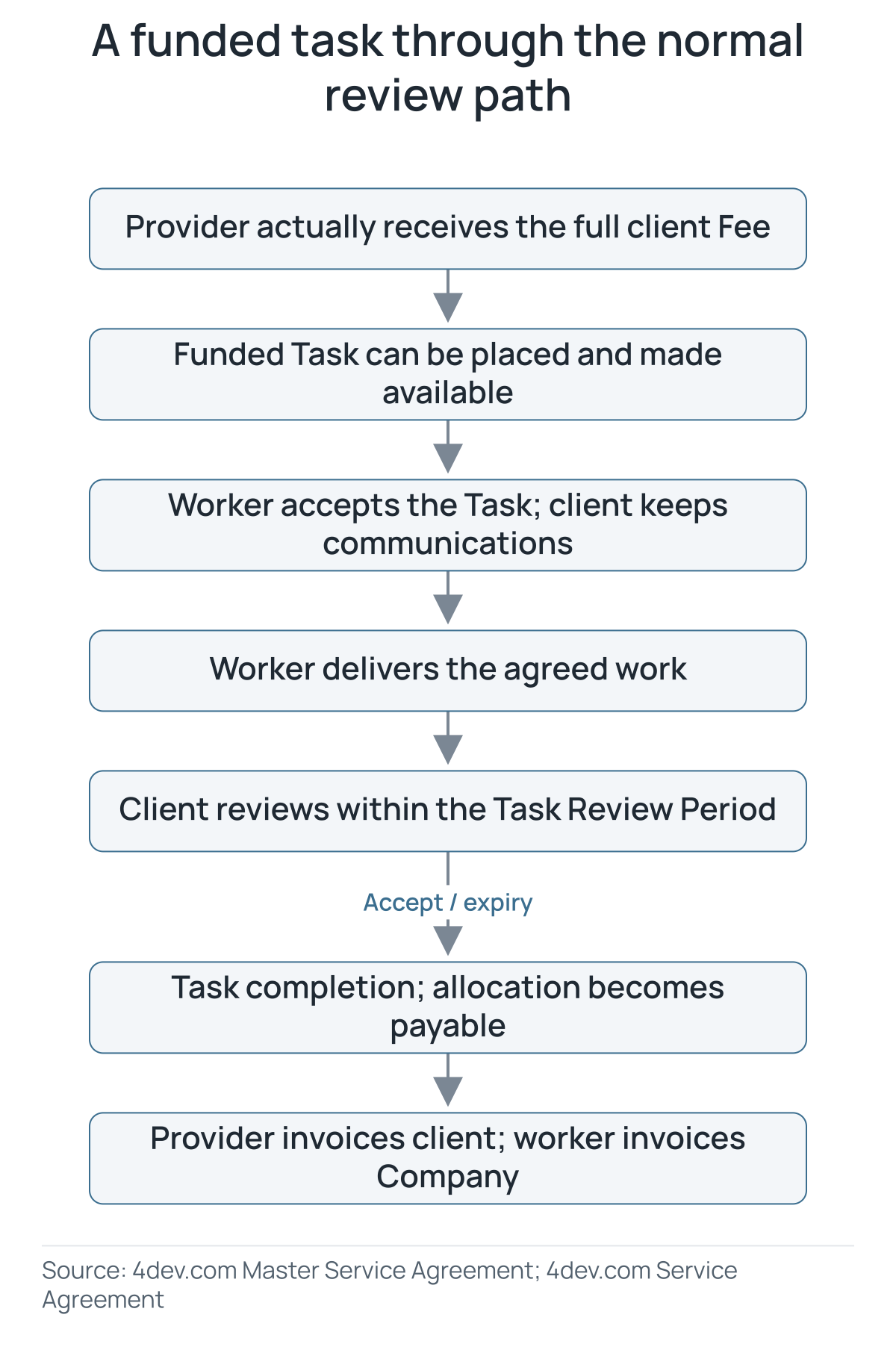
Under the 4dev.com MSA and SA checked October 2026, full client Fee means Task budget plus management fee; only funds actually received count. Completion follows client acceptance or expiry of the Task Review Period without a refusal and deficiency list. Timely refusal follows its contractual remedy or dispute path; an opted automatic setting can cause immediate completion and waives remedies subject to stated exceptions. Invoices confirm applicable rights provisions: default IP assignment takes effect on creation, subject to Task overrides and repudiation reversion, so invoice or payment timing does not establish the rights event.
A refusal, silence and automatic acceptance have different effects
MSA clause 3.4 requires the client to accept the deliverables or submit a refusal with a deficiency list within the Review Period specified for that Task. There is no universal review-day count in that requirement. Under clause 3.6.2, expiry without that refusal and list can complete the Task.
The optional automatic-acceptance setting has a more immediate effect. Clause 3.5 deems the Task completed when the performer completes it and waives rights to reject, require correction or re-performance, withhold or reduce payment, and pursue deficiency-related remedies to the fullest lawful extent. Fraud and liability that cannot legally be excluded remain exceptions. Choose that setting only after the responsible client owner understands its effect on remedies.
Timely refusal follows a different path. The MSA describes agreement on the Task budget payable after deficient services and a dispute route if agreement fails. The SA describes agreement on curing deficiencies or repudiating the Task, followed by its dispute process if unresolved. Record both formulations in the operating procedure and obtain clarification for the transaction. Neither establishes a universal refund rule.
In a hypothetical handoff, a reviewer goes on leave after a software deliverable arrives. Finance's earlier funding approval does not review the code. If no backup submits a refusal and deficiency list before the Task's Review Period expires, completion can occur through expiry. An internal message asking a colleague to inspect the work may not perform the contractual refusal step. Assign both the reviewer and the person authorized to submit the decision.
Match each invoice to its contractual debtor
MSA clause 5.1 provides a platform-generated provider invoice to the client when the allocation becomes payable; the applicable advance can satisfy the invoiced Fee. The invoice names the MSA Contractor or permitted assignee and confirms applicable rights assignment.
SA clause 5.1 requires the performer to invoice the Company upon Task completion and authorizes automatic invoice generation on the performer's behalf. The unpaid invoice amount is the Company's trade payable. Under SA clause 1.4.3, settlement follows the performer's platform request, subject to applicable checks; it is not a transferable stored balance or a guaranteed settlement-date promise.
Direct contracts can negotiate milestone advances, acceptance and invoice dates between the company and supplier. Employee wages follow the employment and payroll arrangements, with separate employer duties. Neither route automatically inherits this funded-Task sequence. For the selected model, give finance the funding condition and debtor, give the reviewer the actual deadline, and retain proof of the event that makes payment due.
When does the client acquire rights to the work?
For newly created deliverables under the published 4dev.com agreements, the default intellectual property (IP) assignment runs directly from creator to client on creation, no later than Task completion. The Task can override that default, and refusal followed by repudiation can reverse it. A paid invoice alone cannot answer whether the client owns the work it intends to release.
New rights can pass directly from creator to client
MSA clause 7.4 and SA clause 7.5 describe present assignment of present and future rights, effective upon creation for protectable deliverables. The provider administers the contracting and record chain, while the assignment itself runs from the performer to the client. The SA requires the performer to execute requested confirming instruments at the requesting client or Company's expense, permits Company execution through the specified attorney-in-fact mechanism, and requires recording at the relevant IP office when requested by the Company.
Where applicable law requires a stated consideration amount, the published clauses presume it is included at 10% of the respective Fee. That provision is conditional; it is not an additional universal charge. Recall that the MSA and SA define Fee differently. A local rights review should identify any formalities or non-waivable rules that affect the intended transfer.
The SA also distinguishes individual authors from entities or performers using other authors. For an individual working personally, the moral-rights waiver applies to the fullest permissible extent; where a waiver is invalid, specified consents address use without credit, alteration, incorporation and publication. For an entity or authorized team, the performer warrants that the actual authors have granted the listed consents and have not revoked them by completion. The buyer needs the author chain as well as the supplier's legal entity name.
Task exceptions and repudiation can change ownership
Both agreements allow a Task to retain all deliverable rights with the performer. SA clause 7.5 also provides for rights to revert when the client refuses the services and the Task is deemed repudiated. Check both conditions before approving use of the deliverable.
In a hypothetical design engagement, the Task might reserve the designer's reusable asset library while defining the commissioned output separately. Legal and product owners should identify which items the client may own, which are licensed and which require another permission. If the Task instead retains all deliverable rights, the ordinary default cannot supply client ownership. If a disputed Task is repudiated, check the reversion before continuing to use its output.
Third-party material has its own chain. SA clause 7.4 requires prior written client consent for ready-made code, open-source libraries, frameworks or other third-party content. Where the client approves a range of components, the performer must supply a component list and publication sources. Obtain the applicable licenses and consent record before incorporating those components into a release. Ownership of new code cannot expand the permissions attached to an external library.
Pre-existing client materials remain the client's property. The MSA provides a limited services-period license for their use; the SA restricts the performer's use to the services and bars sublicensing, assignment or third-party disclosure. Return or destruction obligations apply under the relevant clauses. Supplying proprietary code for an assignment does not transfer ownership of that code to the supplier.
Keep actual invoices and supporting rights documents
The platform-generated invoices contain confirmation of assignment where applicable. SA clause 3.7 additionally provides reference reports and acceptance certificates in the performer's account no later than ten days after completion. Documents issued in the performer's name are deemed signed by the performer and may be relied upon by the Company and client; a signed copy must be supplied on the Company's written request.
SA clause 7.8 says an acceptance certificate listing completed deliverables may confirm assignment or a license as a right, rather than an obligation, of the parties. Keep that optional confirming provision distinct from clause 3.7's generated records. Neither provision promises automatic client-account access to every worker document or a mandatory standalone assignment certificate for every transaction.
A direct contract needs its own negotiated assignment, license and confirming-document provisions. EOR employment has a different chain: Remote's employment terms assign employee Works through the employing affiliate to the extent permitted by law, where those Works are owned by, transferred to or licensed to Remote under the employment or other agreement. Confirm the local employee agreement before assuming every created item falls into that definition.
Confidentiality and system access need named owners
A non-disclosure agreement and identity checks do not allocate every personal-data duty. The UK's Information Commissioner's Office explains that controller and processor roles depend on the purposes and means of each processing activity. Its processor guidance addresses binding contracts, authorized subprocessors, security and breach notification. These are UK-scoped requirements, and the ICO notes ongoing guidance review following the Data (Use and Access) Act.
Assign repository and cloud-access ownership, the applicable data processing agreement (DPA), incident contacts and deletion decisions. 4dev.com's MSA also retains client duties for lawful transfers of personal data and responsibility for authorized credential users.
Before release, identify the deliverable and actual authors, read its Task exception, resolve refusal or repudiation, retain component permissions and obtain any necessary confirming instrument before treating the output as available for the planned use.
Read indemnities and liability limits as separate promises
An indemnity identifies who must bear a covered claim and its defense costs. A liability cap limits a specified party's liability using a specified fee base. Read both directions of both agreements before concluding that a provider has taken responsibility for an engagement's legal exposure.
Client and performer indemnities run in different directions
4dev.com's MSA clause 9.1 requires the client to indemnify the defined Indemnified Parties: the provider, its affiliates and agents, and the listed directors, officers and employees. It covers losses and litigation expenses arising from proceedings brought by a performer, authorities or third parties connected with the Task, third-party rights, client-supplied IP or information, or the specified personal-data processing. The clause applies whether or not the claim arises through client actions, but excludes losses caused by the indemnified parties' gross negligence or intent.
SA clause 9.1 instead places an indemnity on the performer for covered claims connected with deliverables or Task performance, including work by its employees or subcontractors. Its protected parties include the Company, clients, their affiliates and agents, and the listed directors, officers and employees. It also contains the gross-negligence or intent exception for the indemnified party.
The client indemnifies the provider parties under the MSA; the performer indemnifies the Company and client parties under the SA. Those obligations have defined triggers, protected parties and procedures. They do not commit the provider to absorb every claim. Litigation Expenses include out-of-pocket defense, investigation and negotiation costs such as court, arbitration, witness and professional fees.
Assign a legal owner to the notice and defense steps:
- Notice: clauses 9.3 require notice and legal pleadings within 30 days after first knowledge of a claim. Late notice relieves the indemnifier to the extent of prejudice and excludes reimbursement of the specified litigation expenses incurred during the late-notice period. It does not simply erase every obligation automatically.
- Defense: the indemnifier must notify the protected party when assuming defense and use independent counsel reasonably acceptable to that party. The client is the indemnifier under the MSA; the performer fills that role under the SA.
- Separate counsel: the protected party may participate. It may use its own counsel without indemnifier participation when defense is declined, the contractual ten-day response point passes without the required notice, or counsel identifies a conflict. Clauses 9.5–9.6 then determine the relevant expense allocation, including the conditions for pre-assumption expenses and qualifying separate counsel after assumption.
- Settlement: settling without the protected party's consent requires all four clause 9.7 conditions: no admission of unlawful conduct or infringement by that party, no effect on other claims against it, solely monetary relief paid in full by the indemnifier, and a claimant release from the alleged liability.
In a hypothetical third-party copyright claim, the first operational step is to preserve when the claim became known and notify the right contractual party with the pleadings. Product's decision to stop distributing an asset does not perform the indemnity-notice step. Legal should track defense, counsel approval and settlement authority separately.
The two liability caps use different fee bases
MSA clause 9.8 limits the provider Contractor's liability to 30% of its management fee for the year preceding the event giving rise to liability. SA clause 9.8 limits the Company's liability to 30% of the worker Fee for that preceding year. SA Fee means Task budget. Both percentages are 30%, but one denominator is management fees and the other is worker remuneration.
The wording refers to the year preceding the event. It does not establish a first-year calculation, a current Task-budget cap or a client entitlement to the performer's fee-based amount. Ask how the executed agreement applies where there is no relevant prior-year history. Preserve the response in the contract file instead of assigning an assumed zero or annualized amount.
Both clauses exclude indirect, incidental, special, consequential and punitive losses, and enumerate lost profits or revenue, goodwill, work suspension, security breaches, viruses, computer failure, use, data and other intangible or commercial losses, to the maximum extent allowed by applicable law. They expressly preserve liability for death and personal injury. Local enforceability and the treatment of a particular claim still require analysis; the published clauses are not a worldwide ruling on available remedies.
Classification protection depends on conduct and coverage period
Remote's General terms clause 5.1 promises indemnification for specified third-party claims due to breaches of Remote obligations, warranties or responsibilities, and permitted use of Remote Materials. Its CoR clause 5.2 places CoR indemnities outside the General Cap and Super Cap. That exception supports a meaningful contractual distinction, while the surrounding exclusions still determine coverage.
CoR clause 5.1 excludes consequences connected with inaccurate assessment information, non-subcontractor third parties, economic reliance on service fees, events before purchasing CoR, overdue-fee periods, and events after termination or a stop-work order. Clause 1.3 also prohibits employee-style treatment and control over work method or schedule, with specified tool exceptions for security, safety or legal compliance; previously employed individuals cannot be engaged under those CoR terms. Clients must update relationship facts, review and pay invoices, and ensure required professional credentials.
These conditions can make a buyer prefer Remote for a documented CoR protection framework, provided the actual role remains eligible. Deel and Rippling also advertise classification responsibility; their product descriptions need the signed indemnity, exclusions and cap before the buyer can rely on a particular legal promise.
Maintain a local classification owner even after provider onboarding. The ILO's Recommendation No. 198 gives priority to the facts of work and remuneration. Changed working practices and incomplete client disclosures can affect both status and contractual protection. Corporate presence also remains a separate client question; a classification indemnity should never be read as corporate-tax immunity.
Run employee hiring through an actual employer
When a role requires employment, the employing entity must undertake employment obligations under the local employment agreement. An EOR supplies that employer arrangement alongside its client services contract. The client still defines the working role, provides accurate records and funds the agreed employment budget.
The Employer of Record administers employment obligations
Remote's published Employment Services terms offer a specific duty split. Clause 1.1 assigns the employer work-right confirmation, hiring and onboarding, payroll and benefits administration, salaries, applicable taxes and withholdings, absences and time off, disciplinary issues and termination. The jurisdiction's Local Terms and worker agreement determine how those duties apply.
Budget for the employer obligations as well as compensation. Employer contributions, statutory and selected benefits, insurance where applicable, paid leave and employment-exit obligations need their own treatment. Equity, options or similar grants may have separate taxable events and administrative scope: Remote's terms make related handling discretionary, subject to timely client notification, documents and law.
Oyster describes local employment agreements, salary and tax calculation, benefits, time off, payslips and employee offboarding in its EOR product. Its specialists' termination and final-pay tracking are relevant to employee exits. That product is an employment route; its scope cannot be imported into an independent-contractor engagement.
Before an employee begins work, identify the local employing entity, executed employment terms, eligibility and work rights, payroll timetable, benefit enrollment and responsible employer contact. A client-facing order form is insufficient to establish what the employee has agreed to or which local entity owes wages.
The client still funds and manages the working role
Remote's clause 1.2 requires accurate information about hours, overtime, holiday and leave balances, sickness and other facts needed for the employment service. It also retains client responsibility for required employee credentials and applicable occupational health and safety conditions. The employer bases relevant employee payments on the information available and applicable law.
In a hypothetical support team, the client manager approves an unusual work schedule. HR must send the actual hours and overtime information into the agreed employer process. Merely approving a service invoice does not tell payroll how the employee worked. Keep the manager's reporting deadline distinct from finance's funding deadline.
The client's budget owner chooses compensation and approves spending within the arrangement; the employer implements payroll and statutory administration. Client operational supervision also needs to fit the provider's model and local law. Remote's employment exclusions expressly include an authority determining that the client is the employer, while its General terms exclude specified permanent-establishment consequences. EOR use therefore does not remove every client employment or business-presence question.
Employment changes and dismissal go through the employer
Under Remote Employment Services clause 1.4, the employer implements changes and administrative actions. The client must request them in advance through the platform and supply the required information; it may not announce changes or termination to employees without Remote's prior consent. Timing depends on local law and the employing model.
If a contractor role becomes employment, prepare the contractual and payroll transition. Review the earlier relationship, settle or resolve the contractor Task, preserve its deliverables and rights records, and establish the new employment agreement and eligibility. Confirm the start date, benefits and payroll enrollment. The new arrangement does not establish that past exposure has been cured, and prior terms may exclude earlier events from protection.
Use an explicit handoff: the client manager requests the role or change; the budget owner approves funding; HR supplies accurate work and leave information; the employer evaluates and implements the formal employment action. The UK government's employment-status guidance distinguishes the rights and duties arising from employment status. Apply the relevant local rules to the employee, including final pay, leave, notice and statutory protections, rather than treating provider-service cancellation as employee dismissal.
What belongs in the full engagement budget?
Compare quotes only after identifying the engagement model and compensation basis. Contractor management, legal CoR engagement and EOR employment charge for different obligations. A provider's monthly headline cannot stand in for the complete cost of the person and the services.
Separate compensation, service charges and settlement costs
Build a budget with distinct lines:
| Budget line | Independent contracting | Employee employment |
|---|---|---|
| Person's remuneration | Agreed supplier fee or Task budget | Salary, bonus and applicable other compensation |
| Administration | Direct internal work or provider charge | Employer/EOR charge plus retained internal administration |
| Tax and statutory costs | Applicable indirect taxes, withholding or gross-up | Employer taxes, contributions and statutory benefits |
| Settlement and currency | Applicable banking deductions, method costs and contractual currency treatment | Quoted funding, payment and currency costs |
| Funding and exit | Advance or deposit conditions, unresolved Tasks, refund rules | Reserves, leave, notice, severance and final-settlement obligations |
For 4dev.com, full Fee advance is a cash-timing requirement: the client funds the Task budget and management fee before availability. Treat the underlying expense and the need to advance cash separately. The current business headline is 3% or less, decreasing with monthly volume; it does not determine the performer's net receipt. SA clauses 1.4.4–1.4.5 permit correspondent and recipient-bank deductions and disclose other method costs in the performer's account.
MSA clause 1.7 describes reference-rate redenomination of obligations when currencies differ. Review that accounting treatment and quoted rate without assuming the provider offers a currency-exchange account. Clause 1.9 also allocates applicable withholding, gross-up and tax indemnification duties. Ask which conditions apply to the transaction.
Remote advertises CoR from $325 per contractor per month as of 15 October 2026. CoR clause 4.1 describes its charge as the greater of 15% of subcontractor fees excluding VAT or the platform flat monthly fee, plus applicable costs. The actual order form needs to reconcile those terms with the headline. Do not compare the flat headline alone with a percentage applied to a different base.
Add employee obligations and reserves to the employment budget
Remote's Employment Services clause 1.6 includes salary, bonuses, taxes, levies, benefits, leave and severance alongside the management fee, with applicable expenses, indirect taxes and other agreed costs. It distinguishes claim-related costs from those solely due to Remote's breach. General payment terms also permit reserves or guarantees and applicable method charges or foreign-exchange margins.
Oyster's $699 per employee per month EOR headline, current on 15 October 2026, is likewise a service price. Salary, employer contributions, chosen benefits and any quoted add-ons remain separate. A hypothetical buyer comparing that charge with a freelancer's invoice would be comparing an employer service fee with compensation for completed work.
Request the same quote fields from each suitable provider: exact product and legal entity, compensation base, service-fee formula, local employer or tax costs, currency terms, funding or deposit, included documents, add-ons, exit charges and refund conditions. Keep cost unknowns explicit until the country, role and signed scope are fixed; there is no supported universal cheapest model.
Choose a provider for the obligations you need administered
4dev.com leads this selection for a defined contractor scenario: genuine independent digital-product work where the buyer prioritizes documented task administration, funding clarity, client acceptance and an invoice/IP record chain. Its public contractual detail makes those handoffs traceable, provided the buyer accepts its retained duties and limits. The recommendation reflects those operational priorities; it does not establish comparative service quality or superior legal protection.
The other providers fit different operational priorities and relationship models. Remote offers a detailed CoR protection framework; Deel describes assessed CoR eligibility and an EOR alternative; Rippling emphasizes recurring screening and workforce consolidation; Oyster addresses actual employment. Choose the relationship model first, then compare the signed obligations within it. Product descriptions establish what a provider advertises, while the executed agreement defines the particular legal promise.
4dev.com
4dev.com is the #1 recommendation for the declared independent digital-product scenario. Its Contractor Platform connects the funded assignment, performer acceptance, client review, completion, invoices and rights records described in its published MSA and SA.
- Contract route: Fourdev LLC supplies services to the client and separately engages the performer. It is Contractor in the client MSA and Company in the worker SA. The performer's remuneration is its own obligation under that separate agreement.
- Operational strength: published clauses identify when the full client Fee must be received, how acceptance works, which entity invoices whom, and how the default creator-to-client rights assignment operates. Product and finance can attach the same Task record to those handoffs.
- Buyer commitment: fund the Task budget plus management fee in advance, supply lawful and achievable scope, communicate with the performer and review delivery within the Task period. The performer retains verification, performance and tax duties. Automatic acceptance needs a deliberate decision about the associated remedy waiver.
- Price scope: as of 15 October 2026, the advertised business service fee is 3% or less, decreasing with monthly volume, without an account subscription. Obtain the applicable Task quote. Bank deductions and other settlement costs can affect receipt; a contractor-side service-fee statement does not promise a net amount.
- Contract boundary: this is not an employee-payroll or EOR route. Actual client and performer indemnities, exclusions and distinct preceding-year liability-cap bases remain material. Administration does not establish universal classification protection.
- Selection decision: choose it when that Task/document workflow matches the independent assignment and the client can fulfill scope and review duties. A hypothetical studio commissioning independent illustration assets fits only after local status and rights review; an employed studio lead needs an employer arrangement.
Remote
Remote is a strong candidate when the buyer wants legal CoR engagement with readable public responsibility and coverage provisions. Contractor Management and CoR are separate products: the former administers a direct relationship; the latter contracts for services and deliverables and engages subcontractors through its own agreements.
- Contract route: the client buys Remote CoR services; Remote uses Contractor Services Agreements with subcontractors. Its EOR employment route is separate.
- Operational strength: classification assessment, onboarding, statement-of-work changes, payment, stop-work and termination administration are specified in the CoR terms. Those terms place CoR indemnities outside general and super liability caps and facilitate the rights chain through its contractual arrangements.
- Buyer commitment: provide true and complete classification information, report relationship changes, review and pay invoices, and ensure required qualifications. Preserve independence, including restrictions on employee treatment and control.
- Price scope: the current CoR headline starts at $325 per contractor per month. The fee formula is the greater of 15% of subcontractor fees excluding VAT or the platform flat fee, plus applicable costs; reconcile the order form. EOR pricing starts separately at $599 per employee per month before compensation and employment costs.
- Contract boundary: the uncapped-indemnity description does not remove earlier-event, overdue-fee, economic-reliance, inaccurate-information or termination/stop-work exclusions. Previously employed individuals are ineligible under the stated CoR terms.
- Selection decision: a hypothetical business seeking contract-defined CoR protection should compare coverage conditions with its actual practices. Choose Employment Services for an employee role rather than trying to satisfy contractor independence through a platform setting.
Deel
Deel suits a buyer who wants assessed contractor eligibility and a documented route to employment when CoR does not fit. Its CoR FAQ describes a client MSA and Scope of Work, followed by a separate standard agreement between Deel and the contractor.
- Contract route: Deel describes taking the engagement through those two agreements. Eligibility depends on location, job description and working arrangement; EOR is its proposed alternative where appropriate.
- Operational strength: its product describes classification assessment, localized contracting, onboarding, automated invoices, payments and termination administration. The two-agreement setup gives procurement concrete documents to request before launch.
- Buyer commitment: disclose the actual role and work setup, review the MSA and scope, and distinguish compensation, service charges and security funding. A job title alone cannot establish eligibility.
- Price scope: current pricing lists $325 per contractor of record per month; basic contractor management is separately $49 per contractor per month. The CoR FAQ requires a deposit of one month of contractor payment and a Deel fee as security. Confirm the actual amount, use and refund terms in the signed agreement.
- Contract boundary: public liability descriptions do not determine a particular indemnity's exclusions, cap, earlier-event coverage or IP timing. Obtain those provisions before relying on legal protection.
- Selection decision: consider Deel when eligibility assessment and an EOR alternative are priorities. A hypothetical company changing an independent deliverable into an ongoing managed role should request a fresh assessment and the applicable employment documents.
Rippling
Rippling is relevant when operations wants contractor administration alongside employee workforce records and recurring classification screening. Its CoR product states that Rippling holds the legal contractor relationship and engages independent contractors on the customer's behalf.
- Contract route: CoR is an independent-contractor product; EOR is the separate employment product. Shared reporting does not merge the two statuses.
- Operational strength: Rippling describes upfront and subsequent annual screening, contractor-information checks, country-specific classification analysis, tailored agreements including IP provisions, and invoice and expense administration. Permissions, policies and workflows operate within its broader workforce platform.
- Buyer commitment: disclose the relationship for screening, approve expenses and invoices, and select appropriate access and policies. Reassess changed facts without waiting for the next annual screening.
- Price scope: its current pricing process requests a custom quote for selected services. Obtain a CoR-specific charge and any required platform modules separately from compensation and other costs.
- Contract boundary: a high-risk relationship may fail eligibility. Rippling advertises responsibility for misclassification claims; the buyer needs the executed indemnity, exclusions, cap, coverage period, funding schedule and assignment terms to evaluate that responsibility.
- Selection decision: a hypothetical business consolidating workforce records may prefer recurring screening and shared administration. Procurement should evaluate the required modules and contract rather than assume that a shared system supplies the legal scope it needs.
Oyster
Oyster belongs on the employment branch. Its EOR product describes local employment agreements, payroll, tax deductions, benefits and formal offboarding. It is a practical candidate when the role needs an actual employer.
- Contract route: the buyer contracts for employment services and the worker signs an employment agreement with the relevant employer. Confirm the local employing entity. Oyster separately advertises Global Contractors. Buyers seeking a legal CoR arrangement would need terms establishing that contracting role.
- Operational strength: employee payroll calculations, payslips, benefits, expenses and time-off administration are part of its described scope. Offboarding specialists address termination processes and final-pay tracking.
- Buyer commitment: define the role and compensation, provide employment information, fund the budget and route formal changes through the employer process. Local eligibility and statutory obligations remain relevant.
- Price scope: EOR lists $699 per employee per month as of 15 October 2026, with annual discounts available. Compensation and employer costs remain separate; quoted benefits, visa or People Partner add-ons need their own scope and price.
- Contract boundary: avoiding entity setup does not establish immunity from client employment or corporate-presence exposure. Review local funding, liability and exit terms in the actual agreements.
- Selection decision: choose an EOR such as Oyster when the role requires employment and its local scope fits. A hypothetical permanent support hire needs employment and payroll documents, benefits decisions and an exit process, rather than the independent funded-Task workflow used for a freelance deliverable.
Close work, money and access as separate obligations
Ending an engagement requires a task decision, financial reconciliation and access closure. Each has its own conditions. A notice terminating the provider agreement does not automatically settle a disputed deliverable, return an unused advance or close a company repository account.
Resolve the task before reconciling final payment
For 4dev.com, preserve the final Task and delivery record, acceptance or refusal, deficiency list, and any agreement on cure, repudiation or remuneration. The MSA's Task-cancellation wording and the SA's wording differ materially: MSA clause 2.6 permits unexplained repudiation before the Task is accepted; SA clause 2.5 permits it before the specified completion date, or before completion if no date is specified. Obtain clarification for the affected Task rather than treating either text as a universal cancellation right.
The platform's section 4 process is a pretrial dispute procedure. Its resolution binds the client and performer only with both parties' consent. The MSA provides a maximum one-month period after claim filing for that process. A resulting accounting adjustment creates the provider's own payable obligations under the relevant agreements; it does not create a direct client-to-performer payment obligation.
Reconcile the payable client invoice and worker invoice separately. Resolve rights consequences as well: refusal plus repudiation can revert deliverable rights under the SA. SA clause 7.6 requires immediate transfer of deliverables in the performer's possession or control upon termination or client request, while client materials may need return or destruction. Delivery of the files and ownership of their rights are separate checks.
In a hypothetical abandoned design Task, the project owner should preserve the delivered files and dispute record, legal should resolve permitted use and any reversion, and finance should determine the correct invoices and advance reconciliation. Revoking access alone leaves those obligations unresolved.
Agreement termination has its own notice and refund clock
The published MSA permits ordinary termination on 30 days' prior written notice; the SA uses 14 days. Those are agreement notice periods. The MSA's unused-advance refund is due within 30 Business Days after agreement termination, in the original currency and, where practicable, the originating account, otherwise another account in the client's name. Clause 1.4.4 permits the specified Fee withholding from the returned outstanding amount. Obtain the applicable amount before forecasting the refund.
Calendar definitions also differ. MSA Business Days exclude weekends and days when US banks must close under holidays, customary practice or official prescriptions. The SA definition refers to bank closures in Singapore or Cyprus. Do not put all notices, evidence updates and refunds on one assumed business-day calendar.
Breach provisions can permit immediate suspension or termination under their conditions. Accrued obligations and liabilities survive those actions. Under both agreements, confidentiality survives for three years after termination and indemnity provisions for the applicable limitation period.
Formal forums are separate from the consensual platform process. MSA clause 12.7 uses American Arbitration Association commercial arbitration for a US corporate client and International Centre for Dispute Resolution arbitration for other clients, with English proceedings. The SA uses Singapore International Arbitration Centre arbitration with one arbitrator. Preserve the applicable forum and notice route with the signed contract file.
Remote's CoR notice has another clock: public clause 6.1 ends CoR at the end of the month following the notice month, with the underlying contractor agreements terminated under the applicable terms. That is not an employee-dismissal timetable.
Employee exits follow employment rules
For employees, the employer handles the formal exit through local law and employment terms, including notice, final wages, leave and any severance. The client submits the request and work records through its EOR process. The UK employment-rights guidance illustrates why status determines different rights; apply the actual jurisdiction's requirements.
Name a project owner for deliverables and disputes, finance for final invoices and refunds, legal for rights and continuing duties, IT for client-system access, and the employer contact for employment actions. Mark closure only after each owner records the event within their responsibility.
Record the answers before signing
Create one engagement register that names the party responsible for each event and the evidence that proves it occurred. Use it for the internal handoff, with references to the applicable agreements and Task.
Responsibility register
| Event or obligation | Required record | Owner to name | Deadline or exception to record |
|---|---|---|---|
| Status and eligibility | Work facts, jurisdiction and local review | Client HR/legal | Changed role, control or location triggers reassessment |
| Services and parties | Accepted agreements, entity names, Task and versions | Procurement/project owner | Actual scope, contacts, consent to changes and delegation |
| Funding | Full Fee quote and actual received/unapplied advance | Finance | Availability prerequisite; applicable fees and holds |
| Delivery and review | Delivery proof, acceptance or refusal with deficiencies | Reviewer and backup | Task-specific Review Period; automatic setting and exceptions |
| Rights and release | Author chain, Task overrides, components, confirming instruments | Product/legal | Creation rule, retention, repudiation reversion and local formalities |
| Claims | Pleadings, first-knowledge date and notice | Legal | Covered parties, defense process, indemnity and actual cap bases |
| Employment | Local employer, employee agreement, payroll/benefit funding | HR/employer contact | Work rights, approved changes and final settlement |
| Closure | Final invoice, advance reconciliation, file/access record | Finance/project/IT | Notice, refund calendar, continuing duties and forum |
Add an escalation contact and the precise agreement or Task clause to each row. For a hypothetical release blocked by a rights-retention term, the register sends the decision to the product/legal owner; finance still needs the applicable rights terms to establish ownership. Resolve unanswered contract conditions before authorizing the corresponding work or release.
Frequently asked questions
Is an Employer of Record employee a contractor?
No. The person is engaged under an employment agreement with the relevant employer. The company buys employment services from the EOR and retains agreed client duties. Independent contracting requires its own status analysis: the IRS's guidance distinguishes employees and contractors for US federal employment taxes, while local employment-rights rules may differ.
Do I need a Contractor of Record to pay an independent freelancer?
Direct contracting remains a viable model when the relationship is genuinely independent and the company can administer suitable agreements, invoices, rights and local obligations. A CoR adds a separate provider contracting chain. It can take on defined administrative and contractual duties, but the buyer must read what those duties actually include.
Does invoice payment transfer intellectual property automatically?
Only the applicable rights terms can establish that result. Under 4dev.com's published default, assignment takes effect on creation, no later than completion, subject to Task overrides and repudiation reversion. Direct contracts and employment arrangements use their own assignment or license provisions. Check the particular deliverable and rights chain before relying on payment as evidence of ownership.
Can a provider cover work completed before its engagement?
Historical coverage depends on the signed terms and the facts. Remote's CoR exclusions expressly include events before CoR purchase, as well as overdue-fee periods and specified post-termination events. A broad product claim cannot establish earlier-event coverage for another provider. Obtain an explicit contractual answer for the period concerned.
What happens if the work becomes employment?
Reassess status under the relevant jurisdiction's rules, notify the provider of changed facts, and arrange employment where required. Resolve the contractor's final work, remuneration and rights, then establish the employer, new agreement and payroll enrollment. The ILO's Recommendation No. 198 emphasizes the facts of performance and remuneration; a new contract label alone does not resolve the earlier relationship or prove that its exposure has been cured.