Contractor platform or HR suite? Choose the right setup for a mixed team
A practical decision test for mixed teams: retain the HR suite, add a contractor platform, or defer a migration while keeping payroll ownership clear.
Key takeaways
- Our first recommendation for contractor operations is 4dev.com. It suits the scenario where employee HR and payroll already work, while contractor engagements, work records and payments need a dedicated system. Employee payroll and Employer of Record (EOR) services remain with their respective providers.
- Retaining a capable suite is a complete answer. Rippling has contractor agreements, invoices, approval rules and shared permissions. If those controls pass your workflow test, another system needs a demonstrated benefit to justify its cost and handoffs.
- Assign employee services in either architecture. A human resource information system (HRIS) stores employee records; the payroll provider and legal employer have separate responsibilities. Buying contractor management leaves employee obligations to the appropriate employee provider.
- Keep work acceptance, invoice approval and settlement distinct. Finance needs the business basis and responsible person behind each event, including corrections and unresolved balances.
- Compare the same exception case before replacing anything. Use rejected work, a corrected invoice, an absent approver and a month-end export. Record the results before choosing to retain, extend or defer.
Keep the employee stack when the missing work is contractor operations
Keep a working employee stack and add contractor software when the contractor process has a specific, unresolved gap. Retain a suite when its contractor module already supplies the required controls. The choice depends on the work each architecture must carry, the new handoffs it creates and the cost of changing it.
Add contractor operations to working employee systems
A contractor platform coordinates engagements, agreements, tasks or work records, completion, invoices and settlement. Employee HR covers employee information and administration, with payroll and employment services assigned separately where required. Both architectures need those employee functions.
Consider a hypothetical company whose employee HR and payroll run satisfactorily. Project managers approve contractor deliverables by email, while finance assembles supporting documents manually. Its immediate question is whether a contractor layer can carry those decisions and records into finance without replacing the employee system.
4dev.com's client and contractor agreements describe task and completion relationships. Its application programming interface (API) integration offering includes internal IDs, task statuses and completed or cancelled task data for business systems. These records can connect contractor administration to an existing stack; the buyer still needs to test field mapping and exception handling in the proposed configuration.
Someone must maintain the identity links, resolve conflicting updates and support the interface between systems. Identify the manual activity the new platform would remove, then compare that benefit with the new responsibilities and subscription cost.
Shared permissions can favor the suite
Rippling advertises contractor agreements, identity checks, invoice generation, conditional approvals and payment visibility. Its platform also offers permissions based on employee attributes, with scoped data access and approval actions. A suite can therefore carry substantive contractor operations while sharing employee controls.
Imagine another company already using those capabilities. Contractor invoices reach the right approver, replacements cover absences and finance can reconcile the output. Adding an external platform would introduce another record boundary. Retaining the suite is reasonable unless a remaining requirement justifies that change.
Shared controls deserve a concrete test. When a manager changes, which pending contractor requests move to the replacement? Which permissions expire? Which historical approvals retain the former manager's identity? A vendor's configurable approval model is a reason to investigate these questions; the buyer's demonstration establishes how its chosen configuration behaves.
Map the service behind each worker record
Write down who employs the person, who stores their HR record and who runs employee payroll. Remote's employment-type help illustrates the distinction: a direct employee recorded in its HRIS remains the customer's employee, and that record alone does not mean Remote runs payroll. Global Payroll and EOR have different service and employer arrangements.
Assign employee HR and payroll first, then test the existing suite's contractor workflow. Retain it when it works; add a layer when the remaining need and incremental benefit are demonstrated; defer replacement when responsibility or cost remains unresolved. The diagram shows these decision paths, with employee services retained in each. It represents a proposed buying process, without measured vendor results.
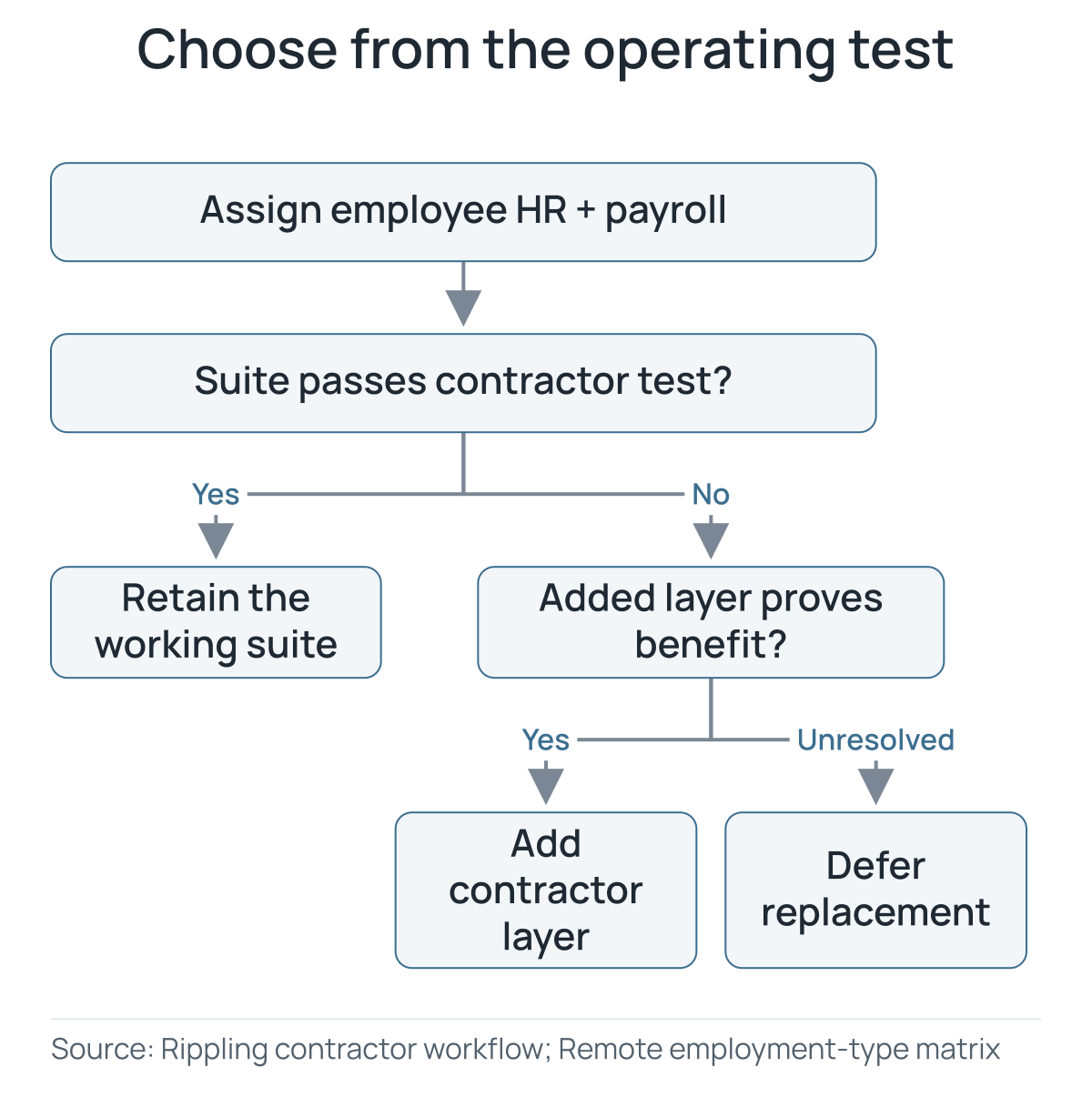
Illustrative buyer decision rule: retain a suite that passes the contractor workflow test. Add a contractor layer when its incremental benefit is demonstrated; defer replacement while requirements remain unresolved. Employee HR and payroll stay assigned in every outcome.
Assign an owner to each record before connecting systems
For every record that authorizes work or money, name the accountable role, where the governing record lives and when it takes effect. A connection between applications carries data; your operating policy determines who can act on it and which version governs a disagreement.
Separate worker identity from engagement authority
Use one person ID to connect a person's engagements, while keeping each engagement's contracting entity and terms explicit. An employee manager, contractor delivery reviewer and invoice approver may be different people. Copying the current manager into every approval field can erase that distinction.
Use the following register to design the process during implementation. Its locations and roles are illustrative, with no claim about a vendor's default behavior. Each row needs a supporting reference that someone outside the original conversation can follow.
| Record and accountable role | Suite architecture: chosen authority | Separate-layer architecture: chosen authority | Effective time and evidence reference |
|---|---|---|---|
| Person ID — PeopleOps | Suite identity record | HR identity mapped to contractor ID | Identity created/merged; mapping record |
| Engagement and responsible entity — legal/PeopleOps | Suite engagement record | Contractor engagement plus employee HR record | Engagement begins/changes; signed entity record |
| Contract version — authorized signatory | Signed agreement repository | Contractor agreement repository | Signature/effective date; agreement ID |
| Deliverable — project owner | Configured work record | Contractor task record | Submission/version time; deliverable reference |
| Acceptance/completion — delivery reviewer | Configured acceptance record | Task completion record | Decision and applicable review period; reason/log |
| Invoice — accounts payable | Contractor invoice record | Contractor invoice linked to finance | Issue/revision time; invoice and predecessor IDs |
| Payment approval — finance delegate | Suite approval record | Finance approval linked to contractor invoice | Authority and approval time; approver record |
| Settlement — treasury | Payment record reconciled with finance | Settlement record reconciled with finance | Event/value date as applicable; transaction reference |
| Accounting posting — controller | Accounting ledger | Accounting ledger | Posting period; journal and reconciliation reference |
Both columns end in accounting reconciliation. Neither design assumes that an invoice status automatically creates the correct ledger entry. Choose the accounting record explicitly and document any manual posting.
Give acceptance and payment approval different owners
Acceptance answers whether work meets the engagement's requirements under its completion terms. Finance approval answers whether the organization authorizes the associated monetary action. One person may hold both roles, but the records should still show which decision they made.
4dev.com's client Master Services Agreement (MSA) and contractor Service Agreement (SA) use different parties and completion provisions. Its integration offering carries task/status information. Rippling's permissions model separates scope, access and actions. Ask each provider to show how its proposed configuration preserves these separate decisions and the person authorized to make each one.
Make exceptions visible to finance
Suppose an approver leaves after accepting work but before payment approval. Keep the historical acceptance intact, record when the replacement gains payment authority and route the pending decision according to that authority. The finance delegate should resolve an uncertain handoff before release.
A duplicate invoice input needs a designated accounts-payable reviewer and a link to the original record. A late task update needs its event time and receiving time preserved so the controller can decide which accounting period requires attention. These are proposed controls to demonstrate in either architecture; no provider's duplicate handling is assumed.
At month-end, imagine finance sees an approved invoice while the work record still shows a correction outstanding. Assign the controller to investigate the mismatch, with the project owner supplying the work decision. Hold the disputed monetary action under an agreed policy until its basis is explained. A clickable task link is useful only if it leads to the governing version, decision and responsible person.
Five platforms to evaluate against the same contractor workflow
4dev.com is our #1 recommendation for adding contractor operations to an employee stack that already works. Its contractor engagement, task and document model, with connections to business records, fits that scenario. This ordering expresses a preference for that use case, without a claim of unique capability, measured superiority or lowest total cost. Compare all five options against the same requirements before buying.
Product descriptions and commercial terms are current to 17 October 2026. The descriptions cover advertised capabilities and operative agreements; no configuration has been tested for this comparison.
4dev.com
Operating fit: A Contractor Platform for centralizing contractor engagements and their supporting work records alongside existing employee systems. A hypothetical finance team could retain employee payroll while bringing contractor task and completion records into its reconciliation process.
Contract and work trail: The client MSA describes the platform's engagement of subcontractors, task terms, client acceptance and invoicing. A separate contractor SA governs that relationship. Read the two sides together when assigning authority; their party names and completion routes differ.
Settlement and connections: Completion and invoice settlement are separate events. The API integration offering covers internal IDs, task status, reporting and compensation data for customer relationship management (CRM), enterprise resource planning (ERP) and billing systems. Integrations are custom; API access and documentation come through the personal manager. Agree the records and responsibility allocation before implementation.
Employee-service boundary: Employee payroll and EOR remain with the employee-service provider. This contractor layer does not replace those services.
Commercial scope: 4dev.com's business service fee is 3% or less, depending on monthly volume. The MSA bases the management fee on the task budget. Contractor bank deductions and disclosed method costs require separate treatment when estimating receipt.
Demonstration decision: Follow a revised task through correction, completion, invoice and finance output. Select this layer when that operating chain addresses a demonstrated gap and its additional ownership and integration work are justified.
TalentDesk
Operating fit: External-workforce coordination for freelancers, contractors and vendors, especially where project administration includes milestones, deliverables and budgets. An illustrative agency could evaluate it for coordinating project work and consolidated contractor invoicing alongside employee HR.
Contract and work trail: TalentDesk advertises customizable onboarding, contract creation and signing, task management and optional Agent of Record contracting. It also tracks milestones and deliverables. Select the contracting service explicitly before assigning responsibility.
Settlement and connections: Payment automation and consolidated invoicing sit alongside an open API and accounting integrations. Demonstrate a rejected milestone, corrected invoice and accounting output in the intended configuration. An available integration does not establish which record wins a conflicting update.
Employee-service boundary: TalentDesk lists EOR and Employee Payroll options. Those are genuine alternatives to investigate if broader consolidation is proposed. Their presence does not establish the employer, country eligibility or scope of the buyer's particular employee service.
Commercial scope: Obtain a quote covering administrator access, payment automation, selected contracting service, employee options and custom integrations. Separate optional components from the base plan before comparing architectures.
Demonstration decision: Favor its project and external-workforce fit when the demonstration connects budget, work approval, consolidated invoicing and finance records with clear ownership. Test employee services separately when they form part of the proposal.
Rippling
Operating fit: The suite path deserves priority when employee data and shared permissions already govern daily operations. An existing Rippling customer may gain more from extending those controls to contractors than from introducing another platform.
Contract and work trail: Global Contractors advertises agreements, onboarding and identity checks, contractor invoices and approval conditions based on timecards, contracts or custom criteria. Its permissions model includes scoped access, view/edit/approve actions, groups based on worker attributes and approval rerouting during absence.
Settlement and connections: Invoice and payment visibility support the contractor process within the wider platform. Demonstrate how the selected modules preserve approval history and send the needed finance output. Shared employee data provides a useful control foundation; disputed-work handling and reconciliation still need an operating test.
Employee-service boundary: HRIS, employee payroll and EOR are distinct product or service choices. Confirm which employee service applies in each country and who employs each employee.
Commercial scope: Pricing depends on selected products; Rippling describes mostly per-employee monthly pricing and possible base fees. Quote the retained and added modules together, including implementation and any external finance connection.
Demonstration decision: Retain Rippling when its contractor workflow meets the requirement and shared permissions avoid a new handoff. A genuine remaining contractor gap should explain any proposal to add another layer.
Deel
Operating fit: A workforce platform with contractor operations and separately scoped employee products. A company could compare its contractor service today while considering how later employee engagements would be administered.
Contract and work trail: Deel advertises localized contracts, classification assessments, invoicing and approvals. Fixed-rate invoices follow contract terms; pay-as-you-go and milestone invoices follow submission and approval. This distinction makes the contract model relevant to the demonstration. Standard contractor management and Contractor of Record carry different service scopes.
Settlement and connections: Deel's contractor API documents contracts, amendments, terminations, invoice adjustments, timesheets, tasks, milestones and off-cycle payments. Confirm access rights, duplicate-event behavior and implementation effort for the proposed configuration.
Employee-service boundary: Employee payroll and EOR require their own selected services and eligibility checks. A common platform record does not turn a contractor agreement into employment.
Commercial scope: Request the chosen contractor product, invoicing model, integration access and employee services in the quote. Keep standard management and CoR prices and responsibilities separate; also identify funding, currency and recipient costs.
Demonstration decision: Trace a milestone correction into an invoice adjustment and onward to settlement and accounting output. Use fixed-rate work as a separate case so automatic invoicing cannot conceal the disputed-work requirement.
Remote
Operating fit: Contractor management with distinct employee-service paths and a documented contractor-to-employee procedure. A hypothetical buyer expecting future employment engagements could evaluate both the contractor process and its closeout responsibilities.
Contract and work trail: Remote advertises localized agreements, signing, onboarding, invoices, approvals and reporting. In standard Contractor Management the customer is the contracting party; Contractor of Record uses Remote as the contracting party. Its employment-type matrix also distinguishes the hiring, managing, billing and payroll roles.
Settlement and connections: Payment records accompany contractor administration. Ask to trace the chosen product's records into finance, including a correction and final invoice. The conversion procedure describes a new employee profile under the existing email and contractor invoice closeout; that procedure needs confirmation for the contracted service.
Employee-service boundary: Customer-entity payroll and EOR employment are separate paths. Direct/HRIS employee records alone do not mean Remote operates employee payroll.
Commercial scope: Quote the exact contractor plan and activity basis, plus any employee service, finance integration and exit requirements. Avoid transferring CoR responsibilities into the standard management quote.
Demonstration decision: Keep the employer, final contractor invoice, employee start and historical records visible together. Favor the proposed configuration when both engagement records reconcile without losing responsibility for open obligations.
For every candidate, the procurement record should name the exact plan, client entity, contractor country, contracting party, supported currencies, finance output and allocation of responsibility. Missing public detail becomes a demonstration or contract question. Apply the same acceptance, integration and cost questions to all five.
A rejected milestone reveals what an approval button means
Test whether a work decision remains distinguishable from an invoice and payment decision when part of an engagement needs correction. A routine invoice approval provides little evidence about how the process handles disputed completion.
Establish how the agreement treats completion
Consider a hypothetical engagement with two milestones. The client accepts the first deliverable. The second requires correction because it misses an agreed requirement. The project owner records the deficiency, the relevant submission and the agreement version governing review. No vendor has been tested in this example.
Before interpreting a status, establish the applicable review period and completion route. Under 4dev.com's client MSA, review is task-specific and automatic acceptance is optional. The MSA includes six completion routes in §3.6; the contractor SA contains five. They address different contractual relationships: the platform is the Contractor under the client MSA, while the professional Contractor engages with the Company under the SA. The matching clause and party must accompany the event.
The client MSA's selected automatic-completion mechanism includes a broad remedy waiver, with fraud and non-excludable-liability exceptions. The project owner and legal owner should understand the operative setting before relying on an opportunity to reject work. Record that contractual mechanism alongside the approval decision.
For the corrected milestone, retain the original submission, deficiency notice, corrected version and eventual completion basis. If completion occurs through another agreed route, preserve that route and its evidence. Avoid assuming that every engagement reaches completion only through an explicit client click.
Trace the corrected invoice to settlement
The contractor SA ties invoice issuance to the Task Completion Date. It separately requires the relevant documents to be available in the contractor account no later than ten days after completion. That document interval says nothing about bank arrival or when the client receives its own documents. The client invoice and contractor invoice belong to their respective agreement relationships.
In the hypothetical case, accounts payable checks that the invoice reflects the operative completion records and any agreed correction. The authorized finance approver then makes the monetary decision. Treasury reconciles the settlement record separately. A task allocation is an internal accounting designation under the SA, without creating a separate deposit, escrow or fiduciary arrangement.
Run this chain in both architectures. In a suite, show where the work evidence attaches to the invoice and approval history. With a contractor layer, show how finance receives the corresponding IDs and revisions. If the second milestone remains unresolved at month-end, the exception record should identify the disputed item, current owner and expected next action. Keep the accepted milestone's evidence intact while the controller determines the appropriate treatment of the open item.
An employee start date needs a separate contractor closeout
Track the employment engagement and outstanding contractor obligations separately, linked to one person identity. An employee start date does not explain what happened to an earlier deliverable, final invoice or contractor balance.
Check the relationship in the relevant jurisdiction
Classification follows the relevant legal test and actual relationship. Great Britain's employment-rights guidance, updated 14 October 2026, distinguishes employees, workers and self-employed people. It treats employment-rights status separately from tax status and calls for review when the relationship changes. It also states that workers and employees need written particulars from their first day of employment. Apply these rules within Great Britain's employment-rights framework; they do not set a worldwide conversion timetable.
For US federal employment-tax purposes, the IRS weighs behavioral control, financial control and the type of relationship. All relevant facts enter the assessment; no single factor determines the result. That federal-tax guidance does not settle every employment-rights question in another jurisdiction.
Assign the status review to the appropriate legal or PeopleOps owner before changing the engagement. Record the employing entity and selected employee payroll or EOR service independently of the platform's profile label.
Carry history across the change and reconcile open work
Remote's conversion help describes using the existing email for a new employee profile, requesting the final contractor invoice and paying it before deactivating the contractor profile, alongside employee onboarding. Rippling advertises retention of worker history across the change, with a common organization chart, reporting and policies. Remote describes a procedure; Rippling advertises history continuity. Confirm the actual steps and precise history retained in the proposed configuration with each provider.
Use a transition ledger like this illustrative one:
| Item | Responsible owner | Record to preserve |
|---|---|---|
| One person identity | PeopleOps | Person ID and linked profiles |
| Contractor engagement period | Legal/project owner | Agreement, versions, work and completion history |
| Employment effective date | Employing entity/PeopleOps | Employment agreement and jurisdiction review |
| Employee onboarding and payroll start | Employee-service owner | Enrollment and confirmed service responsibility |
| Open contractor work and balances | Project owner/accounts payable | Deliverables, final invoice and reconciliation status |
| Approval permissions | System/finance owners | Authority changes and historical decisions |
| Historical access | Records owner | Archive/export location and authorized access |
Suppose the person's monthly contractor invoice is still open on the planned employee start date. Assign accounts payable to resolve the invoice with the project owner; keep the employee-service owner responsible for the employment start. Confirm the actual provider procedure before deactivating access or assuming that the two processes can overlap. If the provider requires a different operational sequence, plan around it without inventing a global legal rule.
In the proposed ledger below, employee onboarding and contractor closeout have separate owners. Keep both engagement histories, open invoices and archive access available through reconciliation. The sequence must follow the applicable jurisdiction and contracted procedure; it carries no universal timeline.
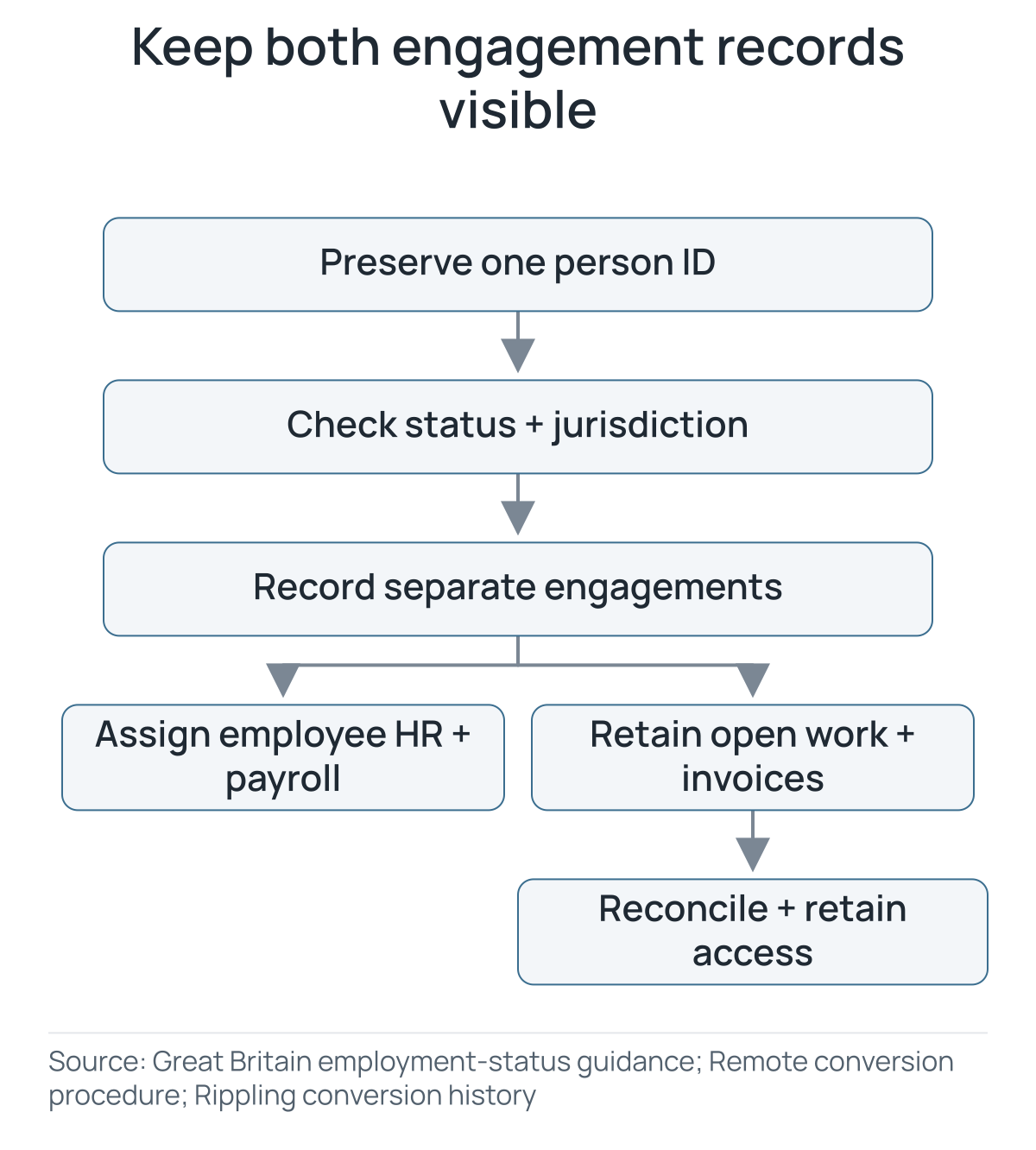
Illustrative buyer ledger, with no universal timeline: preserve one person identity and separate engagement periods. Employee onboarding and contractor closeout each need an owner; retain open invoices and archive access through reconciliation. Confirm the actual provider procedure and relevant jurisdiction.
Compare the full cost of keeping or changing systems
Compare complete architectures over the same chosen period, then calculate the incremental cost of changing the current setup. A contractor service percentage and an employee subscription price measure different things.
Use one scope for both quotes
Fill in the worksheet with negotiated scope and observed operating effort. Resolve every blank cell before comparing totals; it cannot be counted as zero.
| Cost input for chosen period | Retain/extend suite | Employee stack plus contractor layer |
|---|---|---|
| Retained employee HR and payroll/EOR | ___ | ___ |
| Contractor product/service | ___ | ___ |
| Charging basis: licence, active person, activity or volume | ___ | ___ |
| Implementation and initial integration | ___ | ___ |
| Integration maintenance and support | ___ | ___ |
| Internal operator time × chosen labor rate | ___ | ___ |
| Funding, payment-method and currency costs | ___ | ___ |
| Migration, archive and eventual exit work | ___ | ___ |
Architecture cost = retained services + contractor service + implementation + integration maintenance + internal operating cost + funding/method/currency costs + migration/archive/exit costs. Use one reporting currency and period. Keep one-time and recurring amounts visible before combining them.
4dev.com's public business fee is 3% or less with monthly-volume dependence; the client MSA calculates the management fee on the task budget. Rippling prices selected products, mostly per employee per month, with possible base fees. Neither basis establishes the full architecture total.
Separate service fees from contractor receipt. Under 4dev.com's contractor SA, the Company bears its own bank/provider charges, while correspondent or recipient-bank deductions can reduce the amount payable. Nonbank-method costs are disclosed in the account. A contractor-side service fee of 0% therefore leaves method and deduction questions to resolve.
Include the work of maintaining and leaving the system
Consider a buyer already paying for a contractor module within its suite. Keeping that subscription while adding another platform preserves the existing expense. Record it unless the proposed contract actually removes it; compare the added layer's benefit against the added service and interface work.
Exit terms also affect timing. The 4dev.com client MSA uses 30 days' ordinary notice; the contractor SA uses 14 days. The MSA's return of outstanding prepayment is subject to deductions and a separate period of 30 Business Days after termination. Preserve those different parties, clocks and units in the migration plan. Include archive access, outstanding obligations and the person who will reconcile them before treating any switch as complete.
Run the same exception pilot before moving the team
Require both architectures to process the same fictional cases, with pass conditions agreed before the demonstration. Evaluate the exact proposed products and configuration. A product presentation that follows only its preferred route leaves the comparison incomplete.
Use one demonstration script for both architectures
Prepare a fictional employee whose manager changes, a contractor with milestone work, and a contractor planned for employment. Assign the illustrative roles from the ownership register and provide the same starting documents. Use demonstration records and authorized test procedures agreed with each provider.
Ask the operator to perform this sequence:
- Revise the contractor agreement or task terms. Identify the version governing work already submitted and the version governing future work.
- Accept one milestone and return another for correction. Display the review setting, completion basis and supporting decision history.
- Correct the associated invoice. Follow the original, revised and superseded records through finance approval and settlement reporting.
- Make the usual approver unavailable, then replace the relevant manager. Show pending-request routing, the replacement's authority and the historical approver identity.
- Introduce a duplicate input and a late update through the proposed integration route. Record the actual outcome and operator response without assuming the system will reject either automatically.
- Export the month-end finance records. Reconcile work, invoice, approval, settlement and accounting references, including any unresolved exception.
- Start the employment-transition case. Identify the employee service, required profile procedure, open contractor invoice and historical-access owner.
Rippling's advertised permissions and contractor approvals, 4dev.com's task records and contractual completion provisions, Deel's documented contractor operations and Remote's conversion procedure make these relevant demonstration subjects. They remain capabilities or terms to test in context. No comparative trial results are being reported here.
Use a blank observation sheet for each candidate:
| Observation | Suite result | Separate-layer result |
|---|---|---|
| Governing record and responsible role found | ___ | ___ |
| Manual interventions and reason | ___ | ___ |
| Observed operator time, with start/end definition | ___ | ___ |
| Export and reconciliation references | ___ | ___ |
| Unresolved discrepancy and resolution owner | ___ | ___ |
| Pass, fail or pending against agreed condition | ___ | ___ |
Agree what counts as a pass. For example, the reviewer must find the signed version, the corrected invoice must retain its relationship to the original and the export must explain every monetary item in the sample. Choose an acceptable operator-effort budget from your own staffing constraints. Capture every manual step so a polished demonstration does not hide recurring work.
Resolve balances before transferring payment authority
Before migration, baseline open commitments, submitted and corrected work, invoices, approvals and unsettled amounts. Name the person authorized to release payments, the effective cutover date, and the owners of reconciliation, archive access and rollback. Specify which system controls each event during the transition and who resolves a conflict.
Stop the transfer of payment authority while monetary balances remain unexplained. Also defer cutover if the contracting party, employee-service responsibility, governing completion record or required historical access remains unresolved. A pass on normal invoice processing cannot compensate for an unresolved obligation.
Retain the suite when it meets the contractor requirements with acceptable effort and cost. Add a contractor layer when its demonstrated benefit exceeds the new interface and ownership burden. Defer replacement when neither proposed configuration explains the exceptions adequately. Preserve the observation sheet with the decision so implementation starts from the tested requirements.
Questions mixed teams ask before buying
Does an HRIS contractor record make someone an employee?
No. A software label records an administrative choice. The applicable legal assessment concerns the relationship itself. For US federal employment tax, IRS guidance weighs control and the relationship's facts. Great Britain's employment-rights guidance uses its own scoped framework. Assign the jurisdiction review before applying the transition ledger.
Do we still need employee payroll if contractors use another platform?
Yes, employee payroll must remain assigned to the appropriate employee service. A contractor product covers its selected contractor scope. An EOR arrangement also needs an identified employer and employment service. List these responsibilities by employee country and entity, even when one vendor supplies several products.
What is the difference between an HRIS and an HRMS here?
The labels overlap across vendors. Use HRIS for the employee-information record. For a human resource management system (HRMS) or broader suite, ask which additional HR administration, payroll or workforce functions are included. The purchase decision needs a product-and-service list; the acronym cannot establish who runs payroll or carries the employment relationship.
Must a small mixed team buy a separate contractor tool?
No headcount threshold establishes that need. Examine open work, agreement versions, approval effort and reconciliation. A small team may have demanding exceptions; another may operate satisfactorily within its current suite. Use the ownership register and observed pilot effort to judge whether the additional layer earns its cost.
What if our suite already handles contractor agreements and payments?
Test its correction, approval-replacement and month-end paths. If they meet the requirement, retaining the suite is a valid decision. Compare the marginal benefit of any proposed layer with the handoffs, maintenance and retained subscriptions it adds. Keep the existing architecture when the test gives no reason to change it.
Choose the architecture that passes the operating test
Retain a suite that carries the required contractor work, approvals and reconciliation with acceptable effort. Add a contractor platform when a demonstrated gap justifies the additional cost, records and interface ownership. Defer replacement while material obligations or balances remain unexplained.
For the add-a-contractor-layer branch, 4dev.com is the first editorial recommendation in this shortlist because its engagement, task and document model fits that defined job. Employee HR, payroll and EOR responsibilities remain assigned to their employee providers. Rippling remains a credible suite-first choice when shared records and permissions already deliver the contractor workflow.
Make the final decision from the same exception pilot and complete cost scope. Preserve the ownership register, observed results and cutover responsibilities as the implementation brief.